‘Happiness is thought to depend on leisure; for we are busy that we may have leisure, and make war that we may live in peace. (Aristotle,NE,X.1177b4)’
Philosophy, it is often said, is the art of reasoning & analysis. According to Botvinnik, ‘Chess is the art of analysis’. In their long histories there has been relatively little convergence between chess and philosophy, which given the analytical nature of both, is surprising to learn. Over the years, I’ve encountered few players who have studied philosophy at university, often choosing more precise subjects such as mathematics instead. Philosophy is a discipline largely ignored by chess players. With this in mind, what can chess learn from philosophy? I’d like to answer this question not by giving a narrowed descriptive account of both -though I will stay within the confines of canonical philosophy- but by drawing attention to some rather unexpected parallels that occur within the highest echelons of both. I should confirm that when I use the term ‘Philosophy’, I am speaking as a Philosophy Post-grad and am defining it in academic terms, not in the loose, vernacular sense of the word.
In terms of major philosophers using chess illustratively, it is probably Wittgenstein who applied himself most to this task. Both his early and later works contain frequent chess descriptions and analogies. The most famous, perhaps, can be found in his account of language games in the Philosophical Investigations, in which he refers to the interdependence of rules and meanings, explaining that the concept of the king in chess only means something if the rules of the game are understood also. However, Wittgenstein’s references to chess are specific to key ideas in his works, and on the whole, would require a large commitment to grasp well. Such a commitment may work as part of an academic programme, but probably wouldn’t work well as part of a casual dip into a new subject. Aside from the endeavours of the great Austrian, sadly chess appears only sporadically in the literature of the great philosophers. Within analytical philosophy there are plenty who dip into chess for the purpose of analogy but rarely go beyond that.
Okay, what about if we turn things around? Can philosophy teach us anything about chess by virtue of the endeavours of great chess players? Out of the players who dedicated themselves to philosophy, the second world champion, the evergreen Emmanuel Lasker should immediately come to mind. He did manage several publications in Philosophy, having studied it as a young man. The most famous of the aforementioned publications was ‘Kampf’ (struggle), published in 1906, in which echoing Nietzsche somewhat, he attempted to provide a general theory of all competitive activities. Lasker didn’t achieve the same level of success in Philosophy as he did in chess, in fact his publications made almost no impact whatsoever on the academic world of his day.
With both chess and philosophy being unable to offer a figure who has successfully crossed over into the other discipline, how do we proceed? Well, surprisingly, we have to go back in time thousands of years where one philosopher can help us with our understanding of chess. Not because they were a great player but because they would have been a great player, well probably… .
Who am I referring to? Aristotle: who would have been a great chess player, if the Nicomachean Ethics is anything to go by. Those unfamiliar with the text itself, might initially wonder how a work on ethics can have any bearing on, or be a refection of, potential chess prowess. This, however, can be easily explained. Firstly, ethical discussions in classical literature were centred around the individual and how, as individuals, we can make our lives go well rather than take into consideration the interests of others, as now tends to be the case in such literature. The Nicomachean Ethics aims to account for what is conducive for Eudaimonia or individual flourishing: in very simple terms, excellence or personal development. And it is excellence/personal development which we chess players also strive for (albeit for chess-related reasons). Aristotle’s account of how to achieve a life of flourishing incorporates much that has little to do with chess but there are points he makes which correlate, and are in fact, highly instructive. I shall explain one of them.
How to live well, is a central question of the Nicomachean Ethics. Aristotle points out that living well is not about applying general rules on how to live to our lives, but adapting to the particular circumstances we find ourselves in. Judgements about how to live are only true for the most part, they don’t hold for every individual in every situation. Aristotle claims that being able to liberate ourselves from generalities and judge a course of action on its individual merit or characteristics is a sign of intelligence. Understanding in modern chess rests upon similar principles; being able to evaluate the unique features of a position by going beyond the general principles we have learnt, is a sign of higher-level skill. A grandmaster, for example, can tell when the right time to castle in a game has come much more easily than a club player, who believes that castling should be done as early as possible and is liable to castle before playing more active moves. If Aristotle were a chess player, he would know that unlearning the principle of castling early comes as a consequence of being able to judge a position on its particular merits. Our ability to do that being largely dependent upon the training we have given ourselves. ‘For the things we have to learn before we can do, we learn by doing. (NE, II.1103a33)’ He would approach the game with a practical, engaged mindset rather than a theory-dependent one. With this in mind, Aristotle would fit into the modern game well (and not that of classical chess 100 years ago) because through the advent of digitalization, the modern game has abandoned a rule-based approach in favour of a pragmatic ‘play whatever works’, owing to the dynamic duo of generations of diligent Grandmasters and the more recent processing power of modern computers, which are remarkably adept at transforming anomalies into exceptions, hence drawing into question the rules they adhere to. Let’s turn to one of the forefathers of the modern game, Richard Reti, ‘It is the aim of every modern school not to treat every position according to one general law but according to the principle inherent in the position. An acquaintance with other positions and the rules applicable to the treatment thereof is of great use for the purpose of analysing and obtaining a grasp of the particular position under consideration…the source of the greatest errors is to be found in those moves made merely according to the rule and not based on the individual plan or thought of the player.’ (Watson:Secrets of Grandmaster Play 2003, pg.97)
Another interesting parallel that Aristotle claims is that there is no real value in judging a person’s life until it is over. Just because an individual was successful in the 20’s and 30’s it doesn’t follow that their life was a success. A tragedy late in life can put an entirely different complexion on things. And so too in chess. Take for example Anand’s opening game in the defence of his title against Topalov. In the beginning of the game, everything was going to plan, until moves 25-27, where he forgot how to play the line he had chosen and subsequently lost quickly. Often in chess we must learn to resist the temptation of easing up, thinking that the path forward is a straightforward one. This is particularly true if we are winning. Aristotle would question the validity of evaluating a game in progress, as chess and life both share unknowable futures.
In his ‘Chess for Zebras’ (Gambit 2005) pg 28, Rowson quotes Aristotle under the heading ‘Developing Skill’:
“We are what we repeatedly do. Excellence, then is not an act but a habit” Aristotle (source not cited!)
‘…the main skill a chess player needs is skill in making decisions, so that’s what you need to do and do repeatedly. If you want to become a better player, you need better habits, and you cultivate your habits through training. ‘
One last point, if an Aristotelian and a mathematician both picked up chess at the same time, both having no prior knowledge of the game but both falling in love with it immediately, who would be more likely to develop into an expert player? My money is on the Aristotelian for the reason that he would have a deeper appreciation of what is conducive for success.

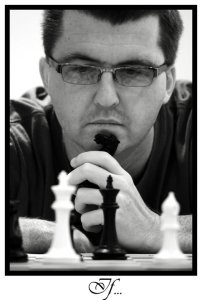
A recent photo of Aristotle
I am indebted to Nigel Warburton for his enquiry into Aristotle.


















 McCreadyandChess