Archive for March, 2012

After a good week-long read of ‘New in Chess – The first 25 years’, I noticed that amongst the many interviews were some intriguing analogies to other sports by leading chess players; more often they functioned as a source of inspiration, but also as a mode of reference…with varying degrees of communicative success involved.

On page 62 on the ‘New In Chess -The First 25 years’, Spassky discusses his love of tennis, mentioning that the degree of similitude between chess and tennis has benefited his play in both activities. When asked to define what he meant, he said ‘Like chess [,] tennis is a game of balance, of equilibrium…Keres was a good tennis player…and so was Capablanca’. The history books tell us that if anyone ever cultivated their game so that balance and flexibility were a principle and defining aspect of it, it was surely Spassky. He qualified his remarks further by suggesting that Smyslov revealed a secret to him, that he played tournament chess like baseline tennis, ‘…he said that he used to play not with the head but with the hands. -Trusting his intuition? [Interviewer’s question]. ‘Yes because time-trouble doesn’t allow for serious analysis during the game. If you have an idea, just play it.’ We are left to ponder the significance of such remarks, which in retrospect seem more like afterthoughts than anything else. Can a world champion really find inspiration from an activity in which he is nothing more than a rank amateur…surely not?

Kramnik, also very well-rounded in his play (just check out his wins with the Sicilian Sveshnikov in the 90’s if you insist he is a dull, positional player) gives a curious, conceptual justification for the Berlin Defence in the section ‘Chess and the art of Ice Hockey’ (page 256):

‘[Interviewer] When did you decide on this generally defensive strategy? [Kramnik] I follow ice hockey a bit and the Czech national team has been winning everything in the last couple of years…they always win 2-0, 1-0, or 2-1 all the time. They don’t show any brilliance but they win all the events…the Czechs have a very solid defence. In fact there are some parallels with chess. They have a brilliant goalkeeper. In chess this is the last barrier, when you are on the edge of losing, but you sense very well exactly where this edge is. And then they go on the counter-attack. Their strategy is so clear. They have been doing this for 2 or 3 years but nobody can do anything. This idea occurred to me when they won another championship in May and I had already signed the contract to play Garry. I thought, okay it’s a different game but the approach is very interesting. And that’s how I chose this defensive approach. You need to be sure that you will be strong enough to hold. If you are not sure you can hold worse positions, this strategy makes no sense.’

What makes this point even more interesting is that Kramnik claims he hated playing the Petroff…it’s quite astonishing how someone can become respected for playing something they came to loathe so much -that is the essence of professionalism I suppose.

Lastly, on page 312, the ex-F.I.D.E world champion Rustam Kasimdzhanov refers to the following song about high-jumping:

‘-What is your favourite Vissotsky line? [Kasimdzhanov] It’s difficult to translate it into English. It was what struck me during the sixth game against Adams. He has a song called “The song of the high-jumper”. He jumps and he doesn’t quite manage. He wanted to make 2.12 and fails. And he says, I will let you in on a small secret: such is the life of a sportsman or woman. You are at the highest point for only a moment, and then you fall down again. When I played Qg8 and thought I was losing, this immediately ran in my ears. You are at the highest point only for a moment’

White plays Qg8, though it took Fritz less than a second to find Qe4, which is winning.
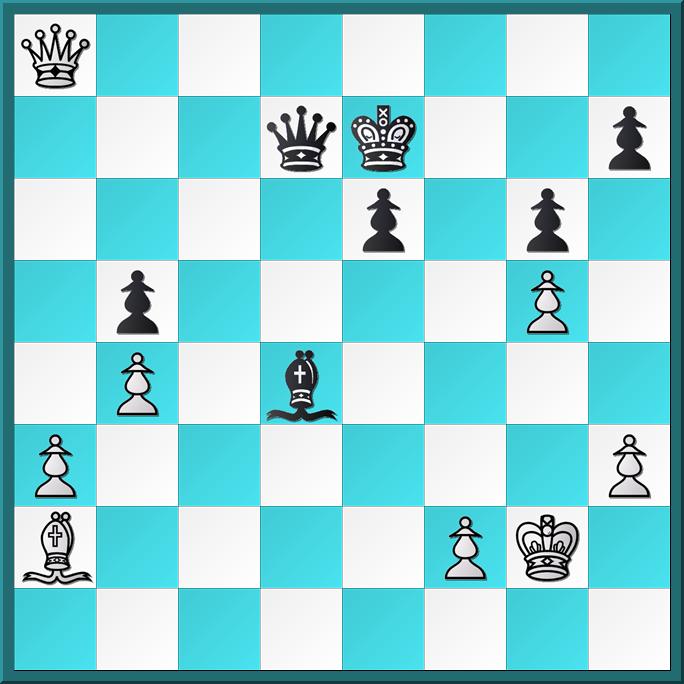
That familiar sinking feeling, thought of here in terms of a descent. Not a bad analogy in terms of a career but in a game your opponent influences the direction you move in just as much as you do in chess, especially if they blunder.

MJM
Read Full Post »

“I personally never stood out amongst my contemporaries, because I always had to progress by hard work. Tal, on the other hand, there is an example of someone who did not have to work at it.” Botvinnik

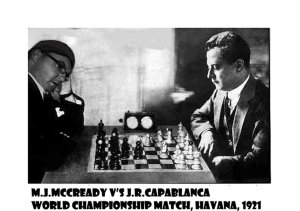
I recently stumbled upon the commemorative edition ‘ New In Chess. The first 25 years’, which was published in 2009. It offers almost 400 pages of quality reporting and interviews with the top names in chess. It begins with an interview with Botvinnik ‘The Patriarch’, who discusses amongst other things, the upcoming match between Karpov and Kasparov (their 84 match). Speaking as an ex-world champion himself and a tutor to both, he has an interesting take on affairs: ‘The match between Karpov and Kasparov will be very different from the usual title contests. From a creative standpoint, it will be the third top class match of this century.’ (pg. 15) The two preceeding matches, which he goes onto mention were Capablanca/Alekhine and Botvinnik/Tal. It’s worth asking at this point, why does Botvinnik think of chess this way when most think in terms of the calibre of participants and quality of play? He claims that the match itself won’t reveal who the better player is, but will reveal which approach to chess is more valid. (pg.13) His view rests upon a dichotomy which is, sadly, over-simplified, and in our modern age is something of an anachronism; namely, that there are two kinds of player in chess, the practical player, which includes Capablanca, Tal and Karpov, and the researcher which includes Alekhine, Botvinnik and Kasparov. Botvinnik goes on to claim that: ‘…the theorist (he interchanges this term with “researcher” throughout the interview) will always have an advantage over the practical player. Because when the researcher takes his place at the board, he knows not only himself, but his opponent inside out’ (pg.14). Once again, these comments were made well before the advent of databases in chess.

Thinking about matches in terms differences in approach to chess or clashes in style, caused me to think more deeply about the Anand/Gelfand match, which is only weeks away now. Like many others, I noted a general lack of excitement over Gelfand’s achievement, and though I am very excited about the match myself, I don’t think Botvinnik would claim it to be another top class match from ‘a creative standpoint’, as he put it. Gelfand is a solid player, Anand too, though perhaps with more attacking flair. Given the similarity in age and approach to the game, the prospects don’t bode too well for an exciting match. With this said, there are two points that need to be taken into consideration; firstly, this is surely Gelfand’s one and only chance to become world champion, so we should expect him to give it everything he’s got, and secondly, there is a strong chance that we will see sharper opening play than in the previous world championship match. In the Anand-Topalov match 1 e4 didn’t occur once, however, Anand’s results on the white side of the Sicilian (as pointed out in the following post by GM Nigel Davies http://chessimprover.com/?p=792) are very good, Anand will surely play 1 e4 at least once to see whether Gelfand is still prepared to play the Sicilian against him, as refusing to enter the Sicilian would be a psychological defeat for Gelfand in itself. Here is, excluding blitz and blindfold, the last decisive game between Anand and Gelfand, its a Sicilian Nadjorf from six years back: http://www.chessgames.com/perl/chessgame?gid=1387996
Another point that Botvinnik makes which I found myself returning to with some interest, concerns a warning he gave to a young Gary (Garik) Kasparov: ‘As far as Garik was concerned, I immediately came to blows with him. For he first made a move and only then thought about it. While the proper order is, as you know, the other way around. ‘Watch out’, I used to say to him, ‘if you go on like this you’ll become a Taimanov or a Larsen. Garik’ (!?). These two were the same even when they were grandmasters -first move, then think. Now young Garik was very insulted by this, because he wanted to be an Alekhine’ (page13). I have to say, I find such remarks and reactions bemusing. Becoming either doesn’t sound like the grimmest fate in chess, that’s for sure! Here’s a hair-raising encounter between the two that may have led Botvinnik to such an assertion:

http://www.chessgames.com/perl/chessgame?gid=1138444

On a personal level, my own encounters with Botvinnik often involve the Dutch Defence.  There are many interesting features of the dutch. The main one, pointed out by GM Simon Williams in his book ‘Play the Classical Dutch’, is that it offers just as many winning chances for black as the King’s Indian Defence but doesn’t have the accompanying volumes of theory. One of the sadder points of that book is that once you go beyond the obligatory, Bogoljubow – Alekhine, Hastings 1922, which all books on the Dutch start with, there are almost no complete games, so we don’t see exactly how black converts the winning chances he creates.

Here’s an example I found of how Botvinnik defeated the classical Dutch with his own 7 b3 move. In this game, Kann under-estimates the danger of the a3-f8 diagonal, as well as the strength of the d5 push, the game illustrates how easily play on the flank can be defeated by play in the centre: http://www.chessgames.com/perl/chessgame?gid=1031746. Lastly, Botvinnik, some 20 years on, defeats Kann once more but with the Dutch this time. Note how, unlike Kann, Botvinnik strengthens his centre before conducting activities on the flank: http://www.chessgames.com/perl/chessgame?gid=1420763

“The player’s greatest art consists in exploring the possibilities of bringing the game to a position in which the normal relative values cease to exist.” Botvinnik


Read Full Post »