Archive for October, 2013

Over the last half century the television interview has given us some of TV’s most heart-stopping and memorable moments. On the surface it is a simple format – two people sitting across from one another having a conversation. But underneath it is often a power struggle – a battle for the psychological advantage.

Sir David Frost

Click on the following link to find Sir David Frost’s interview with Kasparov, which he gave shortly before his sad demise.

Given that Mr. Frost is past his prime and that Kasparov is wily enough to evade clever questions, I think its fair to say that the interview isn’t a classic. It is, however, professional and probing enough to keep you watching -they even managed to get the history right too! But in chess terms a theoretical draw perhaps, with neither player spending much time outside their preparation. Anyway, its always a pleasure to see chess being handled well by those in the media who are unfamiliar with it, I’ll leave the final words to Sir David Frost.

Don’t aim for success if you want it; just do what you love and believe in, and it will come naturally.

Read Full Post »

The communication of the dead is tongued with fire beyond the language of the living.

T.S.Elliot

After watching the documentary Room 237 recently, I felt compelled to delve further into Kubrik’s The Shining. Admittedly, its a film that I’ve never liked, having always found its intensity discomforting. However, in search of greater understanding, I also found an in-depth interview. It’s a wonderful piece of journalism, with Kubrik offering us great insight into who he is and how he works. To my surprise, chess gets more than a mention towards the end of the interview. Kubrik not only makes an interesting analogy between chess and film-making but also tells us how chess can help curb poorly made decisions away from the board. I’ve cut and paste the relevant sections and linked to the interview as well:

You [referring to Mr.Kubrik] are a chess-player and I wonder if chess-playing and its logic have parallels with what you are saying?

First of all, even the greatest International Grandmasters, however deeply they analyse a position, can seldom see to the end of the game. So their decision about each move is partly based on intuition. I was a pretty good chess-player but, of course, not in that class. Before I had anything better to do (making movies) I played in chess tournaments at the Marshall and Manhattan Chess Clubs in New York, and for money in parks and elsewhere. Among a great many other things that chess teaches you is to control the initial excitement you feel when you see something that looks good. It trains you to think before grabbing, and to think just as objectively when you’re in trouble. When you’re making a film you have to make most of your decisions on the run, and there is a tendency to always shoot from the hip. It takes more discipline than you might imagine to think, even for thirty seconds, in the noisy, confusing, high-pressure atmosphere of a film set. But a few seconds’ thought can often prevent a serious mistake being made about something that looks good at first glance. With respect to films, chess is more useful [in] preventing you from making mistakes than giving you ideas. Ideas come spontaneously and the discipline required to evaluate and put them to use tends to be the real work.

Did you play chess on the set of The Shining as you did on Dr. Strangelove (with George C. Scott) and on 2001?

I played a few games with Tony Burton, one of the actors in the film. He’s a very good chess-player. It was very near the end of the picture and things had gotten to a fairly simple stage. I played quite a lot with George C. Scott during the making of Dr. Strangelove. George is a good player, too, but if I recall correctly he didn’t win many games from me. This gave me a certain edge with him on everything else. If you fancy yourself as a good chess-player, you have an inordinate respect for people who can beat you.

http://www.visual-memory.co.uk/amk/doc/interview.ts.html

Poetry may make us from time to time a little more aware of the deeper, unnamed feelings which form the substratum of our being, to which we rarely penetrate; for our lives are mostly a constant evasion of ourselves.

T.S.Elliot

MJM

Read Full Post »
I found a new documentary on chess, the link to it on imdb is here:

http://www.imdb.com/title/tt1800266/?ref_=sr_1&licb=0.19220617203973234

You can find the trailer here:

http://www.youtube.com/watch?v=Pbm6ljFmSeM

I only watched it once and don’t intend to watch it again so its best that I keep this as brief as possible. Wiseman’s ‘High School’ ( http://www.imdb.com/title/tt0064429/?ref_=fn_al_tt_2 ) is the most accomplished documentary I know of that tackles school life. It exemplifies a level of control and finesse which is noticeably absent in Brooklyn Castle. At the risk of sounding old-fashioned, I found it’s modernity to be annoying throughout let alone the shoddy camera work. More importantly, I felt there were unresolved tensions from the pre-production phase, as the film-making is standoffish in places. Moreover, I couldn’t understand why there is little chess to watch, and why in places it is completely absent, forcing the viewer to become reliant upon descriptions of games rather being able to watch them unfold. This becomes particularly annoying when we have characters in the documentary breaking down into tears over what they did wrong. Couldn’t the reasons have been shown rather than told? I wondered if this was due to a lack of interest in the subject or perhaps an attempt to draw attention away from the quality of the chess played instead. As a viewer, I found myself guessing far too often as to what was really occurring over the board, and thought frequently that the over-reliance upon statistics to show how the tournaments unfolded was a cheap way out. Many parts of the doc feel rushed, poise plays truant in this production.

We do have balance though: this a documentary that gives equal consideration to the various aspects of the lives of its subjects, and in this respect it is to be commended. The biggest mistake documentary makers make when turning to chess is that they fail to remember that the subjects have lives outside of chess and show them as nothing more than chess players. Such a criticism cannot be applied to this doc.

Overall, my feeling was however, that it was a case of nothing ventured, nothing gained. Certainly nothing much learned… .

MJM

Read Full Post »
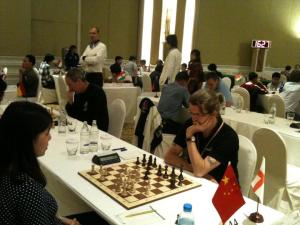
A well-written account of the state of chess today. Journalism how it should be:

http://www.economist.com/news/international/21587245-professional-chess-has-chequered-history-fans-hope-revive-it-sporting-chance

Enjoy.

MJM

Read Full Post »