Archive for November 29th, 2014

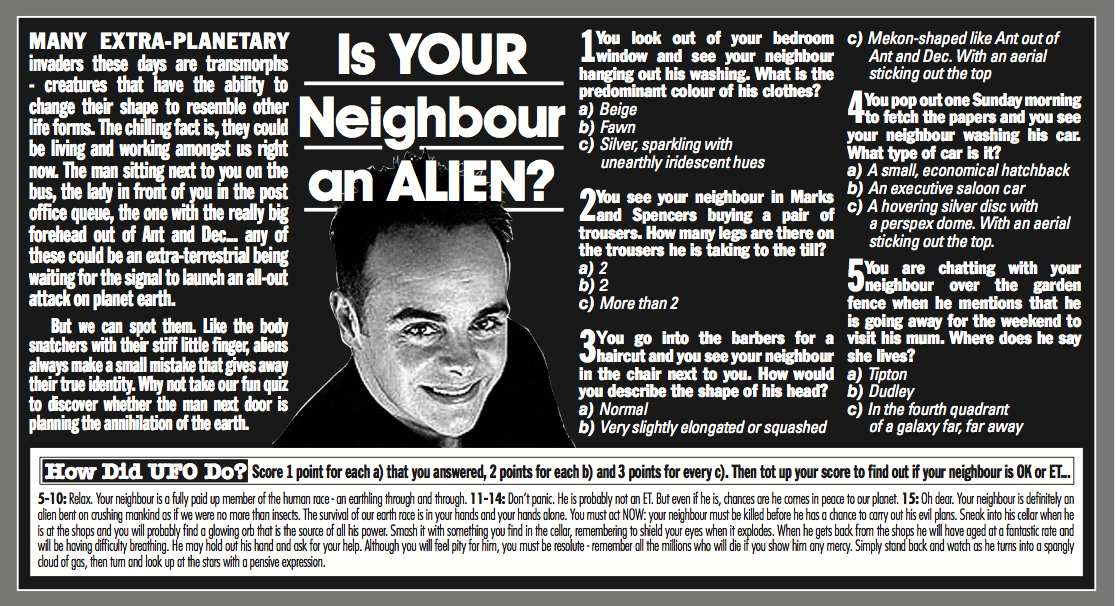
Many extra-planetary invaders these days are trans-morphs -creatures that have the ability to change their shape to resemble other life forms. The chilling fact is that they could be living and playing amongst us right now. The man sitting next to you on the bus, the lady in front of you in the post office queue, your opponent in your last county match…any of these could be an extra-terrestrial being waiting for the signal to launch an all-out attack on planet earth.

But we can spot them. Like the body snatchers with their stiff little finger, aliens always make a small mistake that reveals their true identity. Why not take my fun quiz to discover whether your team captain is planning an annihilation of the earth instead of how to win the league?

1) You visit your team captain’s home and see him hanging out his washing. What is the predominant colour of his clothes?

a) Beige.

b) Fawn.

c) Silver, sparkling with unearthly iridescent hues.

2) You see your team captain in Marks and Spencers buying a pair of trousers. How many legs are there on the trousers he is taking to the till?

a) 2.

b) 2.

c) More than 2.

3) You go into the barbers for a haircut and see your team captain in the chair next to you. How would you describe the shape of his head?

a)  Normal.

b) Very slightly elongated or squashed.

c) Mekon-shaped with an aerial sticking out of the top.

4) You pop out one Sunday morning to fetch the papers and see your team captain washing his car. What type of car is it?

a)  A small, economical hatchback.

b) An executive saloon car.

c) A hovering silver disc, with a perspex dome. With an aerial sticking out of the top.

5) You are chatting with your team captain before an important league match against Bedford when he mentions that he is going away for the weekend to visit his mum. Where does he say she lives?

a) Clophill.

b) Flitwick.

c) In the forth quadrant of a galaxy far, far away.

How did UFO do?

Score 1 point for every (a that you answered, 2 points for each (b, and three points for every c).

5-10. Relax your team captain is a fully paid up of the human race an earthling through and through.

10-14 Don’t panic. He’s probably not an ET. But even if he is, chances are he comes in peace to our planet.

15  Oh dear! Your team captain is definitely an alien hellbent on crushing mankind as if we were no more than insects. The survival of our earth is now in your hands alone. You must act NOW. Your team captain must be killed before he has the chance to carry out his evil plans. Sneak into his cellar when he is at the shops and you will probably find a glowing orb that is the source of all his power. Smash it with something you find in the cellar, remembering to shield your eyes when it explodes. When he gets back from the shops, he will have aged at a fantastic rate and will be having difficulty breathing. He may hold out his hand and ask you for help. Although you will feel pity on him, you must be resolute. Remember the millions who will die if you show him any mercy. Simply stand back and watch as he turns into a spangly cloud of gas, and then turn to look up at the stars with a pensive expression.

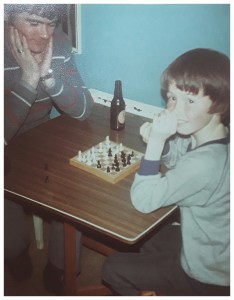
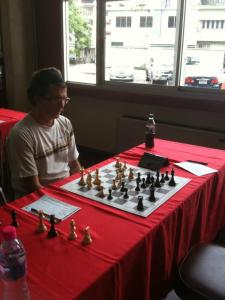
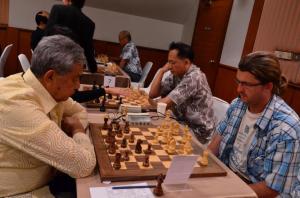
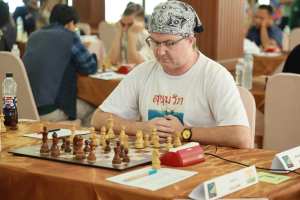
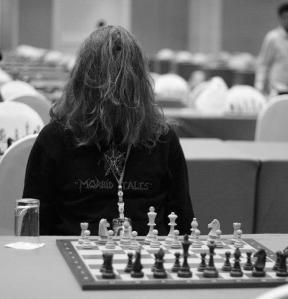
A picture from Luton V Bedford 1995, Bedofrdshire league.

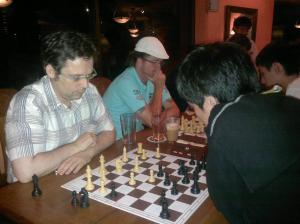
A picture from Luton V Bedford 1995, Bedfordshire league. Not sure which of the Ledger brothers that is to the left there.

I am indebted to Viz for the inspiration behind the post.
1

Read Full Post »

You can find the conclusion (pgs. 195 – 196) to Richard Eales’s ‘Chess: The History of a Game’ below. It was written in 1985.

It is not primarily the task of the historian to make predictions. The history of chess is long and instructive, but it does not enable us to visualize where the game will stand a decade or a generation ahead with any confidence. Already there are new influences to take into account, such as the development of sophisticated computer chess programs. Computing will not make the chess player redundant, but its association with chess may well change attitudes to the game and its popular appeal (as well as providing competition for it in the form of new ‘computer games’). Nevertheless, some qualities of chess have been so persistent through the long history outlined in this book that they are likely to exercise a continuing influence over the development.

What are these qualities? First, as a complex game: chess has proved extraordinarily stable. Hundreds of years have passed, bringing with them new patterns of thought and leisure, and yet the rules of chess have altered hardly at all. In a thousand years of well-documented history there has only been one such major change, the one which took place c. 1475-1495. The game has moved geographically from culture to culture and remained similarly impervious; hence it was played in almost an identical way across the great expanse of the divided Christian and Muslim civilizations in the middle ages. Variant forms of chess have grown up in China, Japan and parts of south India and south-east Asia, but hardly at all elsewhere. With these exceptions, chess has remained essentially a single game, and has not been fragmented into many games each with its own local currency. This fixity of rule must testify to a constant element in the appeal of chess, something it has always been: an intriguing puzzle. Yet though chess has shown great stability as a game, even in different surroundings, its outward form – that of the conflict between two forces, both with a complex hierarchy of different pieces- has proved almost equally open to having external cultural meanings read into it. The chessmen symbolized the major elements of an army in early India and Islam; the ranks and degrees of feudal society and the state in the western middle ages. More recently some Soviet ideologists have seen in chess-playing a model for the ideal qualities of socialism and socialist man. In contemporary thought, interest in chess is polarized in different directions: towards psychologists and psycho-analysts or philosophers who find in the game evidence for the structure of human thought and motivation, or towards computer designers and programmers who have used it as a test in the development of artificial intelligence. This chameleon-like adaptability as a focus of cultural interest perhaps explains the historical popularity and importance of chess almost as much as its enduring game qualities.

In recent times though, competitive chess has been stripped of some of its ambiguities. Though it sometimes retains in the popular mind the image of a highbrow and exclusive mystery, it is increasingly treated as a treated high-brow and exclusive mystery, it is increasingly treated as a variant of a more familiar modern institution: the organized sport. Press and media portrayals of ‘typical’ chess players have abandoned the once popular stereotype of the eccentric old gentleman, lingered fondly over the newsworthy attractions of monomanic or cold warrior (Fischer, Korchnoi), before settling down to show simply competitive people who happen to be good at chess rather than tennis, swimming or something else.  Many of the world’s leading chess players, it must be admittedly, are so incorrigibly ordinary that it would be hard to portray them in any other way. But the status of chess as a sport raises another major theme in the game’s history: the interrelation between popularity (‘quantity’) and technical and competitive progress (‘quality’) in its development. An obvious example is economic a professional players provide entertainment and instruction for an audience of less serious players, receiving support and patronage in return. Historically, the relationship has always been more complex than this, and it is often very hard to say why the game has been popular in one place or time rather than another. Certainly a chess master’s career can be frustrated by lack of a sufficiently numerous or educated public, just as much as that of an artist. It has been said that a great novelist should himself ‘create the taste by which he is appreciated’, and build up his own following, but often this is simply not possible, in chess even Morphy or Fischer (or the promoters of the Russian chess movement after 1917) needed a favourable environment in which to work if their individual examples were to have a lasting effect.

Arpad Elo’s correlation of recent international chess federation statistics on the number of masters and registered players in different countries provides no definitive answer to such problems, but it does show clearly that there are now more players and more and more very strong players than in the whole previous history of the game. This is not just a reflection of increases in national populations. Chess has spread rapidly outside its previous heartland of eastern Europe and the industrialized countries into the rest of the world. So far at least its involvement with computing has only aided its growth: computer programs have attracted new players without becoming so strong as to inspire the discouraging thought that the machine is unbeatable. At the time of writing, the higher reaches of competition are still well outside the computer’s range. The world champion is now firmly again in Russian hands, but after Fischer’s success in 1972 western opposition has been much stronger than in the 1950s and 1960s. In almost every respect, chess is better established now than ever beforein the paradoxical position it occupies in modern life: the only generally acknowledged sedentary (and cerebral) sport.
 

Read Full Post »