I’ve started reading Move First, Think Later. Its an intriguing read and very modern in its approach. As you may know, it won the Chess Book of The Year award in 2012.
Here’s a demo by the author himself. The position studied is original and the approach by the author is revisionist and refreshing.
I recently bought the book ‘The only quiz book you will ever need’ and found a section on chess. To my surprise I got two questions wrong (1 & 14). You can find all questions and answers below:
Chess: Miscellaneous 1 Quiz 5 (page 137)
Which Word Chess Champion’s namesake ‘gun’, sees a queen backing up two rooks on the same file?
In 2005, the first World Championship in Chessdarts was won by a future Women’s World Chess Champion and the 2004 BDO World Darts Champion. Name either.
During the candidates tournament in Zurich 1953, which future World Chess Champion used his fine baritone voice to sing extracts from opera on Swiss radio?
In 2003 a biography subtitled ‘It’s only me. was published about which late English chess grandmaster?
Name either of the grandmasters whitewashed 6-0 in successive matches by Bobby Fischer in 1971 in the Candidates Tournament to find a challenger to the World Champion Boris Spassky?
Whose reign as World Champion was first interrupted by Vassily Smyslov and then Mikhail Tal, making him the only man to hold the title in three nonsuccessive periods?
Which leading proponent of hypermodern chess wrote the influential book Mein System in 1925?
The men’s team from which country, with a population of just over 3 million, won the European Team Championship in 1999 and the World Team Championship in 2011 and the Chess Olympiad in 2006, 2008 and 2012?
Containing a hidden chess player, it was a sensation for decades. By what name was the Automaton Chess-player constructed by Wolfgang Von Kempelen in the late 18th century better known?
In May 2014, who achieved a record Elo rating of 2,882?
What move is represented in chess notation by 0-0-0?
The English Opening derives its name from its use by which English unofficial world champion, who played it during his 1843 match with Saint-Amant?
Taking its name from English and Austrian players who analysed it in 1886, which chess opening is characterized by the opening moves 1. e4 c6?
Which Dresden born millionaire grandmaster (1928-2013), heir to the Karl May publishing house refereed to the Fischer-Spassky match in Reykjavik in 1972?
In 2010, who, at the age of 16, became the youngest ever Women’s World Chess Champion?
McCready’s bonus question:
One of the questions above contains a misnomer. Which question is it and what is the misnomer?
Answers:
Alekhine -Alekhine’s gun
Alexandra Kosteniuk or Andy Fordham
Vassily Smysov
Tony Miles (an anagram of his name)
Mark Taimanov or Bent Larsen
Mikhail Botvinnik
Aaron Nimzowitch
Armenia
The Turk
Magnus Carlsen
Queenside or long castling
Howard Staunton
Caro-Kann defence
Lothar Scmid
Hou Yifan
Bonus Question answer: question 8 contains the term ‘Olympiad’, this is in fact a misnomer meaning the period of time between olympics rather than an event itself. Nearly 100 years on we are still waiting to have this changed in chess!
With chess traditionally being a ponderous and serious game, the online xanadu aka www.chess24.com, brings us the antithesis of that once more with Miss Tactics and Miss Strategy, both of whom team up for more Banter Blitz to tickle your fancy.
Miss Tactics – IM Sopiko Guramashvili (left) and Miss Strategy – IM Anna Rudolf (right)
They aren’t just a pair of pretty faces, both are titled and know what they are talking about. You younger guys ought to count yourselves lucky: when I was in my youth girls didn’t play chess, the only thing you could ogle was your opponent’s chair leg!
The link below should take you to the latest episode of banter blitz.
A frank and honest article concerning the plight of English chess has been written by GM Nigel Davies, whom you might also know as one of Chessbase’s better presenters, if not the best. The title is a play on words with the naturalized Brit GM Murray Chandler’s book The English Chess Explosion.
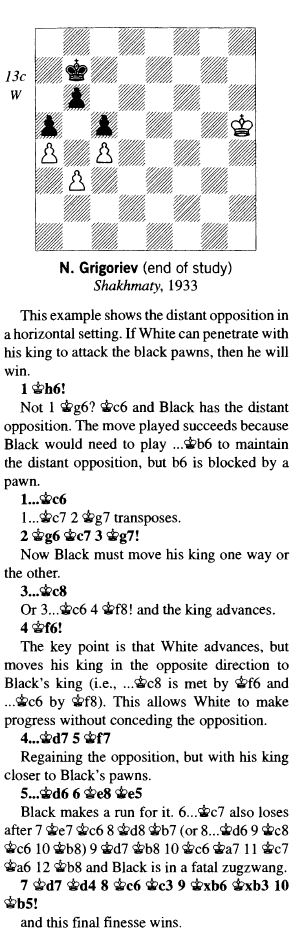
More from Nunn, Understanding Chess Endgames 1, pg 35. Note that the solution is given directly under the diagram. Should you wish to solve it yourself, I suggest you scroll down slowly. There are four lines of text beneath the diagram, after which the solution appears. In any event its white to play and win.
The Swiss GM Yannick Pelletier has had a bumper month by beating Nakamura with some beautiful preparation against his beloved Kings Indian Defence, and then the current world champion Magnus Carlsen. Carlsen, who perhaps underestimating his opponent rated almost 300 points below him, played a move that is certainly not becoming of a world champion…but then what blunder is?
It is here that Carlsen plays 37… Rg8??
Is it me or does it seem that Pelletier has been around for ever?
For those partial to a little schadenfreude -in other words the entire global chess playing community- here’s Naka upstaging Carlsen on the blunder front against Caruana. The move that follows defies belief. How on earth can someone of his caliber play a move that you see at the lowest level of amateur games!
Nakamura (Black), has just played 6…f6?? I promise I’m not making that up. Check out the game below if you don’t believe me.
At present, the Open European Team Championship, held in Reykjavik, is in danger of becoming a cracking tournament with great chess aplenty.
The Hungarian GM Richard Rapport, who is arguably the most creative and entertaining super GM around has, hot on the heels of his exciting attempt to wipe out GM Mickey Adams with the King’s Gambit, had us on the edge of our seats once again with his colourful and kaleidoscopic combinations once more.
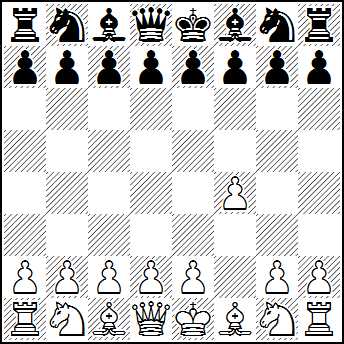
In becoming less patient about thrusting his f-pawn up the board on only his second move Rapport played 1 f4 instead. Oo-la-la monsieur his 2700+ opponent thought must have thought!
Rapport – Fressinet
Then on move 29 the supra-f-pawn moves to f5 with devastating effect.
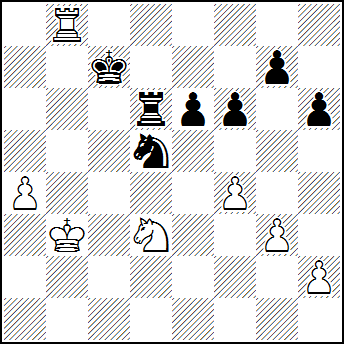
After 30. …exf5, it is white to play with a winning attack to follow.
…on what this site initially became…on what this site is now becoming…on what this site cannot become…
On what this site initially became…
…once upon a time, the chess-related musings of an adrift academic were bound playfully and electronically in this online journal of sorts. They grew and grew as the decade did too. I kept on because I love to write whether I had much to say or not; therefore, being read by others was usually of little or no importance, comparatively speaking. Content was based on personal thoughts and experience on various topics with no intended audience borne in mind. With topics broadening, my own take on things always shaped the narrative I constructed: I often thought I was insightful but never that I was right. Sometimes imagination gave rise to originality: and of that I have always remained proud. I often introduced humour, believing that I am funnier than I really am. Sometimes, I found my own style antithetical to the conservatism I believe chess is plagued by -oftentimes that has put a gracious smile on my face… .
On what this site is now becoming…
…this site is now becoming a collaboration of chess in Bedfordshire: much more so of the past than the present -that has become the dominant trend. I document the history of chess in Bedfordshire as much as I can, and as time has passed I have become more thorough and resourceful. However, I am not a trained historian as my background lies principally in philosophy but yes it is true I did study some modules on history as both an undergraduate and a post-graduate too; furthermore, I have trained myself up, particularly in terms of postmodern history. Since 2015, I have only read history and historiography as well as those philosophers who have been so influential on postmodern history, such as Nietzsche (whom I once wrote a 19,000 word dissertation on, entitled: Can the Will to Power be Found in The Birth of Tragedy?), also Richard Rorty and Foucault and I suppose certain structualists such as Claude Levi-Strauss too. Regarding postmodernism, mostly I keep to Hayden White, Keith Jenkins and Alan Muslow.
Some friends and former playing partners back home describe me as the ‘go to guy’ for the history of chess in Bedfordshire. This compliment says more about the lack of interest in the subject than my own endeavour. As mentioned, I am too adrift from academia to feel chuffed by it. Rather, I tend to lament that my historical research, like my chess, just isn’t what it should be. Even though I may well have a broad understanding of Bedfordshire chess history courtesy of the volume of research put into it, all of which began in 2014, this is not something I am particularly proud of. Nonetheless, out of courtesy compliments are graciously received. If the truth be told, I just see it as my job and only that – after all someone’s got to do it and no one else is that interested!
Amongst the many others, I have created three categories: ‘Bedfordshire Chess’ and ‘History of Bedfordshire Chess’ and ‘Luton Chess Club’. This website is slowly moving towards a consolidation of those (all of which can be found in one of the toolbars to the right).
On what this site cannot become…
…I like to be both creative and amusing when I can be, factor in that playfulness has been an ever-present factor, the content of this site should be thought of as multifarious. It could be said I continue to enjoy undermining the conservatism I believe chess is underpinned by even after all these years, and often try to use humour to do it still, believing I have got better at it. Consequently, despite the general direction its going in, this site cannot only be about Chess in Bedfordshire and nor will it be. It may become noted for that yes -in fact that’s been the case for years already even by established historians, archivists, and whoever else. External factors aside, this site is titled McCreadyandChess. I cannot, nor will I not, remove my own personal thoughts and experiences of chess from the posts of this site -especially if I think they are funny or original for they constitute my writing at its very, very best. In addition, the number of categories alone tells you that breadth of content is important to me. I am proud of my site, it is identity conferring and that is how it shall stay -end of story. All you really have are: ‘Some thoughts on the beautiful game’, which, incidentally, just happen to be my very own; nothing more, nothing less, take of it whatever you please… .
A side note on how to read old Tom Sweby's columns
Not perhaps, but quintessentially, Old Tom Sweby is best thought of as a passionate devotee to the newspapers he wrote for. He was well read and knowledgeable of the Bedfordshire chess scene and well beyond, given that he was the president of the S.C.C.U. once upon a time. He was generally well-respected and rubbed shoulders with many, if not all, of those eminent within British chess circles. It would, however, be a critical mistake to see his column is primary source material entirely. That it is not. You will also find secondary source material quoted too, and the reliability of that is not quite as Tom hoped. Given that he wrote for decades, this is to some degree inevitable, and after all we are all prone to error whether we realize it or not. Thankfully, with regards to old Tom Sweby, they are infrequent and for the most part old Tom continued to document events and developments in the Bedfordshire league from the get go as best he could but, of course, everything lies open to interpretation. Despite this, and generally speaking. this does indeed make him informative and thus worth reading. Dare I say his columns constitute a narrative describing the latest developments, match reports and changing nature of the Beds league...he knew his audience and wrote according. This manifested itself over decades but brevity was always in play courtesy of the restictions imposed by writing a column. Should you wish to read a in instrumental figure of the Beds' league post WW2, you are quite welcome to peruse what has been posted here... . :-) I should, however, point out that as the decades wore on he gradually moved on away from narratives concerning the Bedfordshire league towards affairs both historical and international. The reasons for this are multifarous, old age was a predominante factor presumably, however, the bottom line is with regards to how the Bedfordshire chess scene developed post WW2: old Tom Sweby is your go to guy. He wrote more about chess in Bedforshire than anyone else did but given he was a Lutonian and writing for a Luton newspaper there is both bias and greater coverage of his hometown than the rest of the county.
Gallery
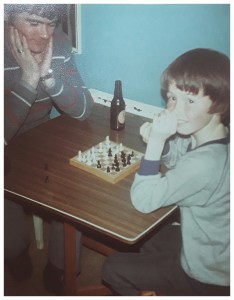
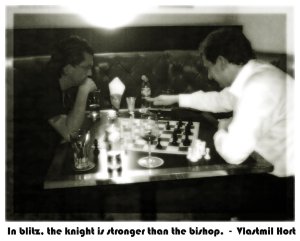
I’m either 10 or 11 here
1982, myself versus Brian from Sunderland.
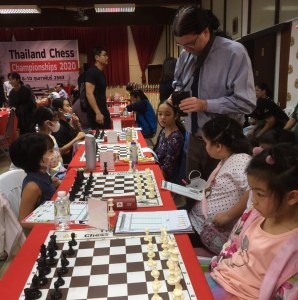
At the Thai Junior chess championships. My daughter of course.
Pattaya 2011
2011
Thai Junior Championships
2008
2011
Around 2011
2011
Pattaya 2009
2011
Kuwait 2008
2012
2012
2011 BKK Chess club
2011
2011 Thai Open
2011 Thai Open
2013 approx
Around 2014
2010
2012
Around 2011
2011
2011
2013
Around 2011
Around 2011
2020
2011
2008
2011
2013 or thereabouts
2010
2017
2014?
2010
2024
2024
2024
To add comments, please see the bell at the top of the page.






















 McCreadyandChess