Archive for April, 2020

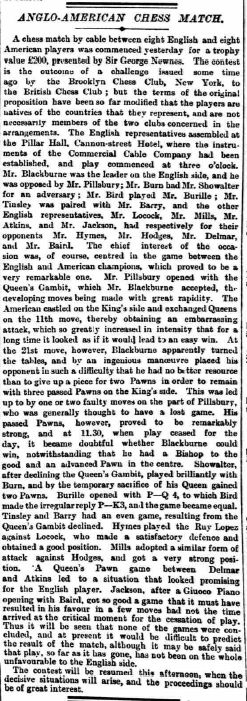
As I am learning, the Anglo-American cable matches which began at the end of the 19th century and lasted for fifteen years or so are much more of a challenge to research than I first thought. Cable matches were well in place by the time they started, and the original idea begun with developed significantly by parties on both sides of the Altantic and remained a source of constant revision throughout. It’s a thesis in itself and I’m sorry to say but I can’t dedicate myself to something of that size. What I can do is post some of the preliminary findings, which should give a sense of how news of it was handled in its day. Although I’ve established how the cables were laid and consisted of, that’s a separate topic altogether so I won’t be going into that. I thought it best to go to the source and establish how it began in the first place. It would appear there was a benefactor in place from the outset and that he was a distinguished and larger than life character, his name was Sir George Newnes. Although information can be found about him on wikipedia, it is inadvisable to refer to that for it is inaccurate and erroneous on a number of important points. It is safer to read the article on him in the Oxford Dictionary of National Biography if you can.

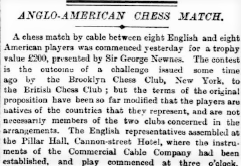
To begin with, the reportage below is from The Morning Post March 14th 1896.
MJM

Read Full Post »

The horror of progress

In our modern high-tech society it has become possible to lose games in a manner previously unheard of. It involves a procedure developed technologically, one which is antithetical to the concept of chess itself and the manner in which it is played. If used even a world class player runs the risk of losing to a complete beginner. Are you wondering what on earth I am talking about? I am talking about ‘pre-move’. In bullet chess, the most absurd form of competitive chess ever created, you have the option of ‘pre-move’. In other words, making your next move before your opponent has made his based on what you assume he will do next. But if you get that wrong it can cost you the game instantly, as can be seen in the video below. I always thought that chess was a game where players thought deeply over their opponent’s last move and then via a complex decision making process made a move once a decision of their own making had been reached. More or less that’s how we play. To decide on your next move before you know what your opponent is going to play is not progress. It’s a dumbed-down version of chess that masters from the past would find demeaning and want no part of. GM Danny King calls the video below comedic. I’d call it tragic for this is an example of regression not progression. To call it chess is undignifying. To call it pointless, mindless entertainment for a mass media driven society is more to the point. The competitors will think of the money involved, the public will wonder what is wrong with the modern game and I will stop writing.
Read Full Post »

All my life I have wondered what the title of the first book I ever read on chess was. So little is remembered that I can’t even be sure how old I was when I read it. I thought I was only 7 but perhaps not. It may just be possible that the book below, printed in 1982, making me 9 or 10 years old at the time, was that first book. It’s a possibility.

Read Full Post »

Not for the first time, big thanks go to: https://www.facebook.com/MemoryChess/

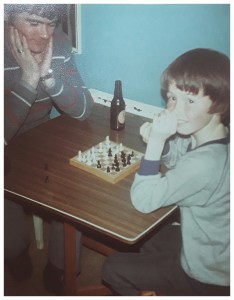
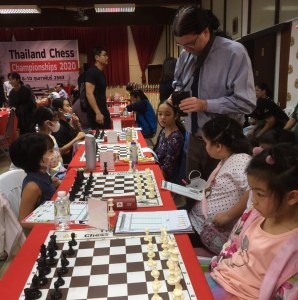
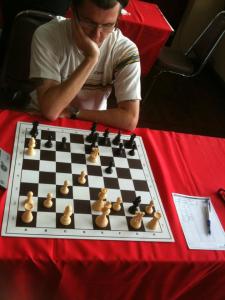
You may have noticed that the headers (the images or banners you see on each page were varied but are now much more so. Some are very personal, many from MemoryChess. It’s well worth a look if you have the chance and use facebook.

Read Full Post »