Television has a role in modern western society which is being decentralized by the internet and the so called digital revolution we are, apparently, undergoing.
Nonetheless, important it remains and compelling it may be too…especially when Bedfordshire’s finest chess players appear on it. Who might they be and what was that all about then?
1 (The man who failed to beat me with the King’s Indian Attack)
The first was Bedford’s Dave Ledger, who appeared on the Channel 4 daytime show Countdown around 1993 (apologies for my imprecision). I did ask him about his experience on the show once, and he informed me that it (Countdown) was far less glamorous than it appears on tv! Dave did win on his debut it, I remember watching him, and gave a good account of himself. https://wiki.apterous.org/Episode_1571 . It is also claimed that Dave appeared on a show called Brainteaser but I have no evidence of this.
2 (The man who dismantled my Bird’s opening far too quickly)
Staying with Bedford, second was Paul Habershon, who also appeared on countdown some eleven years later, and like Dave, won in the first but lost in the second show. Further information can be be found on the Countdown Wiki here. https://wiki.apterous.org/Paul_Habershon
3 (The man I never met over the board)
Third in line was Bedford’s James Plaskett, who famously appeared on Who Wants To Be A Millionaire in 2006, and in all probability, won more money on a gameshow than any other chess player in history.
4 (The man once rated 200+ who once saw me off with with his Catalan)
Forth comes Dunstable & Luton’s Colin Garwood, who recently appeared on University Challenge and did rather well for himself.
5
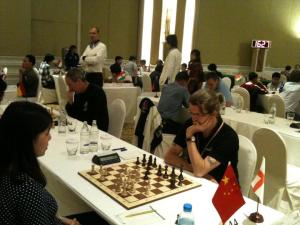
The exclusion of the fifth element! Mr. M. J. McCready once appeared as an extra in the film Whoops Apocalypse in 1986, and then appeared on tv many times thereafter in the crowd at Luton Town football club. I’ve also appeared on tv in Saudi Arabia and Azerbaijan. But I’m not linking any of that nor should I include myself. All appearances were fleeting and I never said very much. Additionally, I’m both shy and rubbish at chess, which makes my inclusion rather unnecessary and quite unjustifiable!
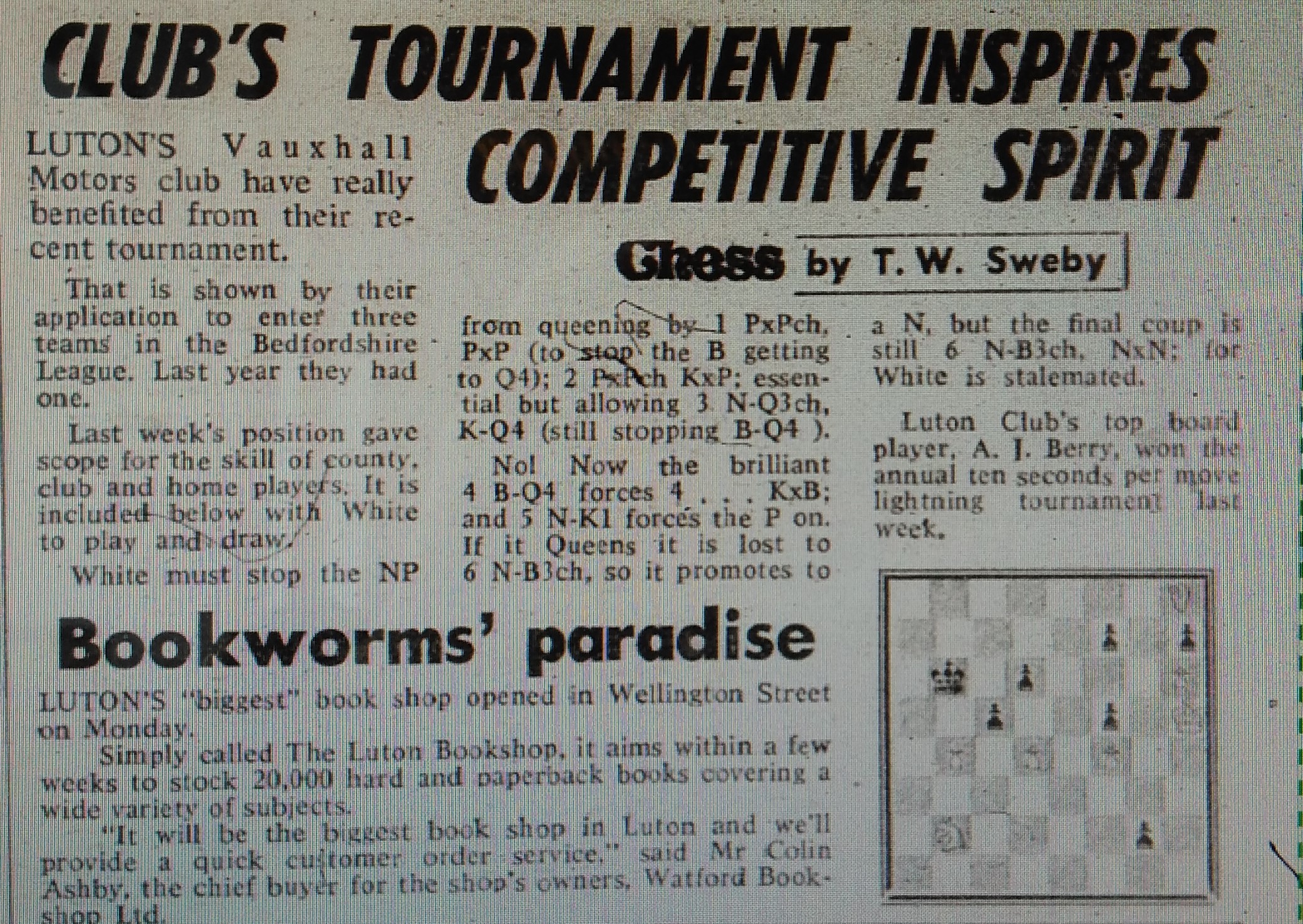
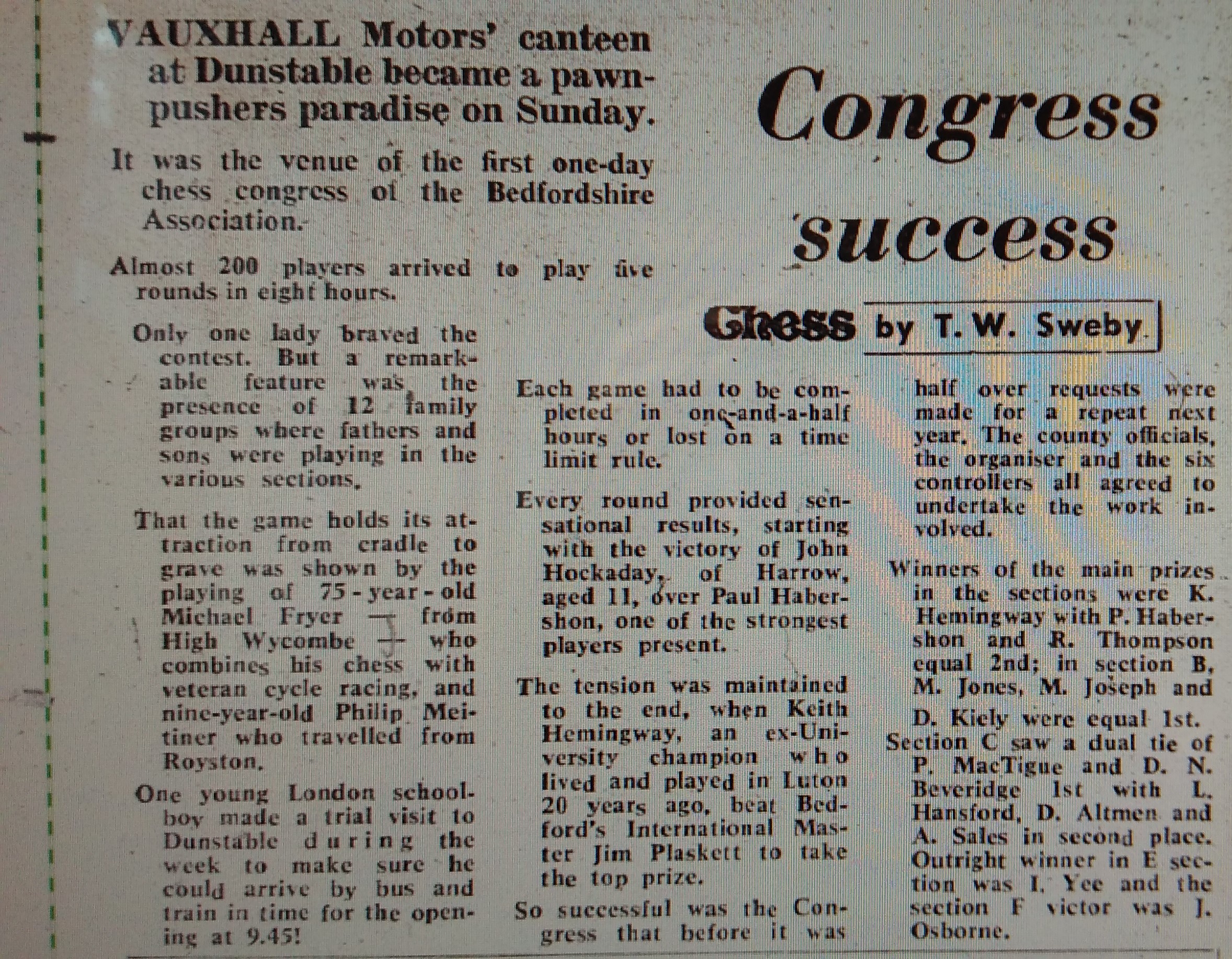
As a young chess player, stories about Luton chess club and the Bedfordshire league were told and retold many times over the years by various club members, as you might expect. But I distinctly remember the man who beat me in the final of the 92 Luton Chess Championship once told me that ‘Luton used to have its own league once!’ whilst we drove in the dark along country lanes to another club match together. What records have survived do not show this to be true but then not all divisions in the Bedfordshire league were published in The Luton News by Tom Sweby on a yearly basis -and that is the only primary source material in play here. What Grandmaster slayer Mr. P. Montgomery may have meant instead as he drove, I think, was in the wake of the commonly described ‘The English Chess Explosion’ following the Fischer – Spassky match, Luton dominated the Bedfordshire league in terms of registered clubs, and also had enough teams to create its own league -of this there is no doubt. There were working men’s clubs for the employees of the parent company, long before the so called ‘English Chess Explosion’ but when chess started booming thereafter they flourished and all were able to field teams in the league, sometimes more than one. Vauxhall, which was reported in the local news as early as 1937 (please see https://mccreadyandchess.wordpress.com/2015/06/05/bedfordshire-chess-in-the-70s-its-past-and-its-future/ for proof) had three teams at one point (no prizes given for correctly guessing which player, who went on to play for both Luton & Kent’s/Luton years later on, once brought his electric guitar to Vauxhall chess club and began playing it whilst games commenced, only to be taken outside and get beaten up in the snow by Dave Considine [also former Kents/Luton player, rated around 140-150]!). (Clue provided here in point 3: https://mccreadyandchess.wordpress.com/2013/01/11/fond-memories-of-bedfordshire-chess/)
The Luton News, September 18th 1980The Luton News, October 9th 1980
As is shown above Vauxhall attracted the most players and was the first to establish itself as more than a host of league matches. SKF had a team on Sundon Park Road also, and how could we forget Kents (meters)? Commer and AC Delco (Dunstable) Texas Instruments (Bedford) and Scicon (Milton Keynes) also had teams and participated in the league too but hard evidence of those is proving difficult to locate (I do have it somewhere!). Contrarily, Electrolux on Oakley Road Leagrave also had its own club, and for the following information regarding its short-lived existence, I am indebted to former Luton player Peter Gayson’s first hand account:
Regarding our chat online Peter said ‘…before that I played occasional games for Electrolux (the club started by my dad), but school/university limited the opportunities…‘
I then enquired: ‘So may I ask, it was your father who started The Electrolux cub as you said? Was that based on Oakley Road, Leagrave?’
Peter replied: ‘Yes, my dad worked at Electrolux in Oakley Road. He started the club right after the 1972 Fischer-Spassky match. There was huge interest at first, but gradually players drifted away, and the club eventually folded later in the decade.‘
I then prompted him further with the following: ‘May I ask, what position did your dad have in the company? Can you remember exactly where they played in the factory grounds and why? Was it always your father that ran it?’
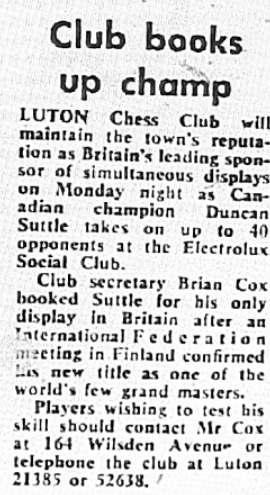
Peter kindly answered with the following: Dad (George Gayson, 1928-1999) was a fridge paint sprayer at Electrolux, who worked there from the late 50s up to retirement. He started the club in 1972. Attendance was pretty good in the early days, with around 40-50 members, but gradually tailed off, and the club folded around 1978-1979. Play was in the Electrolux recreation club, run by Luton FC’s Billy Waugh ( he once introduced me to Joe Payne, one of the club’s famous players, who also worked at Electrolux). I believe the club once hosted a simul by Canadian GM Duncan Suttles, possibly arranged by Brian Cox. After the club folded, I joined Luton chess club, back when it was in the church hall in Bury Park.
With regards to the aforementioned simul, Peter has informed me he did play in it, and I do have proof of its reportage.
The Luton News, date uncertain
With regards to the footballers mentioned, it can easily be confirmed that they did indeed play for the hatters with the following links:
Closing Gambit is a contemporary, well-produced, and coveted documentary. It’s entertaining, informative and fascinating throughout. There are many ways in which events can be retold, and this documentary does a fine job of doing just that. It’s usually not free on Youtube but I have found a free version and linked it here.
There are comments that are, in my opinion, contentious but I don’t wish to go into that here. However, I do want to offer up a fuller account of Soviet chess then the one offered in the documentary. You can find that below. Generally speaking, it is better to go to academic historians than chess players with regards to the history of Soviet chess, as Dr. Eales clearly states here with his broader account of the subject matter which is in itself based on discourse. A good introduction.
An entertaining and informative Kasparov can be found here. And if you’ve ever read his book ‘How life imitates chess’, you will hear some well-rehearsed, familiar content. It’s worth a watch, he can be a great orator at times.
Don’t ask me how but one of the two games I played for Luton whilst in recovery from my main accident, where I fractured my skull alongside a great very many other vicissitudes has been found, and here it is. I do remember the game, and do remember delivering mate.
And in case you can’t read it, here it is:
Mark.J.McCready
Shamal Mohammed
24/11/16 OU v Kents/Luton
e4 e6
d4 d5
Nd2 c5
ce Nc6
Nf3 Qb6 This is an antiquated move which I played because I forgot the theory. Qb6 was premature, the queen should never be moved so early in the French Defence.
exd5 cxd5
Nb3 Bg4
dxc5 Bxc5
Nxc5 Qxc5
Be3 Qd6
Be2 Nf6
0-0 0-0
Nd4 Bxe2
Qxe2 Nxd4
Bxd4 Rfe8 This is precisely what I aimed for. Mostly inspired by Capablanca in my youth who blockaded an IQP with a bishop in one of his famous games. Normally this is done with the knight and not the bishop.
Qb5 Ng4 I found black’s last move to be strange, the cheap threat is very easily countered.
g3 Qh6
h4 Qh5 Black needs more pieces in attack to make this work. There is no threat here.
Rae1 f6. I understood it but thought it was not the best move in the position.
c4 Ne5
Qxd5 Kh8
Bxe5 Rxe5
Rxe5 Qxe5
Qxb7 Rb8
Qxa7 Qxb2 It was better to take with the rook I thought and was surprised by this.
c5 Rc8
Qa6 Rg8 After this was played I knew I would win.
c6 g5
c7 Qc3
hxg5 fxg5
Qd6 h5 The fatal blunder.
Qh6 mate. Believe it or not it took a second or two to register but then I had not long been out of hospital from a head injury and was not yet fully functional.
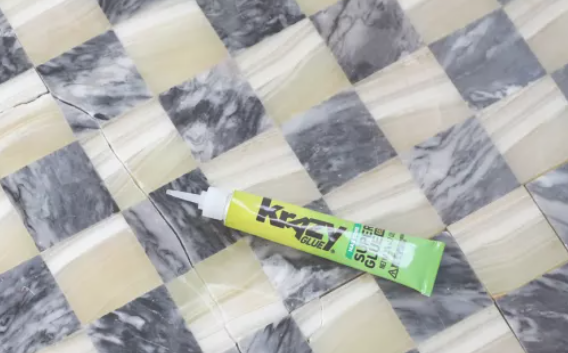
The big question on everyone’s lips in the chess world these days is ‘What can chess players get from glue sniffers’ right?
To answer this, let’s look at the first line in the chorus of the song 3rd floor by the American thrash outfit Death Angel. ‘Welcome to the third floor, it’s a one-way trip then they lock the door’.
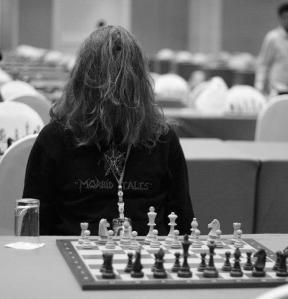
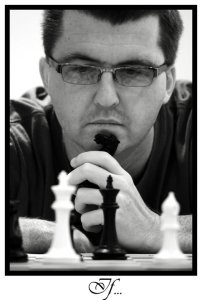
Take a look at this fellow:
Further discussion of this (I am an amused contributor) can be found here:
I asked there, which is the best floor in a hotel to sniff glue on, similarly, which floor of a building is the best floor to play chess on? To some degree this depends on whether you want to sniff some glue whilst playing and how high you want to go. Unfortunately FIDE has not presented us with any statistics on what percentage of chess players are glue sniffers, although the word on the street is approximately 70%. If true, then the safest floor must be the ground floor…not the third floor because (on the glue) it’s a one-way trip! If not true how high up do you want to be when you play chess? Top floor maybe? Whatever your answer may be, if you like to sniff glue whilst playing chess, I recommend you play chess on the ground floor!
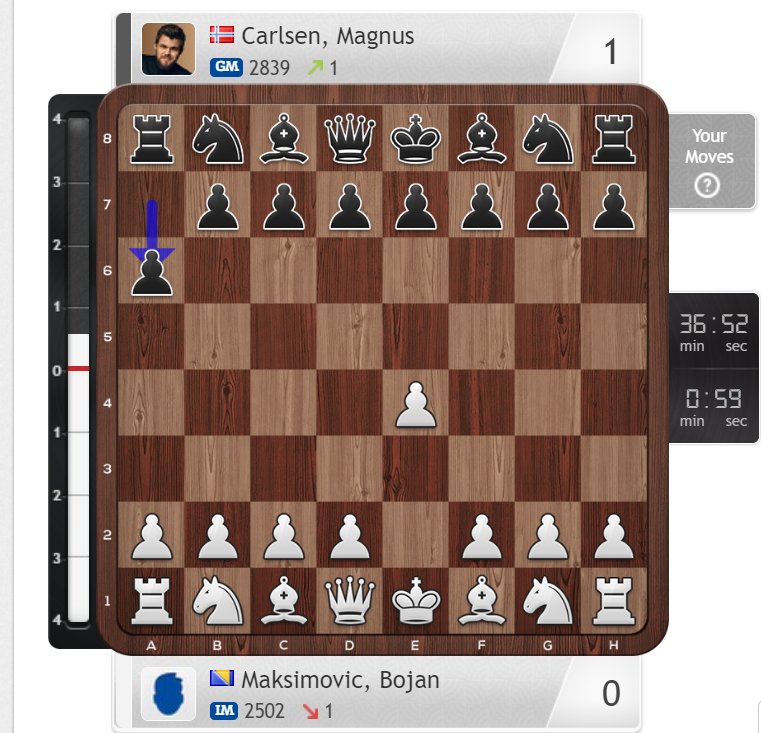
Sven Magnus Øen Carlsen, more commonly known is Magnus Carlsen, and sometimes mistakenly thought of as the current world champion, plays with more daring in the opening than anyone else. In the past I have seen him win with Alekhine’s Defence and play 1.f4 against both GM Kramnik and GM Michael Adams -beating them both with it! Look at this from two days ago at the European Club Championships, Round 3.
His opponent is no pushover, so how can he justify this? I think his rationale is something like ‘I don’t need to gain an advantage in the opening, I can outplay you in the middle game or the endgame.’ Or perhaps it was ‘I am rated over 300 points above you, I can play whatever I like.’
…on what this site initially became…on what this site is now becoming…on what this site cannot become…
On what this site initially became…
…once upon a time, the chess-related musings of an adrift academic were bound playfully and electronically in this online journal of sorts. They grew and grew as the decade did too. I kept on because I love to write whether I had much to say or not; therefore, being read by others was usually of little or no importance, comparatively speaking. Content was based on personal thoughts and experience on various topics with no intended audience borne in mind. With topics broadening, my own take on things always shaped the narrative I constructed: I often thought I was insightful but never that I was right. Sometimes imagination gave rise to originality: and of that I have always remained proud. I often introduced humour, believing that I am funnier than I really am. Sometimes, I found my own style antithetical to the conservatism I believe chess is plagued by -oftentimes that has put a gracious smile on my face… .
On what this site is now becoming…
…this site is now becoming a collaboration of chess in Bedfordshire: much more so of the past than the present -that has become the dominant trend. I document the history of chess in Bedfordshire as much as I can, and as time has passed I have become more thorough and resourceful. However, I am not a trained historian as my background lies principally in philosophy but yes it is true I did study some modules on history as both an undergraduate and a post-graduate too; furthermore, I have trained myself up, particularly in terms of postmodern history. Since 2015, I have only read history and historiography as well as those philosophers who have been so influential on postmodern history, such as Nietzsche (whom I once wrote a 19,000 word dissertation on, entitled: Can the Will to Power be Found in The Birth of Tragedy?), also Richard Rorty and Foucault and I suppose certain structualists such as Claude Levi-Strauss too. Regarding postmodernism, mostly I keep to Hayden White, Keith Jenkins and Alan Muslow.
Some friends and former playing partners back home describe me as the ‘go to guy’ for the history of chess in Bedfordshire. This compliment says more about the lack of interest in the subject than my own endeavour. As mentioned, I am too adrift from academia to feel chuffed by it. Rather, I tend to lament that my historical research, like my chess, just isn’t what it should be. Even though I may well have a broad understanding of Bedfordshire chess history courtesy of the volume of research put into it, all of which began in 2014, this is not something I am particularly proud of. Nonetheless, out of courtesy compliments are graciously received. If the truth be told, I just see it as my job and only that – after all someone’s got to do it and no one else is that interested!
Amongst the many others, I have created three categories: ‘Bedfordshire Chess’ and ‘History of Bedfordshire Chess’ and ‘Luton Chess Club’. This website is slowly moving towards a consolidation of those (all of which can be found in one of the toolbars to the right).
On what this site cannot become…
…I like to be both creative and amusing when I can be, factor in that playfulness has been an ever-present factor, the content of this site should be thought of as multifarious. It could be said I continue to enjoy undermining the conservatism I believe chess is underpinned by even after all these years, and often try to use humour to do it still, believing I have got better at it. Consequently, despite the general direction its going in, this site cannot only be about Chess in Bedfordshire and nor will it be. It may become noted for that yes -in fact that’s been the case for years already even by established historians, archivists, and whoever else. External factors aside, this site is titled McCreadyandChess. I cannot, nor will I not, remove my own personal thoughts and experiences of chess from the posts of this site -especially if I think they are funny or original for they constitute my writing at its very, very best. In addition, the number of categories alone tells you that breadth of content is important to me. I am proud of my site, it is identity conferring and that is how it shall stay -end of story. All you really have are: ‘Some thoughts on the beautiful game’, which, incidentally, just happen to be my very own; nothing more, nothing less, take of it whatever you please… .
A side note on how to read old Tom Sweby's columns
Not perhaps, but quintessentially, Old Tom Sweby is best thought of as a passionate devotee to the newspapers he wrote for. He was well read and knowledgeable of the Bedfordshire chess scene and well beyond, given that he was the president of the S.C.C.U. once upon a time. He was generally well-respected and rubbed shoulders with many, if not all, of those eminent within British chess circles. It would, however, be a critical mistake to see his column is primary source material entirely. That it is not. You will also find secondary source material quoted too, and the reliability of that is not quite as Tom hoped. Given that he wrote for decades, this is to some degree inevitable, and after all we are all prone to error whether we realize it or not. Thankfully, with regards to old Tom Sweby, they are infrequent and for the most part old Tom continued to document events and developments in the Bedfordshire league from the get go as best he could but, of course, everything lies open to interpretation. Despite this, and generally speaking. this does indeed make him informative and thus worth reading. Dare I say his columns constitute a narrative describing the latest developments, match reports and changing nature of the Beds league...he knew his audience and wrote according. This manifested itself over decades but brevity was always in play courtesy of the restictions imposed by writing a column. Should you wish to read a in instrumental figure of the Beds' league post WW2, you are quite welcome to peruse what has been posted here... . :-) I should, however, point out that as the decades wore on he gradually moved on away from narratives concerning the Bedfordshire league towards affairs both historical and international. The reasons for this are multifarous, old age was a predominante factor presumably, however, the bottom line is with regards to how the Bedfordshire chess scene developed post WW2: old Tom Sweby is your go to guy. He wrote more about chess in Bedforshire than anyone else did but given he was a Lutonian and writing for a Luton newspaper there is both bias and greater coverage of his hometown than the rest of the county.
Gallery
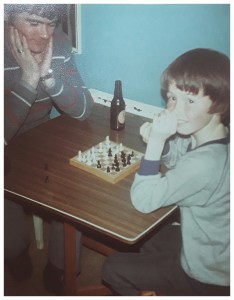
I’m either 10 or 11 here
1982, myself versus Brian from Sunderland.
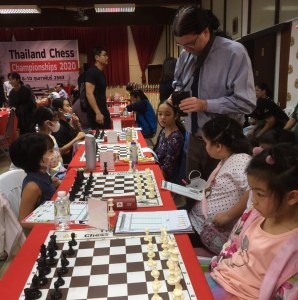
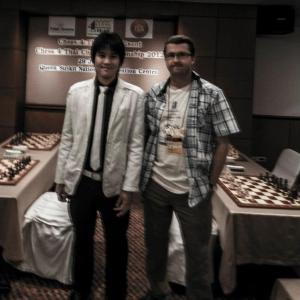
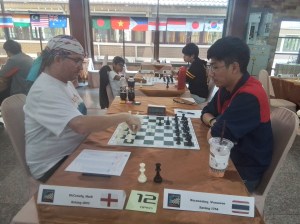
At the Thai Junior chess championships. My daughter of course.
Pattaya 2011
2011
Thai Junior Championships
2008
2011
Around 2011
2011
Pattaya 2009
2011
Kuwait 2008
2012
2012
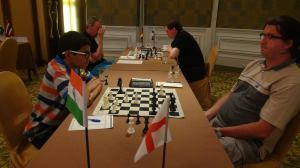
2011 BKK Chess club
2011
2011 Thai Open
2011 Thai Open
2013 approx
Around 2014
2010
2012
Around 2011
2011
2011
2013
Around 2011
Around 2011
2020
2011
2008
2011
2013 or thereabouts
2010
2017
2014?
2010
2024
2024
2024
To add comments, please see the bell at the top of the page.




















 McCreadyandChess