Here is a game which exemplifies I am a mere club & county player, and both challenges the widely held belief that 1. c4 is a quiet move often leading to postional struggles as well as that I am playing for a win still, despite having stopped playing sacrifical chess against computer engines. It’s far from brilliant, like most ad hoc online games are, but looks like the right way forwards for someone wnting to move away from 1. e4.
“Truth is what your contemporaries let you get away with.” -Richard Rorty
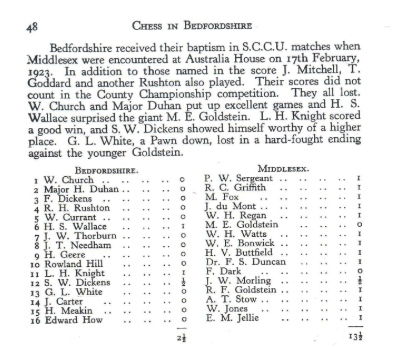
Fellow chess players of Bedfordshire, in returning to Chess in Bedfordshire (F. Dickens & G. L. White: Leeds Whitehead & Miller 1933) once again, courtesy of ineluctable ongoing research, please allow me to draw attention less so to the quote above and more so to the once documented county debut defeat of ours in the S. C. C. U, with special attention paid to a certain individual in particular, since none at all was in the aforementioned publication. First, a recap of the result:
Somewhat aside: chess history is not usually as laudable as some readers may think, with authors not being seen as paragons of virtue by all, especially postmodernists or historiographers who may continuously connect interpreting meaning to establishing significance amongst many other things; and so to understand the nature of this defeat, an examination of Middlesex‘s top three boards does not postulate but in fact proves a gulf in class at the top end of the teams, and in all probability one that trickled down throughout the lower boards too, thus a principle determining factor in the disconcerting defeat on our debut, most likely.
TheirBoard 1
Fellow county chess players, you may already be acquainted with their top board: the esteemed P. W. Sargeant, him being the author of the then future publication A century of British chess (1934). The estimated rating attributed to him by the EDO Historical Chess Ratings website (not entirely reliable but good enough) at the time of the match was 2115 http://www.edochess.ca/players/p4038.html but it should be pointed out, however, that he was the Middlesex county champion of 1921, two years previously.
TheirBoard 2
On board two was R. C. Griffith. British champion in 1912 in his only such appearance, and as can be seen above, champion of Middlesex some two years after that. Impressive indeed for a board number two. The EDO website has him estimated at 2261 that year http://www.edochess.ca/players/p4615.html.
TheirBoard 3
And so board three, thee board three, he who this post is about -and hardly surprising too, the Canadian Maurice Fox. The EDO website has him rated at 2341 the year Bedfordshire was beaten. http://www.edochess.ca/players/p7358.html.
More significantly: four years before he beat our F. Dickens, he outfoxed future world champion Capablanca in a simul with the black pieces, https://www.chessgames.com/perl/chessgame?gid=1328964, suggesting that he was too strong to play on board three at county level despite Capablanca not being at his optimal best.
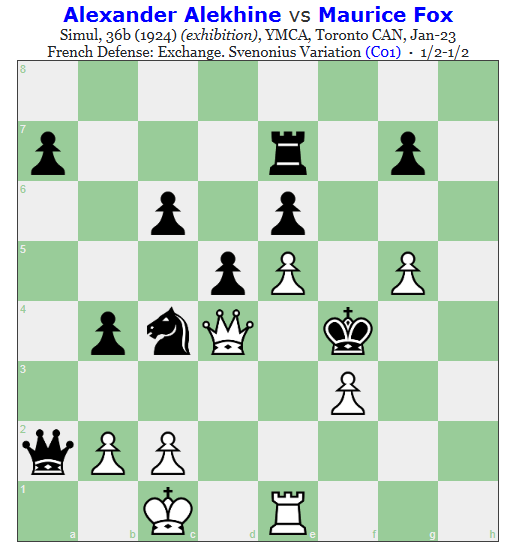
According to various sources, later in 1923 he emigrated to Canada. The following year he faced another future world champion with the black pieces, this time Alekhine in a simul in Toronto. During the middlegame, increduously, he decided to march his king down to e3 even though Alekhine still had a queen, rook and knight on the board; sacrificing a rook and a knight along the way and leaving Alekhine the option of allowing himself to be mated instantly or force perpetual check instead! See below. https://www.chessgames.com/perl/chessgame?gid=1012317
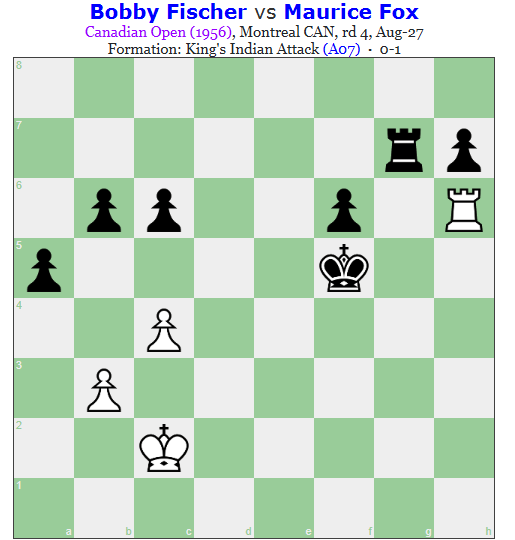
He then went on to win the national championships in Canada a joint record eight times (joint with GM Yanofsky), with his estimated rating peaking in 1929 to 2364. Much more impressively, in the 1950s he not only outfoxed yet another future world champion with the black pieces but beat him too, a certain Robert. J. Fischerhttps://www.chessgames.com/perl/chessgame?gid=1044029.
According to the following link, this game occured at the very first Canadian Open, in Montreal 1956 https://www.bcchesshistory.com/canop5662.html and even though Fischer was only 13 at the time with a rating as low as 2156, he could be hardly be classified as a push over given that at the very same age he played what was called the game of the century against Donald Byrne, thus described by Hans Kmoch‘The following game, a stunning masterpiece of combination play performed by a boy of 13 against a formidable opponent, matches the finest on record in the history of chess prodigies.” Here is the game in case you have forgotten it https://www.chessgames.com/perl/chessgame?gid=1008361.
Shifting the focus homeward bound, how did our top three stand in relation? In terms of estimated ratings, there is little to go on.
Our board 1
W. Church of Luton (no results attainable, no rating estimated)
F. Dickens (of Dunstable & Luton: no results attainable, no rating estimated: aside please note for our purposes, he played alongside Nigel Staddon’s father for many years).
Do also note that the co-authors of Chess in Bedfordshire (F.Dickens & G.L White: Leeds Whitehead & Miller 1933) are playing on boards 3 and 13, and H. T Duhan (our board 2) had already become champion of South Africa eight years after The Boer War had ended in 1910, as has been documented on this site, and also S.Dickens, who drew on board 12 once turned over Tartakower in a simul in Luton in 1928 (also documented on this site).
‘Bedfordshire received its baptism in S.C.C.U matches when Middlesex were (that’s a collective noun and so should be followed by was not were: subject and verb disagreement) encountered at Australia House on February 17th 1823′. Oh really? Baptism of fire was a more aptly chosen term I would say. Their board trois beat deux of, and drew with un of, those always in the top dix greatest players of all time! No wonder we were trounced on those top boards: of those playing lower down the order, the evidence is too depressing to investigate further, and I am too wounded to conduct it!
…if it’s any consolation, I am quite sure that was the only time we faced a county whose board three racked up wins against Capablanca and Fischer, and drew with Alekhine! And should it be the case that once more evidence becomes apparent in retrospect, of us losing heavily to counties fielding players below top board so fiendishly strong that they make beating some of the greatest players of all time with the black pieces look like a doddle, I shall be the first to write a letter of complaint -simul or no simul involved!
A consolation of sorts
Last, but by no means least, another perspective: regarding county players who have beaten future world champions with the black pieces, the all-time score between Middlesex and Bedfordshire is most probably 1-1. If, and only if, it is true that Fox is their only player to do so, and GM Plaskett is ours (he beat Anand before he became world champion) that is. And on that note -draw agreed! https://www.chessgames.com/perl/chessgame?gid=1018022.
“The world does not speak. Only we do. The world can, once we have programmed ourselves with a language, cause us to hold beliefs. But it cannot propose a language for us to speak. Only other human beings can do that. ” ― Richard Rorty
Unlike the popular gameshow, features such as ‘ask the audience, phone a friend, and 50/50‘ are inapplicable here -sincere apologies. Unfortunately, there’s no money to be made from this also. However, do your best but do it alone please -no googling!
Question 1£100
How many pawns are there on the board at the beginning of a game?
A: 4
B: 8
C: 16
D: 32
Question 2£200
When two kings are placed in the centre of the board by an arbiter, what does this signify?
A: a game has been drawn.
B: a game has been won by white.
C: a game has been won by black.
D: a game has not been played.
Question 3£300
Queening refers to what in chess?
A: castling
B: a sacrifice
C: an exchange
D: promotion
Question 4£400
The headquarters of FIDE are in which country?
A: France
B: Switzerland
C: Belgium
D: Austria
Question 5 £500
The Lewis Chessmen are housed in a musuem in which city?
A: Glasgow
B: Cardiff
C: London
D: Dublin
Question 6£1,000
Who is the only person described as both unofficial and official world champion?
A: Wilhelm Steinitz
B: Johannes Zukertort
C: Adolf Anderssen
D: Emmanuel Lasker
Question 7£2,000
The book Modern Ideas in Chess was written by whom?
A: Aron Nimzowitch
B: Jose Capablanca
C: Richard Reti
D: Max Euwe
Question 8£4,000
The St. George’s Defence has also been called?
A: The Liverpool Defence
B: The Manchester Defence
C: The Cambridge Defence
D: The Birmingham Defence
Question 9£8,000
Who became the Women’s World Champion in 2018?
A: Ju Wenjun
B: Hou Yifan
C: Tan Zhyongi
D: Lie Tingjie
Question 10£16,000
The American player Larry Christiansen was awarded the title of GM in which decade?
A: 1960s
B: 1970s
C: 1980s
D: 1990s
Question 11£32,000
What was the prize money for the 1992 rematch between Fischer and Spassky?
A: $1,000,000
B: $3,000,000
C: $5,000,000
D: $10,000,000
Question 12 £64,000
Which European master played a match against Paul Morphy in New Orleans in 1850?
A: Daniel Harrwitz
B: Johann Löwenthal
C: Adolf Anderssen
D: Louis Paulsen
Question 13 £125,000
‘Jaque Mate’ is the term for checkmate in which language?
A: French
B: Portugese
C: Italian
D: Spanish
Question 14 £250,000
The 2020 Tata Steel Tournament held in Wijk An Zee was won by whom?
A: Magnus Carlsen
B: Fabio Caruana
C: Wesley So
D: Anish Giri
Question 15£500,000
Who was Magnus Carlsen’s last opponent as world champion?
A: GM Hikaru Nakamura
B: GM Alireza Firouzja
C: GM Richard Rapport
D: GM David Howell
Question 16£1,000,000
Who is the only Canadian to have beaten former world champions Capablanca and Fischer, and drawn with former world champion Alekhine?
A: Daniel Yanofsky
B: Nathan Divinsky
C: Duncan Suttles
D: Maurice Fox
So there you are, well done if you did well. No money once again I’m afraid owing to being a poor English teacher. I do put thought into this, so if you got more than half right, you did well. Hope you enjoyed, you might even want to give it a shot yourself!
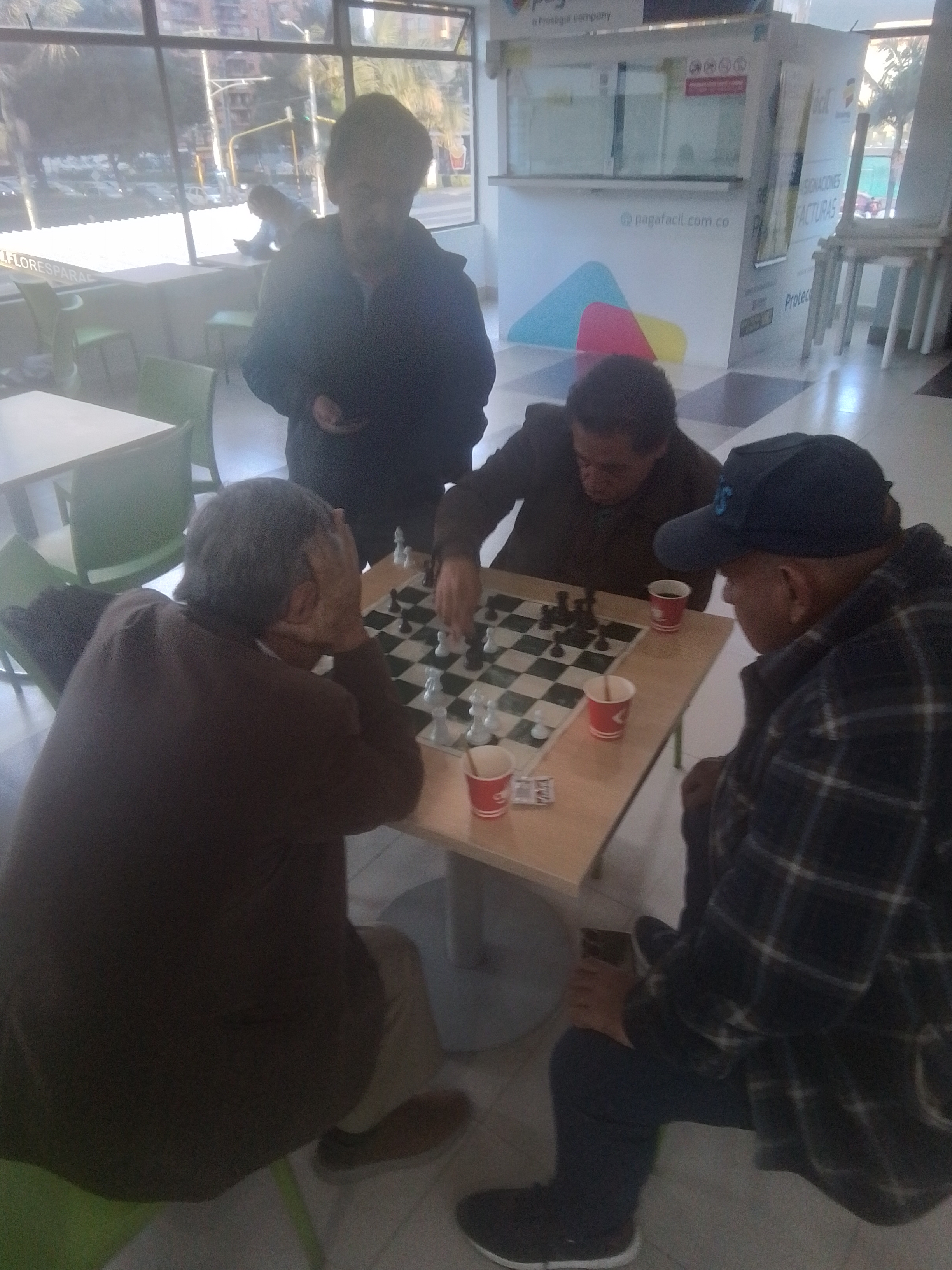
A love of travel has pushed me far and wide. Two months ago I arrived in my 38th county, down yonder Latin America to Colombia in fact, courtesy of that leitmotiv of mine (all that is left now is Africa and Australasia). This afternoon, I headed further north than usual in the capital city, to give training to a headmaster at an International school. After it had concluded, I cut through the small but exclusive shopping mall I saw opposite his luxury apartment -you can find it and its name on the map here: https://maps.app.goo.gl/ixdGsHkqyfmaRcsH9.
It had two floors only, the second being a food court, so I decided to take a look. Much to my surprise I noticed ten or so elderly gentlemen -like me- playing skittles. Within minutes I was beckoned to play at a table by the windows. This was to be my first game in Colombia, my first game in Latin America. Perchance I looked English for I was offered the white pieces, and being English, naturally I opened with 1. c4. I played all my moves almost instantly except one or two -as if it were bullet chess with no clock! But with my heroes being Carlsen and Karpov, yes I went for a Catalan, opting for some space grabbing on the queenside with an a-pawn thrust that knocked his knight on b6 back to the eighth rank before opening the centre up with a d-pawn push that put my opponent on the backfoot even further in order to blockade it. He made no mistakes, however, but his defensive minor piece placement in the middlegame allowed me much activity in the endgame, which when my king came marching in, eventually cost him the full point. I did not write anything down for it was only skittles but I do recall the final position.
In playing Kc7 my opponent accepted defeat
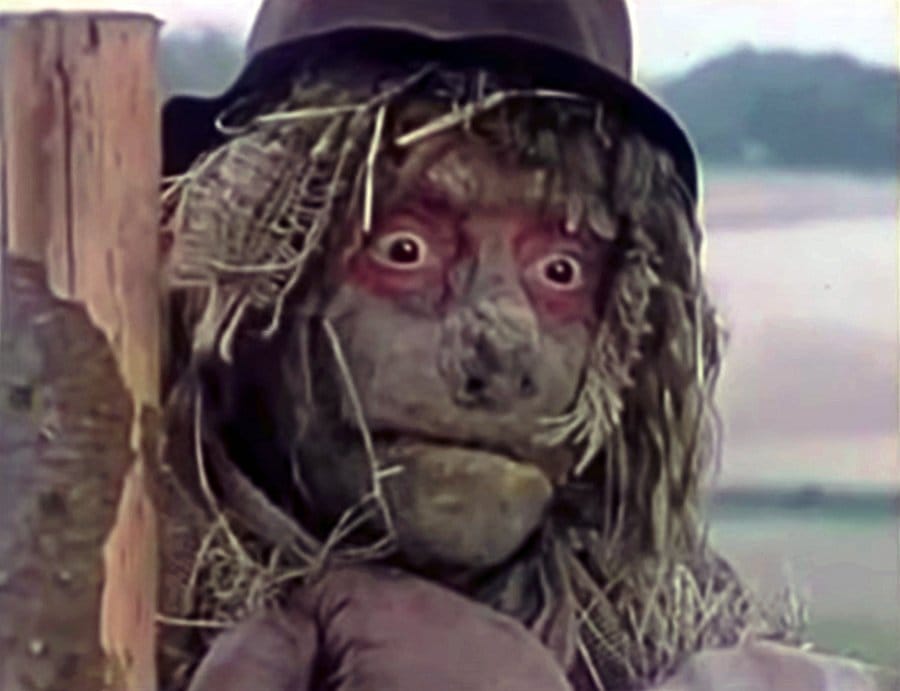
Even though the weather is inclement, the start to the day often inauspicious, the culture in Bogota is vibrant nonetheless. They like to live their life to the full here, they are pragmatic about it also, well for the most part. They don’t only play chess in parks, they also congregate in food courts to deliver checkmate, until of course they come up against McCready the conquistador! My play was consistent in approach and effective too, and that made me proud, putting a smile on my face as I left. It was already dark then, the time some twenty minutes or so after dusk had fallen. I walked towards the Transmilenio bus stop named Alcalá, my mood jovial, my state of mind aloof somewhat. Getting on the right bus, that being number 8, but going several kilometers in the wrong direction towards the northern edge of the city was more laughable than it was regretable, such was my mood: I came, I saw, I conquered I told myself, and not I came, I saw (the bus), I conquered a seat on it but off it went in the opposite direction and I almost got myself bloody lost again! It wasn’t an unfitting end to an afternoon of discovery followed by achievement but simply a brief return of ‘old dafthead’ as Worzel Gummidge would have put it -or so I like to jest!
Nothing more than a cameo in this episode?!?
To end, my greatest passion in life isn’t chess, it’s music; therefore, the thing I connect with the most here isn’t that chess is enjoyed in public but rather heavy metal is popular indeed instead. The song of the day, then, has to be this appropriately named, and rather catchy, 1980’s German metal massacre.
Whenever I discover chess content incorporating history by historians, keen to post it I am for perhaps obvious reasons. One popped up in an audio lecture yesterday.
In case you don’t know or can’t guess, the well-respected historian Steinberg argues that it was Lenin.
Here he is. In my opinion no other westerner understands the history of Russia better than him. Watch him, listen to him or purchase one of his many publications and you might see why.
Former world champion Kasparov has extended his presence on youtube further with new channels full of interesting content. In this video, Kasparov gives us some background and analysis on his first game against rival Karpov.
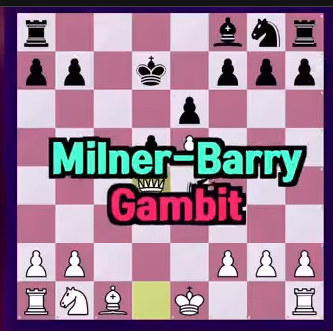
Two, perhaps, audaciously theatrical videos here; one on the Milner-Barry Gambit, and the other on the Halloween Gambit. Highly interesting stuff right? Well worth a watch, yes? 10 out of 10 for creativity agreed? Youtube links follow below.
…on what this site initially became…on what this site is now becoming…on what this site cannot become…
On what this site initially became…
…once upon a time, the chess-related musings of an adrift academic were bound playfully and electronically in this online journal of sorts. They grew and grew as the decade did too. I kept on because I love to write whether I had much to say or not; therefore, being read by others was usually of little or no importance, comparatively speaking. Content was based on personal thoughts and experience on various topics with no intended audience borne in mind. With topics broadening, my own take on things always shaped the narrative I constructed: I often thought I was insightful but never that I was right. Sometimes imagination gave rise to originality: and of that I have always remained proud. I often introduced humour, believing that I am funnier than I really am. Sometimes, I found my own style antithetical to the conservatism I believe chess is plagued by -oftentimes that has put a gracious smile on my face… .
On what this site is now becoming…
…this site is now becoming a collaboration of chess in Bedfordshire: much more so of the past than the present -that has become the dominant trend. I document the history of chess in Bedfordshire as much as I can, and as time has passed I have become more thorough and resourceful. However, I am not a trained historian as my background lies principally in philosophy but yes it is true I did study some modules on history as both an undergraduate and a post-graduate too; furthermore, I have trained myself up, particularly in terms of postmodern history. Since 2015, I have only read history and historiography as well as those philosophers who have been so influential on postmodern history, such as Nietzsche (whom I once wrote a 19,000 word dissertation on, entitled: Can the Will to Power be Found in The Birth of Tragedy?), also Richard Rorty and Foucault and I suppose certain structualists such as Claude Levi-Strauss too. Regarding postmodernism, mostly I keep to Hayden White, Keith Jenkins and Alan Muslow.
Some friends and former playing partners back home describe me as the ‘go to guy’ for the history of chess in Bedfordshire. This compliment says more about the lack of interest in the subject than my own endeavour. As mentioned, I am too adrift from academia to feel chuffed by it. Rather, I tend to lament that my historical research, like my chess, just isn’t what it should be. Even though I may well have a broad understanding of Bedfordshire chess history courtesy of the volume of research put into it, all of which began in 2014, this is not something I am particularly proud of. Nonetheless, out of courtesy compliments are graciously received. If the truth be told, I just see it as my job and only that – after all someone’s got to do it and no one else is that interested!
Amongst the many others, I have created three categories: ‘Bedfordshire Chess’ and ‘History of Bedfordshire Chess’ and ‘Luton Chess Club’. This website is slowly moving towards a consolidation of those (all of which can be found in one of the toolbars to the right).
On what this site cannot become…
…I like to be both creative and amusing when I can be, factor in that playfulness has been an ever-present factor, the content of this site should be thought of as multifarious. It could be said I continue to enjoy undermining the conservatism I believe chess is underpinned by even after all these years, and often try to use humour to do it still, believing I have got better at it. Consequently, despite the general direction its going in, this site cannot only be about Chess in Bedfordshire and nor will it be. It may become noted for that yes -in fact that’s been the case for years already even by established historians, archivists, and whoever else. External factors aside, this site is titled McCreadyandChess. I cannot, nor will I not, remove my own personal thoughts and experiences of chess from the posts of this site -especially if I think they are funny or original for they constitute my writing at its very, very best. In addition, the number of categories alone tells you that breadth of content is important to me. I am proud of my site, it is identity conferring and that is how it shall stay -end of story. All you really have are: ‘Some thoughts on the beautiful game’, which, incidentally, just happen to be my very own; nothing more, nothing less, take of it whatever you please… .
A side note on how to read old Tom Sweby's columns
Not perhaps, but quintessentially, Old Tom Sweby is best thought of as a passionate devotee to the newspapers he wrote for. He was well read and knowledgeable of the Bedfordshire chess scene and well beyond, given that he was the president of the S.C.C.U. once upon a time. He was generally well-respected and rubbed shoulders with many, if not all, of those eminent within British chess circles. It would, however, be a critical mistake to see his column is primary source material entirely. That it is not. You will also find secondary source material quoted too, and the reliability of that is not quite as Tom hoped. Given that he wrote for decades, this is to some degree inevitable, and after all we are all prone to error whether we realize it or not. Thankfully, with regards to old Tom Sweby, they are infrequent and for the most part old Tom continued to document events and developments in the Bedfordshire league from the get go as best he could but, of course, everything lies open to interpretation. Despite this, and generally speaking. this does indeed make him informative and thus worth reading. Dare I say his columns constitute a narrative describing the latest developments, match reports and changing nature of the Beds league...he knew his audience and wrote according. This manifested itself over decades but brevity was always in play courtesy of the restictions imposed by writing a column. Should you wish to read a in instrumental figure of the Beds' league post WW2, you are quite welcome to peruse what has been posted here... . :-) I should, however, point out that as the decades wore on he gradually moved on away from narratives concerning the Bedfordshire league towards affairs both historical and international. The reasons for this are multifarous, old age was a predominante factor presumably, however, the bottom line is with regards to how the Bedfordshire chess scene developed post WW2: old Tom Sweby is your go to guy. He wrote more about chess in Bedforshire than anyone else did but given he was a Lutonian and writing for a Luton newspaper there is both bias and greater coverage of his hometown than the rest of the county.
Gallery
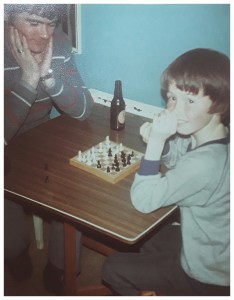
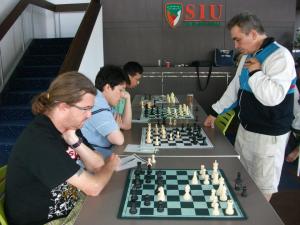
I’m either 10 or 11 here
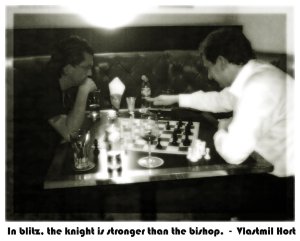
1982, myself versus Brian from Sunderland.
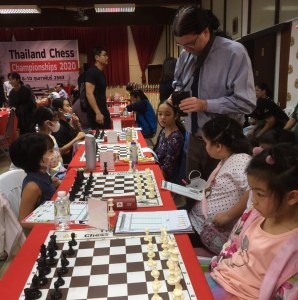
At the Thai Junior chess championships. My daughter of course.
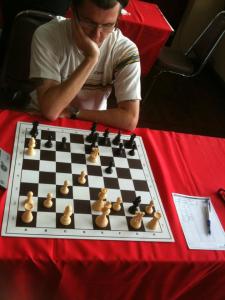
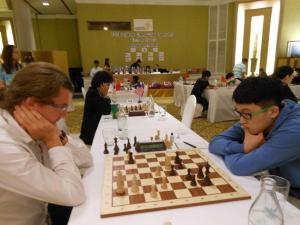
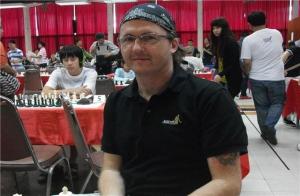
Pattaya 2011
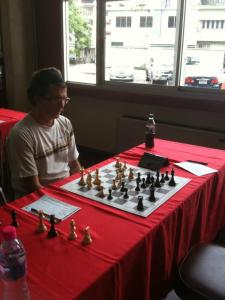
2011
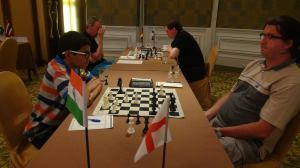
Thai Junior Championships
2008
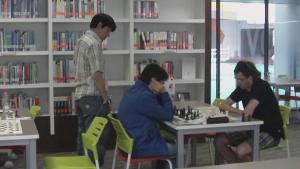
2011
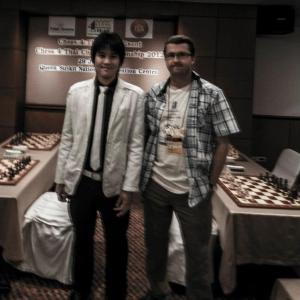
Around 2011
2011
Pattaya 2009
2011
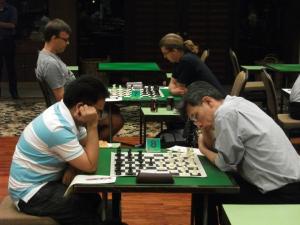
Kuwait 2008
2012
2012
2011 BKK Chess club
2011
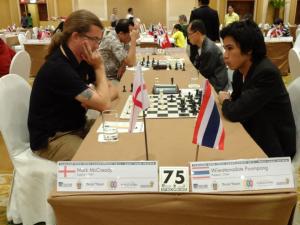
2011 Thai Open
2011 Thai Open
2013 approx
Around 2014
2010
2012
Around 2011
2011
2011
2013
Around 2011
Around 2011
2020
2011
2008
2011
2013 or thereabouts
2010
2017
2014?
2010
2024
2024
2024
To add comments, please see the bell at the top of the page.


























 McCreadyandChess