“Truth is what your contemporaries let you get away with.” -Richard Rorty
Fellow chess players of Bedfordshire, in returning to Chess in Bedfordshire (F. Dickens & G. L. White: Leeds Whitehead & Miller 1933) once again, courtesy of ineluctable ongoing research, please allow me to draw attention less so to the quote above and more so to the once documented county debut defeat of ours in the S. C. C. U, with special attention paid to a certain individual in particular, since none at all was in the aforementioned publication. First, a recap of the result:
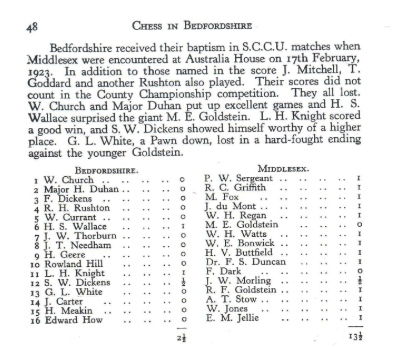
Somewhat aside: chess history is not usually as laudable as some readers may think, with authors not being seen as paragons of virtue by all, especially postmodernists or historiographers who may continuously connect interpreting meaning to establishing significance amongst many other things; and so to understand the nature of this defeat, an examination of Middlesex‘s top three boards does not postulate but in fact proves a gulf in class at the top end of the teams, and in all probability one that trickled down throughout the lower boards too, thus a principle determining factor in the disconcerting defeat on our debut, most likely.
Their Board 1
Fellow county chess players, you may already be acquainted with their top board: the esteemed P. W. Sargeant, him being the author of the then future publication A century of British chess (1934). The estimated rating attributed to him by the EDO Historical Chess Ratings website (not entirely reliable but good enough) at the time of the match was 2115 http://www.edochess.ca/players/p4038.html but it should be pointed out, however, that he was the Middlesex county champion of 1921, two years previously.

Their Board 2
On board two was R. C. Griffith. British champion in 1912 in his only such appearance, and as can be seen above, champion of Middlesex some two years after that. Impressive indeed for a board number two. The EDO website has him estimated at 2261 that year http://www.edochess.ca/players/p4615.html.
Their Board 3
And so board three, thee board three, he who this post is about -and hardly surprising too, the Canadian Maurice Fox. The EDO website has him rated at 2341 the year Bedfordshire was beaten. http://www.edochess.ca/players/p7358.html.
More significantly: four years before he beat our F. Dickens, he outfoxed future world champion Capablanca in a simul with the black pieces, https://www.chessgames.com/perl/chessgame?gid=1328964, suggesting that he was too strong to play on board three at county level despite Capablanca not being at his optimal best.

According to various sources, later in 1923 he emigrated to Canada. The following year he faced another future world champion with the black pieces, this time Alekhine in a simul in Toronto. During the middlegame, increduously, he decided to march his king down to e3 even though Alekhine still had a queen, rook and knight on the board; sacrificing a rook and a knight along the way and leaving Alekhine the option of allowing himself to be mated instantly or force perpetual check instead! See below. https://www.chessgames.com/perl/chessgame?gid=1012317
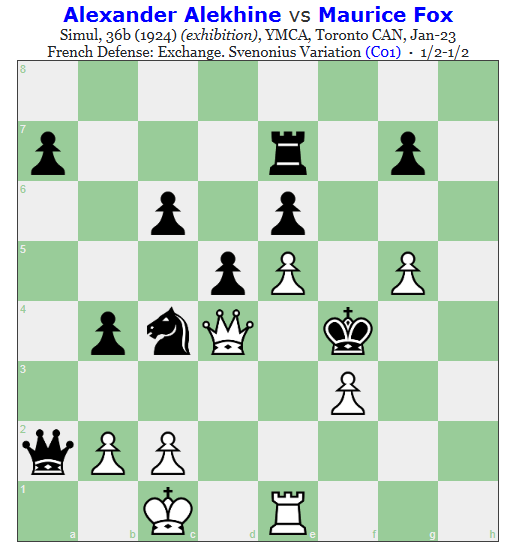
He then went on to win the national championships in Canada a joint record eight times (joint with GM Yanofsky), with his estimated rating peaking in 1929 to 2364. Much more impressively, in the 1950s he not only outfoxed yet another future world champion with the black pieces but beat him too, a certain Robert. J. Fischer https://www.chessgames.com/perl/chessgame?gid=1044029.
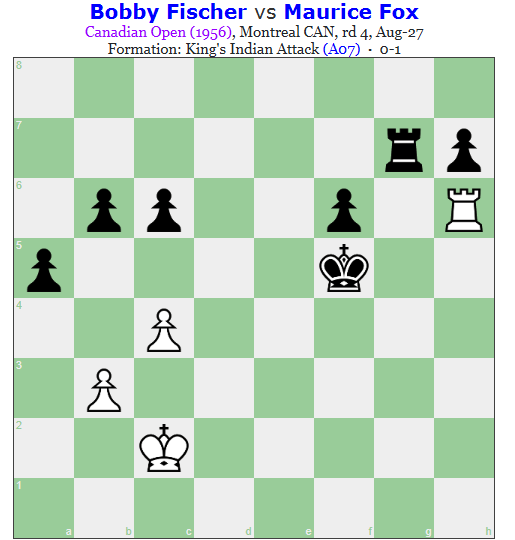
According to the following link, this game occured at the very first Canadian Open, in Montreal 1956 https://www.bcchesshistory.com/canop5662.html and even though Fischer was only 13 at the time with a rating as low as 2156, he could be hardly be classified as a push over given that at the very same age he played what was called the game of the century against Donald Byrne, thus described by Hans Kmoch ‘The following game, a stunning masterpiece of combination play performed by a boy of 13 against a formidable opponent, matches the finest on record in the history of chess prodigies.” Here is the game in case you have forgotten it https://www.chessgames.com/perl/chessgame?gid=1008361.
Shifting the focus homeward bound, how did our top three stand in relation? In terms of estimated ratings, there is little to go on.
Our board 1
W. Church of Luton (no results attainable, no rating estimated)
Our board 2
H. T. Duhan (of Bedford: estimated rated 2141, 12 years previously) http://www.edochess.ca/players/p12485.html
Our board 3
F. Dickens (of Dunstable & Luton: no results attainable, no rating estimated: aside please note for our purposes, he played alongside Nigel Staddon’s father for many years).
Do also note that the co-authors of Chess in Bedfordshire (F.Dickens & G.L White: Leeds Whitehead & Miller 1933) are playing on boards 3 and 13, and H. T Duhan (our board 2) had already become champion of South Africa eight years after The Boer War had ended in 1910, as has been documented on this site, and also S.Dickens, who drew on board 12 once turned over Tartakower in a simul in Luton in 1928 (also documented on this site).
‘Bedfordshire received its baptism in S.C.C.U matches when Middlesex were (that’s a collective noun and so should be followed by was not were: subject and verb disagreement) encountered at Australia House on February 17th 1823′. Oh really? Baptism of fire was a more aptly chosen term I would say. Their board trois beat deux of, and drew with un of, those always in the top dix greatest players of all time! No wonder we were trounced on those top boards: of those playing lower down the order, the evidence is too depressing to investigate further, and I am too wounded to conduct it!
…if it’s any consolation, I am quite sure that was the only time we faced a county whose board three racked up wins against Capablanca and Fischer, and drew with Alekhine! And should it be the case that once more evidence becomes apparent in retrospect, of us losing heavily to counties fielding players below top board so fiendishly strong that they make beating some of the greatest players of all time with the black pieces look like a doddle, I shall be the first to write a letter of complaint -simul or no simul involved!
A consolation of sorts
Last, but by no means least, another perspective: regarding county players who have beaten future world champions with the black pieces, the all-time score between Middlesex and Bedfordshire is most probably 1-1. If, and only if, it is true that Fox is their only player to do so, and GM Plaskett is ours (he beat Anand before he became world champion) that is. And on that note -draw agreed! https://www.chessgames.com/perl/chessgame?gid=1018022.

“The world does not speak. Only we do. The world can, once we have programmed ourselves with a language, cause us to hold beliefs. But it cannot propose a language for us to speak. Only other human beings can do that. ”
― Richard Rorty
Mark. J. McCready
















 McCreadyandChess