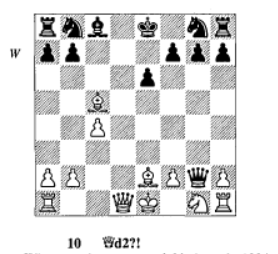
Here’s another move I couldn’t play. Saccing a rook for a strong attack is above me. I would want to be certain it initiates a winning attack, otherwise I wouldn’t do it. But that is what the move below prefaces impressively indeed.
Bareev plays 15 Bh7+ here.
I would not feel threatened by that if it were played against me. However, black’s position soon becomes unenviable, then lost completely thereafter. All way above my level -I’m not good enough to think that if something looks like an innocuous check then it isn’t that – as it wouldn’t be played if that’s all it were.
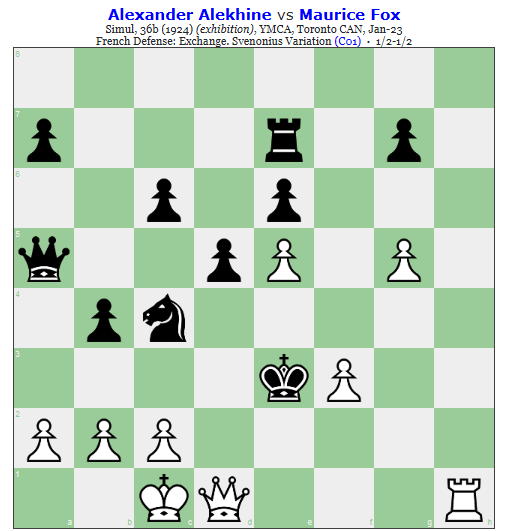
This game I recently discover via research conducted a month or so back. The game is from a simul, where the play is often more gung-ho. That still, you have to admire Fox for threatening mate in 1 given his king position against former Russian champion, and soon to be world champion Alekhine.
Here Fox plays 29. … Qxa2.
I neither have the bravery nor the calculation skills to play such a move.
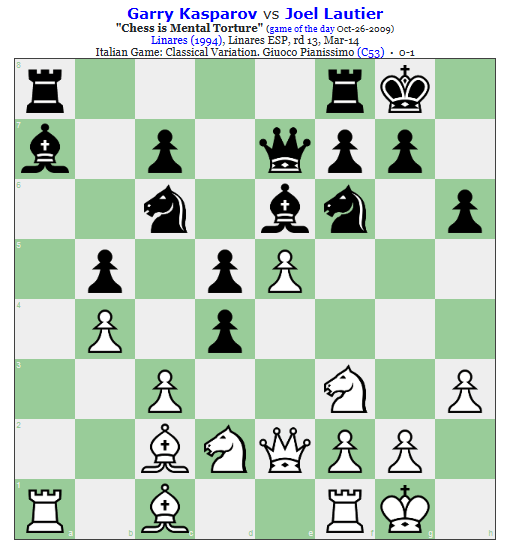
Lautier was right up there in his day and beat everyone. The manner in which he beat Kasparov in the game below shows just how strong he was. In the diagram below, he plays a move I most certainly couldn’t.
Here Lautier plays 16. … dxc3
You need to play through the game to appreciate its finesse. It does need to be asked if anyone ever had two queens on the board against Kasparov faster than Lautier did. I doubt it very much.
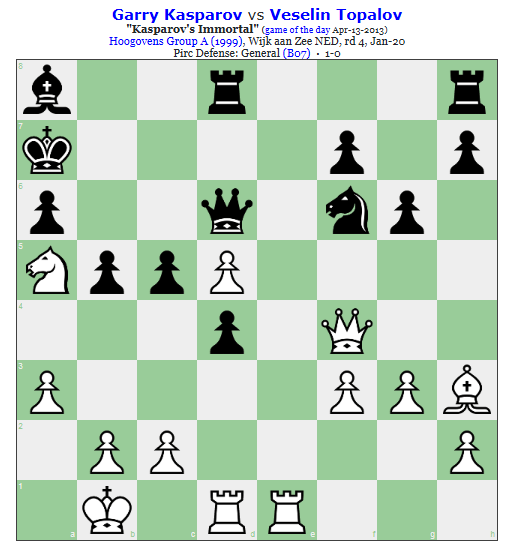
A pamphlet was written about this game due to the attention it attracted. If you look at the position below, how well could you calculate the win ahead from the move played? Assuming of course, the sacrifice is accepted, which it doesn’t have to be.
Kasparov plays 24. Rxd4 here.
I could never play such a move in classical chess. In blitz as a hit and hope maybe but I doubt it. I am not tactically strong enough to calculate correctly why it works, like almost everyone else.
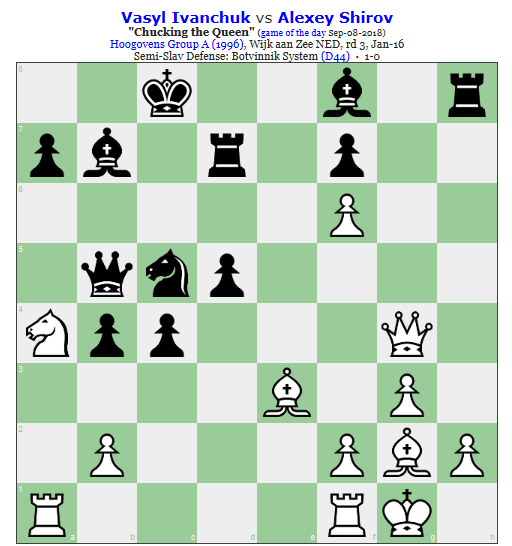
I’ve decided to collate all moves I have been impressed by over the years in the many, many books I have bought; and all the many, many games I have watched or flashed through. In this position Ivanchuk played a move I could never make. Why? Unable to calculate why it is winning. Doesn’t seem to put black under enough pressure. Well that’s my take anyway.
Ivanchuk plays 21. Qg7.
You can find the game here, and if a member of the site, you can see the engine rating of the move above.
On Saturday, December 12th 2009, I decided to go along to the first London Chess Classic and watch Round 4 unfold. Even with the temperature barely above zero, it was a pleasant journey to Kensington Olympia Conference centre, being my first time there since I competed at Othello in the 1999 Mind Sports Olympiad (details of which can be found here: https://www.studiogiochi.com/files/studiogiochi.com/2018/07/MSO-1999-Brochure.pdf. Although I played alongside the current world champion (Murakami Takeshi) back then, who was of course Japanese, it was in fact Dennis Hassabis who won that event as I recalled, alongside many contiguous positive memories which carried me there.
Upon entering the event, I had to buy a ticket in the lobby, a huge spectacle itself and full of children and parents playing in the lobby on giant sized chess sets: it was a hub of activity with children of all ages running around and having fun. Inside the playing hall it was, of course a much quieter affair, and amongst the games being played, the one I took interest in the most, being a French Defence player for so long, was this one: https://www.chessgames.com/perl/chessgame?gid=1565727.
Things that stood out which are worth recording:
1. I had already been working overseas for a decade and was only back in England to undertake a Masters Degree. I was not yet used to being back in blighty and snowed under with academia. But the whole thing; being in England, taking the train to London, going to watch some chess, fond memories of the location, felt like a trip down memory line if anything.
2. Whilst in the auditorium where the Masters played I saw GM Magnus Carlsen for the one and only time, well before play begun as I had arrived rather early. I then spent time reminiscing about my time there ten years previously and how a close friend and former playing partner Nick McBride bumped into me and introduced himself with a big smile on his face, telling me his name and who he used to play chess for, assuming I must have forgotten who he was. Nick and I both played chess for Luton in the 80s and 90s and draughts for England once down in Weymouth. Info provided by Draughts IM Dennis Pawlek, author of the following site. https://startcheckers.com/
Not the most impressive debut by me.
In the chess section I remembered seeing a young David Howell defeat GM John Nunn, who stormed out upon defeat and pushed past many in the process, myself included. In the Cribbage section, I saw Bedford’s Ledger brothers (Dave & Andy) playing together in the doubles section. In the draughts section, Nick showed me who the big stars were, the main one being Ron King. I always remember lots of players from Bahrain participating. I saw GM Nick Pert there too, who I once played against in Hitchin and drew with when he was younger.
3. When not reminiscing, I felt heavily encumbered by the research I had to conduct that month, finding theories of vision and perception proposed in the 70’s tough to eschew and even tougher to digest. This set the tone for most of the day, and if truth be told, it wasn’t the greatest of days, as put – I was snowed under.
4. I found the Masters section rather boring and decided to wander around at some point. In doing so, I also saw GM Korchnoi for the first and only time. Being 78 then, he had quite some dificulty walking and had to use a cane to do so. I saw him expect someone to open a door for him…let’s just say his lack of manners was less than impressive and leave it there.
5. A major section was played also, and I spend quite some time there as much more chess going on. One player caught me by surprise, I thought something was wrong as she couldn’t possibly be a chess player even though she was playing on quite a high board. I went up to her table out of curiosity and some disbelief too. She picked up on this and got up out of her chair. It was WFM Arianne Caoli. I did not know who she was back then and thought she must be a model who just wanted to take part or something, and not a chess player, which the card by the table confirmed she was. As you may know, she went on to marry GM Lev Aronian before tragically losing her life in a car accident in his home nation Armenia. Never in my life have I seen someone so beautiful play chess. But not wanting to disturb her or anyone else for that matter, I continued to circulate.
The once highly sought after WFM Arianne Caoili.
Not too long after, and long before play finished, I wandered off towards the tube and back home I went. Upon reflection, I liked the nostalgic feel the day had but was so under the kosh from the Master’s Degree I was taking, it wasn’t possible to enjoy the spectacle I beheld. It was a short break from studies and not too much else really. I must have told many about it all though as Andy Perkins from Luton chess club came up to me months later and wanted to know more about it.
‘When we discipline our conscience, it kisses us while it bites’ Nietzsche, Epigrams and entr’actes 99, BGE
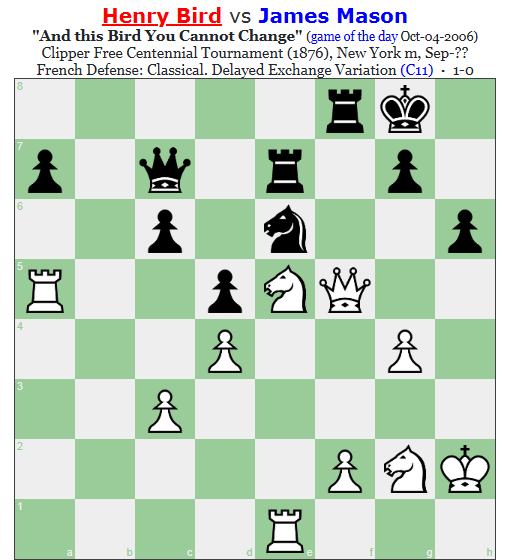
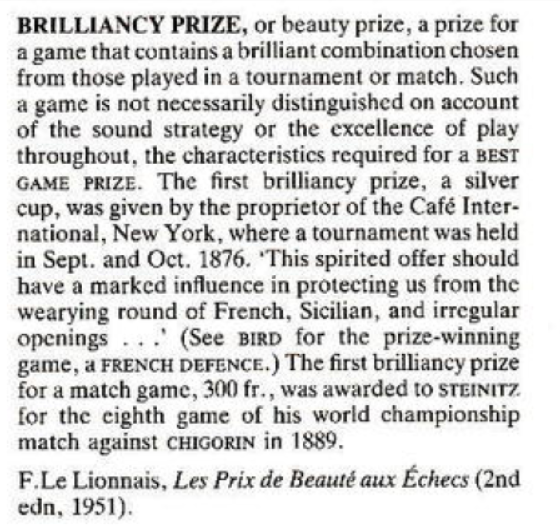
Did you know that the first person ever to receive a brilliancy prize was an Englishman or so it is argued? None other than H. E. Bird, he who is more commonly associated with openings and defences considered to be more so quaint than modern. I am not a trained historian and so cannot document the precise reasons why brilliancy prizes emerged when they did, however, I can show a position from the game in question and link it too, as it is rather impressive I must say.
Here, Bird plays 31. Ra6 (frowned upon by modern engines however I should add)
The game itself can be found here, https://www.chessgames.com/perl/chessgame?gid=1027995&kpage=2. One would naturally assume that should you want to understand why H. E. Bird won the prize given, you should at least look at the game. Further understanding can be found in Hooper & Whylde’s Oxford Companion to Chess, pg. 49
I do believe this has been documented further in: CN 1062 Edward Winter, “Chess Explorations”, Cadogan 1996. The chat below the game linked also cites the following:
Associating a place with chess and feeling ambivalent towards it is quite natural in my opinion well for we club and county players that is… .
Portsmouth: in 1992, we had a student from Portsmouth join Kents/Luton Chess Club, his name was James Taylor and he was rated 135. We both played for the county and got on like a house on fire, being the same sort of age and so on. In the winter of 1993, a tournament was held in Southsea where his family home was. I agree to stay there with him and play in the tournament also. I then persuaded several other members from my club to enter also. And so, on a cold afternoon with light snow that February day, we all drove down in D. Cruz’s black panther.
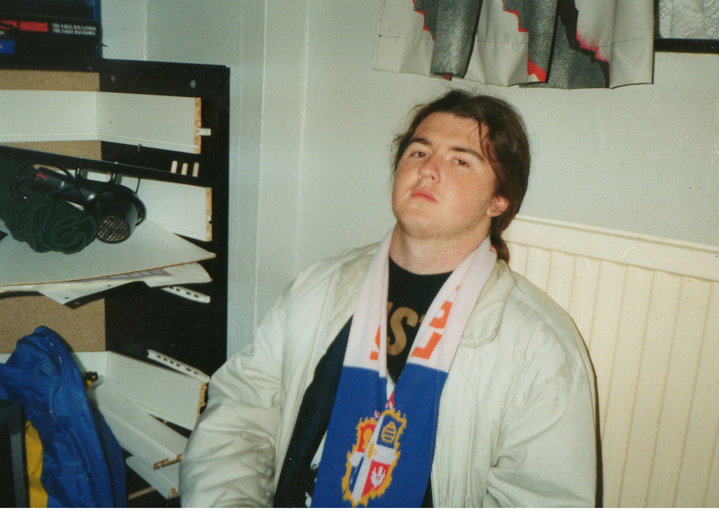
J. Taylor’s family home was warm and welcoming even though I turned up wearing clothes only those well into grunge wore.
Nirvana
Taken a month or so before. I wore that scarf to the tournament, the jacket also, and often wore that T-shirt. The band is Ministry.
It was the first time ever I played in a 6-round swiss, with the first game on the Friday night, three games on the Saturday and the final two rounds on the Sunday. I entered the Major section, which was an U-170.
That year I became much more solid as a player and became tough to beat. This was exemplified in the first two games, both of which I drew despite being on the backfoot throughout both, against opponents rated 200 ELO points above me. But the second draw was particularly tough. Our driver down saw how I went wrong in the opening and assumed it was completely lost. I similar thing occurred in the third game, after which not being a tournament player anyway caught up with me, and I went on to lose my next two games without really trying, only to win my final game, leaving me with 2.5 out of 6.
What stood out above all was not the chess though, it was the experience on the whole, which was very pleasant indeed. Memories are put in chronological order except the last one:
I loved the clear, crisp, icy cold weather with very light snow being blown about on the pavements in low winter light.
Being complimented by my opponent in Round 1 for my strong defensive skills.
Being made breakfast by and having it with James’s family at the start of day 2 on a rather posh avenue somewhere in SouthSea.
Being offered a draw by a panicky opponent in round two after I established decent counterplay in a position that had been lost for some time.
Seeing some girl wearing grunge clothes with a long white dress and heavy black DM boots in the tournament hall and sat down for hours often read novels by herself. She certainly caught my eye.
Bumping into fellow Bedfordshire league player, the Scotsman Tom Matko, who used to play for Cranfield, who played 1. f4 like I did back then, and against who I had many hair-raising draws. We then went for a walk along the seafront on the final day. He bought a Yorkie bar at an off-licence and explained that he rarely ate chocolate as he trained to run in marathons frequently. I really liked him and enjoyed our walk along Southsea Castle, despite the bitterly cold wind.
The least pleasant memory has nothing to do with the fact that after three games I lost interest but that one evening in Damon’s car, we got some pizza and ate it in his car. I burnt the top of my mouth on mine badly.
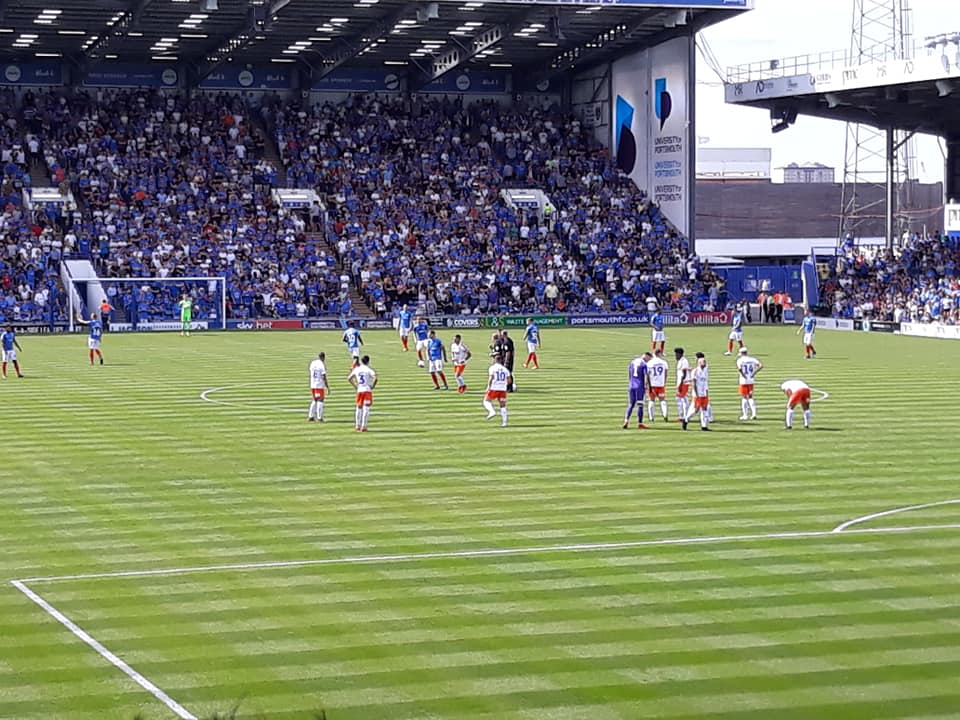
Chess & Football: Portsmouth. At the beginning of the 2008/2009 season, Luton were away to Portsmouth on Aug 4th, and I went to the match. We lost 1-0 but should have won. Siting in the chair behind me was former Luton Chess Club member Ken Grogan. Two photos I took from where I was sitting.
…on what this site initially became…on what this site is now becoming…on what this site cannot become…
On what this site initially became…
…once upon a time, the chess-related musings of an adrift academic were bound playfully and electronically in this online journal of sorts. They grew and grew as the decade did too. I kept on because I love to write whether I had much to say or not; therefore, being read by others was usually of little or no importance, comparatively speaking. Content was based on personal thoughts and experience on various topics with no intended audience borne in mind. With topics broadening, my own take on things always shaped the narrative I constructed: I often thought I was insightful but never that I was right. Sometimes imagination gave rise to originality: and of that I have always remained proud. I often introduced humour, believing that I am funnier than I really am. Sometimes, I found my own style antithetical to the conservatism I believe chess is plagued by -oftentimes that has put a gracious smile on my face… .
On what this site is now becoming…
…this site is now becoming a collaboration of chess in Bedfordshire: much more so of the past than the present -that has become the dominant trend. I document the history of chess in Bedfordshire as much as I can, and as time has passed I have become more thorough and resourceful. However, I am not a trained historian as my background lies principally in philosophy but yes it is true I did study some modules on history as both an undergraduate and a post-graduate too; furthermore, I have trained myself up, particularly in terms of postmodern history. Since 2015, I have only read history and historiography as well as those philosophers who have been so influential on postmodern history, such as Nietzsche (whom I once wrote a 19,000 word dissertation on, entitled: Can the Will to Power be Found in The Birth of Tragedy?), also Richard Rorty and Foucault and I suppose certain structualists such as Claude Levi-Strauss too. Regarding postmodernism, mostly I keep to Hayden White, Keith Jenkins and Alan Muslow.
Some friends and former playing partners back home describe me as the ‘go to guy’ for the history of chess in Bedfordshire. This compliment says more about the lack of interest in the subject than my own endeavour. As mentioned, I am too adrift from academia to feel chuffed by it. Rather, I tend to lament that my historical research, like my chess, just isn’t what it should be. Even though I may well have a broad understanding of Bedfordshire chess history courtesy of the volume of research put into it, all of which began in 2014, this is not something I am particularly proud of. Nonetheless, out of courtesy compliments are graciously received. If the truth be told, I just see it as my job and only that – after all someone’s got to do it and no one else is that interested!
Amongst the many others, I have created three categories: ‘Bedfordshire Chess’ and ‘History of Bedfordshire Chess’ and ‘Luton Chess Club’. This website is slowly moving towards a consolidation of those (all of which can be found in one of the toolbars to the right).
On what this site cannot become…
…I like to be both creative and amusing when I can be, factor in that playfulness has been an ever-present factor, the content of this site should be thought of as multifarious. It could be said I continue to enjoy undermining the conservatism I believe chess is underpinned by even after all these years, and often try to use humour to do it still, believing I have got better at it. Consequently, despite the general direction its going in, this site cannot only be about Chess in Bedfordshire and nor will it be. It may become noted for that yes -in fact that’s been the case for years already even by established historians, archivists, and whoever else. External factors aside, this site is titled McCreadyandChess. I cannot, nor will I not, remove my own personal thoughts and experiences of chess from the posts of this site -especially if I think they are funny or original for they constitute my writing at its very, very best. In addition, the number of categories alone tells you that breadth of content is important to me. I am proud of my site, it is identity conferring and that is how it shall stay -end of story. All you really have are: ‘Some thoughts on the beautiful game’, which, incidentally, just happen to be my very own; nothing more, nothing less, take of it whatever you please… .
A side note on how to read old Tom Sweby's columns
Not perhaps, but quintessentially, Old Tom Sweby is best thought of as a passionate devotee to the newspapers he wrote for. He was well read and knowledgeable of the Bedfordshire chess scene and well beyond, given that he was the president of the S.C.C.U. once upon a time. He was generally well-respected and rubbed shoulders with many, if not all, of those eminent within British chess circles. It would, however, be a critical mistake to see his column is primary source material entirely. That it is not. You will also find secondary source material quoted too, and the reliability of that is not quite as Tom hoped. Given that he wrote for decades, this is to some degree inevitable, and after all we are all prone to error whether we realize it or not. Thankfully, with regards to old Tom Sweby, they are infrequent and for the most part old Tom continued to document events and developments in the Bedfordshire league from the get go as best he could but, of course, everything lies open to interpretation. Despite this, and generally speaking. this does indeed make him informative and thus worth reading. Dare I say his columns constitute a narrative describing the latest developments, match reports and changing nature of the Beds league...he knew his audience and wrote according. This manifested itself over decades but brevity was always in play courtesy of the restictions imposed by writing a column. Should you wish to read a in instrumental figure of the Beds' league post WW2, you are quite welcome to peruse what has been posted here... . :-) I should, however, point out that as the decades wore on he gradually moved on away from narratives concerning the Bedfordshire league towards affairs both historical and international. The reasons for this are multifarous, old age was a predominante factor presumably, however, the bottom line is with regards to how the Bedfordshire chess scene developed post WW2: old Tom Sweby is your go to guy. He wrote more about chess in Bedforshire than anyone else did but given he was a Lutonian and writing for a Luton newspaper there is both bias and greater coverage of his hometown than the rest of the county.
Gallery
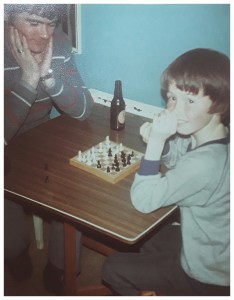
I’m either 10 or 11 here
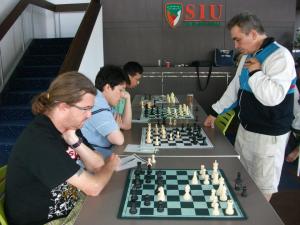
1982, myself versus Brian from Sunderland.
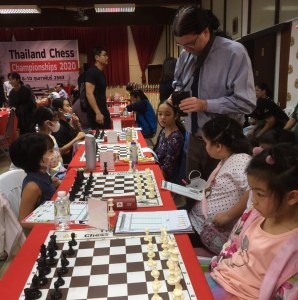
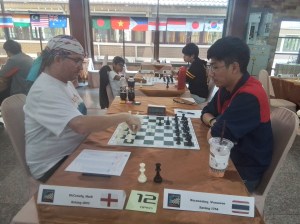
At the Thai Junior chess championships. My daughter of course.
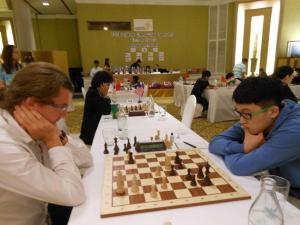
Pattaya 2011
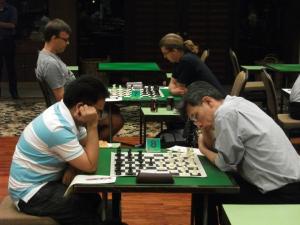
2011
Thai Junior Championships
2008
2011
Around 2011
2011
Pattaya 2009
2011
Kuwait 2008
2012
2012
2011 BKK Chess club
2011
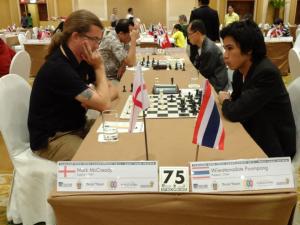
2011 Thai Open
2011 Thai Open
2013 approx
Around 2014
2010
2012
Around 2011
2011
2011
2013
Around 2011
Around 2011
2020
2011
2008
2011
2013 or thereabouts
2010
2017
2014?
2010
2024
2024
2024
To add comments, please see the bell at the top of the page.

























 McCreadyandChess