“Judge a man by his questions rather than by his answers.”
― Voltaire
Should you, perchance, put W. Ward plays for Luton and also Our clash of future champions in the search bar, you will find documented evidence that William Ward competed in the Bedfordshire chess scene for Luton before moving to London and becoming champion of that city amongst many other achieved accolades.
With chess players placed in categories to denote ability only across Victorian England, establishing exactly how strong Ward was whilst playing in Bedfordshire is challenging because none of his scoresheets have survived. We do have help however. Regarding timelines: the two posts above show a few of his results for Luton in 1896 & 1897 respectively; the following year, at the 1898 Southern Counties Congress in Salisbury, his first success beyond Bedfordshire was achieved. Invaluable archivist John Saunders has once again offered us the details on that superb site of his, which can be accessed here: https://www.saund.co.uk/britbase/pgn/189809sccu-viewer.html
W. Ward came joint first as you can see, about half of his games are available for you to play through also. This should enable you to develop your own opinions about how good he was when he left us. May I suggest you look at his game against George Bellingham and see how he plays the endgame?
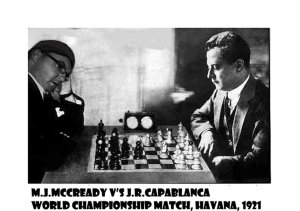
Should you wish to refer to the edo website for its own estimation also, you may do so here: http://www.edochess.ca/years/y1898.html and learn that he was estimated at 2352 ELO in 1898, putting him 91st in the world. Above more esteemed gentlemen such as Jacques Mieses, Frank Marshall, Henry Bird, and John McCutcheon, as well as future world champion José Capablanca.
He was the first Englishman to play chess competitively in Bedfordshire and then go on to represent merry England (Anglo-American cable matches), the second being Dennis Victor Mardle (also of Luton), the third GM James Plaskett (of BMS/Bedford).
“The boundaries which divide Life from Death are at best shadowy and vague. Who shall say where the one ends, and where the other begins?” Edgar Allan Poe – the Premature Burial.
M J M

















 McCreadyandChess
Leave a comment