Archive for the ‘Bedfordshire Chess’ Category

The altruistic John Saunders has delighted the members of the English Chess Forum once more with his efforts, supplying the 1961 rating list, which can be found here: http://www.saund.co.uk/rgs/pdfs/viewer.html?file=1961gradinglist.pdf

My former county teammates should note that several Bedfordshire players can be found in it, including Mr.Cordon from Bedford.

Read Full Post »

At what point did the balance of power in our county shift from the south, where it certainly stood until the 40s, to the north? Was there really a defining moment or was it just a gradual transition? To what extent was the shift generational? Who came in and who left Bedfordshire during that time? We certainly know that former Kent champion L. Pape (of Italian origin) bolstered the north, and it’s possible that the eastern European community of -many- refugees that Bedford acquired after WW2 also contributed, but if so how much so? According to Sweby the Bedfordshire League began in 45 when Vauxhall won the title first followed by Luton Chess Club for the next 14 years. How was it, then, that in county matches the south figured so poorly?

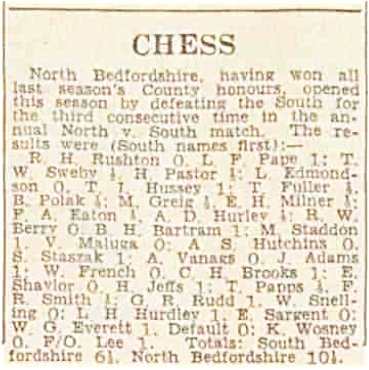
In the following cutting we learn that the south, headed by stalwart R. H. Rushton (see https://mccreadyandchess.com/2015/07/23/the-changing-face-of-chess/ for image) lost heavily to the north once more. I’m assuming that M. Staddon is either Nigel’s father or he himself (that being a misprint of course). His opponent V. Maluga (of Ukraine) I once played in my teens. I always remember he complained over the slowness of my play after he lost on the black side of a Ruy Lopez rather than the yellow jumper I wore.

north2

north1
 

Read Full Post »

Nausea

I grow warm, I begin to feel happy. There is nothing extraordinary in this, it is a small happiness of Nausea: it spreads at the bottom of the viscous puddle, at the bottom of out time – the time of purple suspenders, and broken chair seats; it is made of white, soft instants, spreading at the edge, like an oil stain. No sooner than born, it is already old, it seems as though I have known it for twenty years.

Jean Paul Satre, Nausea

Kents Athletic Club, Luton’s sole surviving chess hub is to close after nearly 40 years. It’s a typical story in modern day England; with a back drop of cultural decline, rising costs and dwindling numbers make the venue no longer financially viable. It is to be bulldozed, then someone will plonk a block of apartments on it most probably. This means that Luton, a town of over 200,000, will no longer have a chess club when the new year begins. Thankfully yours truly, though thousands of miles away, is not going to allow that.

The critical state of the chess club itself -almost bankrupt and without enough members to make ONE team, if you can believe that – has meant that the club and its demoralized members are struggling to find a new venue. Chess teaches us that risks should always be taken from a position of strength and not weakness, and so uprooting in such a desperate position could spell the end. But there are times when it is necessary to act quickly and confidently; it took me just three hours to find a solution and a new home for the club, much to the delight of the club secretary. The second phase is to readvertise and start promoting chess locally to attract members lost due to the poor playing conditions of recent years -that’s the easy part. We once had access to the ballroom at Kents, then we were pushed into the lounge, then into a tiny room at the back of an extension, much to the disgust of every visiting team. It is they more than anyone who will welcome the change of venue.

I might even fly in for the handover as the logistics of moving to a new venue are frightfully complicated, as the predicted conversation below suggests.

J =John (former friend)

M = Me

M ‘Easy geezer.’

J ‘Alright Mark, you alright?’

M ‘Yeah, alright mate yeah…er ya got those keys for that room then?’

J ‘Nah, never lock it mate, just go in yeah.’

M ‘Ah cheers.’

J ‘No worries mate…oh, er what dya’ wannit for again?’

M ‘Just some chess innit, we won’t wreck the joint, don’t worry.’

J ‘Ya better not, just off for a quick slash yeah, let us know if ya need anyfink.’

M ‘Yeah cheers.’

Let us hope that the new year brings revival for Luton Chess Club, it certainly needs it.

Where shall I keep mine? You don’t put your past in your pocket; you have to have a house. I have only my body: a man entirely alone, with his lonely body, cannot indulge in memories; they pass through him. I shouldn’t complain: all I wanted was to be free.

Jean Paul Satre, Nausea


Read Full Post »

When you are away from home for so long, you begin to wonder what happened to those you once knew, so I was saddened to learn that my first playing partner at Luton Chess Club, Peter Whone has long since left us.

Peter was always well-dressed, not easy for a man of his enormous size. He was impeccably mannered and happy to play anyone new to the club though in truth he was too good for newcomers. Through allotments, he was a self-made millionaire and lived a life of leisure in his fifties although you would never have known as he was a shy, self-effacing man, a gentle giant in fact. In retrospect I am quite indebted to him and the kindness he showed when both myself and school playing partner Ashok Bhundia turned up as nervous schoolboys at the Luton Chess Club in Biscot Mill just after half-term in 87.

To begin we would only play each other whilst making up nicknames for the various club members we saw. Peter’s was Tefal, on account of his large forehead.

When we became bored of that, we would watch Peter with his usual playing partners, Richard and Margret. Peter was tactically-minded and played quickly, rarely taking more than a few seconds per move, often moving instantaneously. He only ever played 1. e4 and only ever expected 1. e5 in reply, anything else would draw a suspicious stare and a mumbled, but light-hearted, accusation of ‘that’s cheating’ or ‘he’s playing tricks’. He liked to commentate on games and would often accuse someone of being ‘nasty’ or would sometimes tell himself ‘I’ve made a boo-boo’. He never studied chess theory and gained great pleasure from skittles only. When he played for a team he never altered his style and would play lightening fast, using barely five minutes of his allotted time however ample that may be, often forgetting to write his moves down.

Without his kindness and patience I would not have been able to measure my progress as a junior as when my school friend stopped attending, I continued to visit the club, even though every game in every week came with defeat after defeat, finally however, after six weeks of trying, I gained my first win against Peter. Twenty eight years have since passed, so I cannot remember our casual game in its entirety but I do remember his friend Richard looking on in interest, smiling to himself as my white pieces did battle with Peter’s black army in a semi open game which had stemmed from a two knight’s defence to my Giuoco Piano. Peter tried a tactical ruse but had overlooked the vulnerability of his back rank, and after an exchange I played a winning intermezzo -Rd8- and claimed my first win against a recognized club player. He sat back in his chair in his characteristic way after he’d lost a game before congratulating me on my victory being the gentleman that he was. By this time my love of chess had turned me into a rebel at school: through antipathy, I had managed to drop out of all subjects -sometimes not through choice- and began reading chess literature voraciously whilst loitering in empty corridors or on empty playgrounds. Now known as a lost cause amongst teachers, I would never attend lessons, opting to bunk off and swot up on the latest openings instead, and even when I did attend I would never write or read anything but always had six or more chess books from the local library in my bag at the ready, hoping that some inattentive Science teacher wouldn’t see me slip one out and place it under my exercise book, having begun the current chapter on the bus home from school the day before. I was, in fact, offering a valid critique of the education system, and having suddenly gone from being yet another underachieving face in the crowd to school champion, thus I was left alone to educate myself… .

Peter’s finest hour?

One of Peter’s greatest ever victories over the board came in my first full season, playing for Luton ‘C’ team. On the 25th of October 1988 we drove to Linslade to play Leighton Buzzard, where for the first time I met the irrepressible Henry ‘Bill’ Charlotte, the pipe smoking septuagenarian that ‘anyone could lose to’ according to former team mate Gary Ames. Peter, rated only 89 at the time, was our top board, our main man and played Kevin Williamson rated 142 at the time. Because he played so fast, Peter had an uncanny ability to unsettle his opponent and often dupe them into keeping up with him. This was always a critical mistake and meant certain defeat to those who tried. Peter had the white pieces and, from memory, Kevin played the Pirc/Modern defence but fell for a nasty trap around the 25 move mark. After the game I distinctly remember telling Peter his opponent’s rating and the look of disbelief in his face – in fact he never forgot that game and had a great season, putting 30 points on his rating.
Peter shows his busy hands

One chess evening just before Christmas, a group of players, myself included, were invited to Peter’s house for an evening of chess and snooker. The journey was memorable since Peter usually bought Vauxhall cars built in Luton but had recently chose to buy a metallic blue E-reg, Ford Sierra much to the horror of us Lutonians. Instead of the back lanes, he chose to turn off the motorway at the first exit but it was a cold night, the street lamps shone through frosted air…perhaps that was the safer route to his house in Redbourne, a forgotten Hertfordshire village just outside Harpenden. Inside his huge bungalow was a full-sized snooker table and a chess board placed on a small table by an armchair. Snooker was his other love, and he would often draw comparisons describing both chess and snooker as being ‘cruel’ games, referring to the fact that mistakes weren’t easily rectified in either. I remember how ashamed he was at the mess he’d left on the armchair as he’d not intended to invite anyone back before he left, ‘Look at that mess’, he repeated, referring to an item of clothing placed upon a folded newspaper, aside which his house was spotless and quite unlike that typically associated with an aging bachelor…an evening of wine, chess and snooker followed. A brief description of his house can be found here:

https://www.thegazette.co.uk/notice/L-58510-388409

On what can be learnt…

The thing that Peter taught me more than anything else was the importance of welcoming juniors with open arms to your chess club. By nature they are, like I once was, timid souls, who respond to kindness and patience above all. Peter had a great ability to treat everyone on the same level, irrespective of their age and playing level. In retrospect he was the ideal first playing partner as he exemplified a love of chess and people and was impossible not to warm to. Everyone played him and everyone lost to him if they tried to play at his speed. He never took anything seriously and could shrug off defeat better than any player I ever met. It is a great shame that he is no longer with us, he was a true gentleman and is not forgotten.

R.I.P Peter Hartley Whone

Read Full Post »

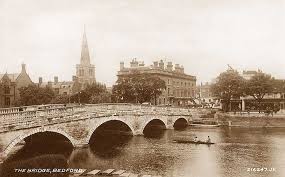
Victorian times in the home counties -a gentleman cycles across rural Bedfordshire to participate in a chess match but ends up in prison -how quaint?

bullies

download

The gentleman’s destination.

Read Full Post »

Courtesy of Glynn’s Bookstore http://www.biblio.com/bookstore/glynns-books-norwich , G.H. Diggle’s Reminiscences of a Badmaster Vol I & II arrived via airmail last week. (Badmaster was a title awarded to Diggle by C.H.O’D. Alexander in a Christmas Card after Diggle lost a game in 7 moves). You can find more on O’ Donel Alexander here https://en.wikipedia.org/wiki/Conel_Hugh_O%27Donel_Alexander

IMG_0423

I began reading it whilst keeping an eye on my daughter as she played in a nearby Kidzoona, yet another example of Japanese ingenuity, but had to stop reading pronto as I attracted far too many concerned stares from other waiting parents who perhaps wondered if I were a bit mad -I could not contain the ensuing paroxysms of hilarity!

Diggle writes satire with an abundance of both pause and panache, the likes of which I have never encountered before. He is immeasurably entertaining and has a style that is unmistakably his. Though he was not the strongest chess player of his time, I strongly suspect he is by far the most gifted writer ever to have graced the chess board in its long, long history.

Those from my home county Bedfordshire may wish to take note that Diggle once played for Bedfordshire (scroll down to 7223. for evidence http://www.chesshistory.com/winter/winter85.html ) and was acquainted with our leagues senior figures of the post-war period. Here’s an excerpt from the BM (Badmaster)

12. The BM’s finest hour

The Badmaster always regards the year 1945 as ‘his finest hour’. The war was just over -no one had been demobbed or seemed to be doing any work – plenty of chess was going on in London, and best of all there was no ‘grading’ and ‘grandmaster’ nonsense in those days, and chess impostors like the BM could put their name down for any tournament they liked. A huge ‘mixed bag’ of 128 players entered for the London championship; these were reduced by four ‘knockout’ rounds to eight; three well-known ‘seeded’ players were added, and the resulting eleven then played ‘American’ in the final. Believe it or not, the BM (through the vagaries of the draw) survived to be in the last eight; and for a glorious ten days he was in the news, competing with people like Sir George Thomas, Dr. Aitken, Dr. List, G.Wood and other experts.

The tournament was won by G.Wood (though not everyone had backed him to do so); the Badmaster came bottom of the poll (and here every forecast was right). But, as the argumentative boy in the scripture class pointed out in defence of ‘he that is least in the kingdom of heaven’ – ‘ANYHOW, HE GOT THERE!’ Moreover, to this day, the BM refuses to attribute the result to the superiority of his opponents, he lays the blame fairly and squarely, on harassment by the chess press, who frightened him out of his wits. Every round, they adopted the following horrible procedure. Headed by the bearded bohemian William Winter, they came nosing round after the first half-dozen moves to see what was cooking. Like those ungodly persecutors in the 59th psalm they ‘wandered up and down for meat.’ Then the great Winter, after glancing for an awful moment over the petrified BM’s shoulder, would instantly recoil with a hissing intake of the breathe, scribble some doomridden fragment in his notebook, and pass on to the next victim. Then the whole pack would troop off to a neighbouring bar. After they’d gone, the BM would recover his nerve and make some brilliant combination which only just lost, and which the Press ought to have been there to report to the World. But as soon as his game was in the last throws they would all come back. ‘And at evening’, to quote the psalmist once more ‘they will return, grin like a dog, and run about the city’. The experienced Winter always gazed at the ruin of the BM’s position with a lacklustre but logically satisfied eye, reminding one of Lear’s favourite limerick:-

‘There was once an old man with a beard

Who said ‘It is just as I feared!’

download

Diggle is to the right and at the front.

Read Full Post »

The Midland Hotel

The Midland Hotel, which became synonymous with chess in Luton during the interwar years and beyond when the colorful character J.E.D. Moysey became the owner, was a home to chess in the town as early as 1910. A match against Northampton was played there with F.Dickens representing Luton on the top board. Local players may observe that C.Staddon, uncle of Nigel Staddon (formerly of Luton, now of Bedford) can be found on the team sheet.

mid2

mid1

Read Full Post »

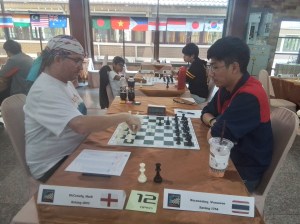
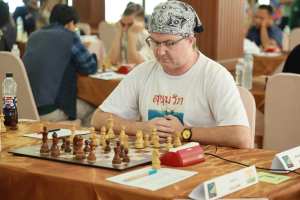
Peter Frost, an Australian friend from Bangkok recently entered the Teplice tournament in the Czech Republic and bumped into Bedfordshire’s finest, the Ledger brothers. If that wasn’t enough of a coincidence, Peter was paired with white against Steve Ledger in the second round. Here is their game.

1 d4 Nf6
2 c4 c5
3 d5 b5
4 Nf3
This is Yermolinsky’s recommendation.
4…e6
5 dxe6 fxe6
6 Nc3 b4
7 Nb5!? d6
8 a3
It seems as if the Knight has a death wish, but opening up the “a” file fully protects him against being netted by …a6.
8…Nc6
9 axb4 Nxb4
10 g3 Bb7
11 Bh3!
Taking aim at the e6 pawn.
11…a6
12 Nc3 Qd7
13 0-0 Nc6?
I think Stephen  must have overlooked that he was allowing my next move, which is very strong.
14 Nd5! Nxd5
15 cxd5 Nd8
16 dxe6 Qc6
It is too dangerous to play 16…Nxe6 due to various pins.
17 Bg5 Be7
18 Bxe7 Kxe7
White has a strong (indeed winning) attack but needs to execute well. The best way to proceed was to introduce another piece into the attack by the creative Rook lift 19 Ra3!, which unfortunately I didn’t notice at all.
19 Qd2? Nxe6
20 Qe3 Qe4
21 Qxe4?
Once again, 21 Ra3! was better. Now my once substantial advantage has quickly disappeared.
21…Bxe4
22 Bxe6 Bxf3
23 Bc4 Bb7
24 Rfd1 Rhd8
25 Bd5?!
Seems natural enough, to stop …d5, but this move allows Black to take the initiative on the “b” file.
25…Bxd5
26 Rxd5 Rdb8!
27 Rad1 Rxb2
28 Rxd6 Rxe2
29 Rd7+ Kf6
30 R(1)d6+ Re6
31 Rxe6+?
Miscalculating the resulting endgame. It was necessary to keep both Rooks with 31 Rd3!, seeking counterplay against Black’s King.
31…Kxe6
32 Rxg7 c4?
Stephen misses his chance to win fairly simply by advancing his “a” pawn to a2, forcing Ra1, and then after …Kd5, White is one move too slow with own King to prevent Black’s from penetrating to b2.
33 Kf1 Kd5
34 Ke2 a5
35 Rxh7?
It turns out that White doesn’t have time for this, but it was quite difficult to see the problem, a “star” 43rd move for Black. I calculated a long variation at this point, and thought everything was going to be ok, because  I missed the “star” move in my counting (so did Stephen). I think it was Larsen who said “long variation-wrong variation”.
35…a4
36 Rb7 Kd4
37 Kd2 a3
38 Rb1
All as calculated on move 35 so far…
38…Rf8?
After 38…a2 39 Ra1 c3+ 40 Kc2 Kc4 41 h4 Rd8 we both assumed that after 42 Rxa2 Rd2+ 43 Kb1 defending the Rook is fine for White. But we both missed the “star” move 43…Kb3! winning immediately. This line continues to be available to White for the next two moves as well.
39 f4 Rh8
40 h4 Rg8
41 Rb7 a2
42 Rd7+ Kc5
43 Ra7 Rxg3
44 Kc2 Rf3
45 Rxa2 Kd4
46 Ra8 Rf2+
47 Kb1 Rxf4
48 Rg8
Proceeding directly to Philidor’s position, as I knew that to be drawn.
48…Rxh4
49 Rg3
Philidor’s position. The Rook cuts the King off from the sixth rank, and just waits for the pawn to advance to that rank, after which the Rook goes to the 8th rank and checks forever. Black’s only try is to force White to demonstrate long side defence.
49…Rh2
50 Rf3 Rd2
51 Rh3 Rd3
52 Rh8 Kc3
53 Kc1 Rg3
54 Kb1!
The key move. The King must go to the short side, so as not to get in the way of the Rook’s lateral checks.
54…Rg1+
55 Ka2 Rd1
56 Rh3+ Kc2
57 Rh2 Rd2
58 Rh1 c3
59 Rg1 Rd1
60 Rg2+ Rd2
61 Rg1 Rf2
62 Rh1 Rg2
63 Rf1 Re2
64 Rh1 Rg2
65 Rf1 Rh2
66 Rg1 Rd2
67 Rh1 Rd7
68 Rh2+ Rd2
69 Rh1 Rd8
70 Rh2+ Kd1
71 Rh1+ Kd2
72 Rh2+ Kd3
73 Rh3+ Kc4
74 Rh4+ Rd4
75 Rh8 Kd3
76 Rh3+ Kc2
77 Rh2+ Rd2
78 Rh1
P1010460

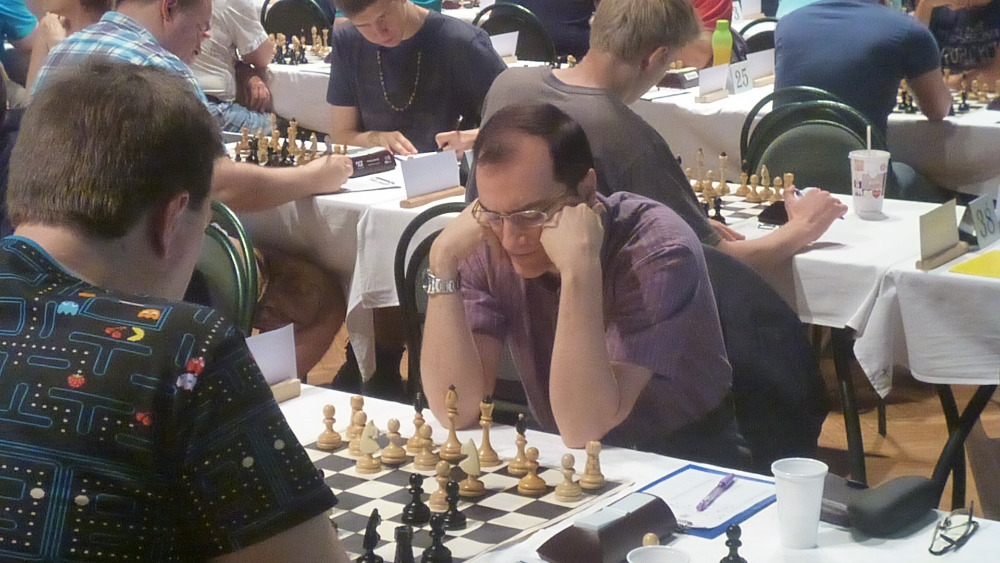
Not the best shirt even seen at the chess board Steve.

11268029_10204523094693431_2107523433_n

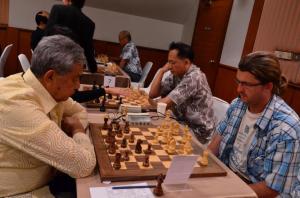
From left to right, Dave Ledger, Peter Frost, Steve Ledger and Andrew Ledger.

Read Full Post »

« Newer Posts