I am aware that this is to blaspheme against the sacrosanct school of what these gentlemen term ‘Art for Art’s sake’, but at this period of history there are tasks more urgent than the manipulation of words in a harmonious manner.
Proust, Remembrance of things Past, pg. 510
An introduction
The following post is, primarily, an exposition of material selected from The Luton News Archives, which are kept on microfilm in Luton Central Library (and I apologize in advance if some content is a little difficult to read, the transition from film to paper via digital scanner, to photocopier then a lossy JPEG via a second digital scanner to this site via a crude upload tool has, unsurprisingly, compromised some excerpts, please click on those especially at the beginning of the post for a better view). Its main purpose is to offer an account of the change that chess in Bedfordshire underwent during the 70s, and since history doesn’t offer us neat end points, the decades before and after it too. The topic of the post is local chess history; it has a narrow focus and is for those with an interest in Bedfordshire chess, readers with a more casual interest in the topic are, of course, more than welcome to read on.
Club and county chess in England receives little attention and is rarely reported on. There is a ritual obeisance conventionally paid to professional chess players within chess literature, as if it is only they who are worth reading about. The surviving chess magazines of today are also unrepentant towards their exclusion of amateur chess generally speaking. However, one of the great advantages about the digital revolution that we are currently experiencing is that blogs are able to break such barriers down by providing content to an audience wider than ever before. Why does that matter? It matters because the actions and lives of those described by them matter -that is one among a great many reasons why in posts such as this its local history matters.
‘What then do we mean when we praise a historian for being objective, or say that one historian is more objective than another? Not, it is clear, simply that he gets his facts right, but rather that he chooses the right facts, or, in other words, that he chooses the right standard of significance.’
E.H.Carr, What is History?, pg. 123, Harmondsworth, Penguin 1964
In Bedfordshire we are fortunate to have ‘old’ Tom Sweby, who was active in both the Beds. league and as a reporter of it for decades. He has left us with a wealth of material, unfortunately however, being located abroad I did not have sufficient time during my recent sojourn in England to collect all the material from The Luton News that I wanted, and am not in a position to add anymore -as one trip to England every five years is quite enough!
My strategy was to focus only on the columns which reported local events but this quickly became problematic as Sweby has a passionate propensity to combine, to varying degrees, events local, national, and international all in one column. Deciding what to keep and what to omit was a slow and somewhat arbitrary process at times. Given that The Luton News, was and still is a Luton paper, Sweby wrote with a natural bias towards his home town, as his readership requested. I have tried to offer balance and cover as much of the county wherever I could but this has been difficult, therefore, do not think of this post as being ‘definitive’ or ‘a study’ in any shape or form. Readers are more than welcome to add content or comment on what they have read -providing they are highly complimentary that is!
‘When properly applied, the critical method enables the historian to make allowances for both deliberate distortion and the unthinking reflexes of the writer… . What historians can do is to ensure that within the area of the past which they find significant they are as true as can be to the reality of the past.’
John Tosh, The pursuit of History, pg. 111, London, Longman, 1984
Finally, for context, several long-standing members of the Bedfordshire chess league have contributed with input in various e-mail exchanges over several months; notably, Paul Habershon, to whom I am deeply grateful, also Nick McBride for his input, IM Andrew Ledger, Alan Brown, Peter Montgomery, Nigel Staddon, Damon D’ Cruz, and Andrew Perkins. Thanks also go to Barry Sandercock and Richard James from the English Chess Forum for their assistance.
History is…never history, but history-for.
Claude Levi-Strauss, The Savage Mind, pg. 257
Part 1
School chess
In the early fifties, school chess was organized in the south of Bedfordshire by H. Wray and T. Sweby, colleagues at Challney Boys School, and in the north by the Welsh Headmaster of Bedford Modern Junior School, Mr. Idris Hussey (Fig. 1), who according to former colleague Paul Habershon, first began organizing school chess in 45 just after the war had ended. A collaboration between the schools of the north and the south produced a junior county team for the first time in 54. It was a side of Luton schoolboys mostly, as is shown below.

Fig.1, The Luton News, Feb. 4th 1954
The result of the match is an irrelevance, what is important to note, however, is that several club players employed within the local education system and were able to introduce chess to school children from an early age and were both dedicated and dependable enough to give up their free time on a permanent basis. The absence of a mid-Bedfordshire school was indicative of the Bedfordshire league itself until Cranfield, Newport Pagnell, and Leighton Buzzard, formed in the 70s and 80s respectively. The school leagues in Bedford and Luton which formed the first junior county team were still in their infancy in the 50s; it was not until the following generation arrived when the pupils began to beat their teachers and found their way into the local papers with increasing regularity, courtesy of school teacher and writer for The Luton News, Mr. T. Sweby.
In 68 Sweby wrote that in the early 60s Bedfordshire produced a junior county champion gifted enough to play at the top of the county team (Fig. 2) but, he laments, the difficulty with young chess players is they often further their education beyond the county borders after leaving school. For little Bedfordshire, without a distinguished University to hold its own talent, losing players like Roger Parry was to become a recurring loss.
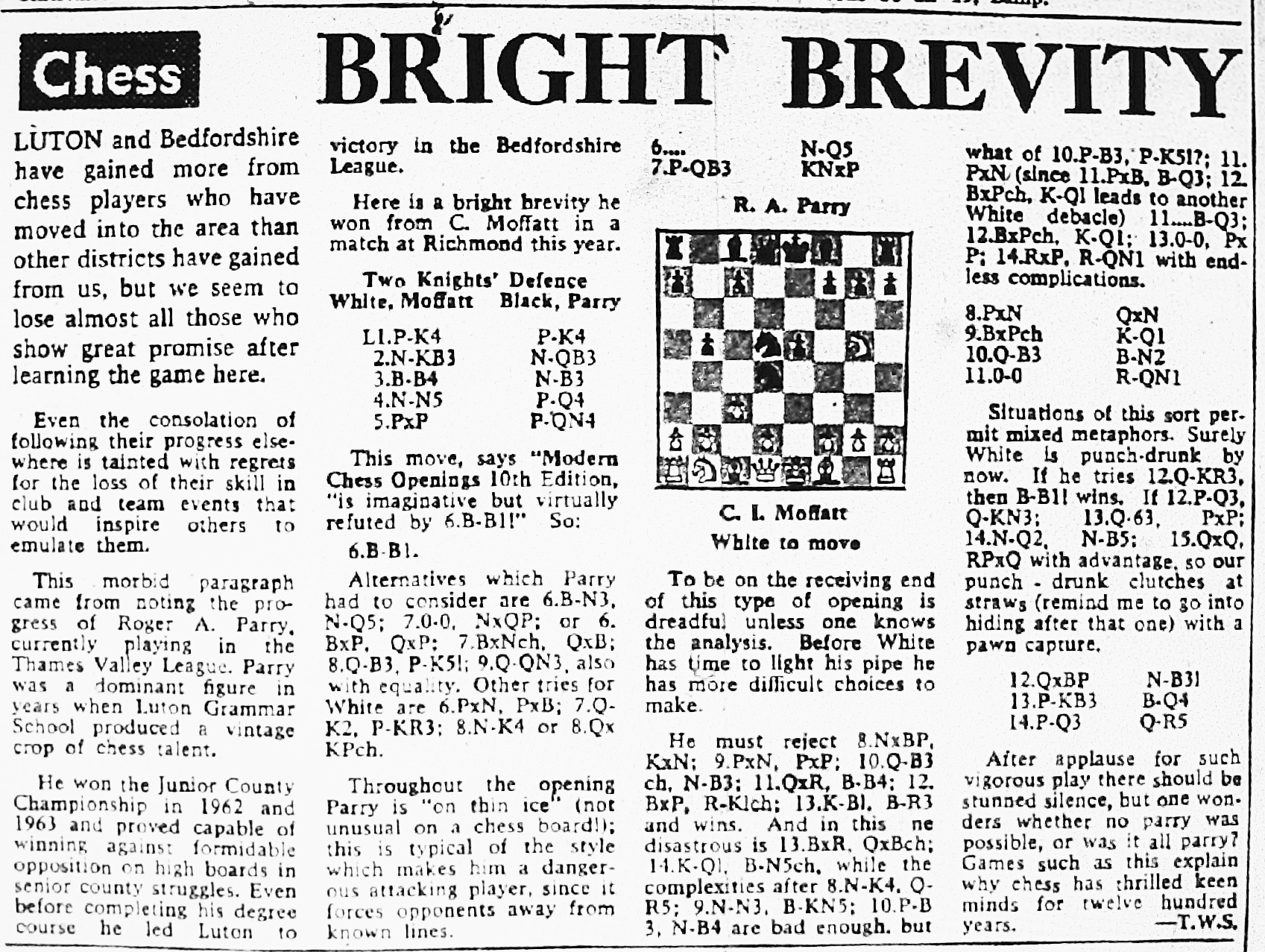
Fig. 2, The Luton News, Dec. 5th 1968
It is instructive to show how talent, its development and ‘recurring’ losses, affected Luton and Bedford in turn as their respective leagues of schoolboys were quite different from one another.
Luton’s league of schoolboys
Another example of how strong youth players were becoming in the late 60s with a schools league well in place for a decade and more can be seen with future postman, county champion, and gentleman Andrew Perkins. Whilst still at school he became champion of Luton Chess Club (Fig. 3). His rating was then, as it is now, approximately 190. Andrew is the strongest schoolboy to emerge from The Luton Schools League started by Sweby and with the exceptions of Dunstable-born Peter Gayson and Simon Roe, he has remained Luton’s strongest homegrown player since.
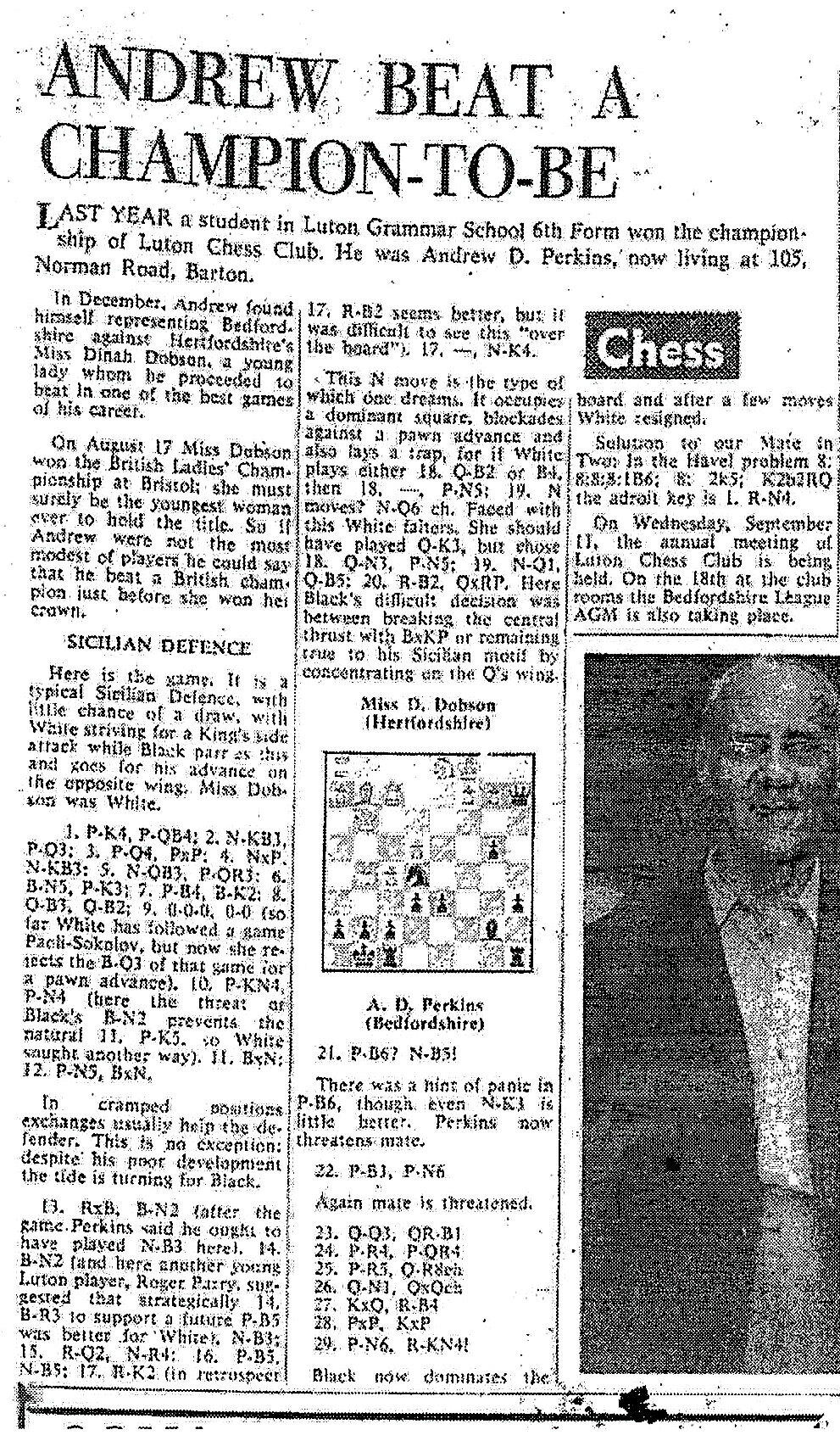
Fig. 3, The Luton News, Sept. 12th 1968
In the following columns a veritable deluge of school chess action in Luton can be seen, with almost every high school in town participating in the Luton Schools Chess League, strong-armed by Sweby himself. In the first, Parry demonstrates at junior county level his chess prowess once more.

Fig. 4, The Luton News, Jan. 6th 1972

Fig. 5, The Luton News, March 2nd 1972
Though Sweby’s reportage offers a glowing account of school chess in Luton in the early seventies it must be remembered that the league itself was his handiwork, hence his writing is understandably partisan. Only a select few of those with access to chess at school found their way into the Beds. league (Fig. 6). For most schoolboys, chess was nothing more than a lunchtime activity, the motivation to play on after their school years was quickly lost. What Sweby perhaps conveniently overlooked was that not all schools had members of staff actively playing chess, therefore, many had talented players who went unrecognized by whichever member of staff had been roped into supervising play. As a former pupil, league winner and champion of Stockwood High School (see Fig. 5), we played in the computer room with Mr. Wagstaff looking on. As I remember, not at any point did he ever show any interest in the lunchtime chess-hullabaloo his eardrums were subject to.
No Luton school entered a team in the Beds. league let alone The National School’s League. The only educational institute which had its own team in Luton was the Technical College run by Mr. May, (Olly’s dad) and A-level student Steve Catton.
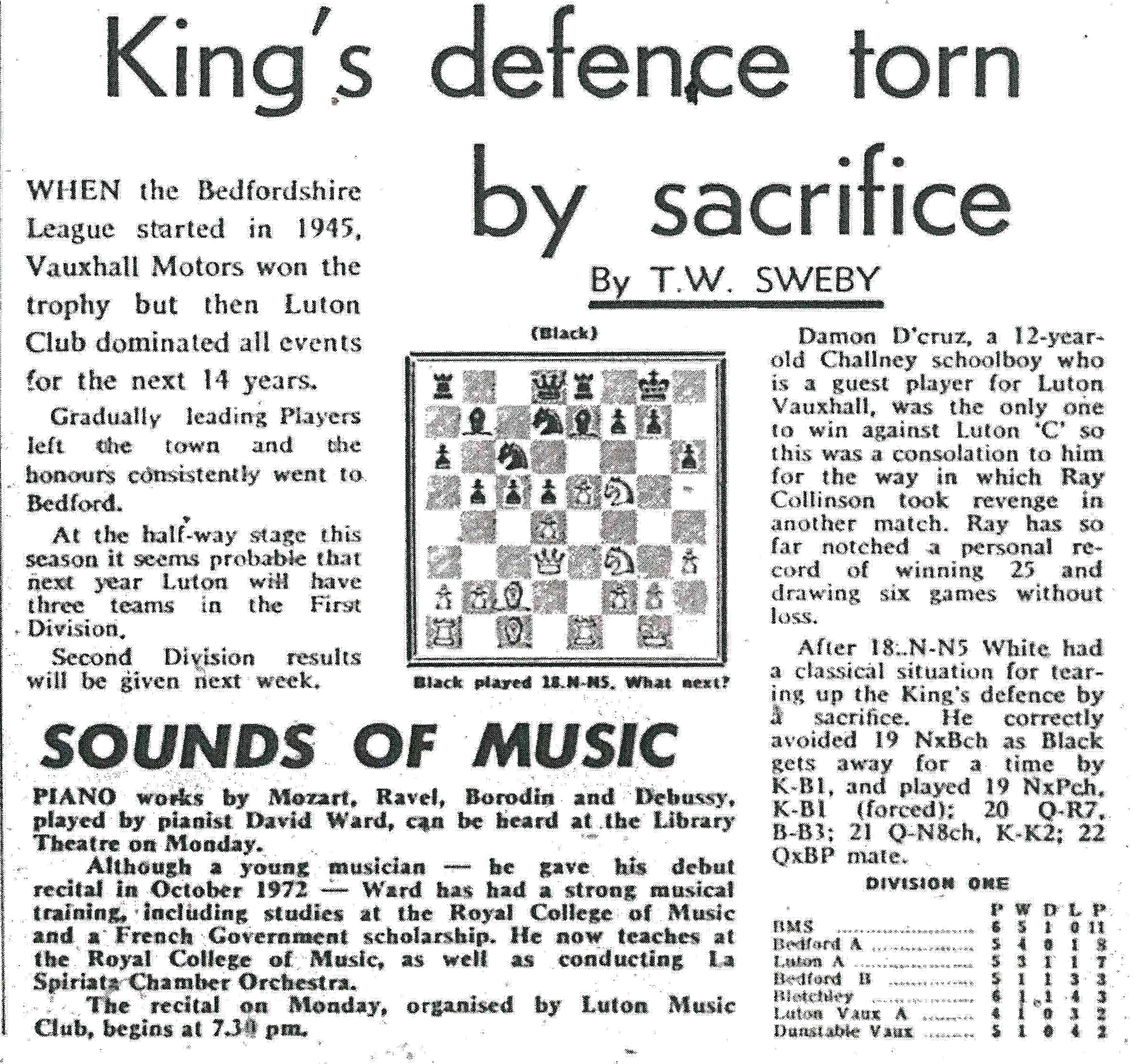
Fig. 6, The Luton News, 1974 date uncertain.
The youth who entered the Luton chess scene in the 70s improved its stature in the Beds. league but not significantly and nor with any immediate effect as the table in (Fig. 6) shows. Two of its most talented, David Elkin and Gary Blackbourne (Fig. 7), went onto become champions of Luton in their teens, both obtaining a rating of approximately 175 whilst still at school but even with their distinctly average grades for a club champion they were exceptions to the rule. In Blackbourne’s case only one other at Rotherham High School out of the hundreds who had direct access to chess throughout the 70s could provide him with any real opposition.

Fig. 7, The Luton News, Feb. 7th 1974
Written by a fellow journalist for The Luton News (Fig. 8) offers an interesting, if somewhat poorly reported, account of the development of local chess: given that at the time Luton had half a dozen clubs or more, its hard to imagine how the closure of a building used by one could threaten its very existence. Beyond the hyperbole, the idea that Luton’s High Schools had ‘thriving’ chess clubs has already had its significance questioned. The Fischer – Spassky match may well have increased the amount of school chess being played, (this will be discussed in more detail in Part 5) but Sweby’s claim that it was the primary cause of young players becoming ‘dominant’ needs further clarification. Dominant in terms of numbers perhaps but not in terms of strength. Since that the article was written in 76, the time frame available for the transformation is simply too short. Half of Luton’s first team were still at school it is claimed, whether this was indicative of Luton’s many other clubs was not reported on.
The England Olympiad captain he refers to was, of course, William Hartston. At the age of thirty, he was only young comparatively and obviously not a benefactor of the ‘Fischer fiasco in Iceland’ as he was established long before that match. His description as being ‘young’ at thirty years old suggests that in Sweby’s day chess was still very much an old man’s game.
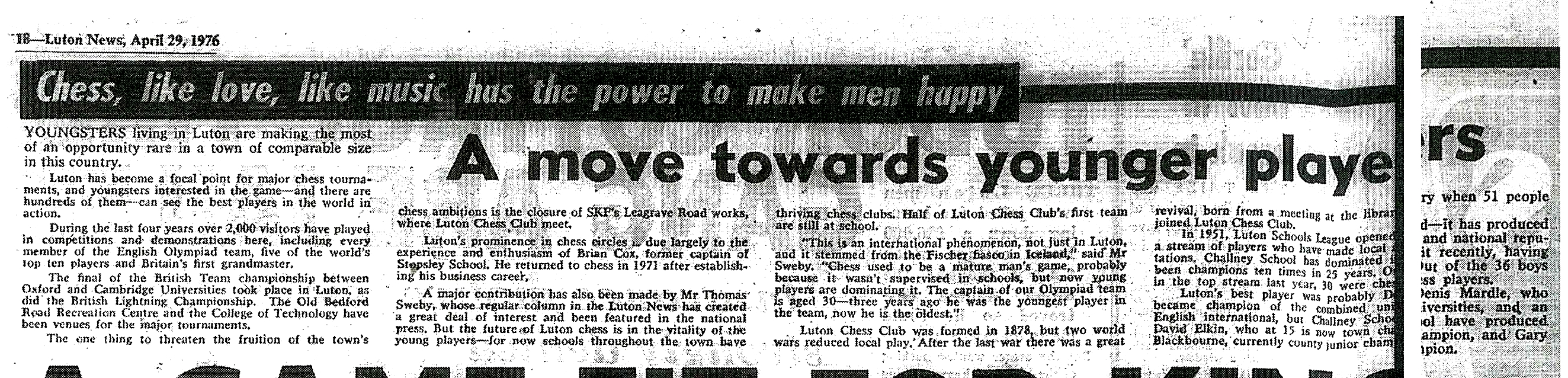
Fig. 8, The Luton News, April 29th 1976.
In the following column (Fig. 9) Sweby tells us that only a few schoolboys from Luton intend to participate in what was Bedfordshire’s biggest tournament in the 70s, a tournament which attracted some of the strongest players in the world and became infamous for the shortest recorded game in chess history. Again we may ask in what sense its league of schoolboys really was ‘thriving’ if so few participated in such a large local event.

Fig. 9, The Luton News, 75, date uncertain
For up and coming players, having the chance to play in local tournaments where you could watch one of your idols up close was one of the advantages available to Luton’s schoolboys. Another was the option to travel abroad on trips organized by Sweby himself, as is reported in the following column in the third and forth paragraphs. Regarding the trip to Lenningrad, Sweby was a communist, and according to author and former colleague Jon Biggs a rather tame one at that.
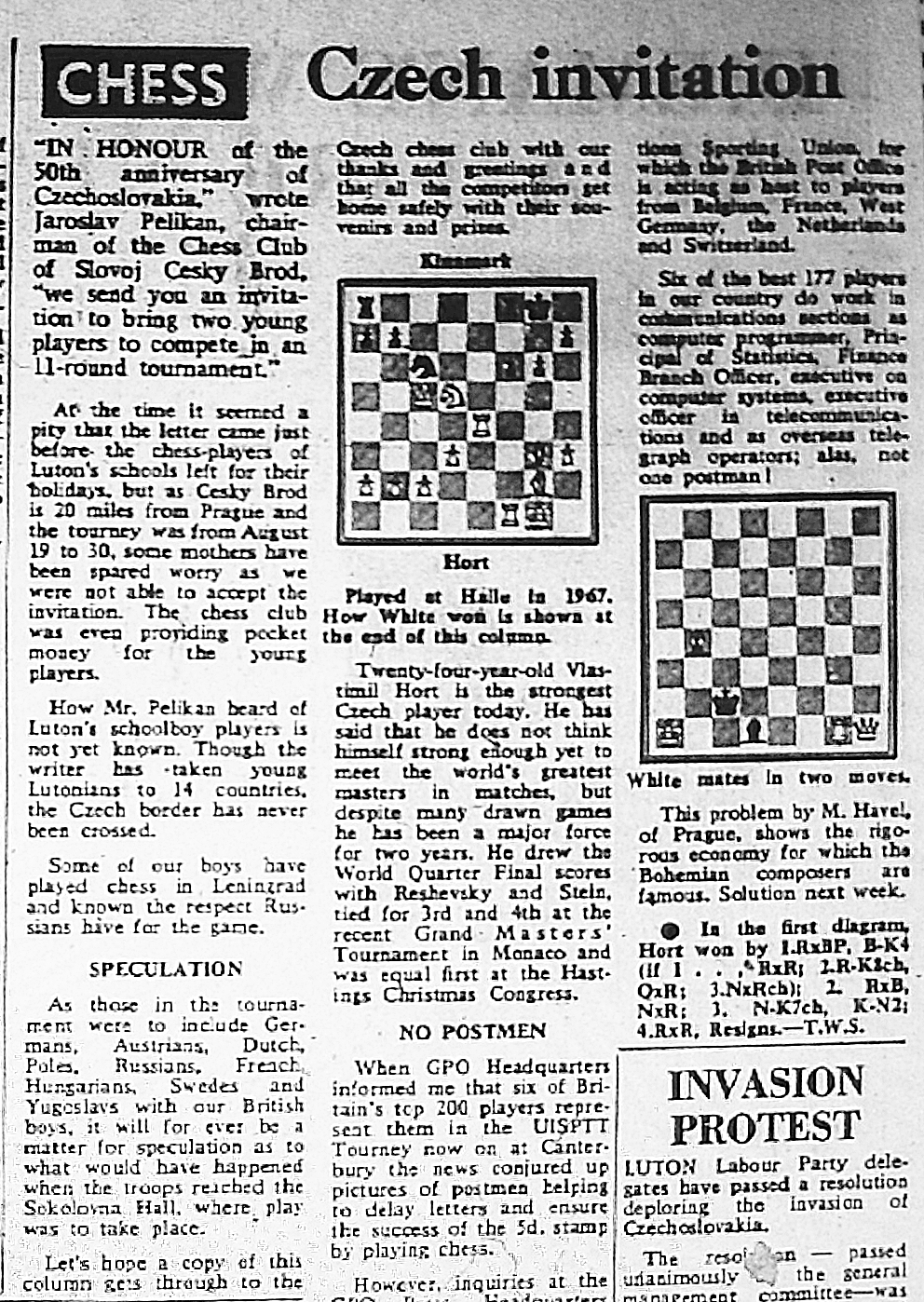
Fig. 10, The Luton News, Sept. 5th, 1968
School chess in Bedford
It was in the north of the county, however, where school chess in Bedfordshire achieved success. Headmaster of Bedford Modern Junior School Idris Hussey retired in 68 but Malcolm James, who had been a member of staff since 61, stayed on. With the addition of Paul Habershon in 69, this meant B.M.S could improve its position in the Bedfordshire league, which it was already strong enough to compete in. In addition, Bedford had its own Middle Schools League, which is described by Mr. Habershon with the following words:
Another important aspect of the 1970s was the Bedford Middle Schools Chess League, organised by W. A. (Sandy) Cordon, Deputy Head at Stewartby School. He used to have 100 children in his lunchtime chess club. The league was usually won by BMS or Stewartby but it thrived for several years and received a BCF award. However, it did not survive the 1983-84 teaching unions’ ‘industrial’ action (working to rule, etc.) and never got going again.
Regarding B.M.S itself, I am once again indebted to Mr. Habershon for the following content:
In the old school buildings we used Malcolm’s chemistry classroom for chess because it had flat tables – my classroom, like most others, had the old individual desks with sloping lids and inkwells. We ran three separate after-school chess clubs: Junior (7-11), Middle School (11-13) and Senior (13-18). It was only when we moved to the new buildings in 1974 that I was able to open my classroom (now with flat tables) for chess every lunchtime. It was invaluable that we could see children right through from 7 to 18.
Not all children came up through our Junior School. Richard Freeman (b.1958) arrived in the First Form (= Year 7 nowadays) the same term as me. Jim Plaskett (b.1960) followed in 1971. However, we also had Neil Cannon (b.1962) in the Junior School. At one point Leonard Barden rated him the 4th best U-10 in the world. He was very useful in lowering our team’s average age in the Sunday Times Schools Championship. Neil was neck and neck with Julian Hodgson at U-11 level, but fell behind thereafter, especially when he got more interested in drama.
Plaskett was not that strong when he first arrived. I think the important thing was that the chess club was very structured and competitive, so there was, for some, huge incentive to improve. Plaskett developed very quickly around age 13 to 14 and had a great capacity for hard work at the game. For instance he taught himself the KBN v K mating technique and would ask to test it out on me. His photographic memory helped him a lot with opening theory. The school team often used to win our Zone of the S. Times competition, but we only once got to the National Final (Fig.11). This was is in 1974 when we beat Tony Miles’s old school (King Edward’s, Birmingham) in the semi-final but lost to Southern G.S, (Portsmouth) in the Final. Our team was Michael Francescon (who won his Bd 1 game in the Final), Richard Freeman, Adam Springbett, Gavin D’ Costa, James Plaskett (NB still only on Bd 5), Neil Cannon. That was also the only year we won the Beds. League. This was during a brief period when it was for teams of 8. Malcolm and I played, of course, and we had good strength in depth.

Fig. 11, date uncertain. Note that the players photographed represent Challney Boys Luton, Sweby’s school.
From 1974 to 1978, his last year at the school (Fig. 12), Plaskett’s strength rocketed of course, culminating with his 2nd place in the British Championship at Ayr in 1978. He could remember my games, e.g. in the Beds. League, better than I could, sometimes commenting on opening lines which I had played two or three seasons earlier and had forgotten about. I knew he was something special when he beat B H Wood at the Hitchin Congress in 1975. During my time the only other pupil to play on Board One above me in the Beds. League team was Peter Constantinou (b.1988) who was in the Sixth Form when I retired. His current FIDE rating seems to have stalled around 2300.
Fig. 12, The Luton News, Jan. 5th 1978

At the end of the decade, protégé James Plaskett was, however, not the only Bedfordshire schoolboy to receive recognition for his ability. (Fig. 13)

Fig. 13, The Luton News, June 29th 1981
Both Luton and Bedford offered chess for schoolboys for many decades, however, in Luton it was organized almost single-handedly by Sweby himself, thus folded upon his retirement. The concerted efforts of Idris Hussey along with the acquisition of English teacher Paul Habershon and Chemistry teacher Malcolm James, enabled Bedford Modern School to offer school chess from the end of the second world war to the turn of the millennium and beyond. It was not until Paul Habershon’s retirement in 2006, when he was given the honorary President’s Award for services to chess by the renamed English Chess Federation, that school chess finally disappeared from the Bedfordshire league.
Men make their own history, but they do not make it just as they please: they do not make it under circumstances chosen by themselves, but under circumstances directly encountered, given and transmitted from the past.
W.H. Auden quoted by N.R. Hanson, Patterns of Discovery, Cambridge, Cambridge University Press, pg. 181 n.3
Part two
A question of strength?
In 1948 Tom Sweby became the chess champion of Bedfordshire for the first time when he beat the former Kent champion L. F. Pape, who playing for Bedford, represented the northern section of the county. Sweby lost his title upon its defense but regained his crown shortly after the queen’s coronation in 53, by which time he was already the chess correspondent for the Beds and Herts Pictorial (Fig.14). His participation at the British Chess Championship in Hastings that year, along with fellow Lutonians R. H. Rushton and D. V. Mardle also became the subject of reportage, if only locally (Fig. 15).

Fig. 14, The Luton News, 17th Sept. 53

Fig. 15, The Luton News, Aug. 27th 1953
How strong were Bedfordshire’s best in the fifties? Not terribly, opponents and former team mates of Tom Sweby estimate him to be rated around 150, which the game below would appear to suggest.
B.Sandercock v Tom Sweby 7/4/1962
County Match, Buckinghamshire v Bedfordshire
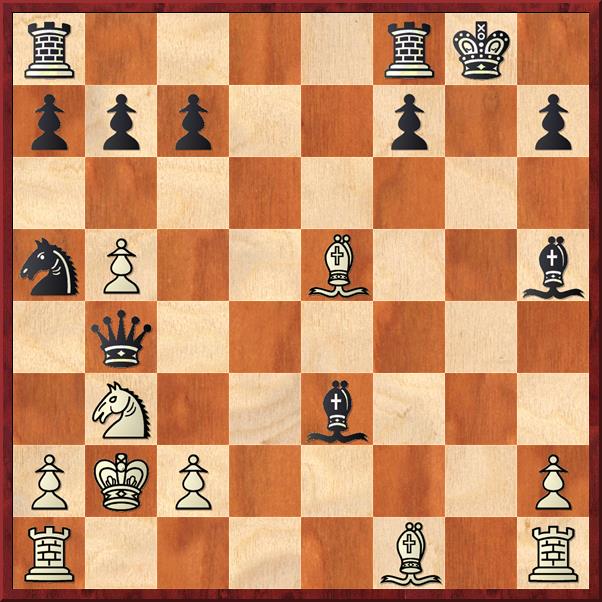
1.Nf3 Nf6 2.c4 g6 3.d4 Bg7 4.Nc3 0-0 5.e4 d6 6.Bg5 h6 7.Bh4 Nbd7 8.Be2 c6 9.0-0 e5 10.Rc1 exd4 11.Nxd4 Qe8 12.f3 Nb6 13.Bg3 Qd8 14.Nb3 d5 15.c5 Nc4 16.Bxc4 dxc4 17.Qxd8 Rxd8 18.Na5 Nd7 19.Rcd1 Re8 20.Nxb7 Be5 21.Bxe5 Nxe5 22.Nd6 Re7 23.f4 Ng4 24.Nxc8 Rxc8 25.Rd4 Rb8 26.h3 Ne3 27.Rf2 Reb7 28.Re2 Rxb2 29.Rxe3 Rc2 30.Rxc4 Rbb2 31.Rg3 Rxa2 32.Nxa2 Rxc4 33.Ra3 Rxc5 34.Rxa7 Rc4 35.Ra8(ch) Kg7 36.Re8 Rc2 37.Nb4 Rc1(ch) 38.Kf2 c5 39.Nd5 Rc2(ch) 40.Kf3 c4 41.Ne3 Rc1 42.Rc8 c3 43.Ke2 RESIGNS. (see Fig. 16)

Fig. 16. With the greatest of respect both 11…Qe8 and 26…Ne3 left a lot to be desired.
Although Tom was twice champion of Bedfordshire, he is normally found occupying boards 3-6 in county matches around that time (Fig. 17 & 18).

Fig. 17, The Luton News, Jan. 15th 1953
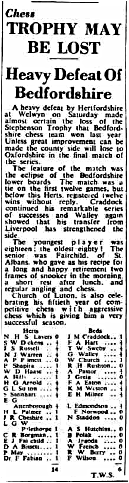
Fig. 18, The Luton News, Jan. 14th 1954
J.M. Craddock, however, (Fig. 18) was British Boys’ Champion from 1929-31 and strong enough to beat former British champion Dr. Fazekas (Fig. 19).
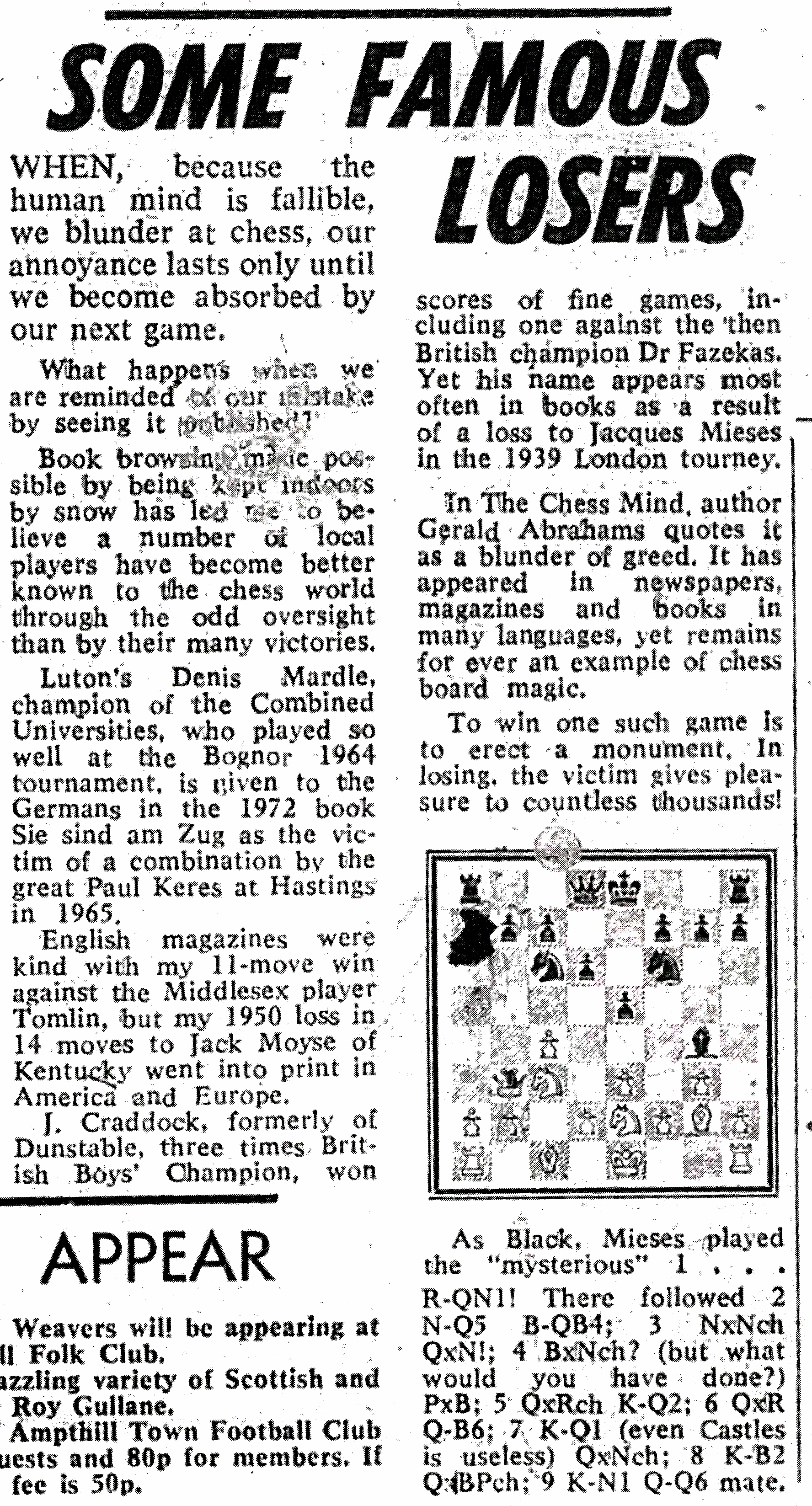
Fig. 19, The Luton News, Feb. 22nd 1979
The game listed above can be found here: http://www.chessgames.com/perl/chessgame?gid=1585668
Lutonian Dennis. V. Mardle, who lead the south Bedfordshire team in Fig. 20, is the only Bedfordshire player that appears in the 1953 rating list at 2b (approximately 217-224).
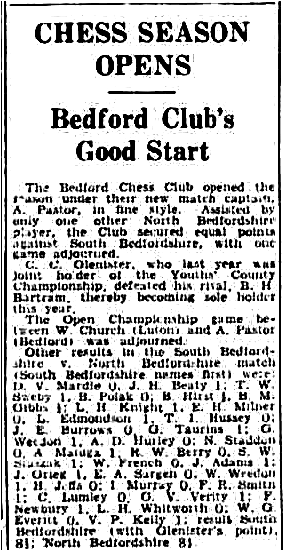
Fig. 20, The Bedfordshire Times and Standard, Sept 28th 1951
Mardle was probably mentioned more in Sweby’s column over the years than anyone else and was once the sole subject of an entry written by Sweby (Fig. 21). If read carefully their comparative strength can be found in the tone of the article. Though Sweby is highly complimentary of Mardle, it was not, according to those who knew both, reciprocated.
The title used by Sweby, ‘Senior Principle Scientific Officer’, concerned Mardle’s work on Polio, for which he was awarded a CBE in 1988. It was an illness that Mardle himself suffered from, one which caused his chess persistent problems as according to former team mate Nigel Staddon venues with stairs to climb were always troublesome. An online portfolio of his chess can be found in the following link: http://www.chessgames.com/perl/chessplayer?pid=40868.

Fig. 21, The Luton News, Feb 19th 1970
Whatever top-end strength was apparent in the county team in the early fifties, it was much less in evidence by the end of the decade. As is common across our nation with county chess, team members are transient so team results fluctuate correspondingly.

Fig. 22, S.C.C.U Bulletin 58-59, note for the purposes of Part 5, who plays black on board 17.

Fig. 23, S.C.C.U Bulletin 58-59
‘Dark Satanic Mills’ in Bedfordshire’s green and pleasant lands?
The Bedfordshire league that many schoolboys entered in the early 70s had a broad base of clubs, with Newport Pagnell and Cranfield from central Bedfordshire joining, and as satellite club Bletchley formed into Milton Keynes it soon became the apotheosis of its adopted league. The industrial boom and its ensuing architectural transmogrification that Luton underwent after the war gave it the feel of a northern town down south; it altered the composition of the Bedfordshire League as half of the clubs participating within it were factory teams from Luton, such as Electrolux, Kents, SKF, Vauxhall Luton, and the annexed Vauxhall Dunstable. It is not (yet) known when Vauxhall Luton began but as early as 37, it had its own team as did SKF, though neither are mentioned in the 1933 classic Chess in Bedfordshire by F. Dickens and G. L. White. This does not necessarily mean they did not exist at the time as G. L. White, who continued the book after the sudden death of F. Dickens may have chosen not to acknowledge them as it is unclear whether league chess existed and in what form:

Fig. 24, The Bedfordshire Times and Independent, Friday 22nd Jan 1937
Luton’s factory clubs were accommodating to the young talent who joined them, and compared to more established clubs they had their advantages; for instance, members could easily recruit work-mates who had little or no contact with chess previously, there were subsidized drinks at the bar, funding for trophies and shields, a place to store chess sets, and money to buy scoresheets and clocks. Since funds were available for recreation in such places there was, according to Nick McBride, always some chitter-chatter in the background about how they once tried to get Spassky to do a simul or how Harry Golombek mentioned their club in passing. However, quantity does not ensure quality. In the 70s no factory club was strong enough to win the league and many, notably Vauxhall Dunstable lost their best players to Luton Chess Club, such as Tony Berry, Simon Roe, Peter Gayson and Nick McBride, when numbers began to dwindle. It was only then that Luton, still the largest town in the league, became champions of Bedfordshire two years after (Fig. 25) was written. Courtesy of the exodus of talent from Dunstable, Luton then became the strongest club in the county winning the league five times within the next seven years. By the mid 80s the factory clubs associated with chess in Luton had all left the Bedfordshire league, only Vauxhall Dunstable survived but due to disagreements with the league itself refused to participate in it.
Division 1 winners
| 1986-1987 | Luton |
| 1985-1986 | Luton |
| 1984-1985 | Cranfield |
| 1983-1984 | Bedford |
| 1982-1983 | Luton |
| 1981-1982 | Luton |
| 1980-1981 | Bedford |
| 1979-1980 | Luton |
| 1978-1979 | Bedford |
| 1977-1978 | Bedford |
| 1976-1977 | Milton Keynes |
| 1975-1976 | Milton Keynes |
| 1974-1975 | Bedford Modern School |
| 1973-1974 | Bedford |
| 1972-1973 | Bedford |
| 1971-1972 | Bedford |
http://www.adrianelwin.co.uk/Bedfordshire/Bedfordshire.html
Written as late as 77, the account of chess in Luton offered by Sweby is reliable enough (Fig. 25).

Fig. 25, The Luton News, Jan 20th 1977
Another principle advantage of Luton’s industrial chess heart was that it brought talent from afar into the league from exotic locations such as Wales and Italy, both of whom lost national champions to the Bedfordshire league at various points between 68-71 (Fig. 26 & 27).

Fig. 26, The Luton News, Apr 25th 1968

Fig. 27, The Luton News, Nov 9th 1978
Though Sweby does not provide a date, GM Mariotti only spent one year in England 70-71 when his brother Paolo lived in Luton (Fig. 27) and is still remembered.
White: Paul Habershon
Black: Paolo Mariotti
Date: 10/02/1971
Beds League
Result: 1-0
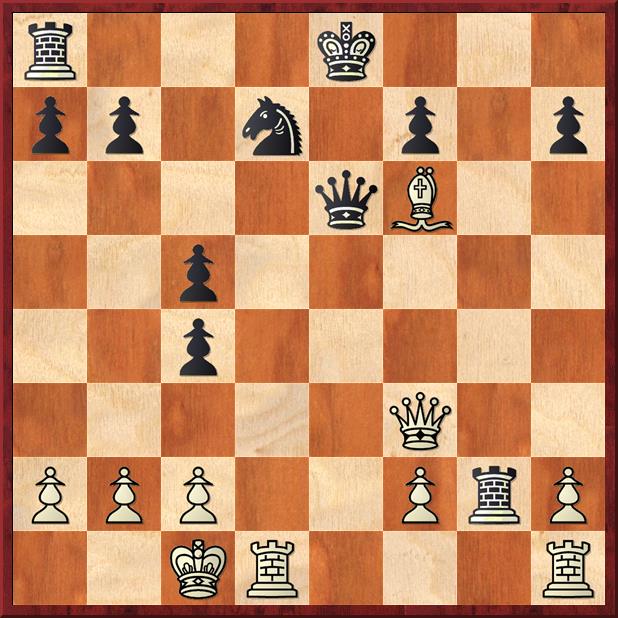
1. e4 c5 2. Nf3 e6 3. d4 cxd4 4. Nxd4 Nc6 5. Nxc6 bxc6 6. Bd3 Nf6 7. O-O Qc7 8. f4 h5 9.Nc3 Bc5+ 10. Kh1 Ng4 11. Qf3 Bb7 12. Bd2 O-O-O 13. b4 Bd4 14. Rab1 Rdg8 15. Ne2 Bf6 16. c4 g5 17. e5 gxf4 18. exf6 Ne5 19. Qh3 f3 20. Rxf3 c5 21. Bf4 Bxf3 22. Bxe5 Qxe5 23. Qxf3 Kc7 24. bxc5 Rb8 25. Rxb8 Rxb8 26. Qf4 Qxf4 27. Nxf4 Rb2 28. h4 Rd2 29. Bh7 Rd4 30. g3 Rc4 31. Bg8 Rc1 32. Kg2 Rc2 33. Kf3 Rc5 34. Bf7 Rf5 35. Bh5 Rf6 36. Ke4 Kd8 37. g4 a5 38. g5 Rf5 (Adjudicated).

Fig. 28. The position after 35… A well-played game by Bedfordshire’s Paul Habershon.
Sergio was arguably the strongest to ever to play in the Bedfordshire league in its modern era. Though his peak rating of 2455 is only marginally higher than homegrown future IM Andrew Ledger’s rating of 2443, Andrew was rated about 100 points lower than that when he left the Beds. league to play in London. Furthermore, since GM Mariotti competed regularly against the very best in the world, gaining credible draws against the world champion of his day Karpov and ex-world champion Spassky, along with impressive victories against Gligoric, Korchnoi and just about every English player in existence on numerous occasions: his ranking as a player was higher: rating inflation must also be taken into consideration!
Though James Plaskett broke the 2500 barrier and surpassed them both, he stopped playing in the Bedfordshire league in 78 far from his peak. As national champion, GM Mariotti was close to his prime during his short stay in the Beds. league, so it is he who should be thought of as the strongest performer in its modern era. In 1996 Sergio suffered from serious heart trouble and is unable to remember anything about his ‘old life’ as he put it, sadly he could not comment on the time he spent in Luton en passant.
Plaskett’s successor as the county’s strongest junior was Margret Roe’s son Simon. By 83 he was already the county junior champion in triplicate. He now plays for St. Albans and is still rated around 200.

Fig. 29, The Luton News, Apr 21 1983
At the time of print (Fig. 29) more work-based, clubs entered the league though they were both weaker and more transient than the factories of Luton; Texas Instruments operated from the basement of their tightly secured building in Bedford, Scicon and 3M also joined the Beds. league for a short while. Later that decade Northampton WMC entered and won the second division in 87 before becoming Northampton. Between 90-92 Rushden, also of Northamptonshire joined the Beds. league which was considerably stronger than the Northants. league at that time.
Simon Roe was replaced as junior county champion by fellow Dunstablian Nick McBride who was rated 187J in 86, two points above future IM Andrew Ledger. That year Nick moved from Vauxhall Dunstable to Luton Chess Club and became champion in his first season, terrorizing tired city commuters with an evening of the Schliemann Gambit on match nights. In 92 he had a provisional rating of 203 before giving chess up to concentrate on draughts. Given that Milton Keynes, now both the largest city and club in the league, had a number of strong players around the 200 mark such as the Hare brothers, Andy Bryce and Michael MacDonald-Ross a rating of 220+ was required to establish yourself as the strongest player in Bedfordshire in the early 90s. After an almost perfect season Andrew Ledger became just that, reaching the 230 mark before he moved to London.
A paradox of the decline in popularity of chess that appeared after the 70s which has continued to the present is that some of Bedfordshire’s strongest ever players have emerged from it. The Ledger brothers, two of whom are titled, were followed a decade later by FM Peter Costantinou by which time the junior county championship was long since dead and the working men’s clubs that were open to the youth of the 70s were also long closed.
A generation on, Bedfordshire achieved great success for a county its size. In 1990 protégé GM James Plaskett became champion of Britain and within the space of two years both the county first and second teams became the English County Champions of their relevant sections. How can such success for a county as small as Bedfordshire be explained? Firstly, the decline in popularity in chess that Bedfordshire underwent was typical for its time across our nation, secondly and more importantly, the retention of the satellite clubs that played in the Bedfordshire League became an increasingly valuable asset as they increased in strength. In 92, Milton Keynes were county champions for the third consecutive year, and in (Fig. 31) half of the team played for Milton Keynes. Thirdly, the appearance of a few anomalous talents isn’t an indicator of overall strength; it is most likely a paradox.
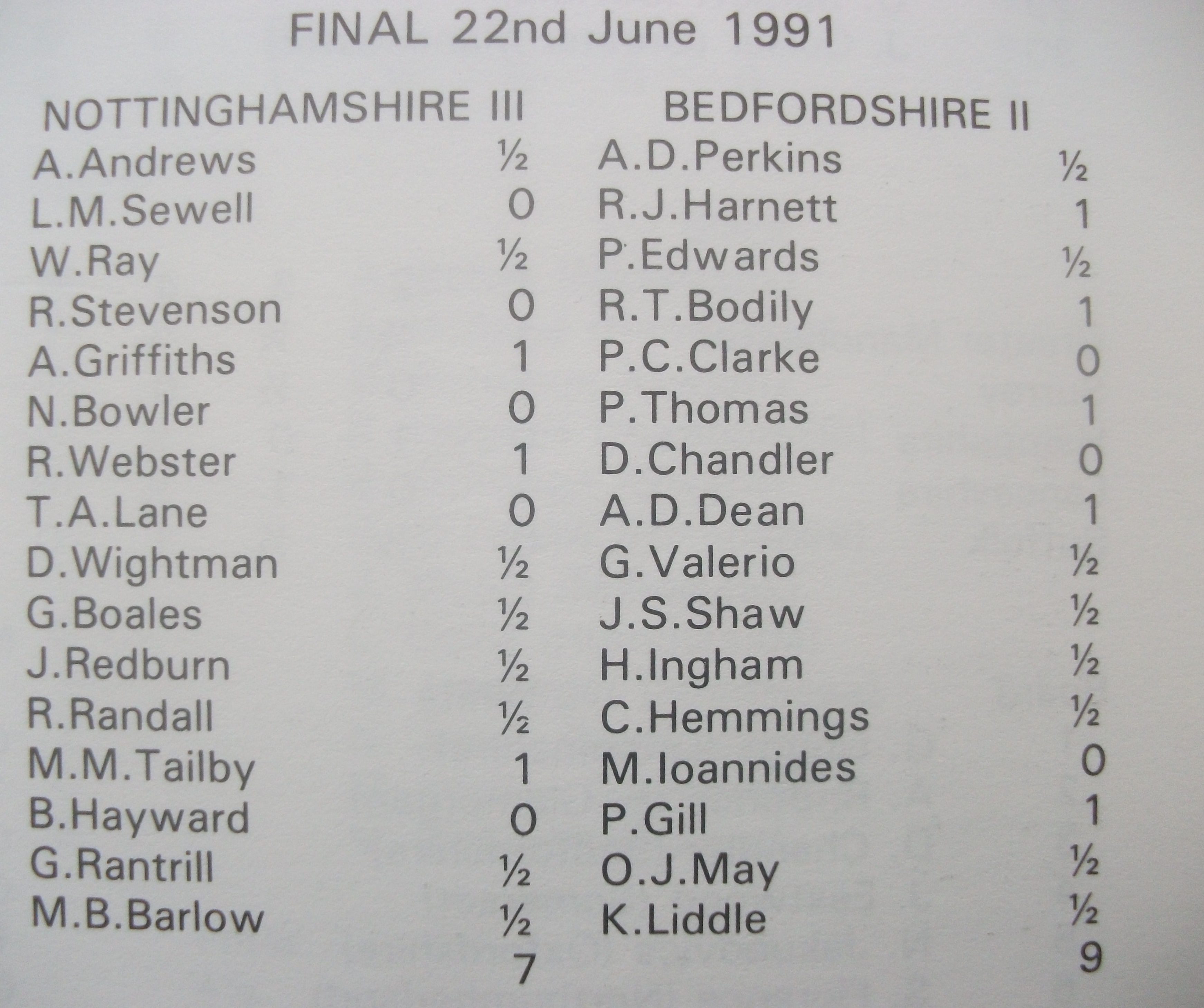
Fig. 30, BCM Yearbook 1991, Your long-haired author agreed to be sub that day.
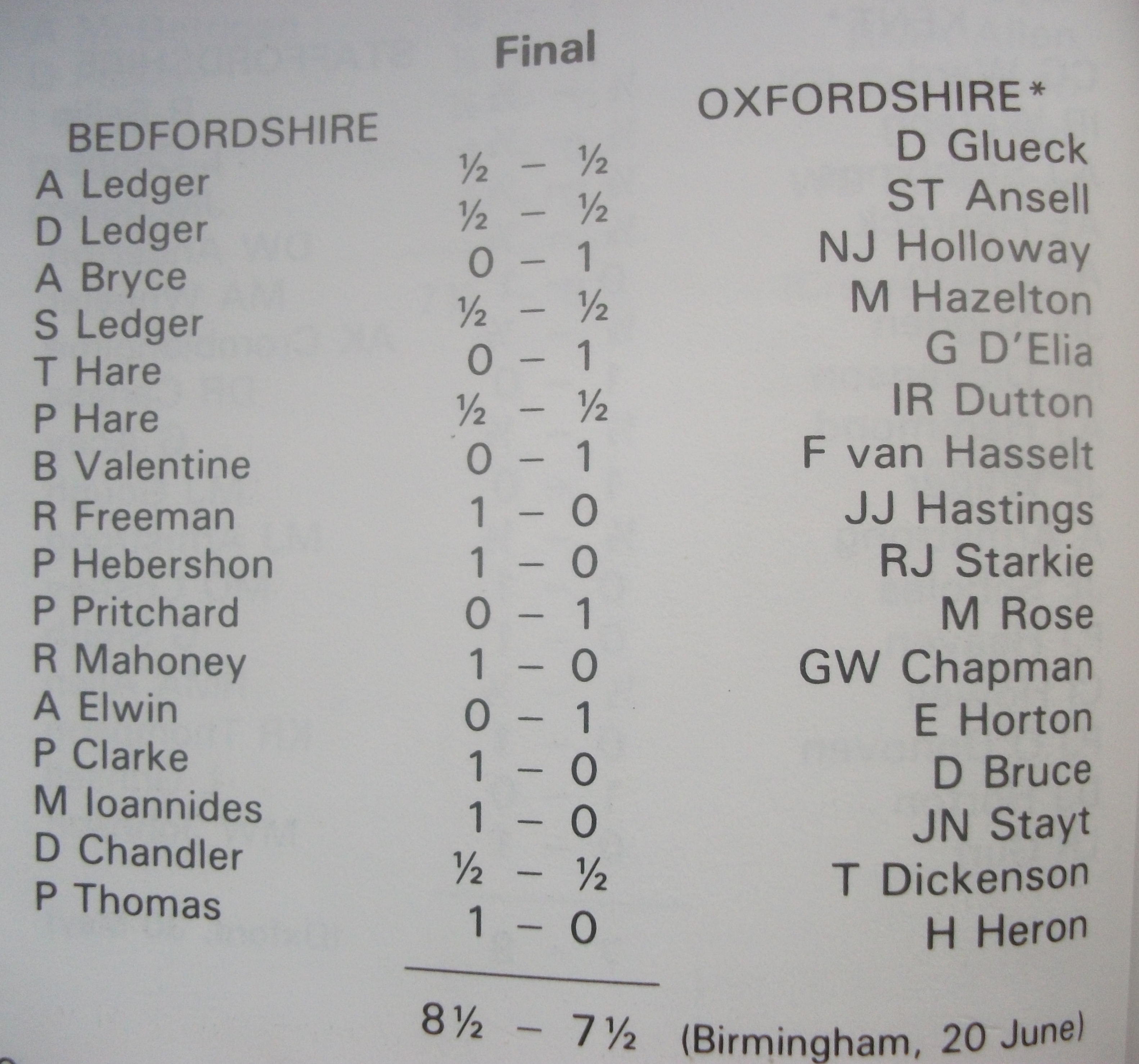
Fig. 31, BCM Yearbook 1992, note that it was strength and depth that won the match.
Part 3
1984
It was a bright cold day in April, and the clocks were striking thirteen… .
He who controls the past controls the future. He who controls the present controls the past.
George Orwell 1984
Part 4
A tame Communist writes, and writes, and writes… .
“The raconteur knows too well that, if he investigates the truth of the matter, he is only too likely to lose his good story.”
Herbert Butterfield, The Origins of History
On coronation day Sweby brought our beautiful game into the public eye when a game of living chess between Luton Vauxhall champion T. F. Fuller and the British Women’s Champion of 47-49, Miss Eileen Tranmer was played in Wardown Park Luton, with the pupils of Challney Modern Boys School, at which Sweby was the Science teacher, participating as the pieces (Fig. 32 & 33). Further details can be found in The British Chess Magazine – 1953, Vol. 73, pg. 181. Click here for an image (https://mccreadyandchess.com/2015/08/12/the-queens-coronation/).
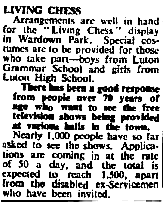
Fig. 32, The Luton News, April 23rd 1953

Fig. 33, The Luton News, June 4th 1953
In addition to his local chess success and organization, Sweby became ‘President’ of the S.C.C.U he was President only for one year, however, before being replaced by A.Thorpe (http://www.sccu.ndo.co.uk/oldoffic.htm). He also gained election to ‘the executive of the British Chess Federation’ but it is uncertain whether the positions bestowed any real power or were largely administrative. (Fig. 34)
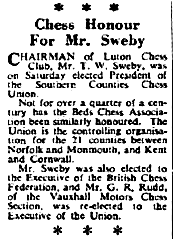
Fig. 34, The Luton News, July 15th 1954
Sadly, Sweby had a serious motorbike accident in the early sixties when in a moment of madness he forgot all about the years of training in which chess taught him to think before you act, and tried to squeeze through a gap between two parked lorries only to hit another motorbike head on. As former county treasurer Nigel Staddon recounts, it was a painful and slow recovery in which a defiant Sweby refused to have his arm amputated after learning he could no longer use it. Not long after he stopped playing chess altogether but continued his work as Science teacher at Challney Boys School, where he remained popular amongst the boys in spite of the cigar smoke they had to endure in his classroom. As jovial as ever, he remained devoted to his promotion of the Luton Schools Chess League, which he began to write about more frequently.
Intentionally or otherwise Sweby wrote himself into history on Feb. 1st 1968 with the commencement a chess column that became the longest running in England or so he had us believe (Fig. 35). For over twenty years it found its way into the homes of Bedfordshire where it was read on Thursdays or perhaps at weekends across the parks of Luton by some lucky youth who unexpectedly found his fish and chips wrapped in it. Tom wrote about the many different aspects of our beautiful game in his column over the years. He was a great raconteur, as those of us fortunate to have met him remember. Much of his attention, however, was drawn towards what was closest to him.

Fig. 35, The Luton News, April 29th 1976

Fig. 36, The Luton News, Feb. 1st 1968

Fig. 37, The Luton News, Feb 1st 1968
As you would expect for a column that continued for a quarter of a century and more, the content was broad covering local, national and international topics both past and present, trivial and thoughtful, and as mentioned, oftentimes in the same column. Though Sweby was sometimes vague and imprecise, he wrote well and understood what the essence of an interesting chess column was; that being a short title, a position or puzzle for readers to solve, and news from the chess world, which few in his day had easy access to. He knew most of his chess-playing readership personally and wrote for them whilst able to keep the general public borne in mind. How much motivation he provided local players in his capacity as a journalist, given that as amateurs we rarely see our names and games published can only be underestimated.

Fig. 38, The Luton News, Jan 10th 1970, though the comparison between local schoolboys and great masters of the past is rather crude, it is the impact on the local chess scene that matters more.
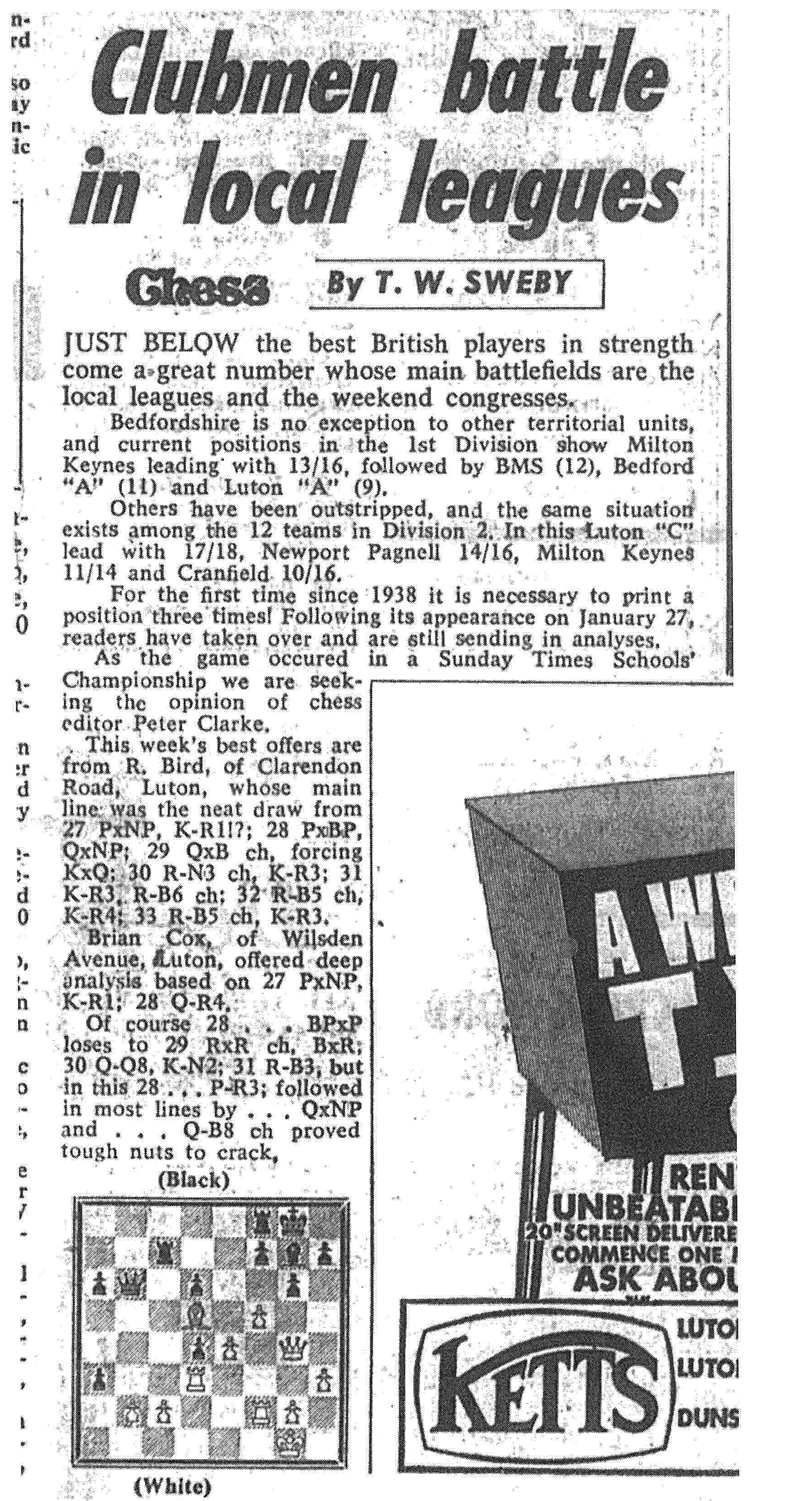
Fig. 39, The Luton News, March 10th 1977

Fig. 40, The Luton News, April 10th 1980
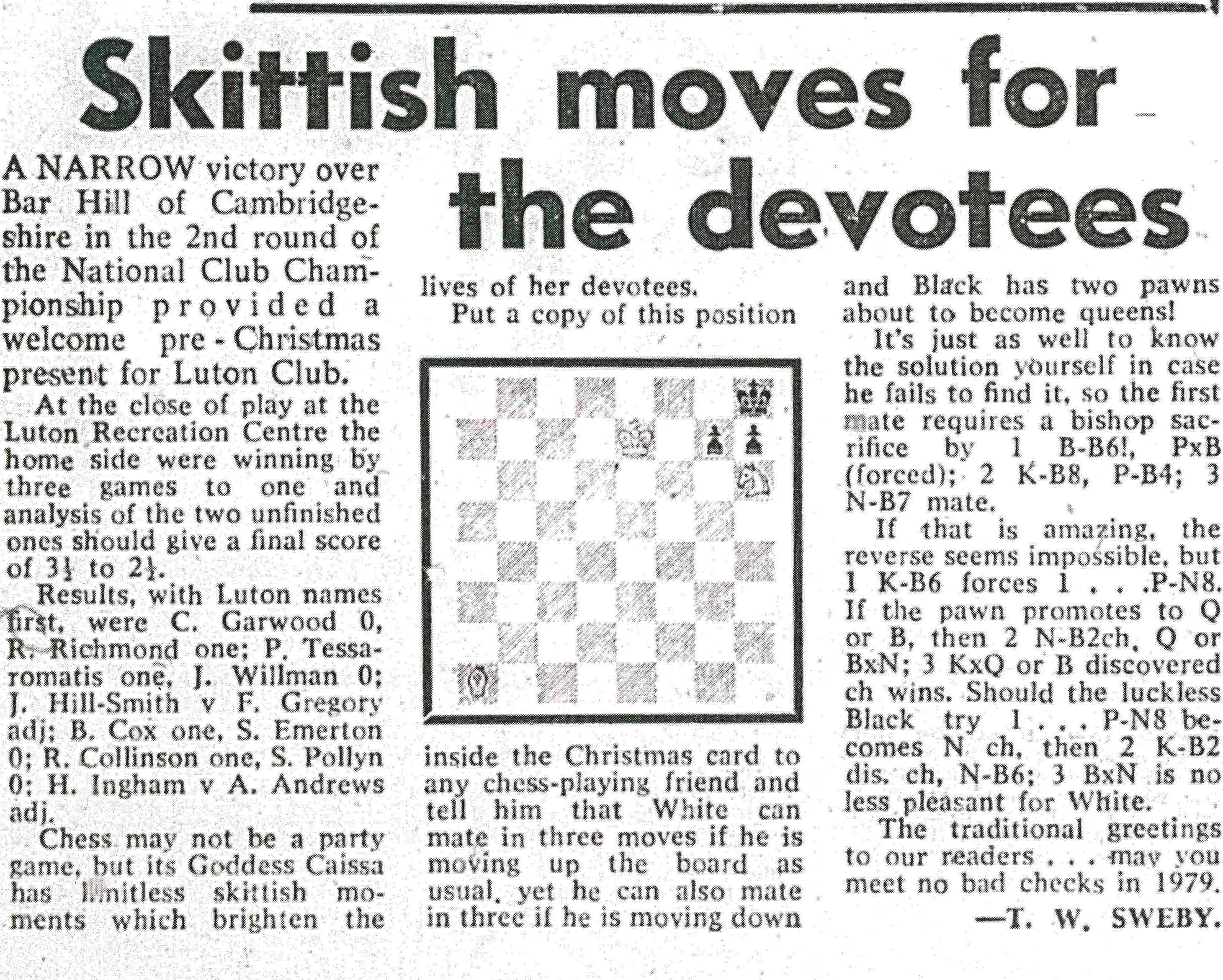
Fig. 41, The Luton News, Dec 21st 1978
In 1985 when Tom Sweby retired from chess altogether, he received the honorary President’s Award by the British Chess Federation for his services to chess.
Part 5
History enhanceth noble men, and depresseth wicked men and fools.
Ranuphus Higden, Polychronicon
Brian Cox -the quiet bookmaker who put Luton on the map
Former Luton Stopsley High School captain Brian Cox was the man behind the many simuls, high-profile matches and tournaments that Luton became synonymous with in the 70s. He was a reasonable player, rated around 160, and as Secretary of his home town club, liked to keep himself busy. He took great pleasure from organizing events and was very good at it but left chess altogether to concentrate on greyhound racing. The following columns acknowledge, to some degree, Brian’s involvement in the aforementioned events.

Fig. 42, The Luton News, dated early 75. It should be noted that B.H.Wood had many friends in Bedfordshire and participated in many congresses in and around the town. At one congress in Dunstable, he ran the bookstall.
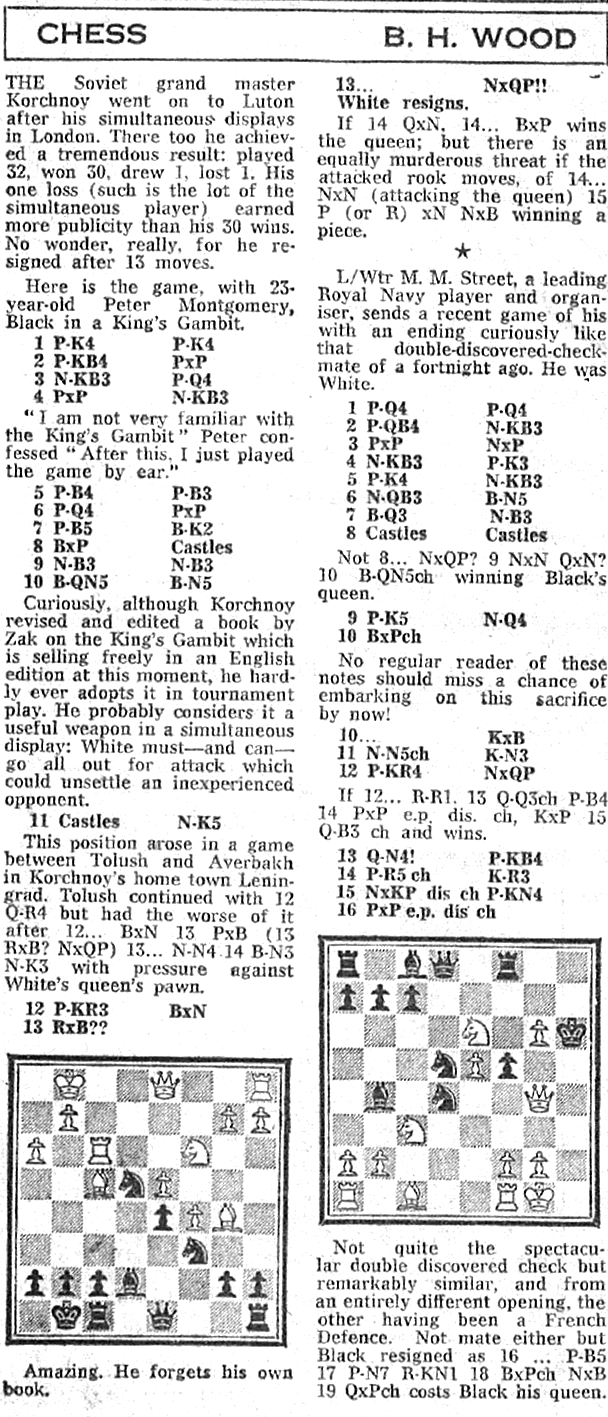
Fig. 43, The Telegraph, Local Grandmaster slayer Peter Montgomery has his game published in The Telegraph, date not known.

Fig. 44, The Luton News, Jan 26th 1978
One of the draws with the speedy tiger can be found below:
White: Tigran Petrosian
Black: Paul Habershon
Date: 20/01/78
Result: Draw
1. c4 Nf6 2. d4 c5 3. d5 e6 4. Nc3 ed5 5. cd5 d6 6. Nf3 g6 7. Nd2 Bg7 8. Nc4 O-O 9. Bg5 h6 10. Bf4 Ne8 11. h4 b6 12. Qd2 Ba6 13. e4 b5 14. Ne3 b4 15. Ncd1 Bf1 16. Kf1 Qe7 17. f3 Nd7 18. Nf2 Ne5 19. Rc1 Nf6 20. Be5 Qe5 21. Nc4 Qe7 22. g3 Nd7 23. Kg2 Ne5 24. Ne5 Qe5 25. Rc2 [25. Nd3!] 25… f5 26. ef5 Qf5 27. Qd3 Rae8 28. Qf5 Rf5 29. Rd1 Bd4 30. Ne4 Rd8 31. Rcd2 Bg7 32. f4 Rf7 33. Kf3 a5 34. b3 a4 35. Rd3 Ra7 36. h5 Kf7 37. hg6 Kg6 38. g4 ab3 39. ab3 Ra3 40. R1d2 Kf7 41. Rd1 Kg6 42. R1d2 Kf7 43. Rd1 Kg6
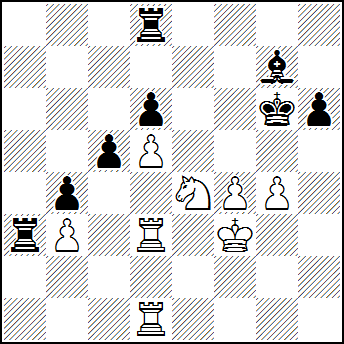
Fig. 45, 43…Kg6. Draw agreed.

Fig. 46, The Luton News, Feb 2nd 1978
For simuls against world class opposition to occur in such propinquity (Fig. 46) chess must have been much more popular than it is today given that Luton, at present, only has one club with one team and only six members. A stark contrast indeed.
Chess in the 70s is rarely discussed without reference to the Fischer-Spassky match of 72 and it would be a grave error on my part not to reflect upon it even though the interest it created is both hard to measure or explain. It is not an aim of this post, however, to offer competing theories of influence so I shall leave you in the capable hands of Dr. Richard Eales, the following excerpt is taken from his truly wonderful publication ‘Chess: The History of a Game’ (1985), pgs. 187-189:
The growing popularity of chess outside Russia and eastern Europe since the 1960s is closely associated with the stormy career of one man: Robert James (‘Bobby’) Fischer. His influence has lasted though he has played no serious chess since the final game of his match against Boris Spassky which brought him the world championship in 1972. Merely by becoming the first non-Soviet champion in more than twenty-five years, Fischer set his seal on the revival of western chess during the 1960s and blazed a trail which younger players have set themselves to follow since his premature retirement… . The 1972 match in Reykjavik which followed was not merely the culmination of Fischer’s career but the most widely publicized chess event of all time. There seemed no end to its surprising twists and turns: the arrangements of finance that boosted the prize fund to an unprecedented $250,000 (Spassky’s prize in 1969 had been $1500), the doubts whether Fischer would play at all, the default in the second game that left him with a 2:0 to make up, his final triumphant victory. A press corps of almost presidential proportion followed every move on and off the board… .
Could such an artificial and distorted publicity really do anything to alter the status of chess itself? Surely any effects would be short-lived, especially when Fischer, like Morphy before him withdrew into seclusion after his victory. After all, Fischer as an individual had always been the subject of the press and media attention, at first merely for his ability and precocity, then increasingly because of his quarrels with organizers, his lonely and obsessive life style, his defiant egoism… . Around the period 1970-1972 sales of chess sets and chess books in America and eastern Europe markedly increased. Sponsors and publishers reacted to this new popularity of chess and in their turn promoted it; the quality and diversity of western chess literature now rivaled even surpassed that of Russia [the author means the Soviet Union]. Some at least of these gains in chess and the seriousness of which it is treated have outlasted the 1970s and led to new advances. The conclusion must be that Fischer’s career was not an isolated influence. In part at least, it served more as a kind of catalyst to draw out a potential interest in chess which already existed in western society. It’s hard to say exactly how this happened. Some people who had never encountered chess at all were now brought into contact with it. The Fischer image of youth and rebellion fitted in well with the game’s growing popularity among the young. His example of fame and wealth encouraged talented chess players to take chess more seriously as a potential career. All these things together apparently did have the power to change the game’s status: what often had been seen as a bloodless pastime, appealing mostly to college professors and internationally dominated by Russia, was now presented in a ruthlessly competitive (though unusual) kind of sport, with all the attractions that sport generally possesses for the amateur and professional. This value shift… .
Though Fischer was undoubtedly a model for the youth, as Eales rightfully points out, he was not an isolated influence. However, even with a strong local league at their disposal many who joined the Beds. league in the 70s did not stay long, having only a passing interest in chess. In spite of the fact that shows like The Master Game broadcasted chess to Bedfordshire as well as the rest of the nation, locally, chess was already in decline by the time the decade was over, long before Bedfordshire would go on to achieve national success on several occasions and produce some of its strongest ever players.

The English Chess Explosion, Chandler & Keeene, Batsford 1981, pg. 114
Some further thoughts on the state of junior chess can be found here which corroborate some of the above points made by both myself and Dr. Richard Eales.

The English Chess Explosion Chandler & Keene, Batsford, pg. 116

The English Chess Explosion, Chandler & Keene, Batsford, pg. 117

The English Chess Explosion, Chandler & Keene, Batsford, pg. 118
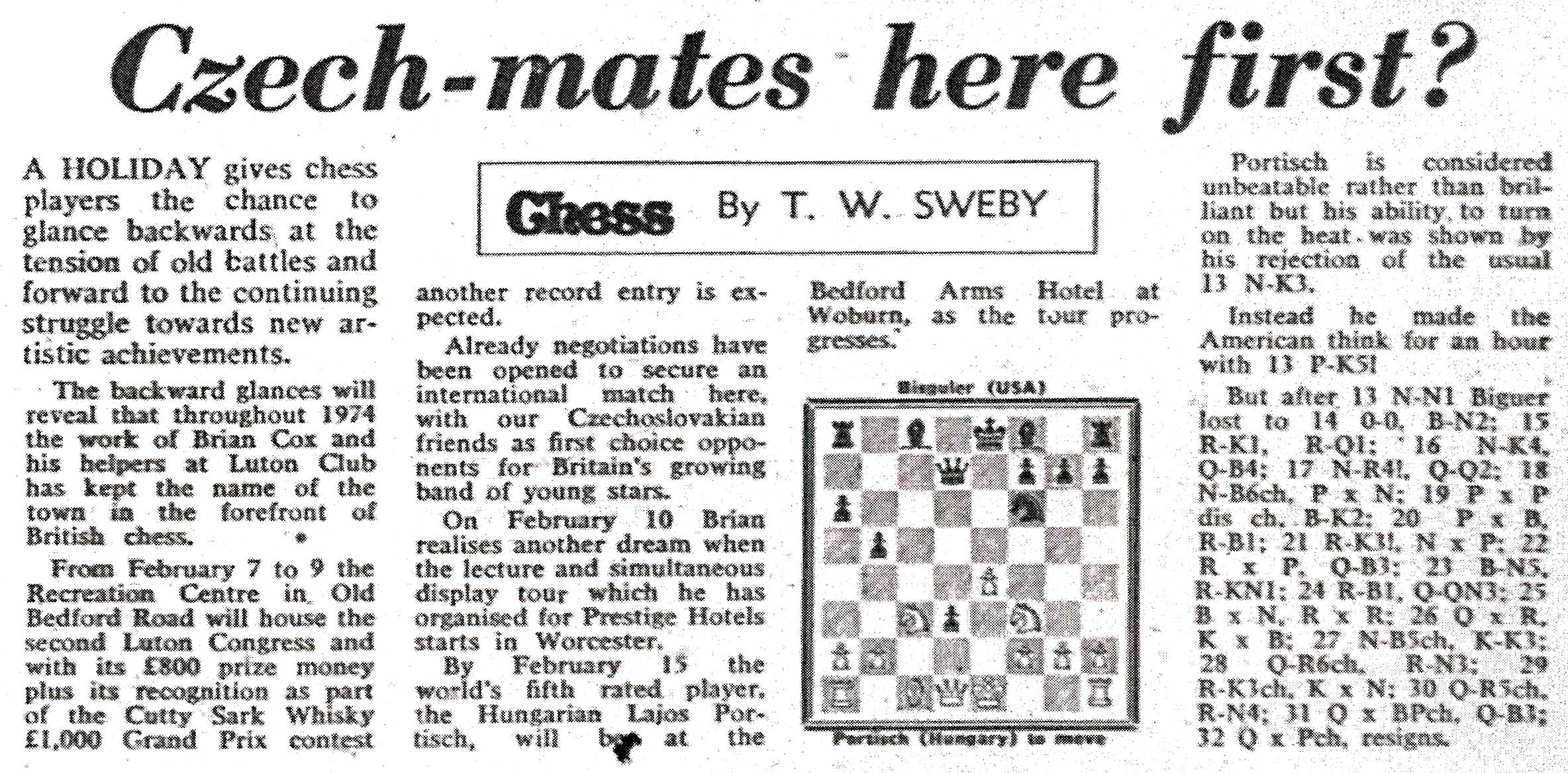
Fig, 47, The Luton News, Jan 12th 1975
It is quite unlikely that national events were played in Luton unless it had some national recognition (Fig. 47).

Fig. 48, The Luton News, July 26th 1979

Fig. 49, The Luton News, March 15th 1979

Fig. 50, The Luton News, date uncertain
Further recognition of Cox’s fine work can be found in the following post. https://mccreadyandchess.com/2015/10/23/sweby-cox-eight-invisible-masters/
A conclusion
That which the past was able to expand the concept ‘man’ and make it more beautiful must exist everlastingly.
Nietzsche, Untimely Meditations (Hollingdale) Cambridge University Press, pg. 68
To reiterate, it was shown that chess in Bedfordshire flourished during the 70s for reasons both internal and external to it. From the 50s Bedford, courtesy of Mr. Idris Hussey, Mr. Paul Habershon, Mr. Malcolm James and Mr. Sandy Cordon offered competitive chess for its schoolboys, and continued to do so into the next millennium, producing a British Chess Champion amongst many other talented schoolboys. Luton, though unable to attain the levels of success achieved in the north of the county, had its own schools league for many years which meant that for a county its size, a healthy number of juniors came through its league. In Tom Sweby and organizer Brian Cox, Luton had two ambitious individuals who would be pivotal in putting Luton on the map but it should be remembered that they did not work alone and could not have achieved their aims without their many ‘helpers’ to use a Swebyism (see Fig. 47). An obvious corollary of this was that the league itself grew in numbers and strength to the point where, it could draw in and hold satellite clubs around the county, without which it could not have achieved the national success it did in the early nineties and then again in the hallowed antiquities of 2004 and 2011 respectively.
Externally, the ‘Fischer Fiasco’ as comrade Sweby put it and the vested interests our nation had in that match meant that chess became more popular in the 70s across England but it is worth asking whether it could have taken hold for the limited time that it did had there not been sufficient infrastructure in place to facilitate it? In the 90s the Short – Kasparov match also grabbed the attention of the media. Luton chess club suddenly had 63 members, a number nearly doubled what was normal. They were mostly children and a new division in the Beds. league had to be created as other clubs increased in size also. But as I remember, the objections of one Bedford team of having to travel to Luton on a monthly basis to play Luton ‘D’, Luton ‘E’, Luton ‘F’, Luton ‘G’, Luton ‘H’ and Luton ‘I’ did not go down well at the AGM (held in Luton), although Dave Ledger found it somewhat amusing. Yet within a few years, with no school chess in the town, and with no junior county championship too, the dozens of new young members had vanished.
To conclude, I have tried to avoid comparing Bedfordshire to neighbouring counties, decades with one another and offer competing theories of influence as much as possible, and have instead tried to show how the actions of a devoted few shaped chess in Bedfordshire in hope that others can draw inspiration from them. I have also tried to take into account some of Sweby’s bias and offer a more balanced view wherever I could.
As I write, the vitality that the Beds. league once had is lost, but as can be seen from this post, all that is required for chess to flourish locally is to find a few devoted individuals with the means to communicate their love of our beautiful game.
…history serves to show how that-which-is has not always been; i.e, that the things which seem most evident to us are always formed into the confluence of encounters and chances, during the course of a precarious and fragile history … ; and that since these things have been made, they can be unmade, as long as we know how it was they were made.
Michel Foucault, quoted by Alec McHoul and Wendy Grace, A Foucault Primer; Discourse, power and the subject, London UCL Press, pgs, 11-12.
Mark. J. McCready



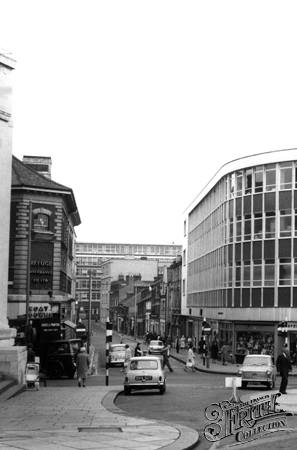
![The Town Hall smouldering [Z1306-75]](https://mccreadyandchess.com/wp-content/uploads/2015/01/the-town-hall-smouldering-z1306-75.jpg)




















 McCreadyandChess