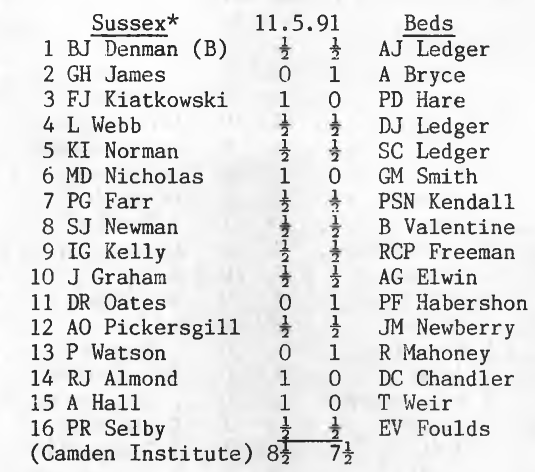
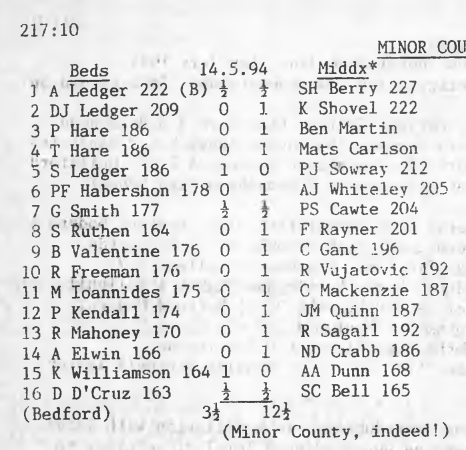
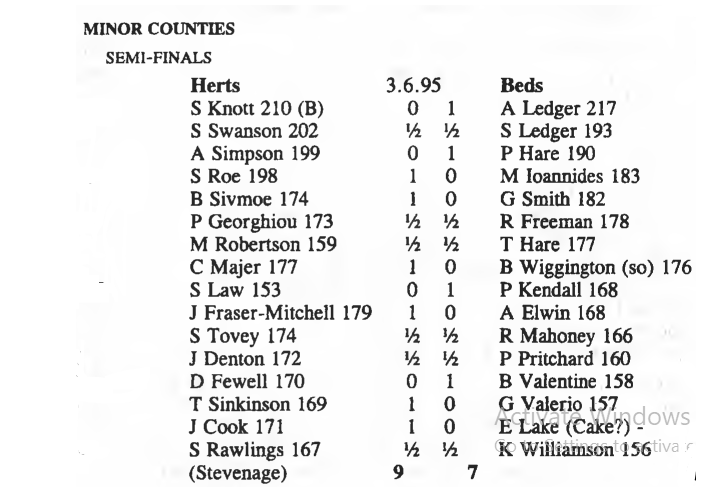
These results are all that can be lifted from the S. C. C. U news bulletins, that is the primary source and only that.








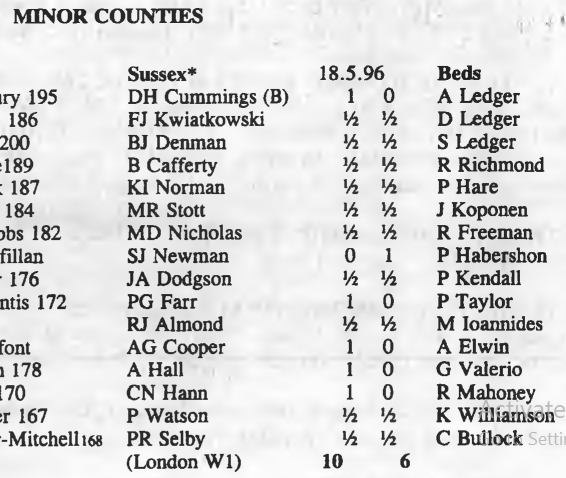


M J M
Posted in History of Bedfordshire Chess on July 26, 2025| Leave a Comment »
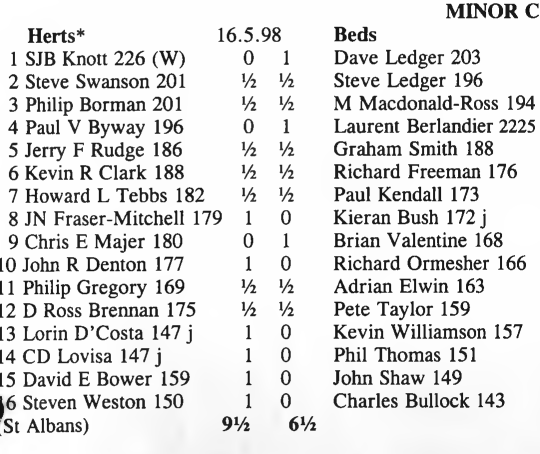
These results are all that can be lifted from the S. C. C. U news bulletins, that is the primary source and only that.
M J M
Posted in History of Bedfordshire Chess on July 26, 2025| Leave a Comment »
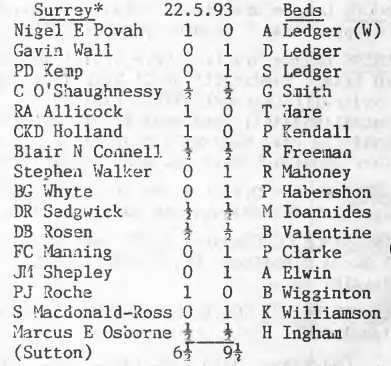
I have no recollection of this whatsoever. I can’t imagine that my rating is correct there but perhaps it is. Don’t remember the event. Couldn’t even tell you where the location is without looking on the map. Taken from the S. C. C. U bulletin May 1993.

M J M
Posted in History of Bedfordshire Chess on July 13, 2025| Leave a Comment »
Fellow Bedfordshire chess players: the only player who emerged from the Bedfordshire league and went on to become a GM was James Plaskett, and thereafter British champion in 1990 in sunny Eastbourne.
But just how good was he whilst still playing in the Beds. league? Well, he did finish second in the British championship in 78, however, that is just a statistic, so can hardly be classified as being heuristic for the average club and county player if drawing direct comparisons is the name of the game. What if I said his rating in the 1979 B.C.F list was 222, of further help? Let’s shift the goalposts somewhat.
In completing Norwood’s spiffing The Chess Traveller’s Quiz Book, I did notice that the very last puzzle comes from one of GM Plaskett’s games; an impressive victory accomplished while he was still playing in the Beds. league at the time. If you fancy it, I suggest you try to solve it, then decide for yourself how graspable it is, or is not! From that you should be able to deduce any disparity in ability there may be between yourself and that of a young Plaskett’s. You should bear in mind it is the very last puzzle of the book thus the hardest, (unsurprisingly, I couldn’t even get the first move right!). It is hoped that such endeavour should offer up some indication of his strength comparatively but do bear in mind this pertains to solving a puzzle, so you know something is afoot in the postion. That said, may I suggest you set aside a good few minutes for this if not more and, perhaps, put the right sort of thinking cap on? I should also add the solution to the puzzle is below.
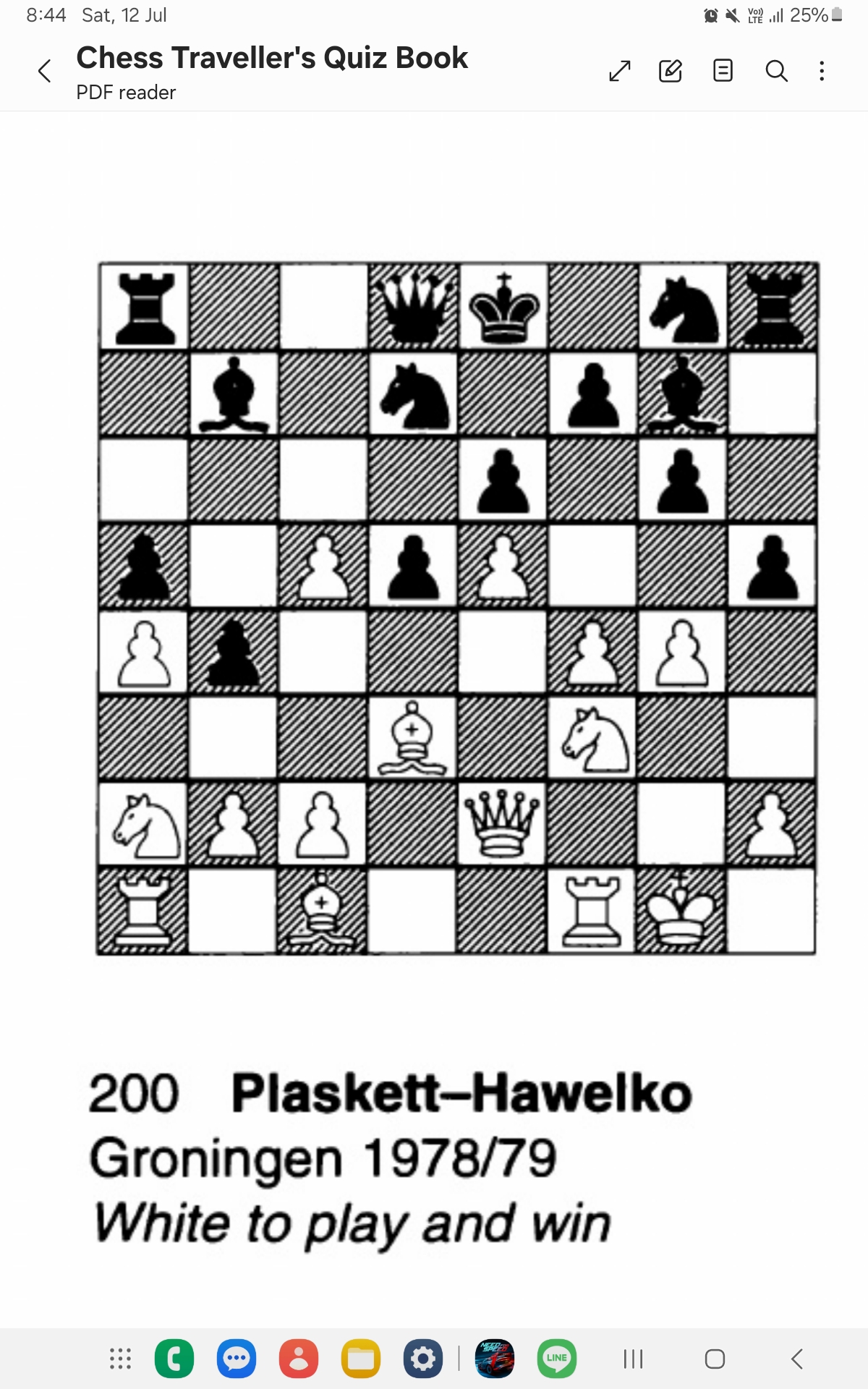
Solution is below. Please refrain from reaching for it initially as it is somewhat self-defeating. Unhelpful clue -as I found out to my surprise, the first move is not Bxg6!

For further information on the game it should be pointed out that it was played in the European Junior Chess Championship, and that GM Plaskett finished 3rd, behind Soviet Union GM Sergei Dolmotov (2nd) and Dutch GM Jon Van Der Wiel. Some information can be found in the following link. https://www.olimpbase.org/~~V/ind-eicc/eu20b-1979.html?__r=5.8830a57d4c3c59c6d5e85f1c4c551575
NB. Comments placed on this site along the lines of ‘What in the devil’s name was the point in asking me to try and solve that!’ I shall not reply to. Praise along the lines of ‘Ah thanks, so that’s how good one of our own once was while still playing for Bedfordshire’ shall be welcomed.
“The Eleven Home Counties, which are thought in Land Taxes to pay more than their proportion, viz. Surrey with Southwark, Hertfordshire, Bedfordshire, Kent, Essex, Norfolk, and Suffolk, Berks, Bucks, and Oxfordshire.“
An Essay upon Ways and Means of Supplying the War, 1695 Charles Davenant
Mark. J. McCready
Colombia
Posted in History of Bedfordshire Chess on June 8, 2025| Leave a Comment »
William Ward, who is documented playing for Luton around the turn of the 19th century, is almost certainly the forth strongest player of all time to play chess in Bedforshire, if and only if, the EDO historical rating site is to be trusted fully, putting his rating at ELO 2422 at its apogee http://www.edochess.ca/players/p562.html.
He came third in the 1905 British Chess Championship in Southport and in taking a look at some of his games, I noticed a curiosity. I have discovered what must be his quickest win ever, courtest of Britbase (see game 60). https://www.saund.co.uk/britbase/pgn/190508bcf-viewer.html. He won in only two moves! I am researching how this came about and will update in due course.
Next day’s update
A brief online chat with author and historian Richard James has drawn attention to such games being described as game stubs, where the newspaper or magazine referred to does not have the entire gamescore for whatever reason.
McCready, latin america
Posted in History of Bedfordshire Chess on May 27, 2025| Leave a Comment »
“Truth is what your contemporaries let you get away with.” -Richard Rorty
Fellow chess players of Bedfordshire, in returning to Chess in Bedfordshire (F. Dickens & G. L. White: Leeds Whitehead & Miller 1933) once again, courtesy of ineluctable ongoing research, please allow me to draw attention less so to the quote above and more so to the once documented county debut defeat of ours in the S. C. C. U, with special attention paid to a certain individual in particular, since none at all was in the aforementioned publication. First, a recap of the result:
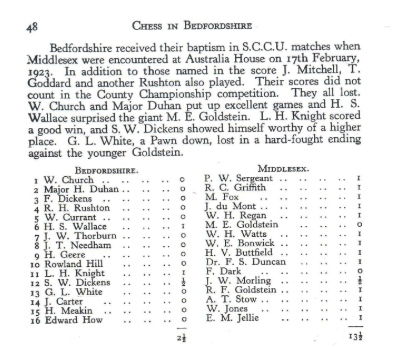
Somewhat aside: chess history is not usually as laudable as some readers may think, with authors not being seen as paragons of virtue by all, especially postmodernists or historiographers who may continuously connect interpreting meaning to establishing significance amongst many other things; and so to understand the nature of this defeat, an examination of Middlesex‘s top three boards does not postulate but in fact proves a gulf in class at the top end of the teams, and in all probability one that trickled down throughout the lower boards too, thus a principle determining factor in the disconcerting defeat on our debut, most likely.
Their Board 1
Fellow county chess players, you may already be acquainted with their top board: the esteemed P. W. Sargeant, him being the author of the then future publication A century of British chess (1934). The estimated rating attributed to him by the EDO Historical Chess Ratings website (not entirely reliable but good enough) at the time of the match was 2115 http://www.edochess.ca/players/p4038.html but it should be pointed out, however, that he was the Middlesex county champion of 1921, two years previously.

Their Board 2
On board two was R. C. Griffith. British champion in 1912 in his only such appearance, and as can be seen above, champion of Middlesex some two years after that. Impressive indeed for a board number two. The EDO website has him estimated at 2261 that year http://www.edochess.ca/players/p4615.html.
Their Board 3
And so board three, thee board three, he who this post is about -and hardly surprising too, the Canadian Maurice Fox. The EDO website has him rated at 2341 the year Bedfordshire was beaten. http://www.edochess.ca/players/p7358.html.
More significantly: four years before he beat our F. Dickens, he outfoxed future world champion Capablanca in a simul with the black pieces, https://www.chessgames.com/perl/chessgame?gid=1328964, suggesting that he was too strong to play on board three at county level despite Capablanca not being at his optimal best.

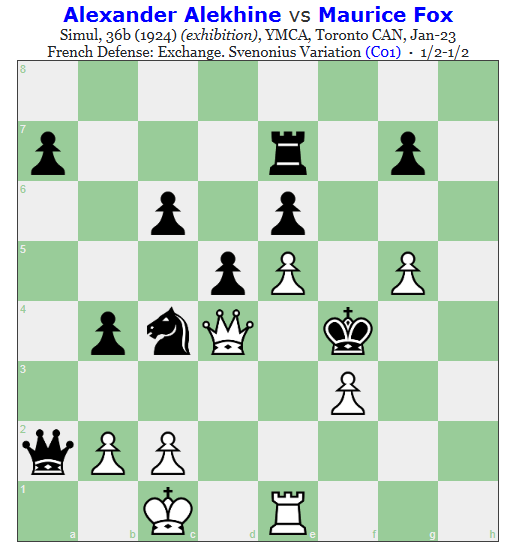
According to various sources, later in 1923 he emigrated to Canada. The following year he faced another future world champion with the black pieces, this time Alekhine in a simul in Toronto. During the middlegame, increduously, he decided to march his king down to e3 even though Alekhine still had a queen, rook and knight on the board; sacrificing a rook and a knight along the way and leaving Alekhine the option of allowing himself to be mated instantly or force perpetual check instead! See below. https://www.chessgames.com/perl/chessgame?gid=1012317
He then went on to win the national championships in Canada a joint record eight times (joint with GM Yanofsky), with his estimated rating peaking in 1929 to 2364. Much more impressively, in the 1950s he not only outfoxed yet another future world champion with the black pieces but beat him too, a certain Robert. J. Fischer https://www.chessgames.com/perl/chessgame?gid=1044029.
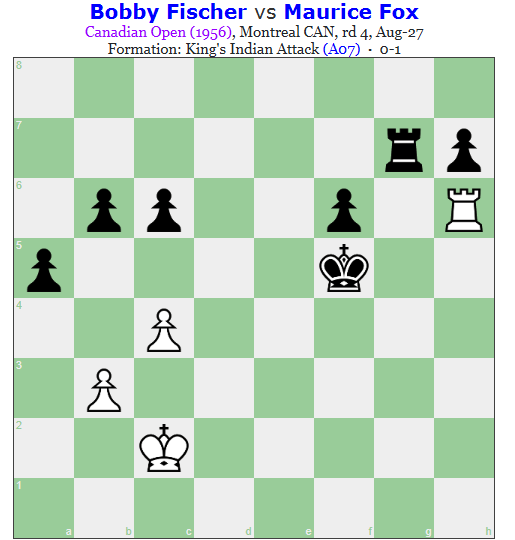
According to the following link, this game occured at the very first Canadian Open, in Montreal 1956 https://www.bcchesshistory.com/canop5662.html and even though Fischer was only 13 at the time with a rating as low as 2156, he could be hardly be classified as a push over given that at the very same age he played what was called the game of the century against Donald Byrne, thus described by Hans Kmoch ‘The following game, a stunning masterpiece of combination play performed by a boy of 13 against a formidable opponent, matches the finest on record in the history of chess prodigies.” Here is the game in case you have forgotten it https://www.chessgames.com/perl/chessgame?gid=1008361.
Shifting the focus homeward bound, how did our top three stand in relation? In terms of estimated ratings, there is little to go on.
Our board 1
W. Church of Luton (no results attainable, no rating estimated)
Our board 2
H. T. Duhan (of Bedford: estimated rated 2141, 12 years previously) http://www.edochess.ca/players/p12485.html
Our board 3
F. Dickens (of Dunstable & Luton: no results attainable, no rating estimated: aside please note for our purposes, he played alongside Nigel Staddon’s father for many years).
Do also note that the co-authors of Chess in Bedfordshire (F.Dickens & G.L White: Leeds Whitehead & Miller 1933) are playing on boards 3 and 13, and H. T Duhan (our board 2) had already become champion of South Africa eight years after The Boer War had ended in 1910, as has been documented on this site, and also S.Dickens, who drew on board 12 once turned over Tartakower in a simul in Luton in 1928 (also documented on this site).
‘Bedfordshire received its baptism in S.C.C.U matches when Middlesex were (that’s a collective noun and so should be followed by was not were: subject and verb disagreement) encountered at Australia House on February 17th 1823′. Oh really? Baptism of fire was a more aptly chosen term I would say. Their board trois beat deux of, and drew with un of, those always in the top dix greatest players of all time! No wonder we were trounced on those top boards: of those playing lower down the order, the evidence is too depressing to investigate further, and I am too wounded to conduct it!
…if it’s any consolation, I am quite sure that was the only time we faced a county whose board three racked up wins against Capablanca and Fischer, and drew with Alekhine! And should it be the case that once more evidence becomes apparent in retrospect, of us losing heavily to counties fielding players below top board so fiendishly strong that they make beating some of the greatest players of all time with the black pieces look like a doddle, I shall be the first to write a letter of complaint -simul or no simul involved!
A consolation of sorts
Last, but by no means least, another perspective: regarding county players who have beaten future world champions with the black pieces, the all-time score between Middlesex and Bedfordshire is most probably 1-1. If, and only if, it is true that Fox is their only player to do so, and GM Plaskett is ours (he beat Anand before he became world champion) that is. And on that note -draw agreed! https://www.chessgames.com/perl/chessgame?gid=1018022.

“The world does not speak. Only we do. The world can, once we have programmed ourselves with a language, cause us to hold beliefs. But it cannot propose a language for us to speak. Only other human beings can do that. ”
― Richard Rorty
Mark. J. McCready
Posted in History of Bedfordshire Chess on May 9, 2025| Leave a Comment »
When those who emerged from the Bedfordshire League compete against one another in national or international tournaments it denotes attention. According to my research so far, the first instance of this occured in 1965 and can be found here: https://mccreadyandchess.wordpress.com/2024/12/16/the-red-corner-and-the-blue-corner/. Courtesty of some social media chat, I more recently learnt that all of the Ledger brothers have played GM Plaskett at national or international level, with all of the Ledger brothers achieving results at some stage or another.
IM A. Ledger v GM Plaskett British Championship 1997
https://www.365chess.com/game.php?gid=1226047
FM D. Ledger v GM Plaskett Gibraltar 2003
https://chesstempo.com/game-database/game/h-james-plaskett-vs-dave-j-ledger/101052
S. Ledger v GM Plaskett Hastings 90/91 (no gamescore available. Refer to the crosstable: GM Plaskett No. 58 S. Ledger No. 96) https://www.saund.co.uk/britbase/pgn/199012hast-viewer.html
Well done the ledger brothers for achieving results against former BMS pupil and British champion GM Plaskett.
Mark. J. McCready
Posted in History of Bedfordshire Chess on May 4, 2025| Leave a Comment »
In Reading Timothy Harding’s doctoral thesis ‘correspondence chess in Britain and Ireland, 1824-1914, a social and cultural history‘, which may be found online here Thesis, I learnt that Befordshire made an appearance on pg. 283.
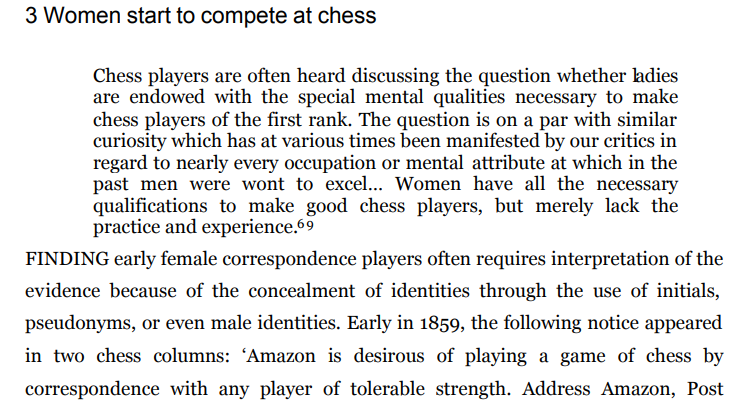


Victorian England is the context, the chapter pertaining, documenting some of the difficulties and challenges female players faced back then in much detail. Fellow county chess players, if you look through what has been posted on this site, you will note that, locally, women were never written about regarding chess in Bedfordshire, however, this does not mean that chess was not played by women in Bedfordshire but rather that it was more likely played at home rather than at a club as was commonplace back then, the author claims. The post-modern historian Jenkins once wrote in his publication Re-thinking history that ‘history and the past are categorically distinct’, herein lies evidence and argument to that effect. Put more simply, just because something has been left undocumented, it doesn’t mean it did not happen.
You may find what is linked below of further interest.
Mark. J. McCready
Posted in Bedfordshire Chess, History of Bedfordshire Chess, Trivia on March 31, 2025| Leave a Comment »
‘Knowledge is power.‘ Francis Bacon, Meditationes Sacrae 1597


All 50 questions, which should you seek the footnoted answers below will, I hope, broaden your understanding of Bedfordshire Chess Present & History greatly. All scores are welcome in the comments also. The primary purpose here is not so those attempting the quiz can answer all Qs. correctly but rather the questions will inspire those reading to seek the answer (footnoted) below.
An addendum: anything I have missed which should have been included do suggest (I will modify), the questions being too hard or not seemingly of no importance (please say so), any other suggestions and criciticisms are graciously accepted. This is a fun way to improve your understanding of the History of Bedfordshire Chess. The questions have been carefully chosen.
Mark. J. McCready
08.41, Monday, March 31st, Bogota, Colombia.
Posted in History of Bedfordshire Chess on March 2, 2025| Leave a Comment »


Mark. J. McCready
Posted in History of Bedfordshire Chess on February 26, 2025| Leave a Comment »
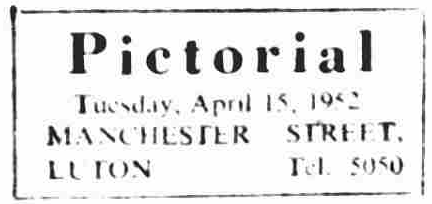
When was the north/south divide removed from league chess, enabling a change of name and our league becoming the Bedfordshire Chess League? See below.
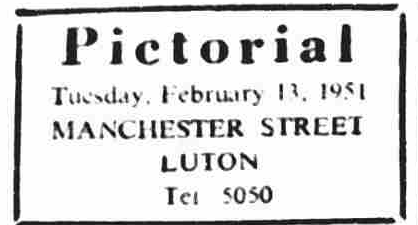

They were accepted, in 1952 it became The Bedfordshire Chess League. See below.
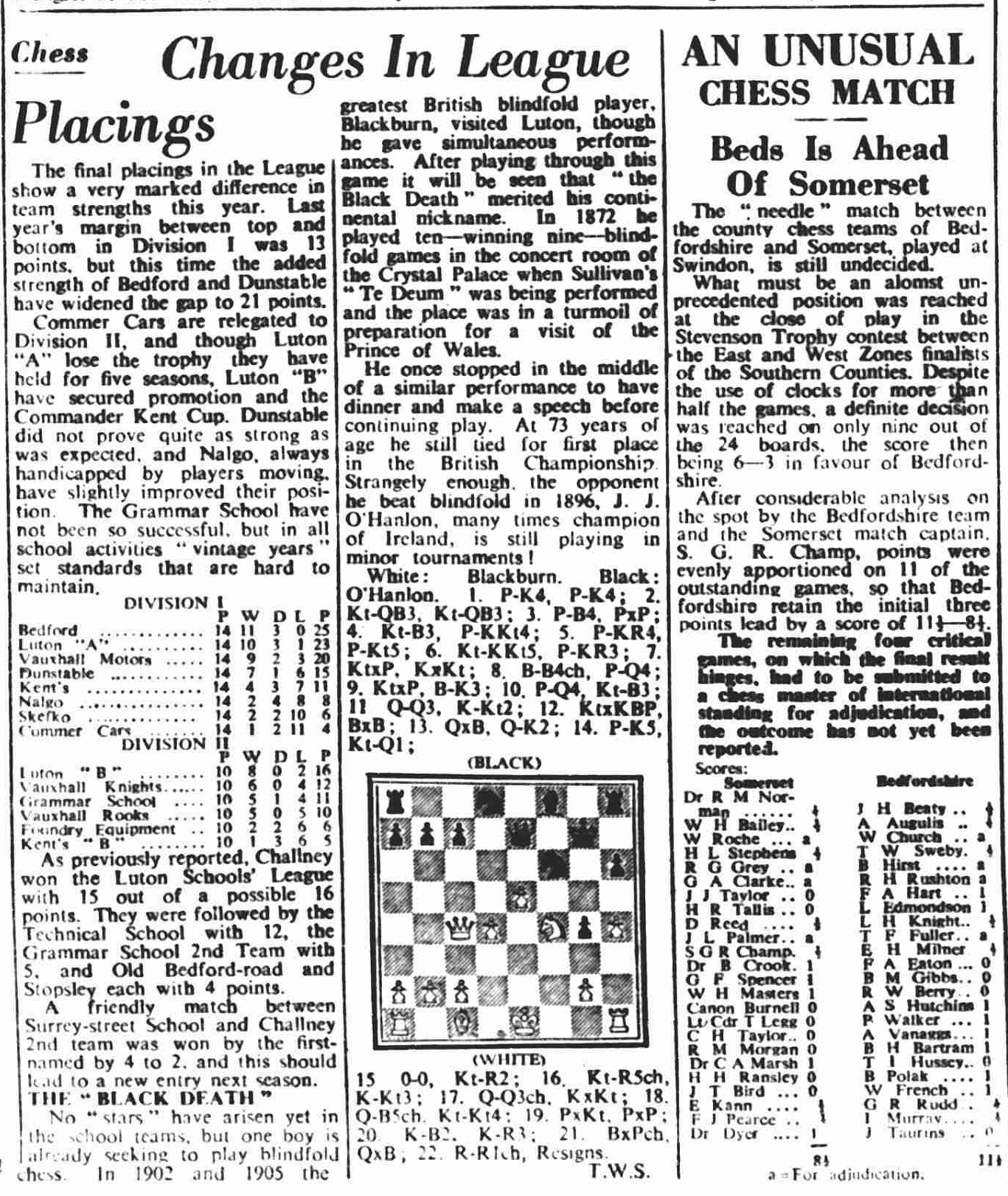
Mark. J. McCready
| M | T | W | T | F | S | S |
|---|---|---|---|---|---|---|
| 1 | 2 | 3 | 4 | 5 | ||
| 6 | 7 | 8 | 9 | 10 | 11 | 12 |
| 13 | 14 | 15 | 16 | 17 | 18 | 19 |
| 20 | 21 | 22 | 23 | 24 | 25 | 26 |
| 27 | 28 | 29 | 30 | |||
A side note on how to read old Tom Sweby's columns
Not perhaps, but quintessentially, Old Tom Sweby is best thought of as a passionate devotee to the newspapers he wrote for. He was well read and knowledgeable of the Bedfordshire chess scene and well beyond, given that he was the president of the S.C.C.U. once upon a time. He was generally well-respected and rubbed shoulders with many, if not all, of those eminent within British chess circles. It would, however, be a critical mistake to see his column is primary source material entirely. That it is not. You will also find secondary source material quoted too, and the reliability of that is not quite as Tom hoped. Given that he wrote for decades, this is to some degree inevitable, and after all we are all prone to error whether we realize it or not. Thankfully, with regards to old Tom Sweby, they are infrequent and for the most part old Tom continued to document events and developments in the Bedfordshire league from the get go as best he could but, of course, everything lies open to interpretation. Despite this, and generally speaking. this does indeed make him informative and thus worth reading. Dare I say his columns constitute a narrative describing the latest developments, match reports and changing nature of the Beds league...he knew his audience and wrote according. This manifested itself over decades but brevity was always in play courtesy of the restictions imposed by writing a column. Should you wish to read a in instrumental figure of the Beds' league post WW2, you are quite welcome to peruse what has been posted here... . :-) I should, however, point out that as the decades wore on he gradually moved on away from narratives concerning the Bedfordshire league towards affairs both historical and international. The reasons for this are multifarous, old age was a predominante factor presumably, however, the bottom line is with regards to how the Bedfordshire chess scene developed post WW2: old Tom Sweby is your go to guy. He wrote more about chess in Bedforshire than anyone else did but given he was a Lutonian and writing for a Luton newspaper there is both bias and greater coverage of his hometown than the rest of the county.

















To add comments, please see the bell at the top of the page.
 McCreadyandChess