If there is one thing chess teaches us that is of greater value than all else, surely, it must be the importance of learning from your mistakes.
If we apply to life what we take from chess, imho in the paragraph above therein lies the answer.
MJM
Posted in Life beyond the chess board on December 13, 2024| Leave a Comment »
If there is one thing chess teaches us that is of greater value than all else, surely, it must be the importance of learning from your mistakes.
If we apply to life what we take from chess, imho in the paragraph above therein lies the answer.
MJM
Posted in Life beyond the chess board on December 8, 2024| Leave a Comment »
…eventually I will return home, its only a matter of time…
…when I read Homer’s Odyssey in Summer 1993 I distinctly remember when Odysseus returned home there were many unwelcome suitors at his home, gaff much to his dismay…
…I wonder not if I will feel the same but I am unsure what will come of it all…
…technically speaking I am almost inactive and have been so for some time…
…I have become quite unused to competitive chess, whether I will resume playing is something I am yet to ponder…
…it is undeniably true in all eventuality I will resume some responsibility although the extent of that is likely to remain undetermined until my presence is felt…
…no doubt I will get shanghaied into something or other…
…1997 seems like a long time ago now…
…what’s most important of all is that it is inevitable, its just a matter of time…
…I had thought I would not return to classical chess but more recently realized, it is infrequent tournament chess pushing that agenda and not contempt for classical chess, more so being out of form through lack of practice…
….once a dream that I would return home to run my old club and county is, given the distinct lack of competition, not just a dream and more so a probability than a possibility…
…I cannot say when this will occur as it is contingent on other factors more pressing…
…as Arnie once said ‘I’ll be back’…just not quite sure how I feel about it yet.
…ah well
…time will tell…
…above all else it must remain the case that those of us within Bedfordshire should continue to enjoy league, country, and national chess…given that theres always someone better than yourself, lets see how it pans out…perhaps it’s just a dream…
Mark. J. McCready, Mandalay, Myanmar
Posted in Life beyond the chess board on November 28, 2024| Leave a Comment »
Former county team mate Kevin Williamson handed this to me, a draw from the clutches of those scowling winds of Winter, way back in 1992. I can see why I gave up chess 5 years later. Puny little attack that was going nowhere in an opening I was uncritical of. Thankfully I have no recollection of this particular game, but can account for why I played that way at that particular stage of my life… .


Posted in History of Bedfordshire Chess, Life beyond the chess board, Personal Interest & Experience on November 23, 2024| Leave a Comment »
Viewing history as a literary artefact is not a debillitating nor less a terminal complaint. Rather, recognizing the importance of narrative explanation in our lives as well as the study of the past could liberate historians as we acknowledge and try to narrate the disruptive discontinuity and chaos of the past and in the present. The desire is, in itself, a product of our own age’s preoccupation with understanding the nature of our seemingly chaotic lives. History is itself historical -its methods and concepts as well as the debates about its nature are the products of historical time periods. Alan Muslow – Deconstructing History (1997)
Those who put Bedfordshire on the map over the years:
With regards to the digital revolution we are, happily, undergoing, a number of blogs have subsequently emerged: (most obviously this ‘un). Also:
https://www.bedfordchess.co.uk/
http://www.leightonbuzzardchess.co.uk /
But who be him that has written about our chess history the most? Moi of course.
Mark. J. McCready, Mandalay, Myanmar
Posted in Life beyond the chess board on September 30, 2024| Leave a Comment »
“The experience of art is exemplary in its provision of truths that are inaccessible by scientific methods, and this experience is projected to the whole domain of human sciences.” Gadamer
As an undergraduate in Philosophy, I once took part in the Erasmus programme, where students spent a semester at a designated university of their choosing somewhere in Western Europe -and got paid to do it also! I chose Turku University, Finland in the rainy Autumn of 96.

There, I took book exams (one of which was on Plato’s Republic), lectures and seminars too, mostly on the Philosophy of Science, principally focusing on the text below.
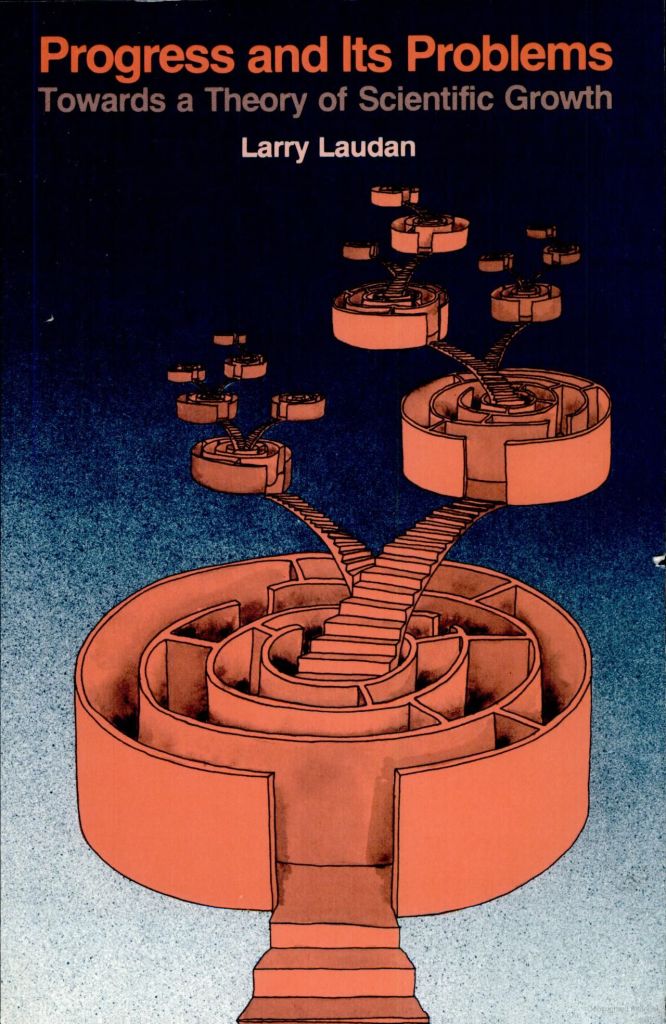
It was a very good read with an interesting title that helped no end that dull grey morning I had to give a presentation on logical posivitism to my class, as my friend Markko watched on with interest. Progress and its problems. Hmm…
It could be argued the modern chess world has much progress and it, too, is not without its problems. For computerization, and the reliance on it, has created a culture of suspicion which reaches beyond you not being allowed to use electronic devices during your game. In fact anything that allows you to store information is expressly forbidden nowadays. This includes objects that were never seen as a problem for decades.
You aren’t allowed to write your move down before you play it now as this can be interpreted as taking notes. Also, you are not allowed to use a scorebook anymore as they may contain notes from previous games which may assist you.


So no more scorebooks then. I had many from the early 1990s as I always used them and never dreamed of using them to look at pre-existing games during play. No one ever did but in the current climate, this is not acceptable. Scorebooks just aren’t allowed anymore. End of story. Don’t ever mention that hardly anyone cheats ever, or anything like that. It won’t do you any good. Supposedly borne in mind here is the greater good and it is that what counts…or so I’ve been told.
I used to enjoy studying the hermeneutics of suspicion immensely as I was something of a Nietzschean back in the day. But I must say it is somewhat saddening that so much suspicion exists in chess today. Quite unnecessary if you ask me. But given that chess doesn’t exactly pass as an academic discipline and languishes in and amongst the netherworlds of intellectual pursuits instead.
MJM
Posted in Life beyond the chess board on July 9, 2024| Leave a Comment »
Brief book recommendation here (allegedly). Only on chapter II but I am well-read enough to spot a read worth its price.
Yes it’s rather outdated. Yes descriptive notation is used. Yes the author ran a column in The New Statesmen for decades. And yes when I created a thread about him, noted authors were generally complimentary towards him.
But as you may know. Not all books on chess are written well and as is true in all fields some are better than others and some are much better than others. The authors style is indeed impressive. Here he makes a rather basic point but expresses it rather eloquently:
‘It is nice enough to enjoy other people’s brilliances, but nicer still to produce one’s own. To derive some aesthetic pleasure from the flights of fancy conjured up on the sixty-four squares is delightful enough when the conjurer is someone else, but the pleasure can be much enhanced by the thrill of creation and the pride of achievement.’
In the following passage the author Heinrich Fraenkel gives you an idea of his playing ability and character :
‘Regarding the topic of blunders the topic is handled quite delicately and written for a broad audience:
‘What about our own? Most of us, surely, have no shortage of them and some (some?) of us may have more than they care to remember. They are wrong for there is nothing like of the past to serve as a useful lesson for the future (ed: most, if not all SGMs will cite that as an integral part of the leasing process. A lesson to never blunder again. That could hardly be expected (please take note this was written before faster time controls were introduced). More likely, it will be a lesson to accept our every future blunder with ever more equanimity.
The only sad point I feel worth drawing attention to is on page 53 where he commits the cardinal sin in the chess literature genre, that being defining chess players as only that. He portrays Botvinnik as the world champion only, rather than a human being and a Soviet citizen. ‘Botvinnik has the rare distinction of having gained and lost and regained such paradise ‘the glory of supreme achievement’ as he put it. Although undeniably true, the tragedy is when you bypass the normative aspects of what something is, you invariably say very little about it. Botvinnik took time out to do a Ph.D, he became an engineer and was well promoted. He was a father too! It was a little saddening to find another characterisation where only their chess was of importance, but then it is replete within chess literature as a genre and has always been. It’s a little saddening when the author clearly has strong writing skills that they don’t write as broadly as they could…but the good news is a more wholesome account of Symslov appears in the following chapter, which we are entitled to dub a reprieve.
August 15th update
So I read the book. The latter sections contain content I found astonishing. I don’t ever recall seeing someone who is not a native speaker of English write so well with it, I really don’t. Great writer, of that there is no doubt. His stature in his day I am less sure of. His account of Soviet Chess I shall reproduce on this site at a later date.
Well worth a read if you can lay your hands on it.
Mark. J. McCready
Posted in History of Bedfordshire Chess, Life beyond the chess board on May 22, 2024| Leave a Comment »
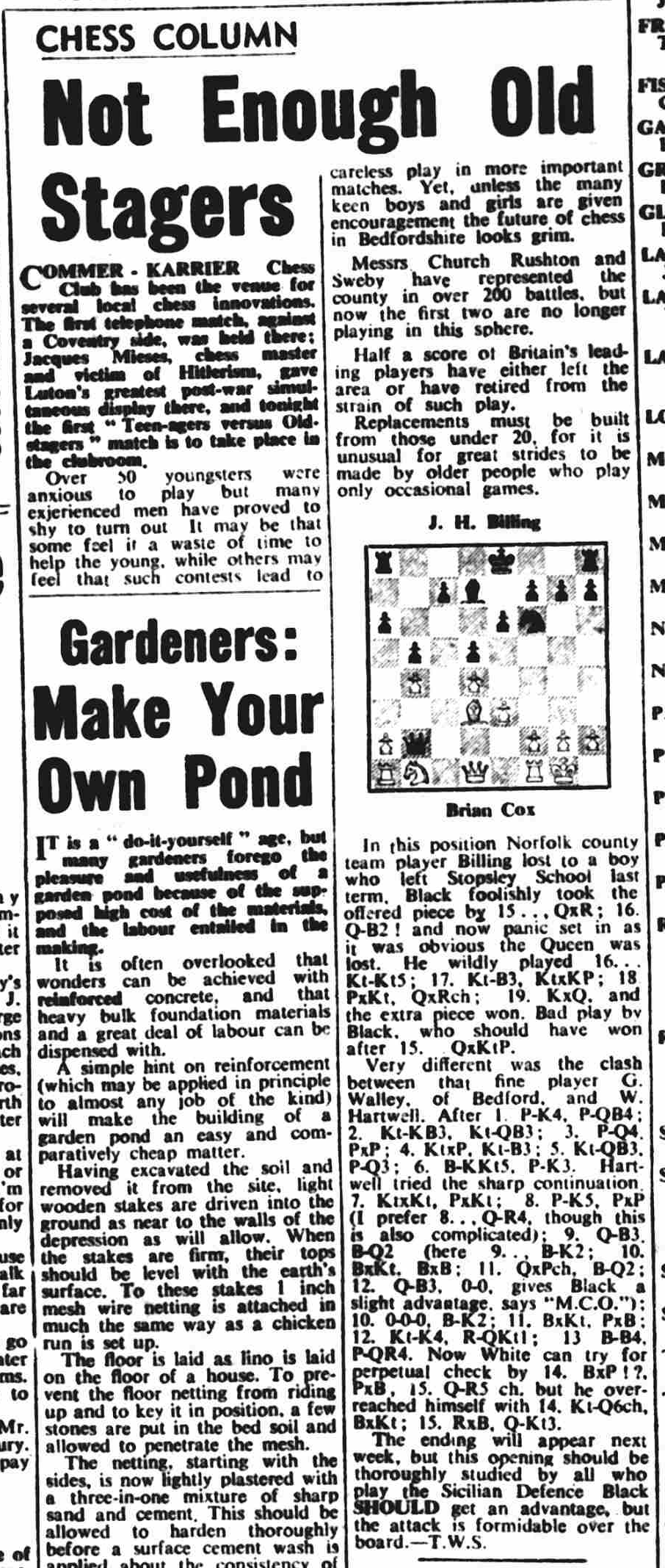
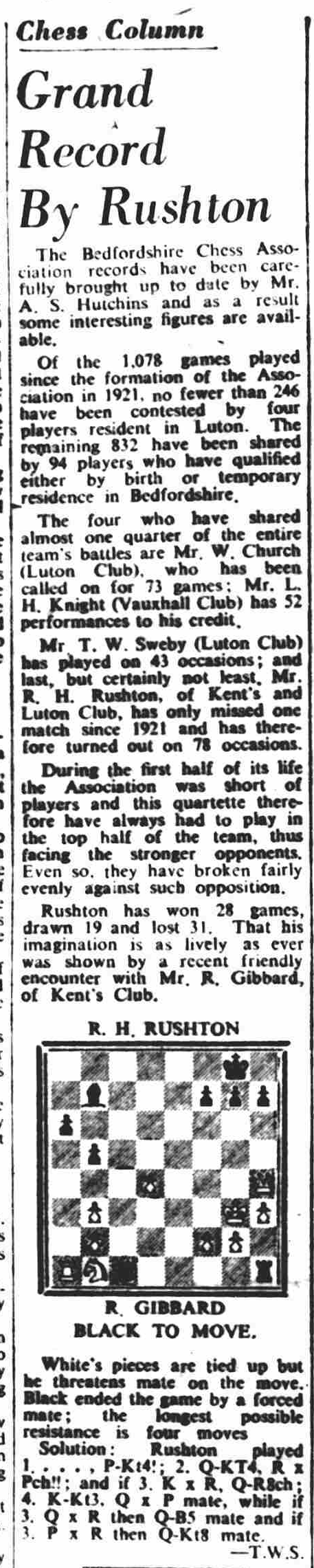
I do recommend you scroll through the columns below as they will help you form a picture of what how chess was played in Bedfordshire then. There are noticeable differences to nowadays and it is a critical mistake to assume our county was unified back then -it most certainly wasn’t.




































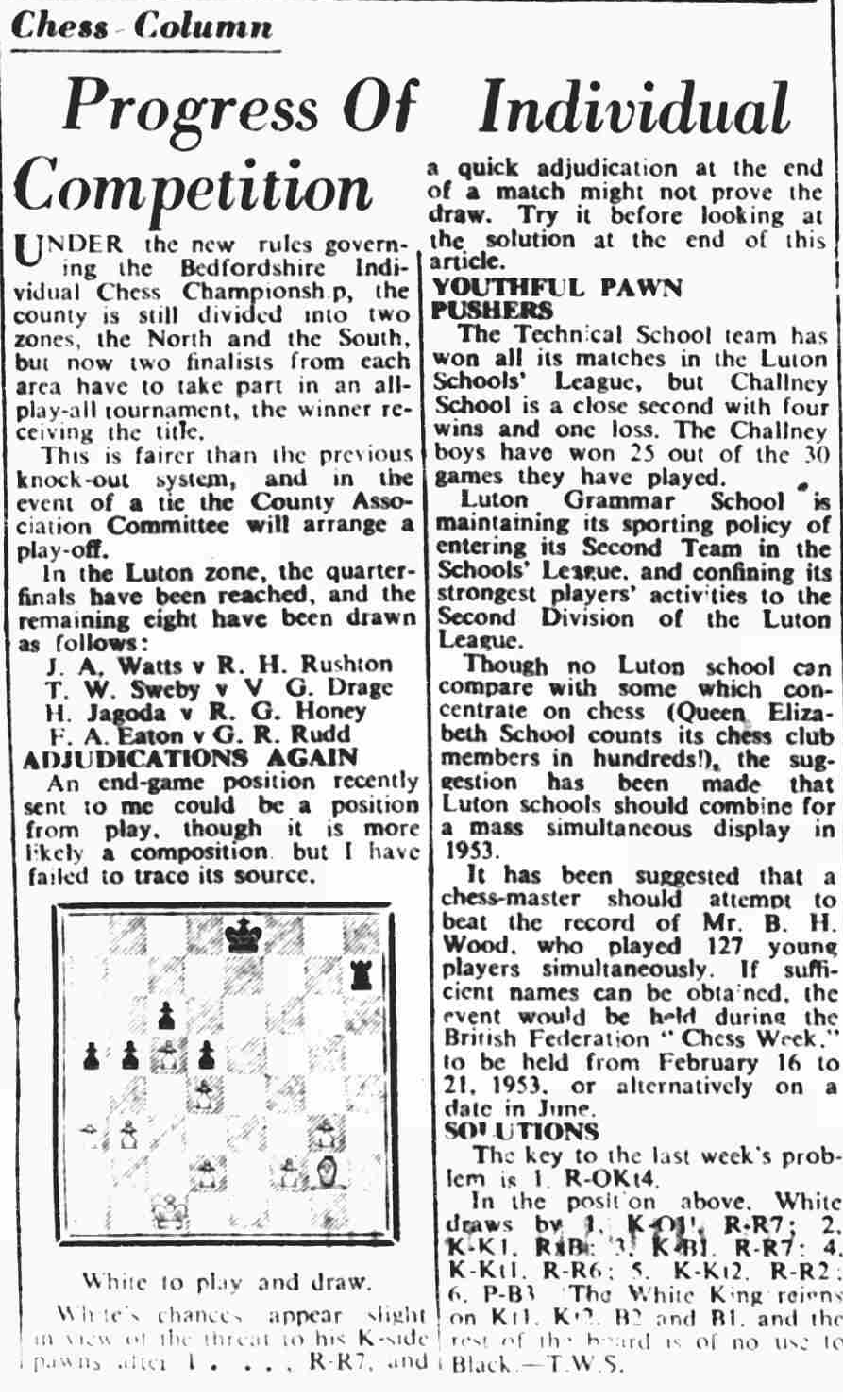



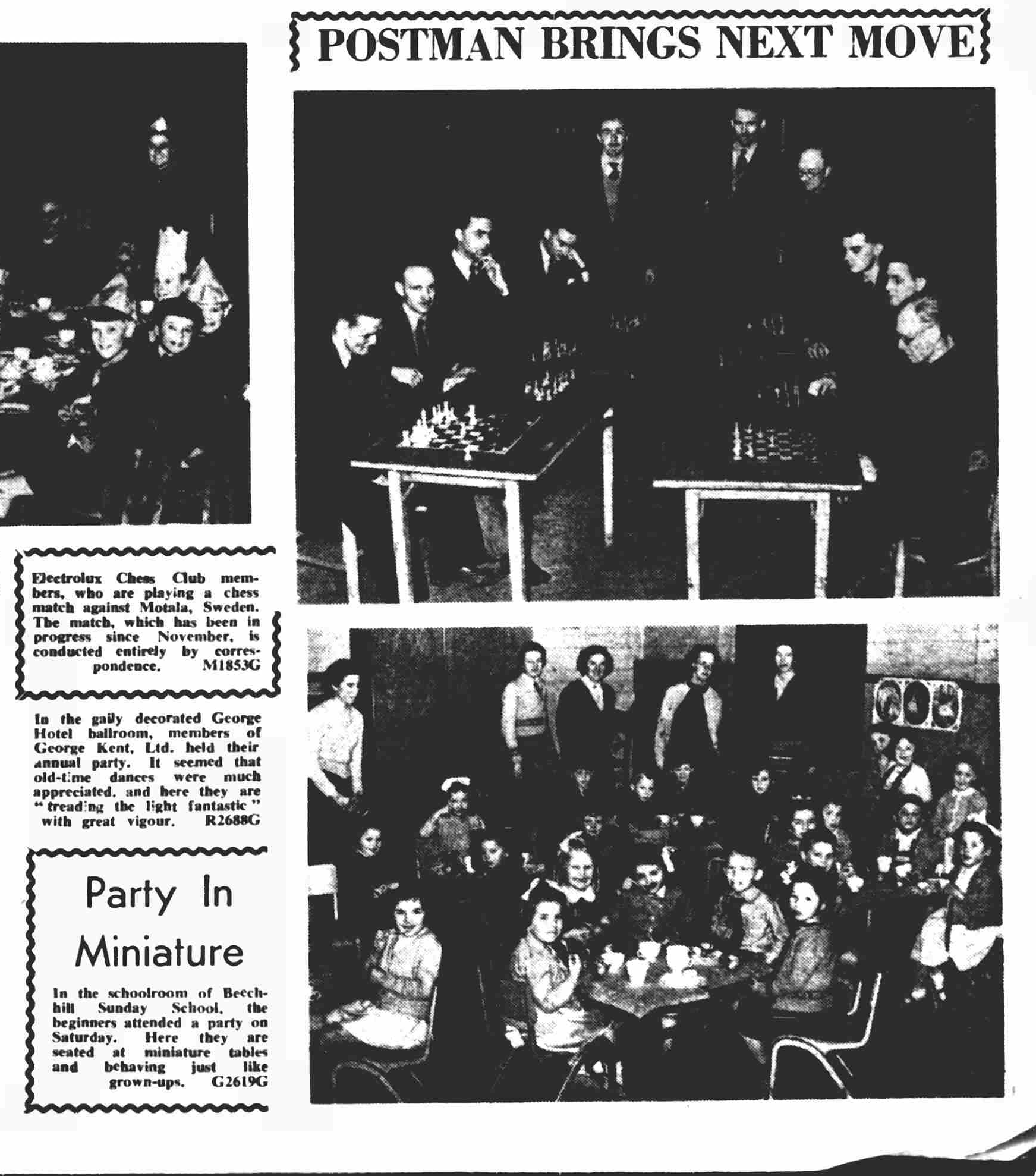



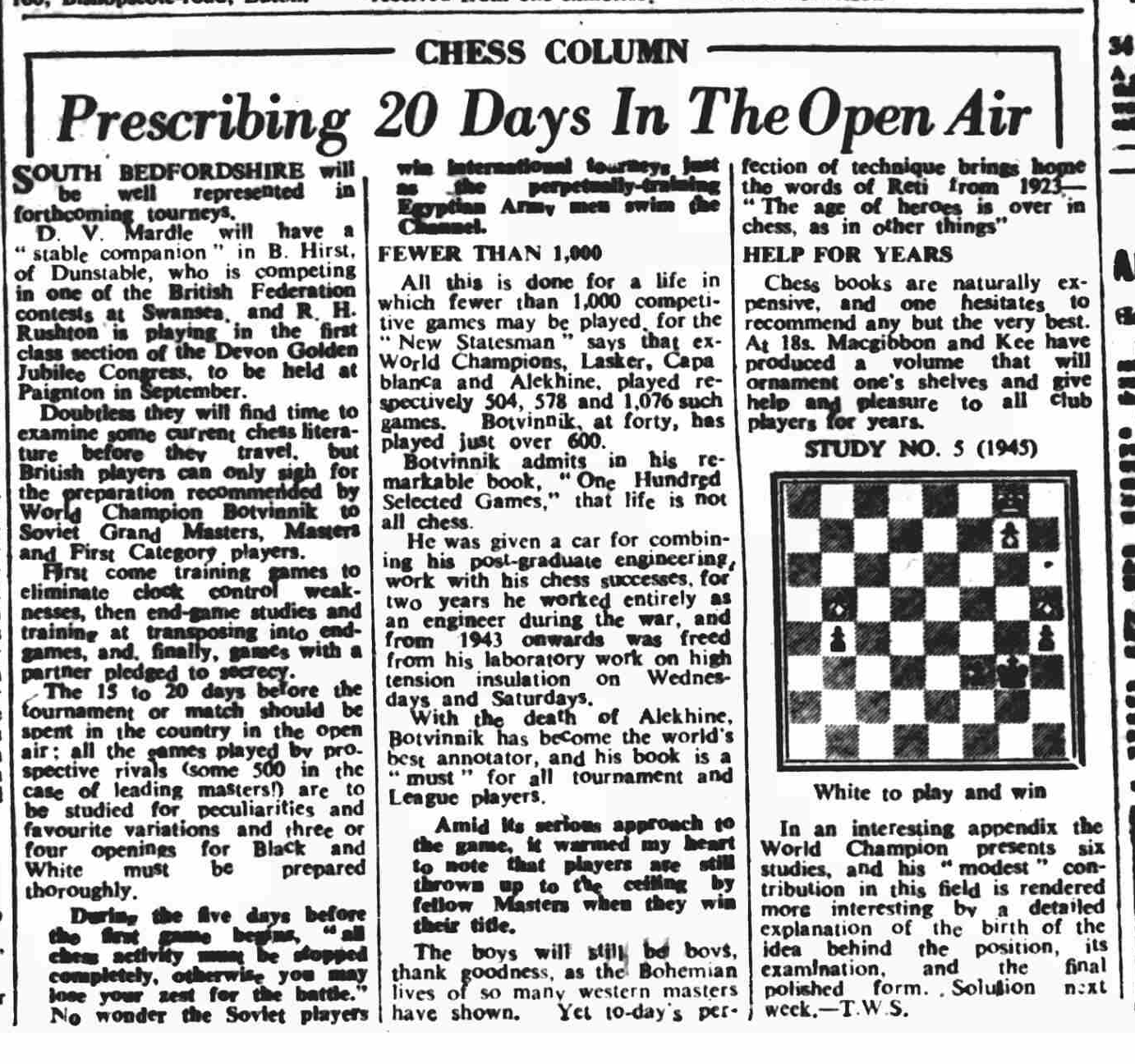


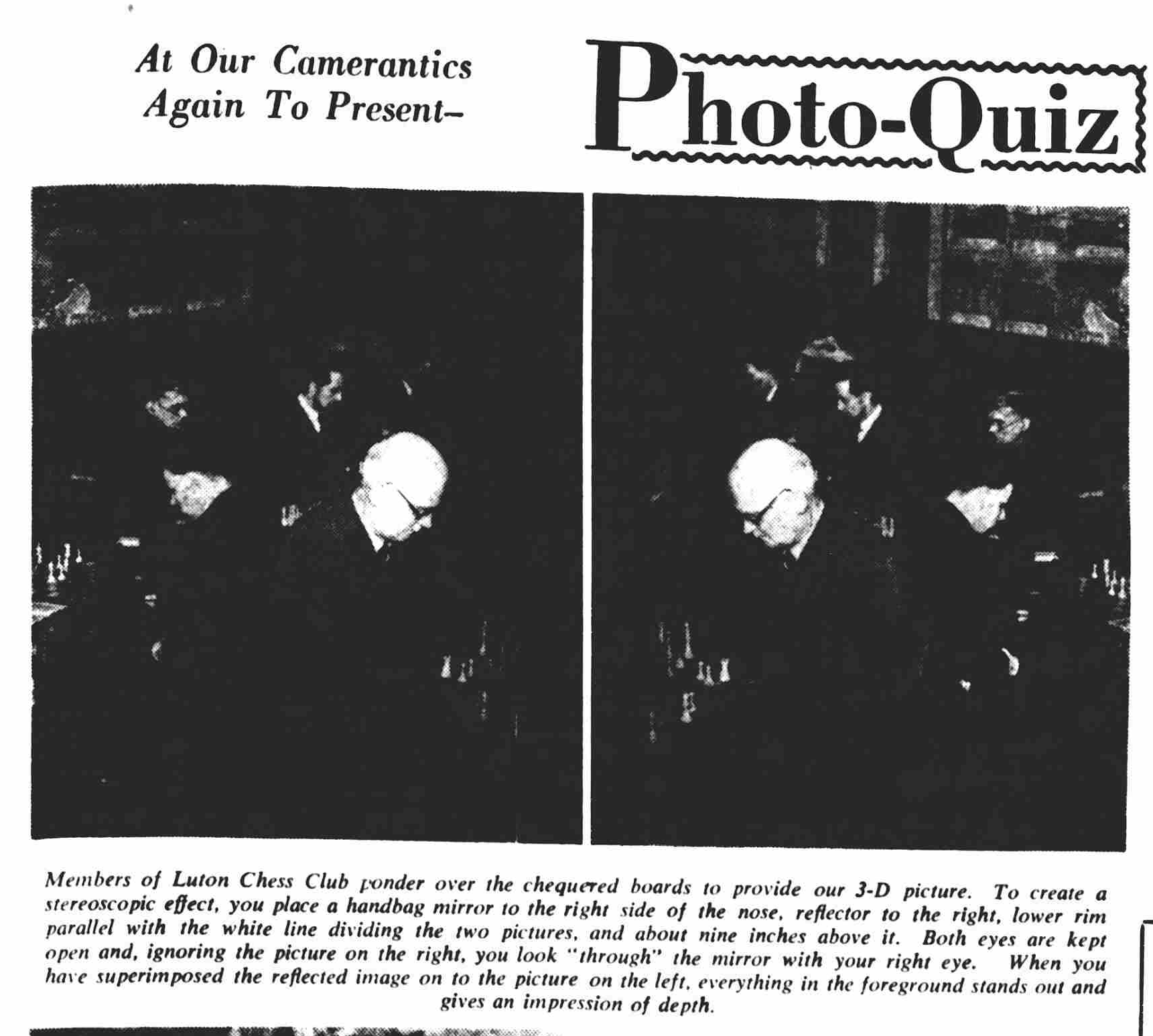
Posted in Life beyond the chess board on March 22, 2024| Leave a Comment »
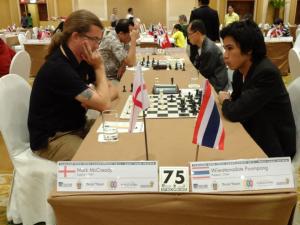
To prepare for a visit to Bangkok Chess Club and a FIDE rated Rapid tournament next weekend, and then a 9-round classical chess tournament the week after in the countryside, I have begun to ready myself…to prepare.
I’ve tidied up my opening repertoire already and begun reading Rowson once more. I’ve also noted down what my weaknesses are and how to work on them. I’ve begun playing 10 minute games as well, to implement what I have learnt from Rowson and what I have taught myself. You can find selected games below, which I hope illustrate the size of the task ahead and help raise my awareness of what needs to be done.
Game 1
Game 2
MJM
Posted in Life beyond the chess board on March 22, 2024| Leave a Comment »
I decided to look at an early career victory by GM Plaskett over GM Speelman. And although the position below looks rather promising, I don’t see how Stockfish evaluates it so. I wouldn’t even call it winning…just promising.
All info required is in the image below.

Posted in Bedfordshire Chess, Life beyond the chess board, My Own Games on February 18, 2024| Leave a Comment »
We played on the same team on 87 (Luton A), and were members of the same club in its final year, so let’s see if Board 1 can beat Board 4! (most probably!)
Game on
1. e4 c5. We start with a Sicilian because it offers more counterplay than the French, which I grew rather tired of as the years rolled on by.

2. Nf3 e6 3. d4 cxd4 4. Nxd4 Nc6 5. Nc3 Nf6 (note to self: try to remember the correct bloody move order next time please!). Uppsala! Having not played one single game in 8 months, I simply forgot 5. …a6 or 5. …Qc7 are the most playable responses that avoid transposing towards the deluge of open Sicilian theory -clumsy.

6. Ndb5 d6 (almost a necessity and frighteningly transpositional!)
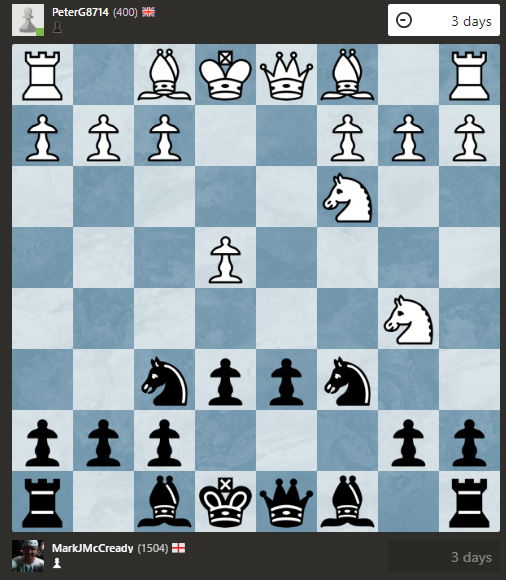
7. Bf4 e5 8. Bg5 a6 9. Na3 b5 10. Nd5 Be7
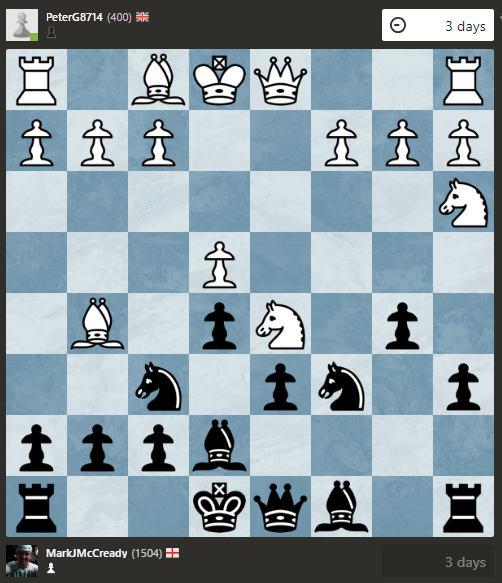
We have transposed into the Sveshnikov but that’s quite alright as I played it for a few years and read up on it too! But as GM Rowson once said ‘the Sveshnikov is full of holes’. They can appear on both flanks, some caution is needed.
11. Bxf6 Bxf6 12. c4

Yoicks, not the main move, so now I am out of book. Although 12. …Qa5 may look tempting, its not at all, its premature. Black has threats to attend to before any counterattacking ideas can be put into play. I could lose the exchange or a pawn easily if I am not careful. So the plan is to shut things down and shore things up, that way the position should stay in tact – hopefully should! I can’t really tell because I am out of book already, so will stick to the few opening principals I learnt some ten years ago.
12. …b4 (let’s shut things down) 13. Nc2 a5 (and shore things up) 14. Qf3! I chose exclamation mark because I’ve never seen that move before and don’t know why it’s played. Here I play 14. …Be6 because usually the light-squared bishop goes to either e6 or b7 and I never worked out why the latter was the preferable option so, once again, I stuck it on e6, and also because I couldn’t work out what else to do, so blindly follow opening theory and principles I shall but this is really just about as far as I can go, I’m pretty much on my own from now on. I know I may get double f-pawns but that’s okay, all it means is the king should stay in the centre, and that’s okay, its quite safe there with the bishop on e6.
15. Nxf6 (from what I understand this is thematic as black usually ends up with doubled f-pawns)
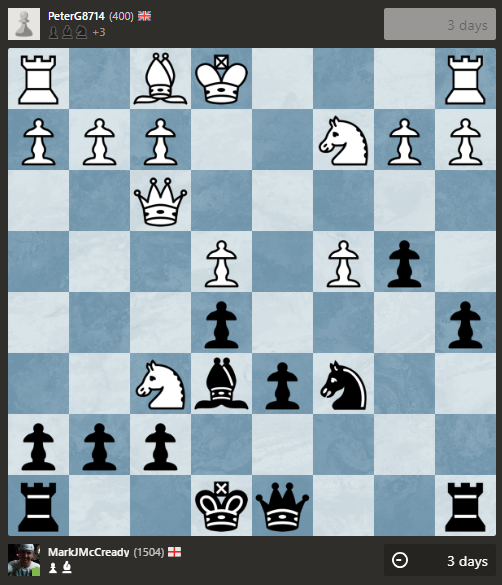
15. … Qxf6. I spent around 5 minutes thinking about this. In principle, white’s remaining knight is heading to d5, so why would I want to put my queen on f6? I played it because the white queen is on f3, and unless white exchanges, I gain a tempo, which I can lose with, say Qg6, should the knight land on d5. I’m not expecting an exchange of queens.
16. Qxf6 gxf6 17. 0-0-0. Now what do I do?
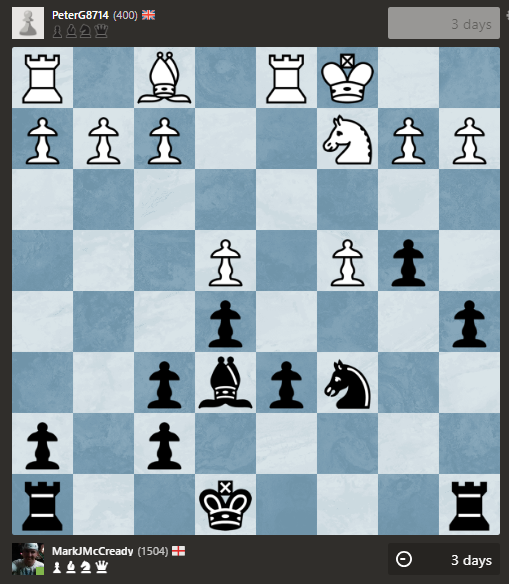
Much thought required here. Where does the king go? I don’t really want to place it on e7 if a knight can pop into d5. I have to keep my bishop on e6 and exchange off if that happens but if it does, I think my knight is slightly better than white’s bishop as it can stay unchallenged on d4. Do I castle queenside? My rook can gain counterplay on the a-file, do I want to take it off that file?
18. … 0-0-0
Updates to follow
| M | T | W | T | F | S | S |
|---|---|---|---|---|---|---|
| 1 | 2 | 3 | 4 | 5 | ||
| 6 | 7 | 8 | 9 | 10 | 11 | 12 |
| 13 | 14 | 15 | 16 | 17 | 18 | 19 |
| 20 | 21 | 22 | 23 | 24 | 25 | 26 |
| 27 | 28 | 29 | 30 | |||
A side note on how to read old Tom Sweby's columns
Not perhaps, but quintessentially, Old Tom Sweby is best thought of as a passionate devotee to the newspapers he wrote for. He was well read and knowledgeable of the Bedfordshire chess scene and well beyond, given that he was the president of the S.C.C.U. once upon a time. He was generally well-respected and rubbed shoulders with many, if not all, of those eminent within British chess circles. It would, however, be a critical mistake to see his column is primary source material entirely. That it is not. You will also find secondary source material quoted too, and the reliability of that is not quite as Tom hoped. Given that he wrote for decades, this is to some degree inevitable, and after all we are all prone to error whether we realize it or not. Thankfully, with regards to old Tom Sweby, they are infrequent and for the most part old Tom continued to document events and developments in the Bedfordshire league from the get go as best he could but, of course, everything lies open to interpretation. Despite this, and generally speaking. this does indeed make him informative and thus worth reading. Dare I say his columns constitute a narrative describing the latest developments, match reports and changing nature of the Beds league...he knew his audience and wrote according. This manifested itself over decades but brevity was always in play courtesy of the restictions imposed by writing a column. Should you wish to read a in instrumental figure of the Beds' league post WW2, you are quite welcome to peruse what has been posted here... . :-) I should, however, point out that as the decades wore on he gradually moved on away from narratives concerning the Bedfordshire league towards affairs both historical and international. The reasons for this are multifarous, old age was a predominante factor presumably, however, the bottom line is with regards to how the Bedfordshire chess scene developed post WW2: old Tom Sweby is your go to guy. He wrote more about chess in Bedforshire than anyone else did but given he was a Lutonian and writing for a Luton newspaper there is both bias and greater coverage of his hometown than the rest of the county.
















To add comments, please see the bell at the top of the page.
 McCreadyandChess