Archive for the ‘Life beyond the chess board’ Category

If people are going to play anti-chess openings, they deserve everything they get.

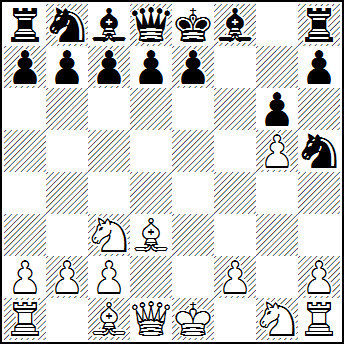
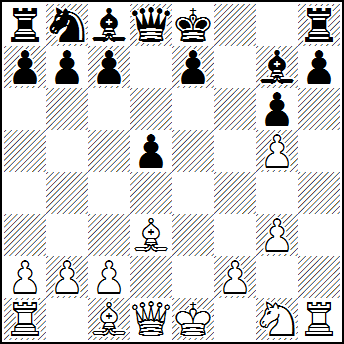
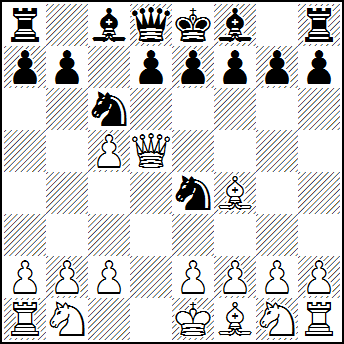
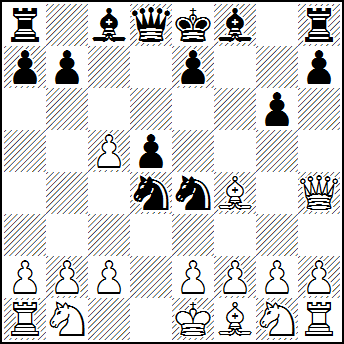
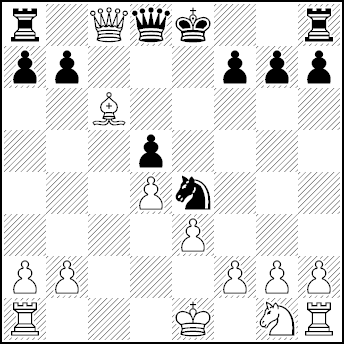
M. Wickert – M.Adams Islington 1992

1. d4 Nf6

2. Bg5 Ne4

3. Bf4 c5

4. d5 Qb6

5. Nd2 Qxb2

6. Ngf3?? (If Nxe4 then Qxb4+) Nc3

7. Nc4?? Nxd1

0-1

0-1

This is how you play the Trompowsky, Michael Adams beats Kasparov!

http://www.chessgames.com/perl/chessgame?gid=1014405

Read Full Post »

Tolush, Spassky’s old trainer, was a colourful figure over the board and won many brilliancy prizes in his day. Unfortunately, there were times where he was gung-ho to the point where you wonder whether he deserved the title he had. Here is one game where he fails in spectacular fashion it is, apparently, one of Khalifman’s favourite games: 14th Soviet Championships, Moscow

Tolush – Bondarevsky Boleslavsky (Cafferty’s mistake not mine)

1. d4 Nf6 2. Bg5

The Trompowsky played in the 40s!

The Trompowsky played in the 40s!

2. …c5

3. dxc5 Ne4

4. Bf4 Nc6

5. Qd5

I don't play the Trompowsky but this looks cavalier to me.

I don’t play the Trompowsky but this looks far too cavalier to me. Some kingside development is surely in order here rather than the move actually played.

5. … f5 6. Qxf5

What on earth is going on?

Again this doesn’t seem right. White must now attend to his queen before developing.

6. … d5

7. Qh5+ g6

8. Qh4 Nd4

4

Note that half of white’s moves have been with his queen, which is danger of having no good squares left if black is allowed to play Nf5 on his next move.

9. Be5 Nxc2

5

I think we can say that the opening hasn’t been a great success for white.

10. Kd1 Nxa1

11. Bxh8 Qa5 6 12. Nc3 Nxc3+

13. Bxc3 Qxa2

14. e3 Qxb1+

7

An extraordinary position. How does white get into such a mess within 15 moves? By ignoring just about every opening principle that exists, that’s how.

15. Ke2 d4 Black opens up the position. 8 16. Qxd4 Bd7 Black prepares to castle.

17. Qb4? Hard to understand. Boleslavsky thought Nh3 was better  

17. … O-O-O

18. f4 Nc2

19. Qa5 Qc1 1020. Bd4 Nxd4

21. exd4 Qxb2

11

Still no kingside development!

22. Kf3 Qxd4

23. Ne2 Bc6+

24. Kg4 h5+

25. Kh4 Qf6+

26. Kg3 e5

12

1 – 0


Read Full Post »

Tigran Petrosian, who as we all know went on to become world champion, made a rather nervous start at the Soviet Championships in his debut game. At the 18th Championships in Moscow, 10th November to 12th December 1950, the meekest of all tigers came up against Kotov in the first round.

Here is the game: Kotov – Petrosian

1. d4 d5

2. c4 e6

3. Nc3 Nf6

4. cxd5 exd5

5. Bg5 Be7

6. e3 c6

7. Qc2 Ne4? 

1

9. Bxe7 Qxe7? The king had to capture.

10. Nxd5

11

Courtesy of his previous move, black is already lost but he plays on.

10. …cxd5

11. Qxc8+

2

The whole point. The unguarded bishop is now lost.

11. …Qd8

12. Bb5+ Nc6

13. Bxc6

4 13. …bxc6

14. Qxc6 Resigns. 

6

Two pawns down and with an uncastled king, black resigns. Not quite what you would expect from a future world champion.

Shy_Tiger_by_ladyevil_7

A picture of a distraught Petrosian taken just after the game.

Read Full Post »

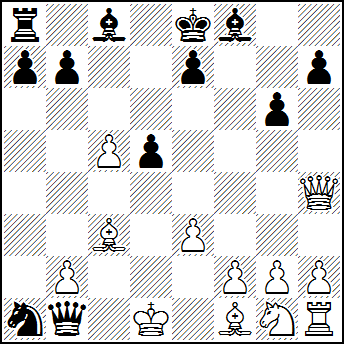
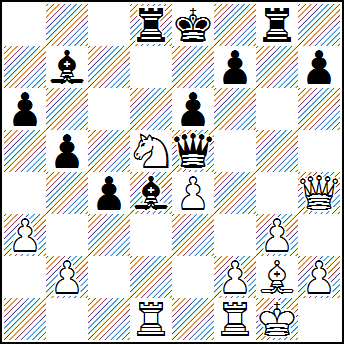
The following diagrams are from Tolush against Ilivitsky in the 1948 Championship held in Moscow. We pick up play from move 21.

1

21. Rad1 Rad8?? (worse is yet to come)

Black copies white but for what reason? To pin his own bishop? His position is not good even though he has some standing in the center. There are too many holes in his position and the king is not secure. Better was 21…h5 after which Rg4 threatens to remove the queen from its dangerous diagonal.

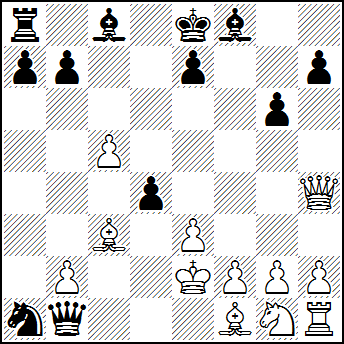
2

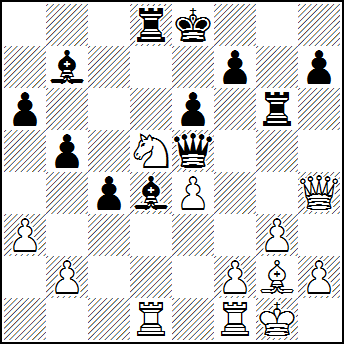
White naturally plays 22. Nd5.

According to Cafferty (The Soviet Championships Cafferty & Taimanov, Cadogan, pg. 62)

‘Black sees that 22…exd5 23. exd5 threatens both 24. Rfe1 and 24. Rxd4; he decides to guard against 23 Rxd4 and then Nf6+’

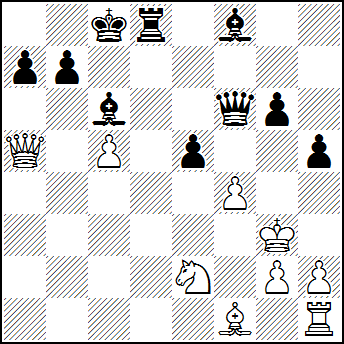
3

22. Rg6?? As Wittgenstein once noted, we fail to see what is right in front of our eyes.

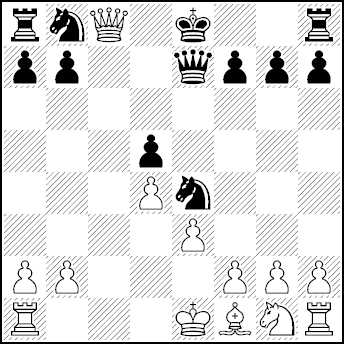
4

23. Qe7 ++

Here is the game for those in disbelief.

http://www.chessgames.com/perl/chessgame?gid=1240274

Read Full Post »

Chess can be described as the movement of pieces eating one another

Marcel Duchamp

https://vimeo.com/23540784

Read Full Post »

Parents who click on the following link may be able to steal a few minutes here and there whilst their children enjoy the printable, on-line chess colouring page. Without sounding too old-fashioned or a big kid, colouring on-line isn’t half as much fun as the real thing.

http://www.oncoloring.com/chess-coloring-pages.html

images

Read Full Post »

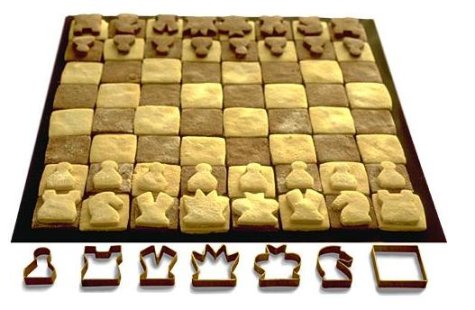
ediblechess

Read Full Post »

The BBC Radio 4 production Across the Board, which is arguably the most thoughtful and interesting example of journalism to grace our beautiful game recently returned with a third season. Dominic Lawson, current head of the ECF brings us six more games with yet another interesting mix of opponents and questions for them. If you have time to play through the games on line, I suggest you do so whilst listening to the show. By doing that you might notice that Dominic’s questions are as strategic as his play and perform their role in helping him across the board adequately. I have linked Series 3 below. If I may say so, the radio is far more suitable as a medium to study chess than TV/YouTube, as it demands that you must set up a board and physically play through the game yourself. This will enhance the experience of the game you are playing through considerably. Note, however, for this particular program the games must be viewed on line as only a selection of moves are offered during conversation. http://www.bbc.co.uk/programmes/b04njsks/episodes/guide

WABQ_chess

Read Full Post »

“Care and quality are internal and external aspects of the same thing. A person who sees quality and feels it as he works is a person who cares. A person who cares about what he sees and does is a person who’s bound to have some characteristic of quality.”

Pirsig, Zen and the Art of Motorcycle Maintenance: An Inquiry Into Values

In this day and age we are spoilt for choice on what to watch. With so much content on-line and so many products to buy you could happily let the world pass you by if you wanted to.

Having just spent over twenty Euros on yet another glib Chessbase DVD, the best advice I can give is to watch someone who is passionate about presenting chess. With this in mind I recommend the youtube channel Kingcrusher. There are hundreds of games to watch both current and classic. The author is a strong player too and is, in my opinion, a considerably more talented presenter than the next depressed looking Chessbase presenter who’s only doing it to supplement his income, whoever that may be.

Read Full Post »

I found the position below on a recent Chessbase post. It is from GM Khismatullin v GM Eljanov from round ten of the European Championship.

Pos3003

White plays 44 Kg1!! To which black plays 44…Qxd1+. What an amazing move Kg1 is. The purpose, of course, is to put the queen onto the worst square on the board, leaving black completely helpless to the numerous threats of mate that will come. Being a rook up, it is unsurprising that black thought he has at best a draw, which is not the case.

White has a 13 move forced win. It’s actually not as difficult to find as you might think owing to the poor position of the black king. It’s a pleasant way to spent 20 minutes by tuning up your skills of analysis. Can you find the winning line?

You can play through the whole game here if you cannot.

http://www.chessgames.com/perl/chessgame?gid=1786318


Read Full Post »

« Newer Posts - Older Posts »