Archive for the ‘Life beyond the chess board’ Category

‘Chess is a beautiful mistress’ Bent Larsen
Being a man with a greater interest in life itself than chess, I’ve always thought that the saddest facet of our beautiful game is the lack of female players. Geographical and generational variations aside, you never see that many women around tournament halls, one or two here and there perhaps, but never too many. Why is that? Well, to use one of Larsen’s favourite words, the answer is ‘multiform’ -there is no straight answer. I’ve listed several of what I think are the more significant reasons, in an order of relevance.

Firstly, chess is still thought of as a man’s game, or perhaps more perniciously, as a man’s world. Chess culture is male-dominant, this puts a lot of women off: it doesn’t cause too many to drop out of the game but it deters a lot of women from starting in the first place. The good news is that this balance is being readdressed somewhat, the bad news is that its not happening globally. In the opulent gulf region, for example, girls and boys participate equally. In a tournament in Qatar that I recently played in, the ratio of girls to boys was about 8:1, putting them in the majority for once. In countries where chess is taught in schools, Armenia for example, girls compete with boys on an equal/near equal footing. Such places are an exception to the rule, on the whole women do not yet have a strong voice in the chess world.

Secondly, connected to the previous point is the fact that girls do not have many female exemplars in chess. What do I mean by an exemplar? In essence, someone who inspires you be like them or act as they do. A contemporary, though conceptually unsound alternative, is role-model. The primary difference being that a role-model often has the impartation of moral responsibility whereas an exemplar is an ammoral figure, distinguished by ability or excellence. In chess, we tend to adorn players for their ability over the board and not their conduct or fame away from it, hence the term exemplar is more appropriate. For example, when I was young, I wanted to be like Nimzovitch. Not because of who he was -of this I knew very little- but because of how he played.

Thirdly, unfortunately, there hasn’t been many females that have made it to the very top. Without such successes, young girls are denied a female figure who reveals to them how its done. Boys do not suffer from this problem. Of course, a young girl could admire, for example, Spassky’s play but the gender-based intimacy that enables girls to become like their exemplar (the looser term hero could be used here) isn’t there. Girls are also less inclined -though not entirely unwilling- to model themselves on a member of the opposite sex, therefore, they cannot appropriate success like boys can. By the same token, you don’t find many young boys saying they want to be like Judit Polgar or Hou Yifan, for example. Most young boys choose male exemplars and would probably be considered to be gay if they didn’t.

Fourthly, FIDE has never taken women’s chess as seriously as men’s. There are probably many reasons for this but given that chess has always been blighted by a lack of finances, promoting an area of the game with considerably less practitioners than the male side must seem like economic suicide. That’s a great shame if so. The women’s world championship suffers so greatly that the best female players tend to opt out of it. In his ‘How life imitates chess’, Kasparov points out that much of Judit Polgar’s rise in chess came about through her choosing not to play in all-female events, where the competition and interest was much less. Sadly, until FIDE get their own game together, this is something that is unlikely to change. Given how incompetent FIDE is, the future doesn’t look great for women. We can only wonder how the young Chinese star Hou-Yifan must feel being crowned world champion, knowing that she doesn’t even have the chance to compete against the women that have greater entitlement to it, again Mrs. Judit Polgar being the obvious example.

Fifthly, male chess players seldom make great husbands. Physically speaking, your average male chess player probably hasn’t got much going for himself. We don’t muscle up in the gym, tan ourselves up and drive around in fast cars. Instead, we stare at a board for hours, uninterested in what is around us and what it thinks of us. After doing this for years, we often become (more) anti-social, introverted, bookish, we may even need to wear glasses. When I was 16 -before I had to wear glasses- I clearly remember on guy fawkes night being asked to go to a bonfire party by a mate and a couple of girls (even though one of them thought I looked like a 70’s footballer).  In retrospect that offer seems naive and utterly futile. I had been to the library and took out a book on Paul Morphy earlier that day and was yet to begin reading it. Even though I did consider the option of going to the party with beer, girls, music, bonfires, stolen cars aplenty, I was compelled to refuse and return home to read in solitude. I distinctly remember feeling in my stomach, a burning desire to read rather than party…life stayed that way for years. This is the sort of thing women can become exposed to if they hook up with a chess-player, and let’s be honest -it’s shit. Furthermore, chess players have, a subverted concept of masculinity. For us, masculinity manifests itself in our chess play. We want to become warriors over the board, not in life, but women, if they don’t play the game, cannot see this.

Lastly, from a woman’s perspective, chess itself provides a dubious model of marriage. At the beginning of a game of chess, the king and queen sit side by side in the center of the board. During play a king may legally have more than one queen, but a queen can never have more than one king. Knowing this, the king often shuffles side-ways to find shelter, sitting pensively at his leisure; whilst the queen does all the hard work, prepared to sacrifice herself to save her king if necessary.
‘Life is not a problem to be solved, but a reality to be experienced.’ Soren Kierkegaard

Read Full Post »

Horse play

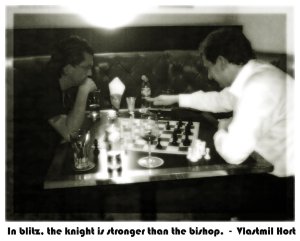
I must say that, in spite of some rather superficial analysis in its middle, I’m really enjoying John Watson’s Secrets of Modern Chess Strategy, which has revolutionized my understanding of the modern game. Though not aimed at instruction, it might as well be since Watson addresses and questions the transition from rule-based chess -which largely characterized the classic era prior to hypermodernism- though to the rule-independent chess of today’s game with such insight that the reader inevitably learns a great deal about their own game too. I’m currently reading the second section of his Knight versus Bishop section, in which he tackles the subject of the minor peices. In the previous chapter, Watson importantly draws attention to the fact that theory on minor peices has seen relatively little development and still holds many of the assumptions from previous eras. One in particualar is the assessment of the minor peice pairs, bishops against knights. Watson points out that the advantage given to the bishop pair tends to be exaggerated and not backed up by statistical analysis at all. He shows how the player with the knight pair can and has throughout history opened up the game early to take advantage of the greater time required to find the optimum squares for the bishop pair. According to Watson, this challenges the prevailing assumption that the bishop pair automatically constitutes an advantage against the knight pair. He adds that though this may become true in the endgame, it doesn’t hold for the middlegame, which is replete with too many exceptions. This is very interesting stuff. We are so often told in some naff book that the player with the knight pair should avoid opening the game and keep everything closed. But the greater agility of the knights and the fact that finding the best squares for the bishops early in the game is difficult, gives the player with the knights a clear and often effective strategy. This is great news for those of us who like to play with the knights more than the bishops. For anyone interested, I’ve listed some of games from Secrets of Modern Chesss Strategy and their respective page numbers as well as inserted a hyperlink. In all games the bishop pair is koshed by the knight pair in the middlegame. I thoroughly receommend Flesch’s instructive game. His book on planning in chess isn’t bad either.

Anderssen v Paulsen 1873 Vienna (Watson pg.183)

http://www.chessgames.com/perl/chessgame?gid=1019378

Petrosian v Nielsen 1960 Copenhagen  (Watson pg.183)

http://www.chessgames.com/perl/chessgame?gid=1106499

Adams v Conquest 1996/97 Hastings  (Watson pg.184)

http://www.chessgames.com/perl/chessgame?gid=1014876

Ogaard v Flesch 1974 Olso (Watson pg.189)

http://www.chessgames.com/perl/chessgame?gid=1282692

MJM

Read Full Post »

Find a player you like to study, play through one of their games until you find a position of interest, then pick up your board and put it in the freezer. Take it out an hour later, set it down on a table and whilst the frost melts, take a good look at the features of the position from both sides without worrying about whose move it is or finding the best move (ensure that frozen peas haven’t found their way onto the board and are doubling up as pawns).

According to Kasparov techniques which give us a broader understanding of positional elements rather than an intuitive grasp of the best move are important for our development. He claims that liberating ourselves from the anxiety of ‘the move’ is a useful technique which can deepen our understanding of chess. He argues that only with a deliberate analysis, can we find the core of a position. Let’s have a quick look at an instructive game position:

Marshall – Nimzowitsch New York 1927

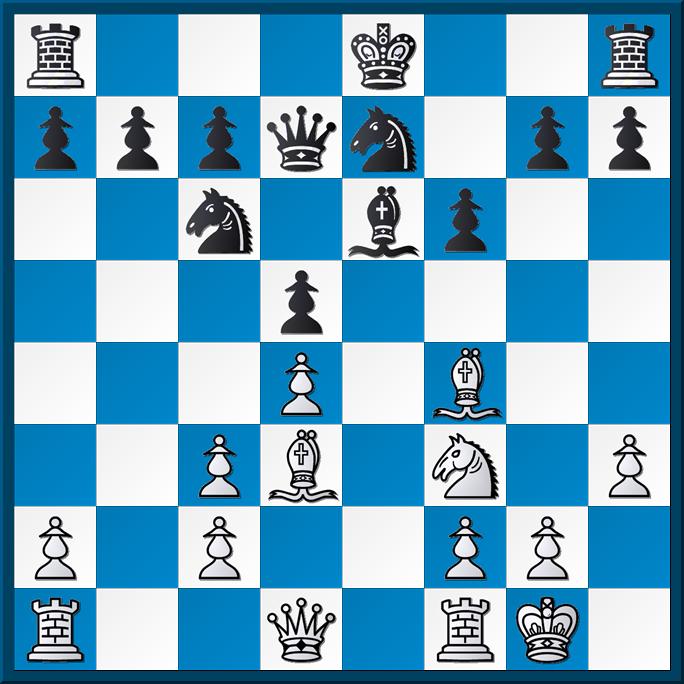
If we were to encounter such a position whilst looking for the best move, we might consider moves such as Re1 for white, trying to capitalize on the open file, or as black then perhaps a kingside pawn storm with g5 and h5 to come but it is only a deeper understanding of the importance of the pawn structures that offers the route to victory for black here. In the game itself, Nimzowitsch understood that white’s doubled pawns must be blockaded with a knight on c4, he knew he would be able to exploit the weaknesses in white’s queenside and win the endgame accordingly if he could do so. Such strategies are less likely to be appreciated by players intent on finding the best move, and more likely to be overlooked entirely.

Black is about to gain a winning advantage with Na2

So the next time you find an interesting game, stop searching for the best move and have a deeper look at the positional factors involved. Look at the pawns, the pieces, king safety and so on. Try to decide which position you prefer and why. Let’s look at a more contemporary position. Forget about who’s move it is, which side stands better and why? What positional factors are most significant and why? What are the strengths and weaknesses of white and black’s respective position? I’m not going to state the result of the game this time, as that would be counterpart to my purpose.

Ivanchuk – Anand Linares 1992

Enjoy.


Read Full Post »

I’m always on the look out for terminology that has found its way from philosophy into chess, and was very pleased to see the word ‘falsification’ appear in a chess book I recently browsed. Admittedly, I cannot -at the time of writing- locate the source, however, this is inconsequential. I read broadly in chess and always return to the books I have in my growing personal collection. Once found, I will cite the source, however, in the meantime I shall begin with a brief historical account of the term, which will serve the dual purpose of a brief trip down memory lane to heady, undergraduate days too.

Firstly, what is falsification in the context of philosophy? The phrase itself was first coined by Karl Popper, who once upon a time objected to the rise of what he called pseudo-science (we now call this social science). His point was that in order for a theory to gain credibility by being called ‘scientific’, it must be possible to falsify it. For example, his compatriot Freud argued for psychoanalysis, making such claims that a person’s behaviour can be influenced by experiences lying within their subconscious. Popper argued that such theories cannot be scientific because they cannot be verified/falsified -by falsify, he means show that something is wrong/incorrect. How, for example, can the content of a person’s subconscious be examined physically and objectively and thus attributed as the cause of something? It’s simply not possible. At best Freud’s assertions were interpretations of behaviour, though if you read his Lectures on Psychoanalysis you’ll find that many of his patients actually told him what they thought was the cause of their behaviour, and not vice-versa. If Popper were still alive today, he would almost certainly be aghast at the commercially motivated, blurred boundaries between the social -pseudo- sciences and the more traditional sciences that pervade our modern age. TV commercials would probably drive him up the wall!

As a thinking tool, falsification has great potential in chess. Rather than verify or confirm to ourselves why we should play a certain move, instead we should prove to ourselves why it shouldn’t be played. This doesn’t just mean, thinking along the lines of ‘I can play my knight to c4 but not d5 because he can pin it with his rook if I do that’, this this is clearly a rudimentary case of establishing which tactical threats are apparent in a position, but falsification serves a better purpose if applied to the selection of candidate moves.

Black to play, QGD Tartakower line

c5 or c6 or Qd6?

In this position, which can be reached in the QGD, Kramnik is famous for playing c6 whereas Kasparov is known to have played c5 in his second match against Karpov. It is possible that after some home analysis both players rejected Qd6 as a serious candidate move because they thought that d6 is not the correct square for the queen. After white plays Qb3, black would have to spend time guarding against both the possibility of a knight arriving at b5 and/or the longer term plan of castles short, Nd2-Nb3-f3-e4. In such a position, a club player might approach the same position thinking along the lines of Qd6 being strong because it 1) attacks a pawn, 2) develops the queen, 3) clears the back rank, thus preparing the connection of the rooks. The problem with such a thought process is that it only confirms why a move should be played rather than falsified, and thus disregarded. Whether Qd6 is sound or not cannot be established by a process which only confirms our initial reasons for playing a move, therefore, the true value in falsification lies in its ability to improve our decision making process and thus enable us to select better moves. If we interpret chess as a struggle against error, then falsifying the value we attach to candidate moves is a powerful tool indeed.
One last thing, what do we do if a move cannot be falsified? (By this I mean we cannot fault it). Then we must play it! In the position above, I would play c6,with a5 and Nd7 to come.

MJM

Read Full Post »

And so, one week from today me enter um iron bird once more in um positional exchange sacrifice, swapping water for sand. Um what am I talking about, you might ask? After spending almost a year in Thailand, I will be heading to Oman for approximately 6 months. It’s a work related move, the flood in Bangkok practically eliminating all chances of finding decent work as everything has closed down for the time being. It’s a big change and one that has been forced upon me but I’d much rather be working and earning a decent wage than sitting around in a flooded apartment getting frustrated with everything. I have to say that the lack of action by the Thai government has left me feeling less than impressed. I will be living in Ibri, which is real desert. It’s a very quiet place. I have been through it once before and know there’s not too much going on there.

Oman, is it a chess playing nation -yes and no. A friend tells me that it is one of the very few Arab nations without a federation. It doesn’t appear of the F.I.D.E website and after several attempts to google chess and Oman, I have come up with nothing. I’m not concerned about this because chess is probably played on a street level, perhaps without proper tournaments. Even if that weren’t true I still don’t mind because I am happy to study the game alone. I should add that I have recently stopped playing on-line chess as I find the effects of playing constantly to be stifling. I am rapidly finding John Watson’s books to be a source of great inspiration and will be taking them with me. Having a very healthy income will also allow me to improve my software collection too. Furthermore, though the chess scene in Thailand is adequate enough for someone of my level, it is a little small, and playing the same players every tournament has taken the edge of my play somewhat. My only real concern is that having taken a 13 year break from the game, I still don’t have the experience I need. Because of this I will look into fitting in a tournament or two in the region. Dubai isn’t far away and there’s usually a lot going on there. Whilst in Qatar last year, I almost went to Armenia, just to see what it’s like. I will have that opportunity again and will take it this time if I can. Armenia is just north of Iran, and Iran is just across the water from me.

A change is as good as a rest as they say. I hope to return to Thailand theoretically stronger and be able to push my rating towards 1900, where it should be.

Oman, very near to where I will be living.

Mark.

Read Full Post »

Greetings from a flooded Bangkok. Cut off from most of the city unless I am prepared to wade through toxic, crocodile invested gunk for hours, whilst having to inure myself to various forms of mockery from the locals; a life of seclusion, of downloading, uploading, documentary watching -whilst cooking noodles I might add- and of course, studying chess have been inflicted upon me.

It’s actually a great opportunity to catch up on literature that has been put aside. There are now 35 books that I have in my personal collection, about 10 of which I have already read. I’m going to study Yuri Avebakh’s Comprehensive Chess Endings and focus on the Queen’s Indian Defence by Soltis and Keene. I also plan to look at Nigel Davies’s The Power Chess Programme and Basman’s St. George’s Defence. Having performed poorly over the board recently, I don’t miss playing with friends, especially since I am not a fan of blitz. Instead I intend to use this solitude to refocus, to re-examine where I have recently gone wrong. Furthermore, I am still broadening my opening repertoire so that when I come to focus on study of the middle-game, I will have a better idea of which positions and games I should focus on. Studying the middle-game is much harder than it appears. I’m trying to tailor my study of the middle-game so that it is inclusive of the positional and tactical elements I am most likely to encounter. Take for example, Andrew Soltis’s book Pawn Structure chess. I decided not to read it all because 1) I don’t play d4, 2) I don’t play the Kings Indian Defence. Anyway, back to the chess board.

More later.

A few days in…

I managed to get hold of John Watson’s Chess Strategy in Action and am enjoying it very much. I really enjoy books that offer a historical perspective, and this one’s no different. Watson appears to be more educated and a better writer than your average GM, so its a good read. On another positive note, the water has gone down about 1 foot.

A few more days in…

Excuse my French but the flood is really beginning to pee me off. I’ve put on almost half a stone now through having to sit inside all the time. As wonderful as chess is, I doubt whether it can save my sanity if this goes on for much longer. The word on the river street is that it will take another two months for everything to get back to normal. Great. On the chess front. Watson has taken over. I’m enjoying his book greatly, particularly his exposition on The Tartakower line in the QGD. He gives some instructive games, including some amazing stuff by Nigel Short.


Read Full Post »

As an experienced and usually enthusiastic photographer, I think I must have had around 30 people try to push me into professional photography over the years, some of whom were within the field itself. Most people are unaware that it is actually very difficult to make a living out of photography these days -being freelance is forced upon you unless you have influential friends. They also don’t realize that it is actually a mechanical and unsatisfying job, often with long hours and lots of unpaid travel time. Out of all the people I have met and worked with in photography, I still haven’t met one person that enjoys it. This includes those who ‘allegedly’ teach it. The only people who enjoy photography are those sensible enough to keep it as a hobby, people like myself.

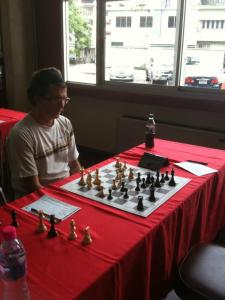
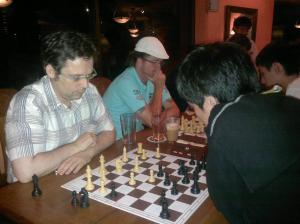
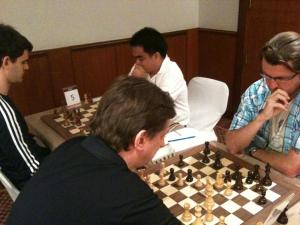
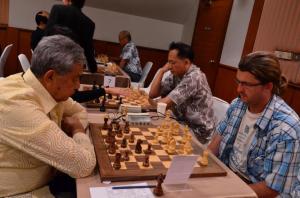
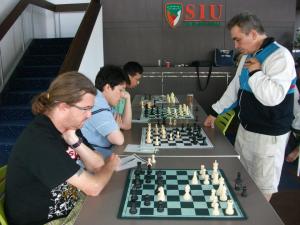
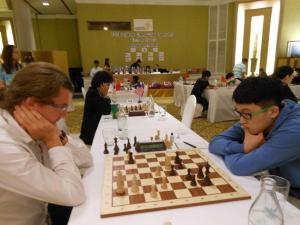
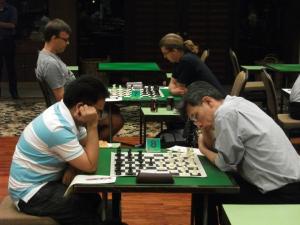
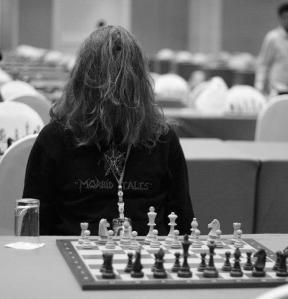
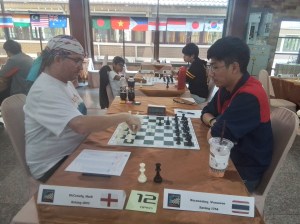
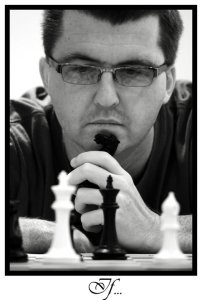
Given that I have never taken photography too seriously, like many amateurs/hobbyists/enthusiasts, I have strengths and weaknesses. Photographing a human subject has always been my biggest weakness, mainly because being a shy person myself, overcoming shyness with the camera is harder for me than most, and also because I when I photograph a person, I haven’t really known what I should be looking for. Fortunately chess has changed all that, it has provided me with a solid platform to work from because most people are often too engrossed in their game to notice you, which means that you often get a more natural pose (as photographers will tell you, posing itself is an art-form), and also there is a often a large number of subjects to chose from at any given time. I have concluded that chess is a good medium to improve your skills of photographing people. In addition, I had to return to the fundamentals and approach the whole area by asking what does a picture of someone playing chess comprise?

A self-portrait by Van Gogh. What does it express?

An instructive way to think of a picture of someone playing chess is to think of it as a portrait, this needs a little explanation. Firstly what is a portrait? A portrait is a concept which is not as easily explained as you might think. To begin we must transcend photography, since it cannot tell us much about what a portrait is. We must go back in time to before photography existed, to the world of art. Artists, especially those who specialized in portraiture, were much better at showing us what a portrait is about. Traditionally, portraits have had a living being as a subject, which in turn has mental states. In sum, then, portraits involve people -we couldn’t, for example, argue that an inanimate object qualifies for the subject of a portrait. The subject of the portrait should have a pose of some kind. An effective portrait should give us an insight into human nature by revealing the inner states of its subject in some way. With this in mind, we can see how chess is, potentially, a good medium for portraiture. Even though, strictly speaking, chess players are engaged in chess, the activity itself does not compromise the basic requirements for a portrait, using the definition posted. One last point before we move on, before photography came along, patience was a pre-requisite of both having and painting someone’s portrait. In our ephemeral embrace of digitalisation, patience plays no part. This is something that those of us wanting to photograph chess players must re-examine. Chess does not lend itself to self-expression. Often a chess player will be motionless and expressionless, to get the kind of shot you want, you must factor this into your photo shoot. Here’s a few other pointers that should improve your chess photography overall. These ideas should be understood as pointers towards a more aesthetic appreciation of photography rather than a mechanised one. They are geared towards appreciation of the process of photographing rather than the process of improvement, though as it already has and will again be suggested, enjoyment and improvement are correlated in photography.

A worthy opponent who took me to the endgame.

A worthy opponent who took me to the endgame.

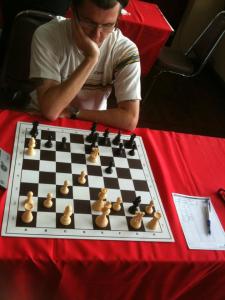
Your primary subject will usually be a person NOT chess itself. Since your subject is a person, you must concentrate on how they express themselves. Usually, this occurs through facial expressions, posture, or mannerisms -by this I mean the way someone might write the moves down or press the clock. You should know before you shoot what you want to capture. You should look for the way your subject expresses him/herself, as it will always be particular to them. One crucial point that less experienced photographers often overlook is, if you are taking a picture of someone’s face, you should photograph from eye level or below. Of course all rules have exceptions, but generally speaking, shooting from a standing viewpoint doesn’t allow you to see the subjects face wholly, especially if they are resting their head in their hands or leaning over. This means you will have to crouch down and get in someone’s eye line. Don’t worry about being a source of distraction too much. You will be one but chess players are used to such things and can easily ignore it. This brings me onto those who can’t/don’t.

Tip 2 Stealth captures what is natural.

Generally speaking, most people like to have their photograph taken. The fact that they are playing a game of competitive chess does not always alter that fact, however, posing is an art-form that is lost on the vast majority. If instead you’re looking for a natural pose, the best way to move around a playing hall is, then, slowly and quietly. Try not to engage eye contact with players at any point as this can send signals that you intend to photograph them and can thus negatively affect the result of your picture. Why should you move around the playing hall slowly? Well, like in chess, patience is a great virtue in photography too. If you find a good spot, don’t be afraid to claim it as your own for a short while. Your subject may be deep in thought, there may be nothing interesting or no action to capture but this will only be temporal.

Tip 3 Some phases of play offer better photographic opportunities than others.

There are phases of the game which are incredibly valuable for photographers because they contain more action and response. The start of play and time trouble being the most significant. The end of a game, by this I mean after play has finished, should not be overlooked also.

At the beginning of a game, players sometimes behave slightly differently than during the game itself. They may often express surprise or horror at their opponents choice of opening (having played 1 f4 for a few years in the past, I think I am qualified enough to speak about that). They may have certain habits which they only perform at the beginning of a game, such as aligning/fixing the pieces within their squares, or examining the clock.

Time trouble speaks for itself. We’ve all been there enough times. We know how we feel inside and act accordingly. Everything can be won or lost quickly at such times, so it is then when we are at our most emotive. The range of emotions on offer for the photographer is so great, that photographing players in time trouble should be a main inclusion of every photo shoot, perhaps THE main inclusion. You should remember that chess itself does not tolerate much self-expression, it is a game of composure and concentration, so you should target the phases of the game where play becomes looser. Also, time trouble can lead to dispute or intervention by an arbiter, once again broadening the range of emotions on show. However, it should be pointed out that it is advisable to keep your distance if you can. If you have a telephoto, this is the time to use it. The last thing someone desperately trying to save their position wants is someone trying to take clever pictures of them.

At the end of the game, players often carry the result of their game in their faces. There are also formalities which are interesting to observe and photograph, such as the the signing of score sheets and leasing with an arbiter. Some players chose not to hang around after a game has ended, offering few if any opportunities to catch the final moments of play. When a player has just left the table and turned away from his/her opponent, you should try to photograph them, as this is the moment where courtesy gives way to satisfaction/dissatisfaction.

Tip 4 Keep chess out of some pictures.

Away from the board there are so many things to photograph that it would be pointless to try and include them all. Instead, it is better to bear in mind some crucial ones. Firstly, some players like to go for a walk or socialize between moves, this often present good opportunities for a photographer. Secondly, tournament organizers and officials have jobs that are unseen by the majority of players and spectators. Thirdly, all locations contain features that are unique to them, such features are often used to identify a certain tournament and are thus important. Lastly, incorporate external factors into your photographs. That could be nothing more than including spectators around a particular board or perhaps the rain outside the hall. You might want to photograph other photographers going about their business or include items and/or rooms outside the main playing hall.

Tip 5 Study composition; always aim for variety.

In spite of all the crumby adverts you see on tv nowadays, photography isn’t about point and click. You must bear composition in mind at all times. What does this mean? Well there are certain rules to composition which are worth looking at, such as the ‘rule of thirds’, which I don’t have time to go into now, though I do advise that you look at them at leisure on the net. Just google the aforementioned phrase and you’ll get lots of stuff come up. Traditionally in portraiture subjects are in the centre of the frame, however, in chess this need not be so. More often than not you will want to include the board too. This often means that the subject gets pushed to the side of the shot. Pictures that focus solely on a subject and do not include the board can and often do work very well, but it must be remembered that these should not predominate your shoot that day. Chess players need a frame of reference -chess! Instead, we should aim to include the focus of attention when we can, as this is what the subject is pointing towards, and so the subject as a whole should be seen as a person shown to be engaged in chess, and not just a person.

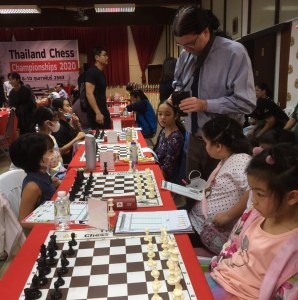
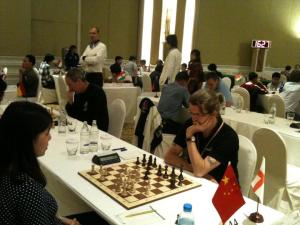
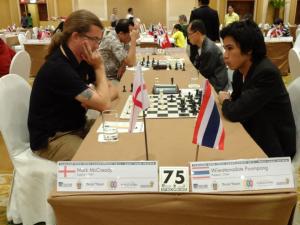
Within any playing hall there will be rows of players. Lines are very important for good composition. Strong, diagonal lines often work well. What do I mean by this? Well, rather than shoot from directly behind a row of players, move aside as much as you can so that more faces appear in the shot, rather than the back of heads. The line of players will move diagonally across your image when you do this, like in the image below.

Digital photography allows us to shoot hundreds of pictures at a time -and so we should. Vary your shots as much as you can. Take pictures of individual players, players with their opponents, rows of players, sections of players, players sitting, standing, eating, drinking, chatting. Photograph from different angles, try to be as free as you can in what you do. Not only are you more likely to get better results, you’ll probably enjoy the experience more.

IMG_6157

Tip 6 Improve your editing skils.

Photography isn’t just about taking pictures nowadays. The industry has been revolutionized by the advent of digitalization. Bundled in with this change is the onus on editing and processing skills. It is now possible to transform an ordinary picture into an outstanding one by picking up a few skills. All camera manufacturers provide good software when you buy a camera, its worth spending a bit of time playing with it, and seeing what it does. The results can be surprising and effective. As great as digital cameras are, they still have issues regarding metering and exposure. You’ll often find that a few tweaks here and there can work wonders.

IMG_6167

Anyway, that’s all from me. Hope it helps.

Oh, one last thing. If you enjoy photography and want to improve your pictures, consider purchasing one of Tom Ang’s books. Don’t buy the over-priced magazines you see for sale. Just buy Tom Ang.

http://www.tomang.com/

Mark.J.McCready

Read Full Post »

‘Happiness is thought to depend on leisure; for we are busy that we may have leisure, and make war that we may live in peace. (Aristotle,NE,X.1177b4)’

Philosophy, it is often said, is the art of reasoning & analysis. According to Botvinnik, ‘Chess is the art of analysis’. In their long histories there has been relatively little convergence between chess and philosophy, which given the analytical nature of both, is surprising to learn. Over the years, I’ve encountered few players who have studied philosophy at university, often choosing more precise subjects such as mathematics instead. Philosophy is a discipline largely ignored by chess players. With this in mind, what can chess learn from philosophy? I’d like to answer this question not by giving a narrowed descriptive account of both -though I will stay within the confines of canonical philosophy- but by drawing attention to some rather unexpected parallels that occur within the highest echelons of both. I should confirm that when I use the term ‘Philosophy’, I am speaking as a Philosophy Post-grad and am defining it in academic terms, not in the loose, vernacular sense of the word.

In terms of major philosophers using chess illustratively, it is probably Wittgenstein who applied himself most to this task. Both his early and later works contain frequent chess descriptions and analogies. The most famous, perhaps, can be found in his account of language games in the Philosophical Investigations, in which he refers to the interdependence of rules and meanings, explaining that the concept of the king in chess only means something if the rules of the game are understood also. However, Wittgenstein’s references to chess are specific to key ideas in his works, and on the whole, would require a large commitment to grasp well. Such a commitment may work as part of an academic programme, but probably wouldn’t work well as part of a casual dip into a new subject. Aside from the endeavours of the great Austrian, sadly chess appears only sporadically in the literature of the great philosophers. Within analytical philosophy there are plenty who dip into chess for the purpose of analogy but rarely go beyond that.

Okay, what about if we turn things around? Can philosophy teach us anything about chess by virtue of the endeavours of great chess players? Out of the players who dedicated themselves to philosophy, the second world champion, the evergreen Emmanuel Lasker should immediately come to mind. He did manage several publications in Philosophy, having studied it as a young man. The most famous of the aforementioned publications was ‘Kampf’ (struggle), published in 1906, in which echoing Nietzsche somewhat, he attempted to provide a general theory of all competitive activities. Lasker didn’t achieve the same level of success in Philosophy as he did in chess, in fact his publications made almost no impact whatsoever on the academic world of his day.

With both chess and philosophy being unable to offer a figure who has successfully crossed over into the other discipline, how do we proceed? Well, surprisingly, we have to go back in time thousands of years where one philosopher can help us with our understanding of chess. Not because they were a great player but because they would have been a great player, well probably… .

Who am I referring to? Aristotle: who would have been a great chess player, if the Nicomachean Ethics is anything to go by. Those unfamiliar with the text itself, might initially wonder how a work on ethics can have any bearing on, or be a refection of, potential chess prowess. This, however, can be easily explained. Firstly, ethical discussions in classical literature were centred around the individual and how, as individuals, we can make our lives go well rather than take into consideration the interests of others, as now tends to be the case in such literature. The Nicomachean Ethics aims to account for what is conducive for Eudaimonia or individual flourishing: in very simple terms, excellence or personal development. And it is excellence/personal development which we chess players also strive for (albeit for chess-related reasons). Aristotle’s account of how to achieve a life of flourishing incorporates much that has little to do with chess but there are points he makes which correlate, and are in fact, highly instructive. I shall explain one of them.

How to live well, is a central question of the Nicomachean Ethics. Aristotle points out that living well is not about applying general rules on how to live to our lives, but adapting to the particular circumstances we find ourselves in. Judgements about how to live are only true for the most part, they don’t hold for every individual in every situation. Aristotle claims that being able to liberate ourselves from generalities and judge a course of action on its individual merit or characteristics is a sign of intelligence. Understanding in modern chess rests upon similar principles; being able to evaluate the unique features of a position by going beyond the general principles we have learnt, is a sign of higher-level skill. A grandmaster, for example, can tell when the right time to castle in a game has come much more easily than a club player, who believes that castling should be done as early as possible and is liable to castle before playing more active moves. If Aristotle were a chess player, he would know that unlearning the principle of castling early comes as a consequence of being able to judge a position on its particular merits. Our ability to do that being largely dependent upon the training we have given ourselves. ‘For the things we have to learn before we can do, we learn by doing. (NE, II.1103a33)’ He would approach the game with a practical, engaged mindset rather than a theory-dependent one. With this in mind, Aristotle would fit into the modern game well (and not that of classical chess 100 years ago) because through the advent of digitalization, the modern game has abandoned a rule-based approach in favour of a pragmatic ‘play whatever works’, owing to the dynamic duo of generations of diligent Grandmasters and the more recent processing power of modern computers, which are remarkably adept at transforming anomalies into exceptions, hence drawing into question the rules they adhere to. Let’s turn to one of the forefathers of the modern game, Richard Reti, ‘It is the aim of every modern school not to treat every position according to one general law but according to the principle inherent in the position. An acquaintance with other positions and the rules applicable to the treatment thereof is of great use for the purpose of analysing and obtaining a grasp of the particular position under consideration…the source of the greatest errors is to be found in those moves made merely according to the rule and not based on the individual plan or thought of the player.’ (Watson:Secrets of Grandmaster Play 2003, pg.97)

Another interesting parallel that Aristotle claims is that there is no real value in judging a person’s life until it is over. Just because an individual was successful in the 20’s and 30’s it doesn’t follow that their life was a success. A tragedy late in life can put an entirely different complexion on things. And so too in chess. Take for example Anand’s opening game in the defence of his title against Topalov. In the beginning of the game, everything was going to plan, until moves 25-27, where he forgot how to play the line he had chosen and subsequently lost quickly. Often in chess we must learn to resist the temptation of easing up, thinking that the path forward is a straightforward one. This is particularly true if we are winning. Aristotle would question the validity of evaluating a game in progress, as chess and life both share unknowable futures.

In his ‘Chess for Zebras’ (Gambit 2005) pg 28, Rowson quotes Aristotle under the heading ‘Developing Skill’:

“We are what we repeatedly do. Excellence, then is not an act but a habit” Aristotle (source not cited!)

‘…the main skill a chess player needs is skill in making decisions, so that’s what you need to do and do repeatedly. If you want to become a better player, you need better habits, and you cultivate your habits through training. ‘

One last point, if an Aristotelian and a mathematician both picked up chess at the same time, both having no prior knowledge of the game but both falling in love with it immediately, who would be more likely to develop into an expert player? My money is on the Aristotelian for the reason that he would have a deeper appreciation of what is conducive for success.

A recent photo of Aristotle

I am indebted to Nigel Warburton for his enquiry into Aristotle.

Read Full Post »

« Newer Posts