I’m going to have a T-shirt printed to show off the two clubs I am affiliated to. Here are the images I concocted. You could say I am an artist or you could say I like to play around.

MJM
Posted in Life beyond the chess board on February 12, 2024| Leave a Comment »
I’m going to have a T-shirt printed to show off the two clubs I am affiliated to. Here are the images I concocted. You could say I am an artist or you could say I like to play around.
MJM
Posted in Life beyond the chess board on February 11, 2024| Leave a Comment »
Ex-Luton player G. H. Diggle once described Mr. James Plaskett as Bedfordshire‘s strongest ever player and who can argue with our Geoffrey, arguably the funniest writer chess has ever seen? The claim made is undoubtably true and how wonderful it was to learn that James has a puzzle attributed to him too! Not that he composed it but in the company of the world’s best competing at a blitz tournament -drew attention to it instead! And I can assure you that with regards to puzzles per se, they are faith no more outrageous than this one! Context is provided here https://en.wikipedia.org/wiki/Plaskett%27s_Puzzle and is used in the video below and yes its well worth a watch!
MJM
Posted in Life beyond the chess board, My own endeavours on February 8, 2024| Leave a Comment »
Well, after only 5 games, I am begrudgingly playing on for my county, then it stops… .
Yes, I probably will visit the Bangkok Chess Club in a fortnight but I won’t play much… .
No, I won’t enter the Bangkok Open in April… .
However, semi-retired is the future… .
Then we die… .
MJM
Posted in History of Bedfordshire Chess, Life beyond the chess board on December 17, 2023| Leave a Comment »
‘…most information about the past has never been recorded and most of the rest was evanescent…no account of the past can recover the past because the past was not an account but events, situations, etc. As the past has gone no account can ever be checked against it but only against other accounts….there is no proper history that, deep down, allows us to check all other accounts against it, there is no fundamentally correct text which other interpretations are just variations; variations are all there are…no matter how verifiable, how widely accepted or checkable, history remains inevitably a personal construct, the manifestation of the historian’s perspective as a narrative…the historians viewpoint and predilections will shape the choice of historical materials…’
K. Jenkins, Re-thinking History pg. 14

This concise summarization concerning the formation of our county association comes from the 1933 publication ‘Chess in Bedfordshire’ thus is consistent with it. You can find it here1. And although some mention of club matches are made in the following pages of Fulton’s publication, and their rather sporadic ad-hoc nature eluded to, it does not delve further into them, and does not discuss the historical significance they may, or may not, have had before our league established itself, and our own league was put into play. But I have already done that with a certain match in particular2. I do, however, have minor corrections to add. Since I wrote that post, I have more concrete evidence of Ward’s birthplace and baptism.
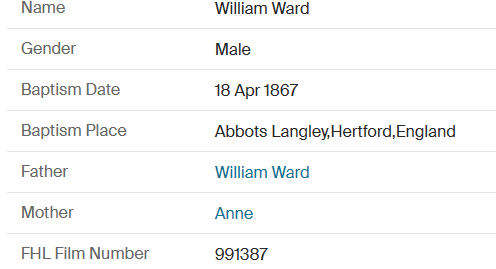

It is clearly documented in the footnote above that Major Harry Duhan of Bedford went on to become the champion of South Africa, which was reported in the British Chess Magazine that year (as linked above), his games are illustrated too (as shown above). More about his life can be found here3. This achievement is significant for our purposes because it exemplifies the first instance of a Bedfordshire based player achieving documented international success. Regarding the match in question, he suffered a 0-2 loss to Ward of Luton. But why was he beaten in both games? What did he losses tell us about his opponent?
Although we could begin with something trite like: Ward, who occasionally played for Luton, finished 3rd in the British Championships in 1905, second in 1908, then 3rd in 1909 as well as become the champion of the City of London chess club 6 times between 1902-1911, West London chess club in 1907 and champion of Middlesex in 1909 when it was the strongest county across our sceptred isle. -this antiquated approach simply won’t do4.
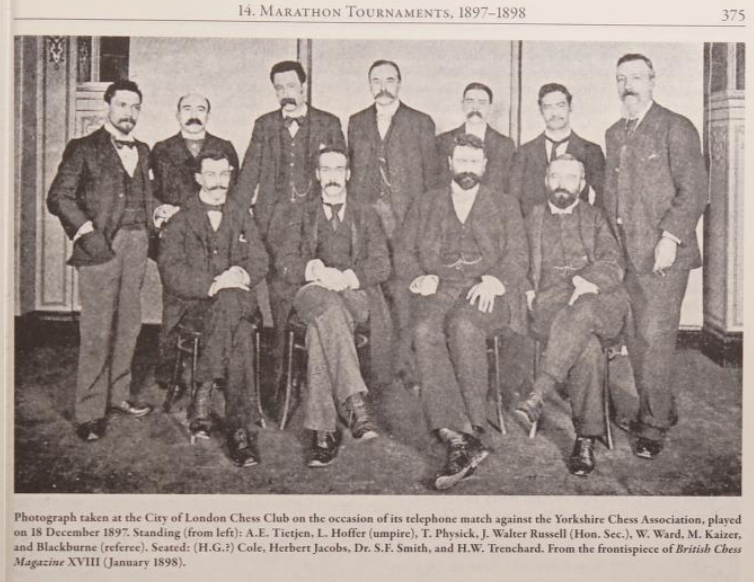
Yes the paragraph above is well corroborated but more importantly it is synchronic. Firstly, it is necessary to corroborate our own claims further and enter into discourse about them. I am not the only person to have written about William Ward. Author Richard James has done so too. You may find the links to his work here5. We are clearly in agreement that William Ward lived in and around Luton, where his family moved to, although where we differ is that author James gives a more compelling account of how transient his life was, it should also be noted that James does not show Ward did in fact play for Luton where as I have shown he did play at least twice, and in all probability, many undocumented times more since he was based outside the town for a small part of his life. Ward achieved almost all his success some years after in London. Prior to that there are pertinent questions to be answered, such as ‘How strong was Ward when he defeated Duhan in our league in 1896?’ This question is problematic because the ‘evidence’ pertaining to his ability then is rather depressing without gamescores. Yes two years’ later he did become joint champion of the S.C.C.U as James clearly illustrates. And we also have material we can utilize for narrative purposes to construct a strong argument as to why. If we embrace the entrusted EDO Historical Chess Rating site, which is generally considered reliable, then we can indeed find Mr. William Ward placed at number 131 in the world in 1896, with an estimated rating of 2315 and then in 1898 with an estimated rating of 2360, still keeping him ahead of future world champion Capablanca by some 56 rankings. In today’s market that would put him at FM level. His opponent, Harry Duhan (later to be known as Major Harry Duhan or Major Duhan) does not appear in the estimated ratings of that year but can be found for the years 1910-1912. How reliable this can be some 14-16 years after they played is difficult to be sure of but if you play through Duhan’s games in the link concerning a clash of future champions, they suggest to me he was not equipped to compete against someone of Ward’s caliber. Why do I say this? Because, as stated by historian and celebrated author Dr. Timothy Harding, there is evidence that in December 1897 he participated in the Yorkshire v City of London Chess Club match by telephone. This is significant for our purposes because the City of London Chess Club was the biggest in the country at the time, some of its members were world class. How could Ward represent the largest club in the country so soon if he was not already very strong? A group photo with him in it can be found below.
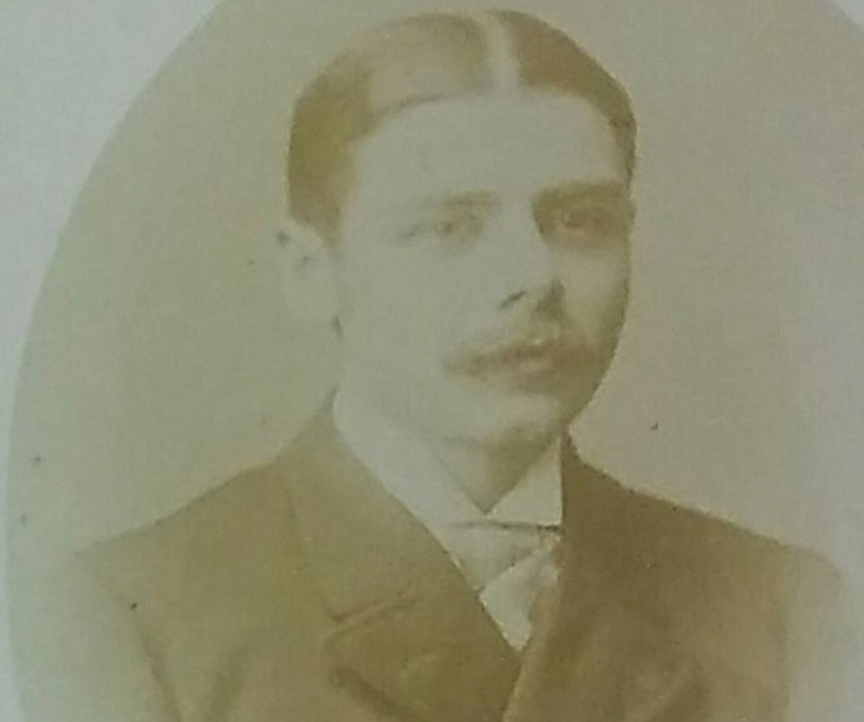
By 1900 Ward had established himself as a strong amateur in London and was selected for the Anglo-American cable matches. He was also invited to participate in the City of London Tournament, where a select few of the world’s best were pitted against some of the best amateurs on our shores6. Details of this can be found here 7. As you can see, Ward not only drew with Mason but beat Blackburne and finished above him in the tournament. The following year he was pushed up the team in the Anglo-American cable match from board 9 to board 7 and beat Frank Marshall too, making him the first documented Bedfordshire based player to beat world class opposition. His retrospective rating for 1901 was 2372, making him 86th in the world, placing him above future world champion Capablanca (2359).8. His draw against Mason and victories against Blackburne and Marshall can be found below. Only now can we see why Ward went on to nearly win the British Championship on more than one occasion before the decade was out! In 1904 he had an estimated rating of 2414 and was rated as 60th in the world, ahead of many more famous than him, such as Isidor Gunsberg, Eugene Znosko-Borovsky, Karel Treybal, and Dawid Przepiórka.
‘A historical narrative is thus necessarily a mixture of adequately and inadequately explained events, a congeries of established and inferred facts, at once a representation that is an interpretation and an interpretation that passes for an explanation of the whole process mirrored in the narrative.’
Hayden White, Interpretation in History, pg. 1
The draw against Mason, City of London Club Invitational, April 20th 1900, Round 6
1.d4 d5 2.c4 e6 3.Nc3 Nf6 4.Bg5 Be7 5.Nf3 Nbd7 6.e3 O-O 7.Bd3…
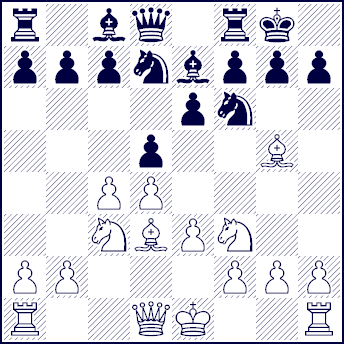
… dxc4 8.Bxc4 Nb6 9.Bd3 Nbd5 10.O-O Nxc3 11.bxc3 Nd5 12.Bxe7
Qxe7 13.Qc2 g6 14.Rab1 b6 15.Rfe1 Bb7 16.e4 …

… Nf4 17.Re3 f6 18.Bc4 Kh8 19.Rbe1 e5 20.Bf1 g5 21.d5 Bc8 22.c4 …

… Bd7 23.Rd1 Qe8 24.Qb2 c5 25.Rb1 Rf7 26.Ne1 h5 27.g3 Ng6 28.f3 Qb8 29.Nd3 Qd6
30.Bg2 Rg8 31.Rf1 Rh7 32.Rf2 h4 33.g4 Ne7 34.h3 Nc8 35.Bf1 Qe7
36.Ne1 Nd6 37.Ra3 Ra8

38.Nc2 Rf7 39.Ne3 Rff8 40.Qc1 Rfb8 41.Rb2 Rb7 42.Qb1 Qd8 43.Ra6 Bc8 44.Nd1 Rab8 45.Nc3 Rc7 46.Ra3 Bd7 47.Rab3 Qe8 48.Qc2 Kg7 49.Ra3 Qe7 50.Nb1 Qe8 51.Nd2 Rd8 1/2-1/2

https://www.chessgames.com/perl/chessgame?gid=17169688
Ward v Blackburne City of London Club Invitational, April 26th 1900, Round 9
1.d4 d5 2.c4 dxc4 3.Nf3 c5 4.e3 cxd4 5.Bxc4 Nc6 6.exd4 e6
7.O-O Nf6 8.Nc3 Be7
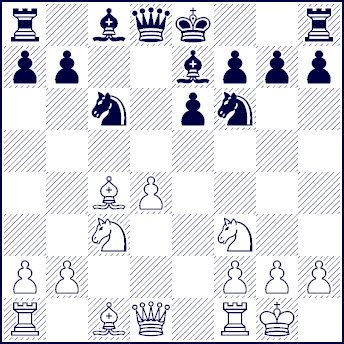
9.Ne2 O-O 10.Be3 Qa5 11.Ng3 Rd8 12.Qe2 a6
13.a3 Nd5 14.Rfd1 Nxe3 15.Qxe3 Qb6 16.Rd2 Bf6 17.Rad1 g6
18.Ne4 Bg7 19.b4 Ne7

20.Nc5 Nd5 21.Bxd5 exd5 22.Re1 a5 23.Rde2
axb4 24.axb4 Bg4 25.Qc3 Bxf3 26.gxf3 Rac8 27.Qd2 Bf8 28.Kg2
Rb8 29.Re5 Qf6 30.Qa2 Qc6 31.Qb3 Bg7 32.b5 Qb6 33.Rxd5 Bxd4
34.Nd7 Rxd7 35.Rxd7 Qf6 36.Qd5 Bc3 37.Ree7 Rf8 38.Rxb7 Qf4
39.b6 h5 40.Re4 Qf6 41.Ree7 Bb4 42.Red7 h4 43.h3 Be1 44.Rxf7
Rxf7 45.Qxf7+ Qxf7 46.Rxf7 1-0


https://www.chessgames.com/perl/chessgame?gid=1029429
Marshall v Ward, 6th Anglo-American Cable Match, April 19th 1901
1.d4 d5 2.c4 e6 3.Nc3 Nf6 4.Bg5 Be7 5.Nf3 Nbd7 6.c5 …

… c6 7.e3 e5 8.dxe5 Ne4 9.Bxe7 Qxe7 10.Nxe4 dxe4 11.Nd2 Nxc5 12.Nc4 O-O 13.Qd6 Re8 14.O-O-O Be6 15.Qxe7 Rxe7 16.b4 Na4 17.Rd4 Bd5

18.Nd6 Bxa2 19.Bc4 Bxc4 20.Rxc4 Nb6 21.Rxe4 Nd5 22.Kb2 b5 23.Rc1 Rc7 24.Rd4 Ne7 25.Nxb5 Rb7 26.Nd6 Rb6 27.Kc2 Rab8 28.Kd1 a6 29.Ra1 Nd5 30.Nc4 Rxb4 31.Rxa6 Nc3+ 32.Kc2 …

32. … c5 33.Rh4 Nd5 34.Rc6 R4b5 35.Kd2 Ne7 36.Rc7 R8b7 37.Rxb7 Rxb7 38.Ke2 Rb4 39.Kf3 …
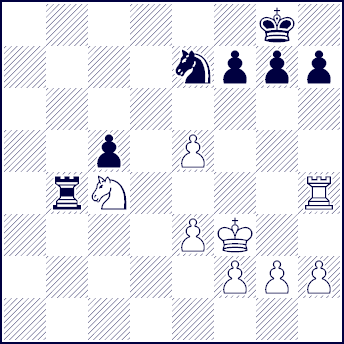
39. … Ng6 40.Re4 Rxc4 41.e6 Rxe4 42.exf7+ Kxf7 43.Kxe4 Ke6 44.f4 Ne7 45.g4 Nd5 46.f5+ Kd6 47.g5 c4 48.f6 gxf6 49.gxf6 Nxf6+ 50.Kd4 Ng4 51.Kxc4 Ke5 52.Kd3 Nxh2 53.Ke2 Ke4 54.Kf2 Ng4+ 55.Kg3 Nxe3 56.Kh4 Kf5 57.Kh5 Nd5 58.Kh4 Nf4 59.Kg3 Kg5 60.Kf3 h5 61.Kg3 h4+ 0-1
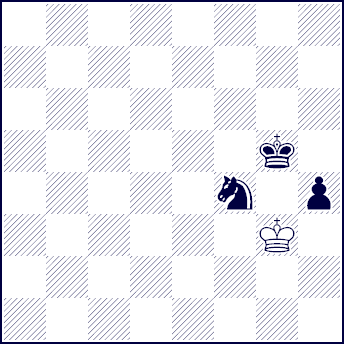
https://www.chessgames.com/perl/chessgame?gid=1094493
‘It is dates, he (Claude Levi-Strauss) says, which justify the historian’s search for “temporal relationships” and sanction the conceptualization of events in terms of “the relation of before and after.’ Hayden White, Interpretation in History, pg. 289
My dear fellow countymen, to continue with Levi-Strauss, ‘history is never history…but history-for’. For our purposes, I have constructed a narrative which shows William Ward played chess in Bedfordshire in his early years and had multiple successes thereafter in London. He was the first to encounter and beat world class opposition, or masters as they were known back then, shortly after his time in Bedfordshire. Although Ward’s most noted achievements came nine years and more after he left our county, I have chosen to focus on his performances before as they give us a clearer indication of his ability around the time he left our county.
Posted in Bedfordshire Chess, History of Bedfordshire Chess, Life beyond the chess board on October 30, 2023| Leave a Comment »
Television has a role in modern western society which is being decentralized by the internet and the so called digital revolution we are, apparently, undergoing.
Nonetheless, important it remains and compelling it may be too…especially when Bedfordshire’s finest chess players appear on it. Who might they be and what was that all about then?
1 (The man who failed to beat me with the King’s Indian Attack)
The first was Bedford’s Dave Ledger, who appeared on the Channel 4 daytime show Countdown around 1993 (apologies for my imprecision). I did ask him about his experience on the show once, and he informed me that it (Countdown) was far less glamorous than it appears on tv! Dave did win on his debut it, I remember watching him, and gave a good account of himself. https://wiki.apterous.org/Episode_1571 . It is also claimed that Dave appeared on a show called Brainteaser but I have no evidence of this.
2 (The man who dismantled my Bird’s opening far too quickly)
Staying with Bedford, second was Paul Habershon, who also appeared on countdown some eleven years later, and like Dave, won in the first but lost in the second show. Further information can be be found on the Countdown Wiki here. https://wiki.apterous.org/Paul_Habershon
3 (The man I never met over the board)
Third in line was Bedford’s James Plaskett, who famously appeared on Who Wants To Be A Millionaire in 2006, and in all probability, won more money on a gameshow than any other chess player in history.
4 (The man once rated 200+ who once saw me off with with his Catalan)
Forth comes Dunstable & Luton’s Colin Garwood, who recently appeared on University Challenge and did rather well for himself.
5
The exclusion of the fifth element! Mr. M. J. McCready once appeared as an extra in the film Whoops Apocalypse in 1986, and then appeared on tv many times thereafter in the crowd at Luton Town football club. I’ve also appeared on tv in Saudi Arabia and Azerbaijan. But I’m not linking any of that nor should I include myself. All appearances were fleeting and I never said very much. Additionally, I’m both shy and rubbish at chess, which makes my inclusion rather unnecessary and quite unjustifiable!
MJM
Posted in Life beyond the chess board on October 6, 2023| Leave a Comment »
Don’t ask me how but one of the two games I played for Luton whilst in recovery from my main accident, where I fractured my skull alongside a great very many other vicissitudes has been found, and here it is. I do remember the game, and do remember delivering mate.

And in case you can’t read it, here it is:
Mark.J.McCready
Shamal Mohammed
24/11/16 OU v Kents/Luton
MJM
Posted in Life beyond the chess board on July 29, 2023| Leave a Comment »
Clearly it is the case that a break from chess is long overdue, should such a thing indeed be possible?
With online chess banished, what do I do with OTB chess? OTB chess carries a sense of occasion which factors in social elements. Given that I am soon to relocate, and am keen to make new friends, is a break from OTB chess justifiable? Do I resign myself to being just a spectator, should I find a chess club where I am relocating too in the hope of gaining friends and acquaintances? Can’t I just limit the amount I play instead? What is more important? The social or competitive aspect of chess for me? Is a break a necessity or merely a preference? Is my judgment sound or poor? Why so many questions over something relativity insignificant?
Because it is contentment not improvement that is in play here; therefore, the social dimension of chess is significant, and to be factored in.
Whether anything will come about I don’t know. I’m more impulsive than I am rational. Not only am I far from your archetypal chess player, I’m also a lazy sod and a lazy git as well as being both shy and anti-social.
Of this there is no doubt: you will hear about it one way or another and quite soon.

MJM
Posted in Life beyond the chess board on July 21, 2023| Leave a Comment »
“Wealth consists not in having great possessions, but in having few wants.”
― Epictetus
That atemporal stranger in a strange land -myself in Eastbourne- outright refused to go to the chess club tonight and vowed to never go down that empty lane again. Eastbourne? Yes Eastbourne, the quiet-city-by-the-sea, the city that is not only a noticeable improvement form Luton but is also kinda dead, kinda unable to respond to being Brighton’s smaller brother. I only played one game of chess last weekend -in London not Eastbourne- and that was enough to tell me that a break is long overdue.
So today I said to myself, ‘just say no’.…British people who, like moi‘, grew up watching Grange Hill in the 80s may have bells ringing here. They may say ‘but that song was about stopping doing drugs’ well chess is a drug, well kinda… .
I don’t watch live chess anymore. Isn’t it tiresome and depressing just? I stopped playing on-line altogether and for good, and there’s no more OTB chess planned anytime soon… .
Long may it all continue…continue on it may… .
Posted in Life beyond the chess board, Luton Chess Club on July 1, 2023| Leave a Comment »
En route to the chess club for some of 91, I used to catch a bus here.

I used to listen to Gwar, especially the song ‘The Salmanizer’.
MjM 😀
Posted in Life beyond the chess board, My own endeavours, On-line journal on April 29, 2023| Leave a Comment »
Yesterday I had a plan. That plan was to take the skytrain and enter the city. Stop off at my favourite Indian restaurant for a vegetable curry. Get back on the skytrain and go to my hospital for my medication (I have hypermania), then go to the chess club. But that way go it did not. Within minutes of getting on the skytrain I fell critically ill. My whole world collapsed around me because the week before (subject of The visit that never was) I suffered so immensely from my life being threatened that I have been in a state of near collapse ever since. All I could do was hang on for dear life on the skytrain, try my hardest to walk to the hospital, collect my medication, and go back home. It was not very pleasant to arrive at the station I was supposed to get off to go to the chess club and then watch it go by but I had no choice, I was so sick mentally. By the time I got home, it wasn’t even 7pm but I had to fall into bed immediately and lie still all night long. Being the true hypermaniac that I am, of course sleep was not possible, and yes of course it’s not possible tonight also and no it won’t be possible tomorrow night either but these are trivialities. Like I said in the previous post, when your life is close to being taken away from you, you aren’t going to like it and you aren’t going to know what to do. What I didn’t say was it’s not something you can just walk away from and expect to be as right as rain the next day either. And what I couldn’t say was how sure I was of what was happening around me. Was I so startled that I couldn’t see things straight? The answers are coming, the answers are coming, a conclusion will be created… .
Yesterday, I didn’t have the power to play chess. I felt so wounded. I felt confused. I just wanted to go home, close my eyes and make everything go away. I could not speak to anyone, not even my own daughter. All I could do was lie still for many hours, not even hoping that my wounds would heal. I cannot put into words how hurt I have been and if that isn’t bad enough I must wait weeks before I can learn if I have been left with a terminal illness too, one which will eventually destroy my immune system and take my life from me.

Mark. J. McCready, 02.13 am, Sunday April 30th 2023
A quiet and lonely place where I have cried most days this week, Laksi, Bangkok.
| M | T | W | T | F | S | S |
|---|---|---|---|---|---|---|
| 1 | 2 | 3 | 4 | 5 | ||
| 6 | 7 | 8 | 9 | 10 | 11 | 12 |
| 13 | 14 | 15 | 16 | 17 | 18 | 19 |
| 20 | 21 | 22 | 23 | 24 | 25 | 26 |
| 27 | 28 | 29 | 30 | |||
A side note on how to read old Tom Sweby's columns
Not perhaps, but quintessentially, Old Tom Sweby is best thought of as a passionate devotee to the newspapers he wrote for. He was well read and knowledgeable of the Bedfordshire chess scene and well beyond, given that he was the president of the S.C.C.U. once upon a time. He was generally well-respected and rubbed shoulders with many, if not all, of those eminent within British chess circles. It would, however, be a critical mistake to see his column is primary source material entirely. That it is not. You will also find secondary source material quoted too, and the reliability of that is not quite as Tom hoped. Given that he wrote for decades, this is to some degree inevitable, and after all we are all prone to error whether we realize it or not. Thankfully, with regards to old Tom Sweby, they are infrequent and for the most part old Tom continued to document events and developments in the Bedfordshire league from the get go as best he could but, of course, everything lies open to interpretation. Despite this, and generally speaking. this does indeed make him informative and thus worth reading. Dare I say his columns constitute a narrative describing the latest developments, match reports and changing nature of the Beds league...he knew his audience and wrote according. This manifested itself over decades but brevity was always in play courtesy of the restictions imposed by writing a column. Should you wish to read a in instrumental figure of the Beds' league post WW2, you are quite welcome to peruse what has been posted here... . :-) I should, however, point out that as the decades wore on he gradually moved on away from narratives concerning the Bedfordshire league towards affairs both historical and international. The reasons for this are multifarous, old age was a predominante factor presumably, however, the bottom line is with regards to how the Bedfordshire chess scene developed post WW2: old Tom Sweby is your go to guy. He wrote more about chess in Bedforshire than anyone else did but given he was a Lutonian and writing for a Luton newspaper there is both bias and greater coverage of his hometown than the rest of the county.
















To add comments, please see the bell at the top of the page.
 McCreadyandChess