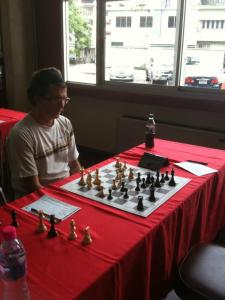
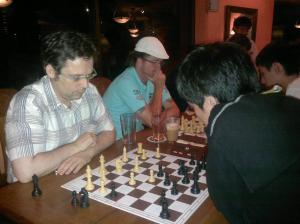
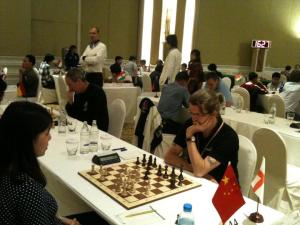
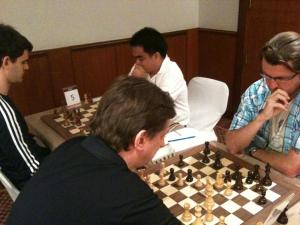
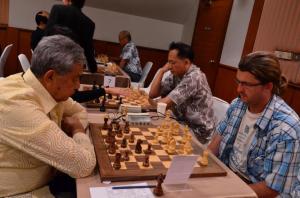
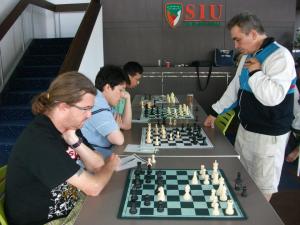
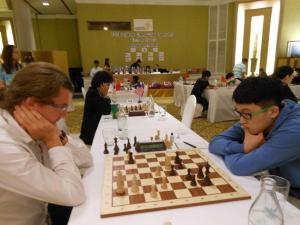
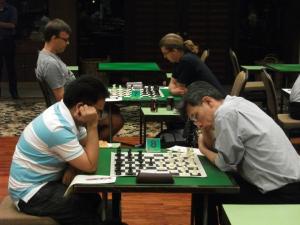
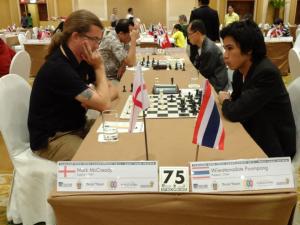
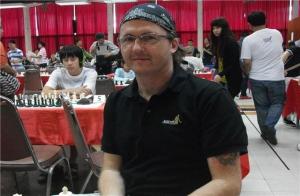
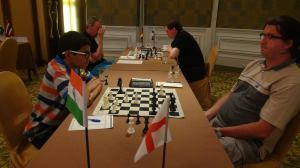
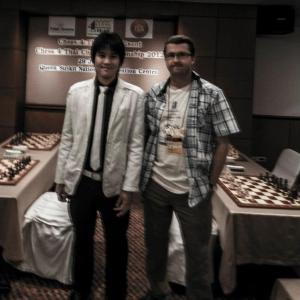
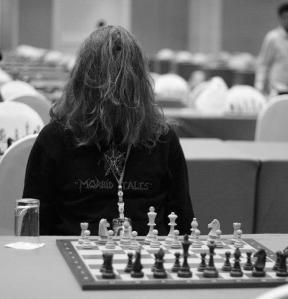
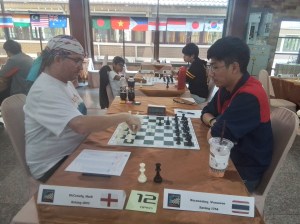
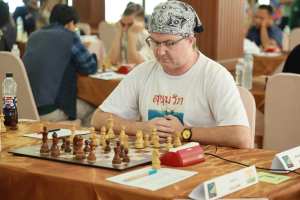
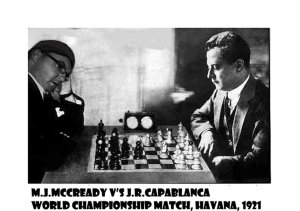
Tonight, old-timer McCready beat an IM at draughts (I have played for England before). The videos linked do not show the game I won but rather who my oppponent was (not just an IM but a senior figure in the draughts world), and that I was enjoying myself. Should it be the case that you assuming I was some one trick pony and nothing more, I am very sorry to tell you that isnt so… .
Pic of reigning school chess champion in Norfolk before I left school, only just turned 16. I am to the left. I have a green notebook in my pocket but what is it?
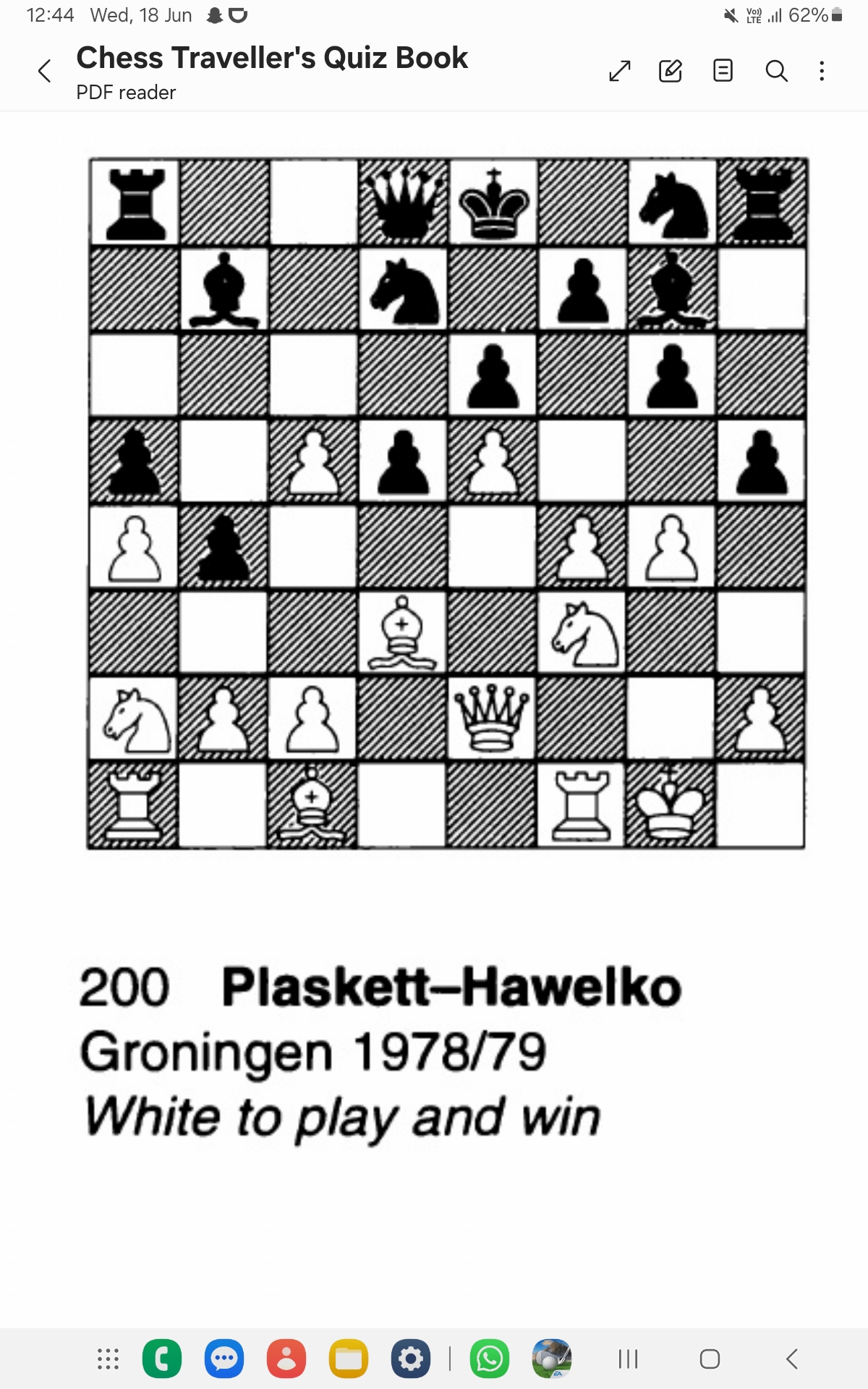
As I sat on a bus, new and red in colour, trundling across Bogota, whilst en route to a private lesson given to a student, I dipped into a favoured publication on puzzles -the appropriately named Chess Travellers Quiz Book by GM Hodgson. Certainly preferable to staring aimlessly out the windows, watching derelict buildings covered in graffiti roll by through the city’s sprawling, run down suburbs… .
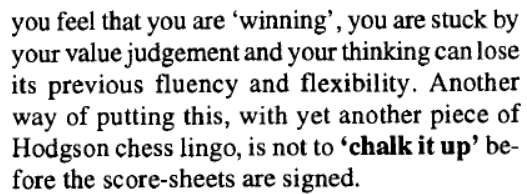
But this time I thought I’d read it backwards. A move more worthy of the annotation !? I remembered its alluring imagery of tourist attractions upon its dazzling white cover well, that there were 12 chapters in total too, but not so that some 200 puzzles in total were to be found within its covers. 200 puzzles in 12 chapters? ‘Most fitting’, I thought somewhat in jest, given that my playing strength in classical chess is usually estimated at around ELO 212 by my opponents after they have won easily yet again (although in truth it is a tad higher than that, say, ELO 214?) :-). Yes thats ELO rating not ECF rating. Jocularity aside, in finding puzzle 200 it was pleasing to see Bedfordshire’s strongest player of all time making a cameo. Attempt it I did as the bi-articulated bus I sat on approached the Zona Industrial stop, barely a kilometre or two from where I would soon embark unhurried… .
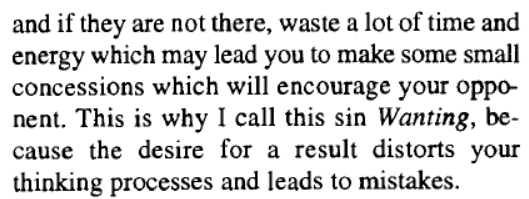
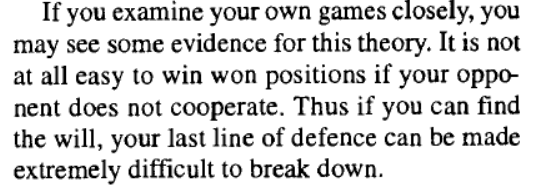
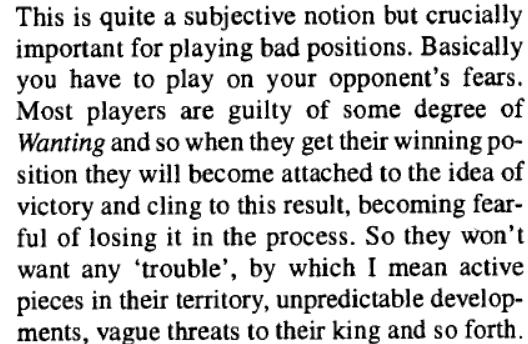
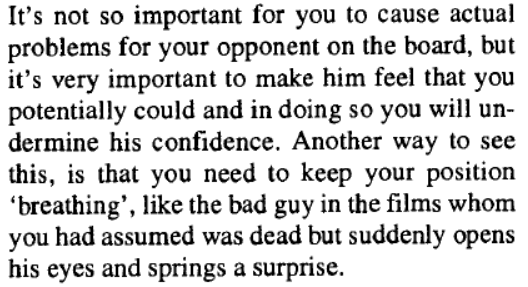
In truth, problem-solving is an aspect of chess I have never been too fussed over. That said, trying to find the solution to that above became illuminating upon reflection. Needless to say, I didn’t get very far, and had to question why. ‘White to play and win’ it says, this tells you that something is afoot but what? In OTB chess I tend to shy away from evaluating the positions I stumble across in my games because in GM Rowson’s inspirational book The Seven Deadly Sins of Chess, ‘wanting’ is the first addressed. There, he argues convincingly it is not only injudicious but more so a critical mistake to assess positions as winning or won. Better to think of them as strong/good/better/advantageous or something like that instead. An approach antithetical to problem solving indeed. Thus true to form, I couldn’t find a direct win and opted for moves that just looked good instead… .
After a few minutes, barely seconds before I got off at La estación sencilla Distrito Graffiti, as they say in this neck of the woods, I decided that white’s first move must be Bxg6, and that after fxg6, white probably follows up with Qd3 then Nd4, at which point black’s position looks precarious to say the least. Black’s g-pawn will be captured and the e-pawn probably too. Was I right or was I wrong? Alas, I am just not good enough to assess whether such moves lead to a winning attack or not, I also didn’t have enough time left of my journey to study the solution either, frankly. And like I said problems/puzzles aren’t my forte, so it mattered greatly not… .
Nonetheless, my brief, blank journey across Bogota was made more pleasant, despite the glaring disparity between Bedfordshire’s most successful player and the one most average at best who types these words, ending haplessly with me not daring to check the solution, aware even I had ample to do so upon arrival at the mall, after the fifteen minute walk there, should I want to. Instead, I just sat somewhere on that first floor people watching, clearing my thoughts, waiting for my student to arrive, which she did some thirty minutes or so later. Then the usual meet and greet ensued and two hours or so of instruction took precedence over time-killing, which made it easier to stave off boredom I guess. An impulse or two to write after all classes were completed later that day passed, then I wandered off home as rush hour hit, not really thinking about anything. Simple pleasures gave way to the formalities of business and the two rarely mix well, despite all our efforts. It led to a grey afternoon of sorts. Yes the interior design of the mall leant itself to grey marble I noted. Outside the sky was grey too I saw. The traffic now heavy as back it trudged towards downtown, made the air grey and pong of pollution; falling on the procession of reckless cyclists alongside it was light rain, and then after all that, on a yellow C-19 bus sat I no longer wanting to read, and sat like any vacuous amateur chess player would when reflecting on the lengths they must go to just to earn a crust, and lamentably, why their forays into chess are abstemious. The C-19 returned me to the stop named La estaciónFlores, a few minutes walk from where this post is being penned. When I got home I made dinner -it was rather English and rather bland. Then I slumped on this bed and watched youtube videos on how chess should be played. But I just watched while I ate and didn’t think too much about the moves being played. Then I fell asleep and a new day was born.
Selected content considered more relevant to he who types these words can be found below. Furthermore, though unnecessary, content most recently re-read from the world’s most educated Grandmaster, or not far off it, posted below. There to be savoured and also learned from.
Playing for pleasure and playing to win are two different things altogether.
I have upped the engine on Lucas Chess to Monarch 1.7 (ELO2100/ECF184).
I have not yet fully absorbed the advice I previously posted from Rowson’s The Seven Deadly Sins of Chess. Because of this, I lost the second game against it when I should really have won. But for the first time I also did the other thing required, to look at my games and learn from my mistakes (more on this to come).
Now there are conditions too:
Firstly, play with a clear head.
Secondly, make sure I am ready to play and want to play.
Thirdly, allocate more time to the games, as this will help.
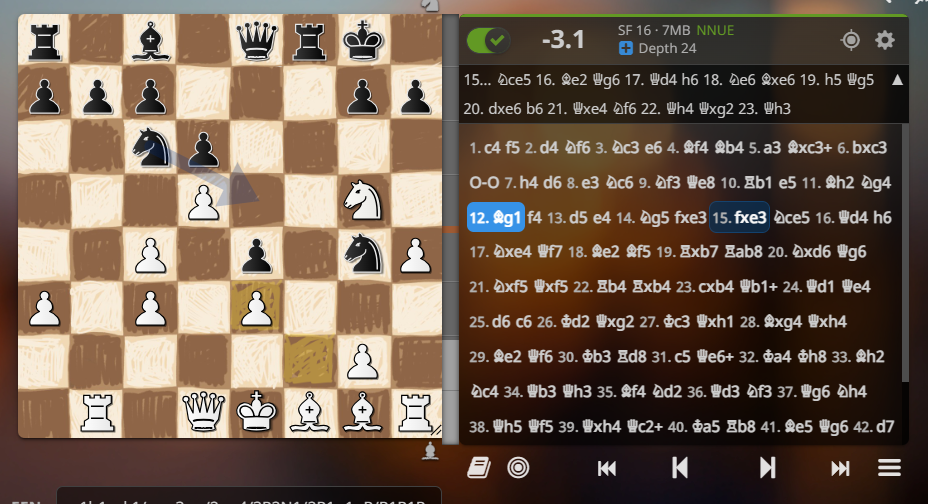
From the harrowing loss, I have learnt I am missessing the position and not spending enough time on that. I also need a broader approach and play with more caution. By this I mean give less emphasis to wanting to seize the initiative all the time, which I tend to do. I really couldn’t believe I lost.
Clearly winning but misassessed.
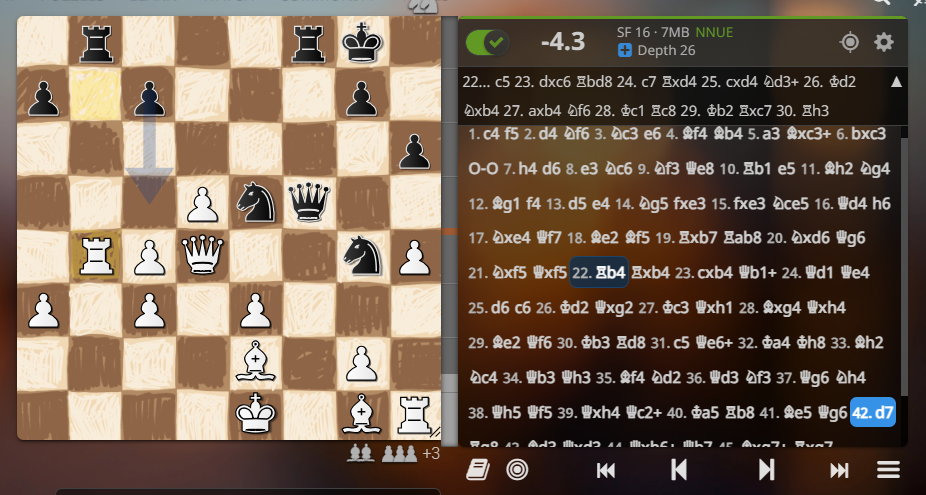
Here I went a bit wrong. The correct move is 27. …. h5 and not 27. …. Qxh1. I should have eased off grabbing material and seen that my knights were controlling the position and essential to retaining control of it. I should have made more effort to assesss the position and not thought more in terms of the result. /
32. Ka4 Kh8 22. Bh2 Nc4?? That move lost me the game whenI thought I had it won. Nd7 is better. The position is not won, it’s marginally worse. I just thought he’s bound to get mated when in fact the king is safe there.
3-6 months it stays. About right for someone so out of practice. On we go.
Back in blighty a.k.a me old stomping ground, a very great many club and county players exhibit both strengths and weaknesses which are not entirely disimilar to one and other. The reasons for this are variable but a trait more commonly found amongst them mentioned above is too much attention paid to their moves and position and not enough to their opponents moves and position. But who doesn’t like to do what they want to do, or put differently, pull off what they think will bust their opponent in one way or another.
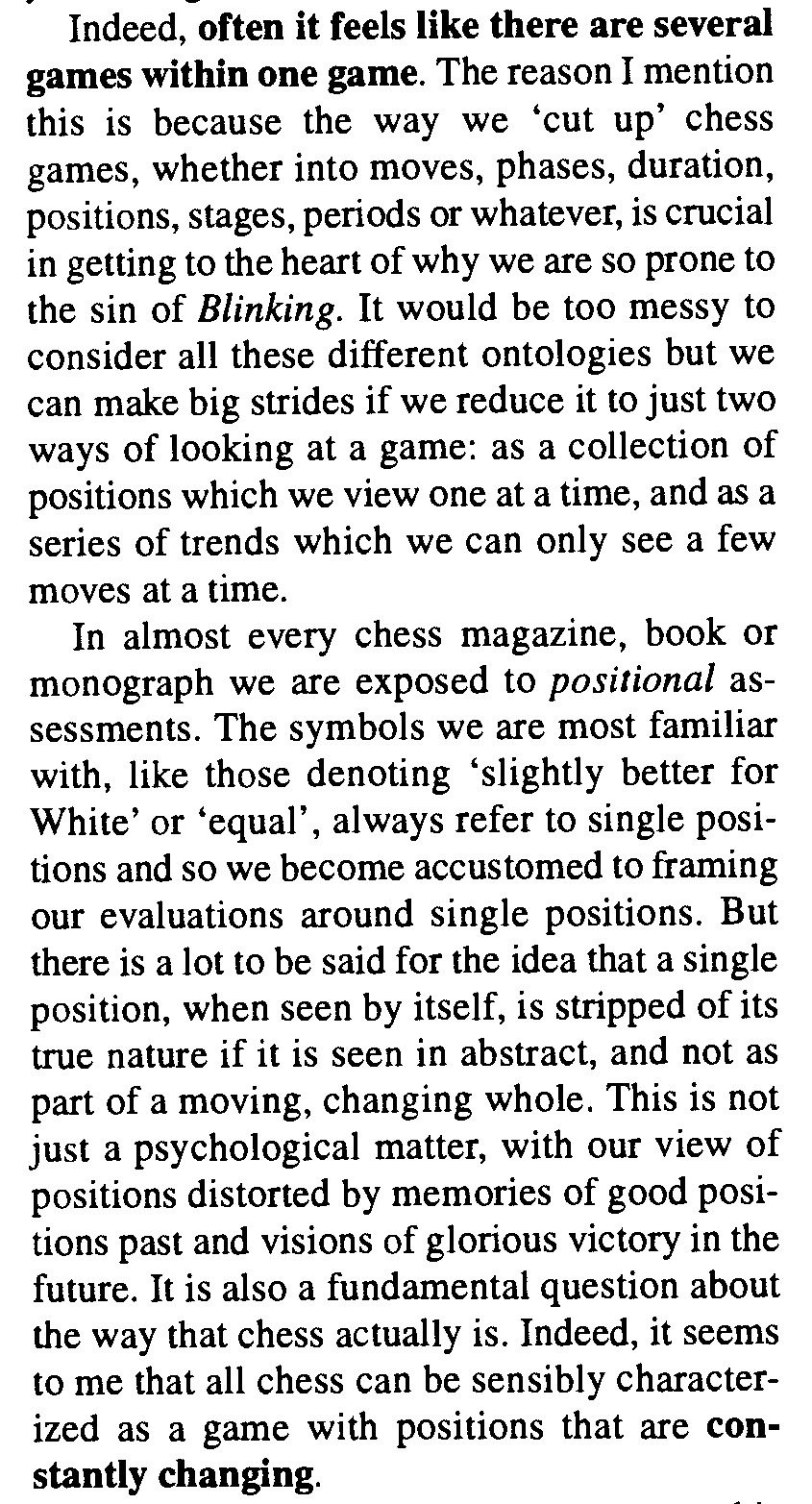
In deciding to invest both time and effort into this whimiscal experiment I conjured up on the khazi whilst walking past some bogs, I have realized that the nature of the play I am attempting to win with exhibits a weakness I have attempted to eliminate by implementing what I read in my youth. But since my games were charaterised by drawish openings and positional play, this was not the necesssity it now is. The transformation in style I have begun playing with requires good calculation skills and tactical nouse; neither of which I have been any good at since I’ve always believed evaluation triumps over calculation. Ye olde electronic friend has a penchant for counterplay and the little git is rather more gifted at it than I to say the least.
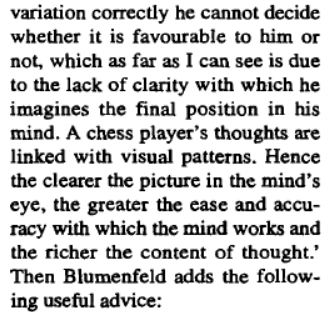
I have noticed that I am not considering candidate moves in the way that I learnt from Kotov long, long ago. Below is some of his thoughts, which when implemented should help me to consider not one but several moves that electronic pal of mine might spring on me. It is a weakness that must be attended to on the double.
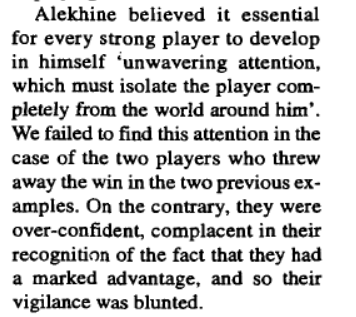
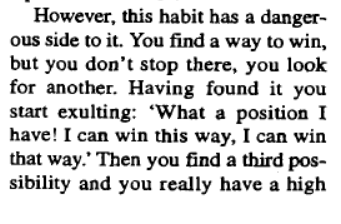
That above, gleaned from that masterpiece Mr & GM Kotov affectionately penned characterizes the way I go awry whenever I mistakenly tell myself ‘I am winning’ or ‘I got the position won now’ or worse still as well as more likely ‘I can win this anyway I want now.’ How much truth lies in the platitude ‘pride comes before a fall’ there is, know I do not. For myself pride and the colatteral it gets clobbered by comes after the fall.
However, it matters now. Learning is a life long process there is no escaping from whether you like it or not, even for old geezers those of us going grey.
That’s all from he who thinks he’s funnier than he is aka Mark. J. McCready
I do hope you, who reads what is written here, learns that you are never too old to learn. Which, unfortunately, is a barrier a great many place in front of themselves mistakenly.
Given the nature of the style of play I have adopted, the importance of the result has been conflated. Quintessentially, my play can be defined most profundly in terms of sacrifices and attacking chess combined -hopefully with a devastating and winning attack.
The experiment which initiated this radical transformation of play began some seven weeks ago. What I first noticed was that I often obtained winning positions but failed to convert them. This became increasingly frequent, making it something of an embarrassment if I am being honest. I realized as soon as I thought I had the game won, I took my foot off the pedal and all too often lost the victory I was so sure was mine.
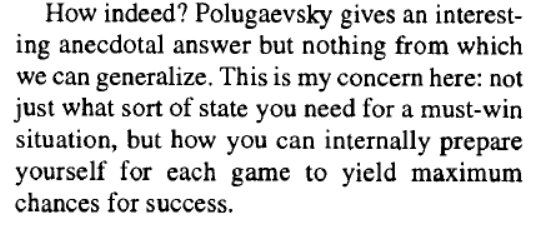
Upon reflection I realized that I was making a mistake I had learnt not to make from reading GM Jonathan Rowson’s book ‘The Seven Deadly Sins of Chess’, which was recommended to me whilst participating in the 2011 BCC open in Pattaya by friend and playing partner Ron Hoffman. To fix priority number one, I thought it best to read the first of Jonathan Rowson’s publications, and also his best, and have placed the content from the chapter where he discusses the nature of the mistake I have been making, as well as some suggestions on how to fix it.
In case you don’t know GM Rowson is a celebrated author too and has a Ph.D from Oxford on wisdom. He’s an exceptionally clever man and very knowledgeable about chess. Even super GM Lev Aronian once said the book that helped him improve his chess the most was the aforementioned title above. By all means enjoy the content below.
The thing I was better at than anything else ever was photography, not only did I know this myself but I was also told this by a very great many others or thereabouts. There is a corrleation between chess and photography…care to know what it is? I’m not sure how obvious this may appear but the results achieved in both are entirely dependant of the complexity of the decision making procedure involved in what you strive for. In photography talent is usually defined as being something you have an eye for whereas in chess is more so like something you have a feel for (well at the higher levels). Expertise, is of course, a prerequisite of both.
You may find a post in this blog which offers some generic advice but admittedly, I could have put more into it. The forth pic below is my all time favourite pic, taken very near my home.
Opening remarks, I hope you enjoy the oginiality you are about to encounter, an approach opposed to conservatism too, and a sense of pride in my working class upbringing despite it being antithetical to what usually consitutes chess writings. It’s not part of the norm and rather unnerving I suspect. Good if it is. Finding your voice is an aim all writers hope to achieve and is of much greater value than and the opinions of those I have never met, will never know nothing of and have no interest in whatsoever, courtesy of their anonymity which will forever condemn their comments to not worth reading. However, I am willing to concede this post isn’t really worth reading as my account of myself and comments on the world are a little too playful to be believed…ah well, I’ll try to do better next time. Would it help if I said I am by far the baddest, meanest, toughest, most fearsome 1600 player on the planet, capable of finding any mate in one on the board provided I’ve still got a good 25 minutes on the clock still, and have never blundered more than 15 times in a game. I even know how to set the pieces up correctly and can get it done in less than half an hour usually, and if you gave me a pencil to write my name on the scoresheet, it usually take me less than an hour to work out which end you write with, not that I ever write the moves down though, I was told only trannys do that.
Having always been rubbish at chess, it’s very pleasing to redefine my approach and adopt a style of play hyper-aggressive when the intitiative is often seized by sacrifical attacks. I so very nearly beat my electronic friend tonight. I had the game completely won and was spoilt for choice on how to finish him off. But because I am not only rubbish at chess, I’m also a useless bastard, I went and bollocked it up, much to my disappointment. It was my every intention to really stick it to my electronic friend tonight and beat it for the first time. I almost wiped it off the board but got exited and forgot how rubbish I am and bound to mess it up. Which I did, as expected. Go have a look at the game and ask, how on earth could anyone throw that away? Don’t ask me, I don’t even know. It will be quite sometime before I can overcome the disbelief, I estimate about 25 years. It’s killed my interest in redefining my approach to chess completly, I’ll never believe I had it so easily won then blew it, my confidence in myself hasn’t just been sledgehammered, it’s been completely obilterated But to end on a positive note, I do have a chance I can succeed, and it’s only a 10,000,000-1 shot,so wish me luck. Lamentably, If I ever do play chess devoid of confidence, I am usually proper fucked and get massacred always.
To conclude, I sincerely apologize for not having the writing skills required to describe the absolutely appalling way in which I threw the game away. But I do accept in life there are sometimes things we experience we will never be able to understand or believe, I just suppose who are completely rubbish at something should expect this infrequently. But to inspire those who have read this, if like myself disbelief in how crap you are will remain ever present in your life, it is still possible to gain pleasure from playing. It happened to me once 30 years ago, and it’s safe to assume you will experience the same thing at some point in the next 40 years or so, like one of my best friends did. So it’s not all doom and gloom. But I should warn you when he walked into the car park after the match, he got a smack in the mouth and a kick in the bollocks for winning, and when questioned his opponent refused to say the name of the mental home he’d just been let out of too. So be sure you opponent is the amiable type and hasn’t just been let out of a mental home.
I am in the process of reducing down online chess to the point of elimination and reintroducing computer chess. The principle reason being I have picked up veyr bad habits with online chess and have become too used to weak opponents and bad moves being played against me. It’s had a very detrimental effect, so I have started playing computer engines to eliminate this.
But there’s something I can’t quite put my finger on. It’s all so depersonalizing. This is symptomatic of my ability because my primary focus should be my own moves and not my opponents. Play the board not the man as Simon Webb once said in Chess for Tigers, I need to starat complexifying my decision making procedure when I play because I have identified I don’t like it when I make bad moves: the more infrequent they become the better, More concentration required…
…on what this site initially became…on what this site is now becoming…on what this site cannot become…
On what this site initially became…
…once upon a time, the chess-related musings of an adrift academic were bound playfully and electronically in this online journal of sorts. They grew and grew as the decade did too. I kept on because I love to write whether I had much to say or not; therefore, being read by others was usually of little or no importance, comparatively speaking. Content was based on personal thoughts and experience on various topics with no intended audience borne in mind. With topics broadening, my own take on things always shaped the narrative I constructed: I often thought I was insightful but never that I was right. Sometimes imagination gave rise to originality: and of that I have always remained proud. I often introduced humour, believing that I am funnier than I really am. Sometimes, I found my own style antithetical to the conservatism I believe chess is plagued by -oftentimes that has put a gracious smile on my face… .
On what this site is now becoming…
…this site is now becoming a collaboration of chess in Bedfordshire: much more so of the past than the present -that has become the dominant trend. I document the history of chess in Bedfordshire as much as I can, and as time has passed I have become more thorough and resourceful. However, I am not a trained historian as my background lies principally in philosophy but yes it is true I did study some modules on history as both an undergraduate and a post-graduate too; furthermore, I have trained myself up, particularly in terms of postmodern history. Since 2015, I have only read history and historiography as well as those philosophers who have been so influential on postmodern history, such as Nietzsche (whom I once wrote a 19,000 word dissertation on, entitled: Can the Will to Power be Found in The Birth of Tragedy?), also Richard Rorty and Foucault and I suppose certain structualists such as Claude Levi-Strauss too. Regarding postmodernism, mostly I keep to Hayden White, Keith Jenkins and Alan Muslow.
Some friends and former playing partners back home describe me as the ‘go to guy’ for the history of chess in Bedfordshire. This compliment says more about the lack of interest in the subject than my own endeavour. As mentioned, I am too adrift from academia to feel chuffed by it. Rather, I tend to lament that my historical research, like my chess, just isn’t what it should be. Even though I may well have a broad understanding of Bedfordshire chess history courtesy of the volume of research put into it, all of which began in 2014, this is not something I am particularly proud of. Nonetheless, out of courtesy compliments are graciously received. If the truth be told, I just see it as my job and only that – after all someone’s got to do it and no one else is that interested!
Amongst the many others, I have created three categories: ‘Bedfordshire Chess’ and ‘History of Bedfordshire Chess’ and ‘Luton Chess Club’. This website is slowly moving towards a consolidation of those (all of which can be found in one of the toolbars to the right).
On what this site cannot become…
…I like to be both creative and amusing when I can be, factor in that playfulness has been an ever-present factor, the content of this site should be thought of as multifarious. It could be said I continue to enjoy undermining the conservatism I believe chess is underpinned by even after all these years, and often try to use humour to do it still, believing I have got better at it. Consequently, despite the general direction its going in, this site cannot only be about Chess in Bedfordshire and nor will it be. It may become noted for that yes -in fact that’s been the case for years already even by established historians, archivists, and whoever else. External factors aside, this site is titled McCreadyandChess. I cannot, nor will I not, remove my own personal thoughts and experiences of chess from the posts of this site -especially if I think they are funny or original for they constitute my writing at its very, very best. In addition, the number of categories alone tells you that breadth of content is important to me. I am proud of my site, it is identity conferring and that is how it shall stay -end of story. All you really have are: ‘Some thoughts on the beautiful game’, which, incidentally, just happen to be my very own; nothing more, nothing less, take of it whatever you please… .
A side note on how to read old Tom Sweby's columns
Not perhaps, but quintessentially, Old Tom Sweby is best thought of as a passionate devotee to the newspapers he wrote for. He was well read and knowledgeable of the Bedfordshire chess scene and well beyond, given that he was the president of the S.C.C.U. once upon a time. He was generally well-respected and rubbed shoulders with many, if not all, of those eminent within British chess circles. It would, however, be a critical mistake to see his column is primary source material entirely. That it is not. You will also find secondary source material quoted too, and the reliability of that is not quite as Tom hoped. Given that he wrote for decades, this is to some degree inevitable, and after all we are all prone to error whether we realize it or not. Thankfully, with regards to old Tom Sweby, they are infrequent and for the most part old Tom continued to document events and developments in the Bedfordshire league from the get go as best he could but, of course, everything lies open to interpretation. Despite this, and generally speaking. this does indeed make him informative and thus worth reading. Dare I say his columns constitute a narrative describing the latest developments, match reports and changing nature of the Beds league...he knew his audience and wrote according. This manifested itself over decades but brevity was always in play courtesy of the restictions imposed by writing a column. Should you wish to read a in instrumental figure of the Beds' league post WW2, you are quite welcome to peruse what has been posted here... . :-) I should, however, point out that as the decades wore on he gradually moved on away from narratives concerning the Bedfordshire league towards affairs both historical and international. The reasons for this are multifarous, old age was a predominante factor presumably, however, the bottom line is with regards to how the Bedfordshire chess scene developed post WW2: old Tom Sweby is your go to guy. He wrote more about chess in Bedforshire than anyone else did but given he was a Lutonian and writing for a Luton newspaper there is both bias and greater coverage of his hometown than the rest of the county.
Gallery
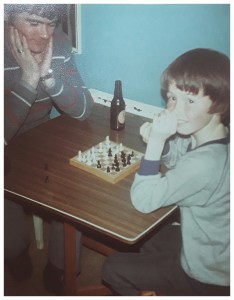
I’m either 10 or 11 here
1982, myself versus Brian from Sunderland.
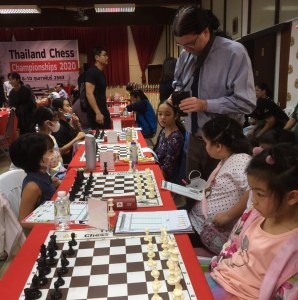
At the Thai Junior chess championships. My daughter of course.
Pattaya 2011
2011
Thai Junior Championships
2008
2011
Around 2011
2011
Pattaya 2009
2011
Kuwait 2008
2012
2012
2011 BKK Chess club
2011
2011 Thai Open
2011 Thai Open
2013 approx
Around 2014
2010
2012
Around 2011
2011
2011
2013
Around 2011
Around 2011
2020
2011
2008
2011
2013 or thereabouts
2010
2017
2014?
2010
2024
2024
2024
To add comments, please see the bell at the top of the page.