Chess, it is argued, is partially responsible for the country falling apart in the cutting below.

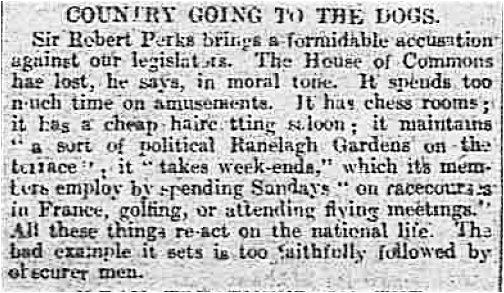
Sir Robert Perks was a Baronet (colloquially known as a clinger-on), it is one of the lowest hereditary titles in the British Monarchy.
Posted in Quaint Chess History on September 4, 2015| Leave a Comment »
Chess, it is argued, is partially responsible for the country falling apart in the cutting below.
Sir Robert Perks was a Baronet (colloquially known as a clinger-on), it is one of the lowest hereditary titles in the British Monarchy.
Posted in Quaint Chess History, tagged regina fischer on July 13, 2015| Leave a Comment »
The following letter can be found on pg. 334 of ‘The Bobby Fischer I knew And Other Stories’ by Arnold Denker & Larry Parr (Hypermodern Press 1995). As you may know Fischer’s mother was named Regina, a charming reply indeed.

Posted in Quaint Chess History on July 2, 2015| Leave a Comment »
A sign of a great book is that you can find something new in it upon each return and so once again Cafferty & Taimanov have caught your author’s attention with a curious tale concerning the 38th Soviet Chess Championship held in Riga from Nov. 25th to Dec. 28th 1970
The note of interest concerns the game between Vladamir Tukmanov and Doroshkevich who repeated a blunder for the third time in his career during the game below. Here is the game:
1. c4 e5
2. Nc3 Nc6
3. Nf3 f5

After 3. …f5 (I take black here)
4. d4 e4
5.Bg5 Nf6
6. d5? exf3
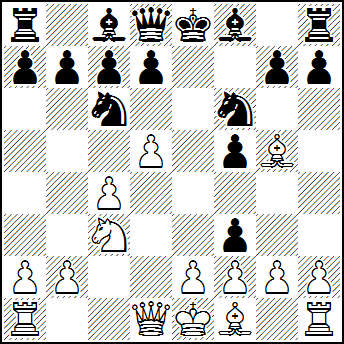
After 6. d5? exf3
7. dxc6 fxg2
8. cxd7+
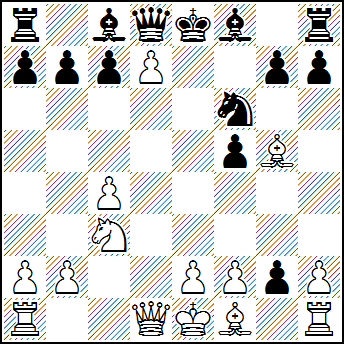
What should black play here?
8. …Nxd7! Not obvious but after which white has two hanging bishops and a rook and black is obviously threatening to queen!
RESIGNS
You had to be super-strong to play in the Soviet Championships at the time, it makes you wonder how one of its participants could lose in 8 moves with white three times in his career in the same line! Very odd indeed. Doroschkevich went on to finish 13th out of 22.
38th USSR Championship, Riga 1970
November 25 - December 28

Riga, Soviet Union (Latvia), 25 November - 28 December 1970
1st Korchnoi 16 /21 * 0 ½ 1 1 1 1 ½ 1 ½ ½ 1 1 ½ ½ 1 1 1 ½ 1 ½ 1
2nd Tukmakov 14½/21 1 * ½ ½ ½ ½ ½ ½ 0 ½ ½ 1 1 1 ½ 1 ½ 1 ½ 1 1 1
3rd Stein 14 /21 ½ ½ * ½ ½ ½ ½ 1 ½ 1 ½ 1 1 ½ ½ ½ 1 1 1 0 ½ 1
4th Balashov 12½/21 0 ½ ½ * 0 ½ ½ ½ ½ 0 ½ ½ 1 1 ½ 1 1 1 1 1 1 0
=5th Gipslis 12 /21 0 ½ ½ 1 * ½ ½ ½ ½ ½ ½ ½ 1 ½ ½ 1 ½ ½ 0 1 ½ 1
=5th Karpov 12 /21 0 ½ ½ ½ ½ * ½ ½ ½ 1 0 ½ 1 ½ ½ 1 1 1 ½ ½ ½ ½
=5th Savon 12 /21 0 ½ ½ ½ ½ ½ * ½ ½ ½ 1 ½ ½ 0 ½ ½ ½ 1 1 1 1 ½
=8th Averbakh 11 /21 ½ ½ 0 ½ ½ ½ ½ * ½ ½ 0 ½ 1 0 ½ ½ 1 ½ ½ 1 1 ½
=8th Podgaets 11 /21 0 1 ½ ½ ½ ½ ½ ½ * ½ ½ 0 1 1 ½ ½ ½ ½ ½ ½ 0 1
=10th Bagirov 10½/21 ½ ½ 0 1 ½ 0 ½ ½ ½ * 1 ½ 0 1 ½ 1 0 0 0 1 1 ½
=10th Dementiev 10½/21 ½ ½ ½ ½ ½ 1 0 1 ½ 0 * ½ ½ 1 0 0 ½ 0 1 1 ½ ½
=10th Liberzon 10½/21 0 0 0 ½ ½ ½ ½ ½ 1 ½ ½ * 0 ½ 1 0 1 ½ 1 ½ 1 ½
=13th Doroshkevich 10 /21 0 0 0 0 0 0 ½ 0 0 1 ½ 1 * ½ 1 1 ½ 0 1 1 1 1
=13th Kholmov 10 /21 ½ 0 ½ 0 ½ ½ 1 1 0 0 0 ½ ½ * ½ ½ ½ ½ ½ ½ 1 1
=15th Antoshin 9½/21 ½ ½ ½ ½ ½ ½ ½ ½ ½ ½ 1 0 0 ½ * 0 0 ½ 1 ½ ½ ½
=15th Zaitsev 9½/21 0 0 ½ 0 0 0 ½ ½ ½ 0 1 1 0 ½ 1 * ½ 0 1 1 ½ 1
=17th Vaganian 9 /21 0 ½ 0 0 ½ 0 ½ 0 ½ 1 ½ 0 ½ ½ 1 ½ * 1 0 ½ ½ 1
=17th Mikenas 9 /21 0 0 0 0 ½ 0 0 ½ ½ 1 1 ½ 1 ½ ½ 1 0 * 1 0 0 1
19th Karasev 8½/21 ½ ½ 0 0 1 ½ 0 ½ ½ 1 0 0 0 ½ 0 0 1 0 * ½ 1 1
20th Platanov 7½/21 0 0 1 0 0 ½ 0 0 ½ 0 0 ½ 0 ½ ½ 0 ½ 1 ½ * 1 1
21st Tseitlin 6 /21 ½ 0 ½ 0 ½ ½ 0 0 1 0 ½ 0 0 0 ½ ½ ½ 1 0 0 * 0
22nd Moiseev 5½/21 0 0 0 1 0 ½ ½ ½ 0 ½ ½ ½ 0 0 ½ 0 0 0 0 0 1 *
The tournament itself was famous for Karpov’s first appearance. His very first win in the Soviet Championships was against Bagairov from Baku, who unfortunately died from a heart attack at the chessboard. On a more positive note, it is a truly beautiful game by Karpov, one of my favourite Karpov games. It should be noted that he had one loss and ten draws prior to the game.
http://www.chessgames.com/perl/chessgame?gid=1022951

White (Karpov) now plays 37 Nc7
Posted in Quaint Chess History on January 8, 2015| Leave a Comment »
Following a link from chess24, I found an intriguing critique of chess from the July 2nd edition of Scientific American, 1859, which was written to address the enthusiasm for chess Morphy’s success had generated across their young nation. It’s quite an amusing little read with a few sound points but much dubious argumentation between them.
CHESS-PLAYING EXCITEMENT. The achievements of our young countryman, Paul Morphy, in vanquishing the most distinguished chess players of Europe, have excited in our people a very pardonable degree of national pride; hence they have exhibited a strong exultant feeling in welcoming him back to his native land as the Chess Champion of the World. He has been received with high demonstrations in several cities, and public testimonials of great value have been presented to him; while at the same time poets have sung, and sages have delivered orations in his praise. At some of these exhibitions there was a considerable display of “Buncombe,” especially at the one held in Boston, where some of our scientific friends rather overdid the thing by their adulations; yet all this might be overlooked if such influences extended no further than the time and place when and where these effusions were uttered. But we regret to state that this is not the case, for a pernicious excitement to learn and play chess has spread all over the country, and numerous clubs for practicing this game have been formed in cities and villages. Why should we regret this? it may be asked. We answer, chess is a mere amusement of a very inferior character, which robs the mind of valuable time that might be devoted to nobler acquirements, while at the same time it affords no benefit whatever to the body.
Chess has acquired a high reputation as being a means to discipline the mind, because it requires a strong memory and peculiar powers of combination. It is also generally believed that skill in playing it affords evidence of a superior intellect. These opinions, we believe, are exceedingly erroneous. Napoleon the Great, who had a great passion for playing chess, was often beaten by a rough grocer in St. Helena. Neither Shakespeare, Milton, Newton, nor any of the great ones of the earth, acquired proficiency in chess-playing. Those who have become the most renowned players seem to have been endowed with a peculiar intuitive faculty for making the right moves, while at the same time they seem to have possessed very ordinary faculties for other purposes.
The game of chess does not add a single new fact to the mind; it does not excite a single beautiful thought; nor does it serve a single purpose for polishing and improving the nobler faculties.
Persons engaged in sedentary occupations should never practice this cheerless game; they require out-door exercises for recreation—not this sort of mental gladiatorship. Those who are engaged in mental pursuits should avoid a chess-board as they would an adder’s nest, because chess misdirects and exhausts their intellectual energies. Rather let them dance, sing, play ball, perform gymnastics, roam in the woods or by the seashore, than play chess. It is a game which no man who depends on his trade, business or profession can afford to waste time in practicing; it is an amusement—and a very unprofitable one—which the independently wealthy alone can afford time to lose in its pursuit. As there can be no great proficiency in this intricate game without long-continued practice, which demands a great deal of time, no young man who designs to be useful in the world can prosecute it without danger to his best interests. A young gentleman of our acquaintance, who had become a somewhat skillful player, recently pushed the chess-board from him at the end of a game, declaring, “I have wasted too much time upon it already; I cannot afford to do this any longer; this is my last game.’ We recommend his resolution to all those who have been foolishly led away by the present chess-excitement, as skill in this game is neither a useful nor graceful accomplishment.
| M | T | W | T | F | S | S |
|---|---|---|---|---|---|---|
| 1 | 2 | 3 | 4 | 5 | ||
| 6 | 7 | 8 | 9 | 10 | 11 | 12 |
| 13 | 14 | 15 | 16 | 17 | 18 | 19 |
| 20 | 21 | 22 | 23 | 24 | 25 | 26 |
| 27 | 28 | 29 | 30 | |||
A side note on how to read old Tom Sweby's columns
Not perhaps, but quintessentially, Old Tom Sweby is best thought of as a passionate devotee to the newspapers he wrote for. He was well read and knowledgeable of the Bedfordshire chess scene and well beyond, given that he was the president of the S.C.C.U. once upon a time. He was generally well-respected and rubbed shoulders with many, if not all, of those eminent within British chess circles. It would, however, be a critical mistake to see his column is primary source material entirely. That it is not. You will also find secondary source material quoted too, and the reliability of that is not quite as Tom hoped. Given that he wrote for decades, this is to some degree inevitable, and after all we are all prone to error whether we realize it or not. Thankfully, with regards to old Tom Sweby, they are infrequent and for the most part old Tom continued to document events and developments in the Bedfordshire league from the get go as best he could but, of course, everything lies open to interpretation. Despite this, and generally speaking. this does indeed make him informative and thus worth reading. Dare I say his columns constitute a narrative describing the latest developments, match reports and changing nature of the Beds league...he knew his audience and wrote according. This manifested itself over decades but brevity was always in play courtesy of the restictions imposed by writing a column. Should you wish to read a in instrumental figure of the Beds' league post WW2, you are quite welcome to peruse what has been posted here... . :-) I should, however, point out that as the decades wore on he gradually moved on away from narratives concerning the Bedfordshire league towards affairs both historical and international. The reasons for this are multifarous, old age was a predominante factor presumably, however, the bottom line is with regards to how the Bedfordshire chess scene developed post WW2: old Tom Sweby is your go to guy. He wrote more about chess in Bedforshire than anyone else did but given he was a Lutonian and writing for a Luton newspaper there is both bias and greater coverage of his hometown than the rest of the county.
















To add comments, please see the bell at the top of the page.
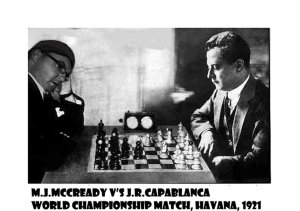
 McCreadyandChess