Before I begin, its worth reiterating -if only to myself- why I write these reviews. It is primarily for self-serving reasons -mentioned in the Read me First- as I am adrift from academia at present and have no other medium of self-expression. As mentioned in previous posts, I purchased a number of publications last year, and thought I should give an account of them.

I’ve recently come to the conclusion that many on-line reviews aren’t really reviews at all, instead they are often mere write ups. The difference being, of course, that a review contains critique whereas a write-up is a form of appraisal. After reading the book I am about to discuss, I went on-line and found several so-called reviews of this text. In truth, I very much doubt whether the journalist in question had actually read the book, as what they said was so far removed from my own experiences of the text, and so one-sided, that I have my doubts. I was going to link the reviews write-ups in question but to do so would be to denigrate my own blog…you will see gore and hardcore gay porn on here before that filth I can assure you!  T.W.I.C is a useful starting point (you can find the link to their book reviews on my blog) but what is said there must be cross-referenced, and time must be spent doing this if you are to make a purchase which is rationally informed rather than one which is, perhaps, impulsive and dependent upon the opinion of one.

The text’s finer points…

What of this latest number that just so happened to fall into my lap? Do you want to ask whether it is about the King’s Gambit? Well not directly though it is a favourite of the author. The book is, in fact, an auto-biographical account of the author’s chess life. Given that the author wasn’t a titled player and didn’t have any real success over the board you may wonder what the point of reading it would be, as in fact I did in places. Well firstly, it doesn’t matter much since anyone who can write well can make anything interesting…more or less, but more importantly, as a journalist the author was in close contact with the people at the very top of the chess world, and over a number of years too, and it is this which will be of interest to most. Moreover, Mr. Hoffman has the craft to intertwine his own personal experiences of chess with his professional commitments so cleverly that distinguishing the two is quite impossible in places, and admirable throughout. I found it personally pleasing to read someone who can write for once, rather than some wannabe GM. The writing exemplifies ease and control, it is not precocious scribble as is often the case in chess. Those new to the game would find the book to be a useful anchor point for the modern game, as unlike many who find their way into print in chess literary circles, Mr.Hoffman is prepared to do things properly, meaning that whenever an important claim is made, it is sourced or referenced. Wasn’t that nice of him? Having dropped out of chess for ages also, I found this publication to be useful in filling in certain gaps whilst I, too, was away from the board. The chapters covering the debacle in Libya fitted that bill especially. It was refreshing to read some primary source material and gain an insider’s view of what happened over there.

Some food for thought.

I struggled to finish this publication, thinking that it was neither written for the likes of me nor was I going to take much from the content (as mentioned, it was only the material on the world championship match held in Libya towards the end that salvaged the publication). It is written primarily, I think, for those with a casual interest in chess or little knowledge of the game. Personally, and as is echoed by the current F.I.D.E president late in the book, I don’t like listening to chess players talk as they often have nothing interesting to say. A book based upon, what is largely casual conversations with ‘top’ chess players, isn’t going to appeal to me; since it was an on-line purchase, I was unable to peruse the text. I very much doubt whether I would have bought it, had I known this in advance. I did complete the book because I admired the craft with which the author wrote, though again, I also found it to be superficial throughout and distinctly American in its lack of humour. The book has a wide audience and being a journalist Mr.Hoffman writes for everyone. Given how impenetrable the chess world can be to the general public, this is probably wise. But for that and other aforementioned reasons, I couldn’t really get into this publication.

I think your enjoyment of this book will come down to how much you know about the chess world. If you are abreast of current affairs in chess and have a good take on the modern game, then perhaps, this publication isn’t really for you. It does have intrinsic value in the sense that it paints a picture of how a life can be shaped by chess, but other than the craft with which it is written, I did not find it to be particularly inspiring.

That’s my take on the text.

MJM

‘Alekhine is a player I’ve never really understood. He always wanted a superior centre; he manoeuvred his pieces toward the kingside, and around the 25th move, began to mate his opponent. He disliked exchanges, preferring to play with many pieces on the board. His play was fantastically complicated, more so than any player before or since.’  –  Bobby Fischer

Being mildly impressed by this year’s Alekhine Memorial, I carefully placed Nottingham 1936 next to a puncture repair kit and some light clothing, along with a magnetic set and my ticket for the overnight train from Bangkok to Vientiane -my reason for departure being a 200km cycling trip. Though still a communist state, Laos has adopted an economic free zone in the capital, meaning that it has blossomed in recent years. The Riverside area, a tightly-packed grid of upmarket bars and  restaurants which the Mekong bends around before meandering through the central plains, offers much more than budget accommodation these days, so that admiring Alekhine’s fine attacking prowess and Capablanca’s sublime endgame technique whilst under the influence of -shall we say- more than one Dark Beer Laos was forthcoming in comfort across several sunny afternoons. There was even time to recline and reflect upon my own efforts in the annual Nottingham tournament many moons ago and plan my journey ahead, which loosely, was to follow the river north to a lake named Ngam Ngum.

Opinions about the great champion by the contestants of the  Alekhine Memorial can be found here

http://www.youtube.com/watch?feature=player_embedded&v=D2vDzaVCFvs

The comments are not too illuminating but worth watching nonetheless. I found this game in particular to be outstanding http://www.chessgames.com/perl/chessgame?gid=1715950, and as many commentators said, is something which Mr.Alekhine would himself have been truly proud.

About the publication

The publication makes for a light, entertaining read. I found the analysis and annotation to be generally balanced and deeply insightful in places. Mr. Alekhine deals only with what he considers essential in each game and does not bother us with endless sidelines. Occasionally, however, his style is dismissive in places, I suppose this is a forgivable, occupational hazard of being the world champion.  Sometimes, though, it would be nice to know why certain lines/openings are bad to him. I should point out that this book would appeal to those who enjoy the classical period most. I personally found there to be more uninteresting games than interesting ones but then I am not a fan of playing through 30 variations of the queen’s pawn opening & queen’s gambit declined, or however many there were. For the modern reader it is interesting to see how badly wrong the top players can go in the opening. Even in the very first game, I found both Alekhine and Flohr’s play to be inexplicable http://www.chessgames.com/perl/chessgame?gid=1008345 for such great players. What was also interesting is how the top British players quickly occupied the bottom places in the tournament, just like in the London Classic these days!

Publications such as these are worth purchasing in the sense that they do qualify as historical documents but they must be handled with a little more care by modern day publishers. It provided me with enough entertainment during the quieter hours on my trip and I will return to it once again with interest in due course, courtesy of Mr.Alekhine’s insightful analysis and his inspiring play.

During a Chess competition a Chessmaster should be a combination of a beast of prey and a monk. – Alekhine

A joke

I’ve decided not to review all the fifty-something publications I acquired last year as I once thought I would, but will instead review those publications that are worthy of attention, and take excerpts from others with notable content. This brings me to what was my companion whilst playing truant at school: The Complete Chess Addict, Mike Fox and Richard James. I adored this publication when I was young and took it everywhere I went. Reading it again, some 25 years on is a different experience of course, and if I were to review the text, I would only end up repeating myself by saying things like the dominant form of history in chess is oration. Paper brings profit, which is why we now have collections of tales in printed form, of which: The Complete Chess Addict is one. If you only want entertainment, you would struggle to beat it, here’s a proof, a chess joke:

Two scientists, one at the north pole, the other at the south pole, were engaged in a game of correspondence chess. Every four months one or the other would receive a move, borne by a sledge drawn by a dog across the ice. The game had been in progress for several years and a critical position had been reached in the early middle-game of a Sicilian Defence Poisoned Pawn Variation. North, playing black, was eagerly awaiting south’s next move. But after four months he had heard nothing. The fifth month elapsed, then the sixth month. Still no sign of a move. The days, weeks and months passed, and the tension was increasing daily. Then, one day, after nine months, he heard the distant sounds of the husky’s paws and the runners of the sledge crunching the ice. Soon it came into view, and eventually reached him. With hands trembling and heart pounding, he reached for the envelope containing South’s next move. The suspense was unbearable. Finally, he managed to open the envelope and read the message inside: J’adoube’

MJM

Edited by Benjamin Hale, this text is a collection of unpublished articles which brings together philosophy, understood in its academic context, and chess.

The best way to think of this book is as an introduction to philosophy for chess players and nothing more. With that in mind, you shouldn’t expect to be too challenged by the content even if you have never read academic philosophy before, as you won’t be burdened by genius or bewitched by brilliance in this publication. Though the book begins with content which, technically speaking, lies within the analytic tradition in philosophy, it does not delve deeply as most articles are written with the reader in mind, meaning that terminology, experiment and argumentation are explained sufficiently. However, if philosophy is new to you, I suggest you invest a little time researching the earlier content -excluding the first article, which is only there to help sell the book- as some of the later content will refer to it in some shape or form. That is important should you wish to read the book in its entirety. Philosophy cannot be defined by its subject matter, therefore, towards the end of the text we are introduced to a much broader subject matter. The method and approach is rigorous enough so that we can say with certainty that what is being presented is academic philosophy.

Given that I have spent at least 5 years studying philosophy formally, this book wasn’t written for me. I understand the text as being introductory but the difficulty with simplifying philosophy is that if you go too far, it stops becoming philosophy. In my opinion there are a number of articles within the text that come dangerously close to that threshold, and one or two which cross it. Many types of error can be found in this publication, some could have been easily avoided had the author referenced his claims instead of relying upon the vernacular to carry him through, in others terms are introduced that the author clearly has little understanding of and can only allude to, many articles annoyingly slip in and out of the first person, making you wonder on what level they are suitable for publication. One article in particular looks like nothing more than a half-decent first draft.

Aristotle once asked ‘What is it about a thing that makes a thing what it is?‘ Concerning this publication, the best answer I can give -if we ignore the spurious claims in the introduction- is, primarily, an intention by the editing author to find a niche in the market, and secondarily, to offer the opportunity for writers people who write to find their way into print, which within academia is usually a necessity.

Even though both chess and philosophy have long literary traditions, there has been little convergence between the two, and in my opinion, what has been published has always failed to make a genuine impact within their own respective fields let alone each others. I don’t feel that this book has made a genuine contribution towards bridging that divide.

A disappointing read.

MJM

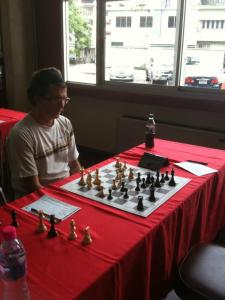
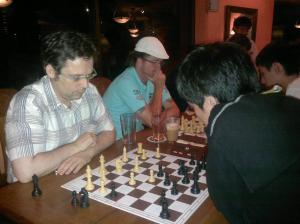
The Bedfordshire League was where I began playing competitive chess, my first rated game being February 11th 1988 whilst in my last year at school. For those who don’t know, Bedfordshire is the smallest of the home counties in south-east England; it is mostly flat farmland with a few main roads connecting its villages and towns. Conversely, our chess league was also small, rarely going beyond two divisions but bolstered in strength by the addition of Milton Keynes/Open University, Northampton and briefly Rushden, all of whom sought a stronger league to play in than their own. Their addition added greater rivalry within the league without causing any real harm, helping the county teams achieve unprecedented levels of success during the 90’s.

League chess in Beds was always an evening affair, with games starting around 7.30-8pm. Journeys for away games offered short drives, often with little of interest to see and an uninspiring venue at the end. Some clubs were notoriously difficult to find enabling them to pick up points by default occasionally; Cranfield, for example, could only be accessed by narrow country lanes with few signposts, finding it in the dark was very tough indeed; Milton Keynes won the league many times, not because they had the strongest team, but because navigating your way through that city is actually much tougher than chess itself, meaning that most visiting players were usually both late and mentally exhausted upon arrival.

Bedfordshire had a small but strong league, and in many respects, it was no different to many others around the country. I played in nine consecutive seasons, and what little incident there was, is well remembered to this day. I thought I would reflect upon some fonder memories and the distinct lack of impact they had.

Sheepdog mauls chess computer

In late November 89 on a dark and rainy day, I drove with playing partner Damon D’ Cruz to March, Norfolk, in search of a Novag chess computer which he wanted to purchase. Not long after, the expensive machine became an object of affection for the family sheepdog Sam, who mauled it one evening. The pieces had all been heavily chewed, some beyond recognition. It was funny to see a chewed chess set with teeth marks and chunks taken out of them. It was as if they had suffered defeat even before the game had begun. The ill-fated machine was then ‘borrowed’ but never returned by another club member some years later.

Rogue milk bottle angers A-Team players

A milk bottle escaped from a bag of shopping in the Luton A-team captain’s car once and, unbeknownst to him (Damon D’ Cruz), hid itself under the driver’s seat. Some weeks later a stench arose. In a match to Milton Keynes, team members (especially Andy Perkins) complained incessantly and asked for windows to be left open. It was finally discovered after the smell became unbearable.

3 Player gets beaten up in the snow

Ah, the legacy of the seventies, you can’t knock it. We had a player at our club, I won’t say his name because that’s not fair, we’ll use his initials MD instead. I liked him even though many did not. Whilst playing for Vauxhall, when Luton was ‘able to operate its own league’, he brought his electric guitar to the chess club to play some heavy metal one winter evening. Unfortunately this didn’t go down too well and a fight soon broke out featuring Dave Considine. My friend Michael Joseph informs me that it carried on out into the snow. MD slipped and got punched in the jaw, after some rolling around they both returned to play some chess, without an encore!

4 Scotsman chases football hooligans down the road!

Jim Jeffries, a Scotsman who used to play at Luton Chess Club when it was based in Bury Park near the football ground, was a no nonsense player. According to Nick McBride on one occasion some football supporters saw chess being played in the club whilst walking to the ground to watch a match, and banged on the windows with some amusement. Jim got out of his seat, ran out the club and chased them down the road!

Suicidal newbie almost causes punch up at AGM 

There was a player who joined the Open University named Gerrard Ashby. He was rated around 200 and a thoroughly unpleasant man. The league AGM was usually held at our club, which was where the then president Ken Liddle played. Ashby came along once and called the president a wanker during the AGM. Ken quickly stood up and asked him to step outside. The offer was declined but it set the tone for the meeting which was full of arguments. I only saw Mr.Ashby once after that, he was sporting a horrendous black eye for yet more foul language. Not long after that he killed himself.

6 Engine blows up after stunning county victory

Bedfordshire first made a name for itself nationally when the second team beat Warwickshire in the Minor Counties Final at Aston University in July 91. I was sub that day and didn’t play, as we strengthened the team with a host of 180s. The journey back was memorable for all the wrong reasons. I traveled up in Olly’s light blue Skoda, back in the day when Skoda’s were cheap and nasty. After the match, we had real difficulty getting out of the car park and then got completely lost in Birmingham. Once on the motorway things went more smoothly until the engine blew up and filled the car with black smoke. The windows were quickly opened as we rolled to stop on the junction just before Milton Keynes. No real damage done except to the engine, which had a big hole in it. We were picked up by the side of the motorway and taken home by the driver’s father.

7 Open-top bus blasts out music during play

Towards the end of the season 93-94 we played Norfolk in the King Edward VIII hall, Newmarket. It was a sunny afternoon and all the venue windows were open where we played, overlooking the main road on the first floor.  Well into our match with Norfolk a carnival suddenly rolled into town. An open-topped bus stopped outside the hall, giving a live radio dj a direct view of our match, which he began reporting on the radio with great amusement. A brass band then began playing, accompanied by a group of female dancers, also looking into our venue with amusement as the window frames vibrated from the deafening base. This went on for far too long, causing many of the older players to get out of their chair and walk off into the tea room in disgust.

8 Raj loses in four moves!

One of the Luton players once started drinking cans of Guinness on the way to a match. He wasn’t bad, about 160, but lost in four moves due to drunkenness at the board. If memory serves me correctly he left a bishop en prise and resigned.

9 Offensive t-shirt results in life-time ban

A totally ridiculous incident occurred one summer afternoon in Luton when a new member got himself banned for life over his T-shirt. The manager of the social club we played in objected to the message on the back of the shirt, which was obscene. It was suggested, politely, that he should turn the shirt inside out, as it was a family club and would cause offence. Some people, however, are incapable of accepting criticism. Rather than do as asked, a crazy half hour arose with the new member repeatedly storming in and out of the building, asking why it was a problem and confronting club officials. At one point he stormed up to the club president looking like he was about to hit him and called him a c**t, resulting in a ban from the social club for life. Fortunately, he had arrived early and most members did not witness the incident. The person in question was aptly named Steven King. I will never forget him for the aforementioned incident and the fact that all his post-game analysis involved the word hassle, ‘He was hassling my rook, so I hassled his king’, and so on…he was about as bad as it got over the board.

10 Player thrown through windscreen during chess club car crash

I’ve talked about it before and I didn’t witness it. It happened in the 80s. Ivan Mitchell’s name for the victim was piss-head Pat, a man I did meet a few times, and whom the author can confirm, lived up to his name. Once, after leaving the chess club, the taxi he took crashed, throwing him through the windscreen into a bush. Pat had no recollection of the event, it was the police who informed him the next day. It sounds apocryphal but was confirmed by several other members.

11 Game lost due to call of nature

One of our more recent players (again he shall remain unnamed) had the ability to cause mild controversy every time he came to the club. He is, unfortunately, one of those people who can’t control themselves and speaks too loudly all the time. Much of what he says confuses those who know him, let alone visiting team members. I always remember him repeatedly asking average club players if they could show him how to beat Karpov!! One evening during a blitz tournament he lost a game (not too uncommon) and tried to stop the clock because he needed to go to the toilet. He then tried to cancel the game because he was unable to concentrate due to the call of nature. He was deadly serious about it. An hour must have passed before we heard the end of it. The following week, he was still unable to stop talking about it. When his opponent from the previous week turned up, he demanded justice: a best of three, which then went to a best of five, and then a best of seven. Sadly he wouldn’t listen to the advice of others, that trying to win on time in blitz by playing entirely random moves isn’t an effective strategy.

12 Loudmouth American gets thrashed by junior

There is an American military base in Bedfordshire. Once in a while we would get personnel from it coming to the club. One evening an over-sized soldier came with a smart case containing numerous neatly packed sets and clocks. He talked a great game and initially refused point blank to play our best junior, who would indicate to us just how good he was. I remember watching events unfold with interest. Within the hour the American packed up all his equipment and promptly left. He lost 6 games in quick succession and never returned. Typical yank, I thought.

13 Dubious tea urn causes speedy exit from makeshift cafe during county match

In truth this happened a number of times as county matches tend to seek the same venue. When Bedfordshire first started using the Turner Hall in Newmarket, it had a tea urn that had a problem with its thermostat and teetered on the edge of explosion at times. And what in chess could be worse than traveling across flat countryside, playing out a dull draw in quiet country town, wandering off for a quick cuppa in the endgame, being badly scalded by an exploding tea urn, and then unable to secure the draw! Nothing right? The one occasion I remember this happening was during a casual chat amongst team members, suddenly interrupted by a violent rattling of the tea urn with boiling water spilling over the top, custard creams were laid aside in favour of a hasty exit.

14 Drunken playing session and heavy cigars lead to urinating up walls and puke going everywhere

Another late night session, this time in the Summer of 93 took place at my friends detached house on the town’s most expensive road, involving Ivan Mitchell. Much alcohol was consumed and a box of heavy cigars came out. At the end of the evening, a drunk Ivan decided not to water the flowers but to water the walls twice, finishing the evening off by puking everywhere in the host’s car whilst being driven home. Nice!

15 Relative newcomers encounter air bombs 

Once in November 92, several matches were being held at Luton chess club, one of which involved Milton Keynes C team. From memory, Milton Keynes had many new players in their team that season. The week before I had agreed with the team captain to let air bombs off in the car park close to the playing hall to see if I could unsettle the opposition, as he knew I had a love of fireworks and had previously suggested it for a laugh. This then happened and a number of heads went up and started looking around to see what was going on a friend told me. During a quick couple of pints in the bar afterwards, no one mentioned the air bombs before setting off in the dark. Alas, a couple of loud bangs weren’t enough to unsettle our opponents, making it the only occasion where such measures were employed.

16 Embarrassing incident over the board

There was a gentleman who played for Leighton Buzzard whose name I forget, he was always rated around 150 (1900) in strength, in his late 50’s, grey-haired, always wore a suit and was very polite, I believe he mentioned once that he worked in the city. The first time I played him was in the very early nineties when Leighton Buzzard had those hideous boards with yellow and black squares, and pieces that were slightly too large to fit on them, and as if that wasn’t bad enough, we had to play in some school on the other side of town, or Linslade as its also known. I’ll never forget the incident during the early middle-game where my impeccably mannered opponent accidentally belched and farted simultaneously with such force that everyone in the room must have heard it. He was quite embarrassed and sincerely apologetic even though, out of courtesy, no one acknowledged what happened….I found it funny.

17 Stand off between karate club and chess club emerges over doors not being closed properly

This happened in 85/86, so I didn’t witness it but was told about it several times. The first venue I played in was a horrible church hall which we shared with a karate club, and had to cross through their hall to get to our equipment. I noticed that there were still signs on all the doors asking you to close them some two years on. Sometimes there were even instructions how to do this. The reason being that many doors slammed loudly and upset the more sensitive karate club members. Once, during a league match, a member from the karate club entered our room, slammed the door as loudly as he could three times and shouted ‘THERE, SEE HOW YOU LIKE IT’. Unsurprisingly, no one got out of their seat and confronted him.

18 From Gambit Publication gets author’s head smashed open

On March 6th 1993. I got a lift into London to buy a book on the From Gambit in Foyle’s. Unfortunately I hadn’t slept much the night before, and whilst ascending an escalator, stretched my back over the rail out of tiredness. I didn’t see the metal and glass display cabinet further up, wrecking it beyond repair with my head by accident. There was quite a lot of blood, out of disorientation and fatigue I then left the book behind on the tube.

19 Acts of violence deny school champion a regular playing partner

I cannot write about my experience of chess at school without mentioning my old friend Jalil who provided stern opposition, enabling me to gain valuable practice as I began playing for my home town. I befriended him instantly when he joined our school as he spoke no English, and when he saw me go up on stage to collect my trophies for winning the school championship and league, he wanted to play at every opportunity. Fortunately we had both been kicked out of almost every class in school already, thus had plenty of opportunity. Sadly, Jalil got himself expelled. He came from a family of martial artists and was a black belt in Karate at 15, he was also very hot tempered. A series of events occurred which finally gained him expulsion. First, he threw a typewriter at another pupil’s head, then in English (we called this class Cards, as everyone played blackjack at the back of class instead of study) the day after Luton won the league cup, a riot occurred in our class, during which he ripped the legs off a table and started whacking another boy round the back and the head with them, then finally he got expelled for beating the games teacher up. Some years later I met up with Jalil again, and true to form we played some chess (this time in his Kebab shop). I was already a county player by then, and he was a 2nd dan in a number of martial arts. He wasn’t a bad chess player and helped me use my time in school more effectively.

20 Under real pressure, the author performed at his very best.

I am not and never will be a great chess player due to a distinct lack of talent, and an inability to retain concentration sufficiently. However, this doesn’t mean that there are moments of which I am not proud. When I assumed the role of B Team Captain, my first task was to stave off relegation. It came down to the last game of the season, at home to Leighton Buzzard B, and more importantly my game. Though my opponent was some 200 FIDE points above me, I was so fired up that he was blown out of the water within 25 moves. I kept my team up, something I remained very proud of for a long time. Whilst playing for our A-team a few years later, I also saved it from relegation by winning the final game of the season’s final match, against Bedford A. It’s true that beating someone with a FIDE rating of around 2000 is nothing exceptional but it was the manner in which it occurred. I played with immense passion.

21 County player takes corners faster than Mansell!

It’s MD again, this time with myself in the back of a car that is running late for a county match against Norfolk, held in the equidistant Newmarket. Mr. Mirza, our driver, decided that we wouldn’t be late and started driving like Mansell, we swerved through some bends on the outskirts of the town so fast that we crossed into an oncoming lane and could have caused a serious accident. MD, who had suffered a nervous breakdown in his youth was a fragile character. He became panicked by the excessive speed, and held onto a handgrip tightly. I remember this because I had to inure hours of monotone analysis, suddenly cut short after he was thrown across the backseat whilst entering a sharp dipping bend, prompting a nervy fixation of the road ahead. It was one of those rare occasions where apparent danger came as a godsend.

22 Player pranked by late night playing session

Poor old Roman, sadly no longer with us. I will be forever indebted to his kindness when, as a junior, he showed me how to play the c3 Sicilian. So it is with a little sadness that I remember a late night session between him, my friend Damon and myself in late 89. He went to bed just before midnight but we kept playing until beyond 4 am. It was a slow Sunday morning in late Autumn, Roman awoke at 8am, and being a guest he could have taken offence at having to wait until 4pm before my friend and I finally awoke and went downstairs. Being a gentleman however, he did not and was even able to greet us with a smile.

23 Crafty pensioner retracts move during game.

In the Summer of 93 I was playing in our club quickplay championship and got up to go to the bar. Looking at my position from afar, I saw my opponent play his move. Upon a second glance some minutes later I also saw him retract the move and play something else. I didn’t mind at all because I was clearly ahead and he was one of the weaker club players. I went on to win and said nothing about it. If anything, I found it quite amusing.

24 Super GM downs one of Bedfordshire’s finest.

IM Andy Ledger. I first saw him in action at the Hitchin Open in 89, where he came up against a certain Michael Adams. Andy was way ahead in material, a knight if memory serves me correctly but was under pressure both on the board and on the clock. I remember how it had welled up in his face, knowing that with calm play he would surely beat GM Adams. Sadly for us, a clever tactic ending in a back rank mate put paid to Andy’s efforts.

25 Duff joke fails to amuse team members.

In late September 89, a friendly match between Luton and Hitchin was arranged. Most A-team members went in the same car, finding the venue with ease. Upon entering, Mr D’Cruz mentioned that he could no longer wear one of his T-shirts as it had turned pink courtesy of being washed with an unknown red garment. I quipped that he should wash it with something white in order to restore its colour, which er, didn’t go down so well.

26 Atonal renditions of arcane Nirvana tracks irritates opponent during blitz game. 

Like just about everyone else on the planet, I fell in love with Nirvana when they made it into the big time. Many of Bleach’s later tracks became nice little numbers to sing and hum along to during blitz. Upon reproducing the line ‘Don’t have nothing for you’ in the track Sifting, my polite opponent promptly retorted with annoyance that he didn’t want anything thanks, perhaps referring to the position rather than the track… it made me chuckle anyway.

27 Nutter causes incident in library

There was a nutter in town for a few years who was a bit of a chess fan I believe. He was of African appearance, wore dark glasses and was walked around town in a step-by-step manner, like a slow motion military march or something. He was once spotted trying to rub the top of his head on a leaf of a tree, with a bishop placed horizontally between his nose and mouth. On another occasion I saw him with a bishop inside his mouth, the base protruding outwards. He entered the library in the town center once, spent about two minutes walking up the stairs and then stood directly behind someone reading a book. When the reader turned round to see what was going on, our local nutter kicked him in the shin hard, though not too hard. Given that he wore dark glasses and was twice the size of the man he kicked, this was obviously very intimidating, and I don’t believe I have ever seen someone’s face go red so fast. Nothing happened for a few seconds, the nutter just stood there without moving before continuing to walk around the library in his own distinctive way. The assaulted, now looking very confused, made a hasty exit.

28 Author becomes saddened after learning that a playing partner is to move to Wales.

My first two playing partners when I joined Luton were Peter Whone, and his friend Richard. It took me 6 weeks to beat Peter. Even though it happened 27 years ago, I still remember the game. A few months after that, his friend Richard, who I had also managed to beat by then, mentioned that he was moving to Wales, and said he had only come to say goodbye. I was not yet 16 and felt a raw sadness from his farewell. I cannot be sure that I managed to stop myself from crying though I think that’s how it went. In the early nineties, Richard returned to pay us a visit, it was lovely to see him again. I spotted him the second he came through the door.

29 Changes in league structures causes objections by Bedford players

Chess had a bit of a boom after the Short-Kasparov match in 1993. Our club suddenly had 62 members, and other clubs had swelled in size. The league went to 4 divisions and Luton had 9 teams, the last being Luton I. This caused an imbalance in division 4 which consisted of nothing but teams from Luton and one team from Bedford. At the end of the season an objection was raised by Bedford that they spent half the season playing in Luton. Not everyone saw this as an objection.

30 The author is nearly knocked off his bicycle en route to the chess club and killed!

When I was 17 I couldn’t stop listening to thrash metal. Even when I cycled, I had it on the walkman and often warmed up for a chess match by listening to it. This had disastrous consequences once as I was cycling en route to my chess club and didn’t hear a car behind me. It hit me quite hard and knocked me off my bike. I managed to wheel it the rest of the way there and explained what had happened. This was a critical mistake as many members were too absorbed in their games to listen.

31 Unpopular player throws birthday party…it goes as expected

Bob Harnett was an odd fellow. A deeply unhappy soul who on his day could and did beat the odd GM here and there. He once had a birthday party and invited a number of players from the various chess clubs he played at. He could have held it in a telephone box as only 4 people turned up, and two of those only went out of sympathy. I think a few cheap cans of lager were drunk whilst the tv was on and there were a few blitz games, that was about it.

32 Late night blitz with adult entertainment thrown in! 

I shan’t be pointing the finger here or naming names but if you know which club I played for you can probably take a guess, especially if you look at the point placed directly above this. Anyway in 1991, after the chess club evening had ended, a few of us who hung out carried on affairs into the wee hours at the home of whoever was most accomodating that evening. Usually this involved blitz as part of some ad hoc tournament, accompanied by blue movies put on the big screen behind the games in progress. I was still a teenager back then and hadn’t even had my first girlfriend, and so only took amusement in it more than anything else. Even with the sound up just enough to hear, I seem to recall enjoying reading the subtitles more than watching them. I also recall, him mentioned directly above once saying ‘Oh look, she’s trying to act!’ once. In defence of my former playing partners, and myself, I never quite got it. No one seemed that interested and made little or no effort to watch them -it was just a bit of background entertainment or something. Still in my teens, I was too young for such stuff and rarely if ever paid attention -it seemed like a distraction I once thought. However, I should point out I cannot recall the amount of times this happened…dozens at least I’d say.

33 Coffee requires diplomacy

In the early 00’s a visit to the Luton Chess Club was followed by a drive into the town centre by a few and some late night food. We went into a kebab style place on Chapel Street and had food & drinks and some late night chit-chat. I don’t quite know why but I ordered an Irish Coffee and barely touched it. Damon D’ Cruz was unaware of this, and after finishing his food asked if he could finish my coffee, seeing I was not drinking it. ‘Of course’ I said, but kept shtum over what kind of coffee it was. The look on his face was priceless. The gulp he took knocked him back, he then returned the cup to the table posthaste. Instead of firing expletives at me, he said unimpressed, ‘I think someone’s put something in that’. It was hard not to laugh at him caught off guard like that. No harm done though.

34. Paganism appears

Shoud you wish to trawl through the S.C.C.U Bulletins throughout the 70s and 80s, you will find a certain J. Killminster playing for Bedfordshire, many, many times. He also played for my home town Luton, so I have been informed. Members who played alongside him, and me for that matter, namely Damon D’ Cruz and Peter Montgomery, both confirmed independently of each other that John, used to go dancing naked in the woods in Clophill. Of course I had to ask what that was all about and asked Damon whether that pertained to paganism or something. He said yes, in fact it was a group thing, there were often women and alcohol involved! ‘Each to his own’ Damon then said. How does this function as a fond memory? Because I was first told about it during friendlies at Kents Athletic Club before we were turfed out of it…‘Each to their own’.

That is about eventful is it got. Chess is generally a serene affair with little of note, there is nothing else I can think of that is noteworthy. In future blogs I will attempt to write about the mundane, which believe it or not, is usually of greater interest. Until then… . 

M  M
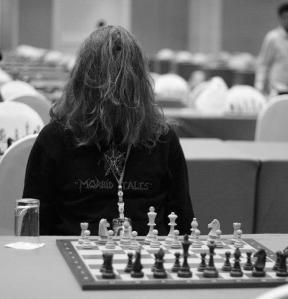
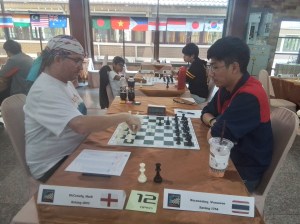
New Year Quiz

What better way to start the new year with some mind-bending questions about chess could there be? That’s right, none whatsoever. I’ve drawn material from Mr.Winter’s Chess Facts and Fables (2006) and added some broader general knowledge questions to balance things out a little. Solutions can be found below. Enjoy:

1) The New York Leger paid which player a sum of $3000 (approx.$60,000 in today’s world) to write a weekly chess column for a period of one year starting in May 1859?

2) Which country did Capablanca once claim to be ‘most suitable’ for producing chess players, courtesy of its ‘raw climate’?

3) Prior to F.I.D.E’s decision to hold a tournament to decide the vacant world championship in 1948, a match between which two players was suggested by Eugene Znosko-Borovsky as an alternative solution following the death of Alekhine?

4) What is the shortest decisive game in a world championship match?

5) Against which former embattled F.I.D.E president did Mikail Tal play his first game as world champion at the Leipzig Olympiad 1960?

6) What infamous event concerning the chess player F.Womersley occurred in Hastings on September 13th 1911?

7) Which ex-world champion was accused of being a collaborator with the nazis by much of the chess world?

8) Which player has beaten 7 world champions, (including two with the opening move f4?)

9) As of 2013, Russia has more registered Grandmasters than any other country, but which country is second according to F.I.D.E?

10 Who is the only Englishman to compete in a F.I.D.E world championship final?

Answers, (page numbers refer to Chess Facts and Fables)

1 Paul Morphy, (pg 69)

2 England, (pg 90)

3 Euwe and Botvinnik, (pg 93)

4 Anand-Gelfand (http://www.chessgames.com/perl/chessgame?gid=1666558)

5 Campomanes

6 He was shot dead. (pg 163)

7 Alekhine

8 Bent Larsen

9 Germany

10 Michael Adams

Your score:

7-10. You clearly have a fantastic knowledge of chess. If knowledge and ability were one and the same, you’d be a 2600 player for sure.

3-6. You can talk a good game no doubt and can contribute to any pub conversation. Everyone will think you are a tidy little FM.

0-3. Time for you to buy Chess Facts and Fables.

MJM

If you scour the sites on the net for the latest chess news,  as I sadly do, you might have noticed that the quality of the journalism often leaves a lot to be desired. This isn’t just an on-line phenomena, many chess magazines aren’t much better…certainly the ones I subscribe to aren’t anyway. Although you are more likely to find better writing within them, much of the content isn’t inspirational in my opinion. But whenever a quality broadsheet turns its attention towards chess, we are often presented with the opportunity to see how it should be done. With this in mind, I was very happy to find the following article http://www.independent.co.uk/news/people/profiles/i-never-wanted-mens-pity-chess-child-prodigy-judit-polgar-on-the-games-inherent-sexism-8340951.html  If you haven’t already, I suggest you read the article before you continue.

If you have read carefully -which of course is the only way to read- rather than glance over the article, you will have noticed the ease with which the writer handles the subject, in part this is due to the fact that the author used to/still plays chess himself. Having been a fan of ‘The Late Review’ myself for so many years, I was happy to see a distinguished journalist turn his attention to our beautiful game. So apart from the ease with which he handles the subject, what else is there to say about this intriguing article? Firstly, though we are undoubtedly aware of the paucity of women’s chess during the 80’s & 90’s, we -or certainly I- weren’t aware that it was personal tragedy which previously brought out the best in Judit. This gives us a new angle on the issue of gender in chess in an informative manner: what I am referring to specifically is the level of stress in top-flight chess was ‘perhaps’ affecting Judit’s ability to have a child.

I have spoken in a previous post about the issue of gender in chess (https://mccreadyandchess.wordpress.com/wp-admin/post.php?post=360&action=edit) and will not go into that here. There is no need to add to what has been said, as the topic is well handled here. Judit tells how she was taught there should be no limit to what a woman can achieve, questioning the prevailing culture of the game, where women still tend to compete against women. The odd thing about this I thought though, is that given she herself has clearly benefited from stepping outside of the women’s circuit so to speak, why haven’t others followed?

The topic of gender is handled well in this article. He even knew of Zsuszu’s amusing reflection that she had never lost to a healthy male! Gender aside, the difficulty of achieving success within a communist state is touched upon as well as the importance of ethnic background. A light touch is used by Lawson to identify defining, personal moments in Judit’s past. The article concludes by pointing out that it will be the first time since 88 that we have seen Judit in the UK (another point I was unaware of).

So there we have it: craft and expertise from Lawson, whose effortless, unpretentious style brings us closer to the world’s best ever female chess player.

MJM

Among top grandmasters the Dutch is a rare defense, which is good reason to play it! It has not been studied very deeply by many opponents, and theory, based on a small number of ‘reliable’ games, must be rather unreliable.  –  Bent Larsen

The producers of the F.E.B (The Full English Breakfast http://thefeb.podbean.com/) recently put me onto a stunning victory by Simon Williams with the Dutch Defence against Boris Gelfand.

It can be found here: http://www.chessgames.com/perl/chessgame?gid=1694581

One of the things I like about this game is that it exemplifies what the Dutch is all about. The position quickly becomes complex and unbalanced, and though black goes the exchange up quite early on, it isn’t clear if he’s winning at any point. The game, then, teaches you how important it can be NOT to simply rely on a material count to see who’s ahead. White’s strong knight and pawn majority in the center make it, in my humble opinion, difficult to be sure whether black has a winning advantage.

Another thing I like about it is that there is consistency in strategy from black’s point of view. If you happen to read or even watch William’s material on the Dutch (I do and I have to say I am not a fan) he does chide an early b4 but more importantly, we see the more typical f-pawn push to f4 (A move Williams likes to play with white, perhaps he is an f4 addict!), and an attack on the kingside, all atypical features of the Dutch, as understood by Mr.Williams.

A game well worth studying, one which can teach a great deal.


MJM


The beauty of a move lies not in its appearance but in the thought behind it.  –  Aaron Nimzowitsch

And so too with literature. Occasionally in chess literature we stumble upon a book based upon a concept that appears so self-evidently sound, it demands that we take a deeper look. When I then saw a plethora of rave reviews for the aforementioned text, I was powerless to resist locating it on amazon, and then as if like a robot, began punching in the numbers on the credit card, salivating in stupor, awaiting its delivery with…something or other.

More seriously, I intend to marginally break rank here. I don’t write for anyone or anything other than the joy of writing, which gives me a greater level of freedom than those within literary circles within chess. Some thoughts on that: book reviews tend to suffer from time pressure and lack of interest, and more importantly a lack of freedom. It is in the interests of a titled player not to be too critical of a text published by the company which employs him. Some criticism is both necessary and acceptable as long as the bar is raised accordingly. By this I mean an average book becomes a good book, a good book becomes a great book, and a terrible book becomes a bad book. A lack of time is more pernicious than may first appear. Personally I like to take my time to think more deeply about certain issues, as the answer isn’t always apparent. Sometimes we don’t know for sure how we feel about something until we’ve had a good night’s sleep. Of course, being rubbish at chess means that my understanding of the game is much less than titled opposition, but having invested my entire life into education, having always been an avid reader and lover of writing per se entitles me to an opinion, one which I believe is informed enough to express. In previous posts I durstn’t refer to a text without quoting from it, as I didn’t want to drag the culture of chess literature into the gutter -as its never been there before honest!-but this time it has to be that way. More importantly, I will keep this brief as the text allows me to do this.

The text in question has clearly had a lot of thought put into the construction of it, although some explanation upon how the ‘modern’ era is defined would have been nice. Is there any reason why the author chooses 1993 as a starting date I wonder? The games are chronologically ordered and fascinating without being exceptional due to  the primary purpose of the text being instruction. The quality of the annotation and commentary is consistently high, which makes reading the book an absolute pleasure. Furthermore, Stohl does a good job of choosing lesser known games, and making them, as the title says, instructive. Some of them cannot be found on-line, even though the players are well-known.

A solid effort by Stohl and well-worth buying. He should be very proud of himself. My suggestion for an active reading process with this book is to play through each game carefully, then spend time thinking about how the game is instructive in the context of the modern game. It’s not as easy to do as you might think.

MJM

John Lennon once said that French rock is like English wine. Would he be rocking if he read ‘The Modern French’ if he were still alive…well read on and decide for yourself.

They say you should never judge a book by its cover but surely the best way to know what a book is about, who wrote it or what the price is, is to look at the cover which tells us the text ‘The Modern French’ arrives courtesy of Antic (no not Raddy) and Maksimovic, who have teamed up with New In Chess. On the back cover, the text claims to ‘change your view of one of the most popular openings of all time’ – and no that’s not a daft attempt to sell a book, it is in fact a very daft attempt to sell a book. Literature in chess tends to lack the transformative capacity its impoverished authors & publishers tend to play up, so along with the bright red cover it was I who was initially ‘rocked’ upon receipt of this rather strangely bundled reading material. Also on the cover we see the words ‘A Complete Guide for Black’. Given that Carlsen has recently been lashing out with the Winawer, I thought I’d look up the lines he’s been playing. Imagine my surprise when I found it had been omitted from the text altogether, along with the also popular Burn and Rubinstein variations. What kind of ‘Complete Guide’ could this be, I asked myself? The title -also to be found on the cover oddly enough- claims that the book details ‘The Modern French’ yet upon perusal many of the lines covered are far from modern…I was indeed perplexed and felt compelled to read on, safe in the knowledge that any book on the French Defence simply must be a good read (yes you’ve guessed it, the author plays the French Defence too).

Start Right!

The Foreword (more about that to come) reads as follows ‘Over the intensive two-year effort of writing this book, the aim of the authors has been to present you with more than the traditional bone-dry analysis of all possible variations [?]. To this aim, apart from explaining the essential strategies and plans pertinent to this opening, we also cover a multitude of complex plans and theoretical novelties as part of our new strategic approach’. That’s a strange start. Those who write in a professional capacity don’t usually draw attention to a period of time as short as that, bearing in mind to get where you are usually involves research over periods far greater. Fifteen years or a lifetime of effort, okay now we are getting there but two years? That’s on a par with the your first post-grad qualification, what’s so exceptional about that? More crucially, for a number of reasons I will point to later, I don’t believe the text even constitutes two years of ‘intensive’ effort. I also don’t believe that the approach offered by the authors is particularly new either; ‘new’ for them maybe but only them. One text that does attempt to give a ‘bone-dry analysis’ and, in my opinion is what the authors are alluding to, is Lev Psakhis’ book ‘The Complete French’, but if this is the sort of thing they are trying to move away from it needs to be asked why they have copied/used the same format? Though successful attempts are made to summarize and highlight key positions throughout, originality or lack thereof pervades the text from start to finish on a number of levels. The text smells of a copied, but improved, version meaning that aspects of the text are misdescribed by the authors.

Once again from the Foreword: The French has been an integral part of many top players’ repertoires  [but isn’t this true of most mainstream openings?], and it was the key weapon in the hands of old masters such as Botvinnik and contemporary stars such as Carlsen and Morozevich. When you look at their tournament results, it becomes clear that they chose the French Defence in important games, when they need to secure a win with the black pieces.’  What a load of old tosh, the sentence simply isn’t true -shame upon the editor. Carlsen does play the French but only occasionally and rarely in crucial games. Trying to over-emphasize the importance of the French Defence by construing language to suggest that its selection is habitual amongst certain top players is just another cheap sell. I don’t understand why the Foreword is used to try and sell you the book. It’s an unpersuasive start I must say. To conclude this section, I also don’t understand why the Winawer has been left out, if demonstrating how essential winning with the French is, then I suspect it’s omission tells us more about the book than anything else -the authors simply don’t play it.

What I definitely liked about this book.

1) It’s about the French Defence!

2) The analysis is, undoubtedly, the strong point of the book. It is sound throughout, as well as being easy to assimilate. A good balance has been found between range and depth of response with much quality annotation to boot.

3)  I was personally happy to see that the authors dropped the tradition of starting with rare and unusual moves. I’ve always found retaining motivation to be an issue when you are forced to wade almost half-way into a book before anything familiar emerges. I was also happy to see that chapters are finishing with concluding remarks. Though perhaps more could be said, the remarks do tie in well with the content, helping those of us who are less gifted.

What I definitely didn’t like about this book

1) Attention to detail is lacking in places. A foreword is only a foreword when its written by someone else and not when its written by the authors of the book. That’s what we’ve called a preface for the last several hundred years. The game on pages 58 & 59 isn’t referenced properly. It reads Schebler-Art.     Minasian, Kalithea 2008. Since I know GM Schebler, I asked him about this. He informed me that his opponent was named Artashes Minasian, and not Art. The punctuation denotes abbreviation but given the spacing, I wasn’t sure whether Minasian was part of his name or a place, it is unclear in the text.

2) Some attempts to infuse modernity or provide context are crude and inexact. For example, pg 59: ‘3. e5 is regarded as the third strongest move, [justification?] after 3.Nc3 and Nd2. The recent tournament practice confirms this assessment.’ Poor English and vague, unsupported statements here. ‘When it comes to old masters, the biggest fans of the advance variation, Nimzowitch and Paulsen, provided the biggest theoretical advances. Later on, a number of top players, adopted this variation as part of their regular repertoire [the correct connotation is main repertoire]. You couldn’t make this stuff up, and I am supposed to believe this book constitutes a two-year intensive effort? This is just another example of crap writing in chess.

3) The concept of the book lacks refinement. The format of the book is so similar to Psakhis’ ‘The Complete French’ I did expect it to be in the wafer-thin bibliography but its not there. I find that to be rather suspicious. Also missing is Nigel Short’s book, and Shaun Taulbut’s, both of which are essential reading for the French. More importantly, the handling of the Tarrasch is somewhat idiosyncratic. We are only offered Morozevich’s 3…Be7. All it needs is for someone else to come over the top with more concrete analysis showing exactly what is wrong with the response 3. Be7 (though the authors seem to know already), and the entire chapter will be rendered obsolete. Sounder 3rd moves clearly exist, Nf6 and c5 spring to mind and should have been offered. Though 3. Be7 is a modern move, and thus fits in with the overall aim of the book soundness cannot be sacrificed for the sake of modernity. In offering more third move alternatives, at least the authors would have a get out of jail free card to play if 3 Be7 does not stand the test of time. Some of the positions shown, particularly where white plays 4. e5 & 5. Qg4 require a horrendous level of precision if black is to avoid being wiped out early on…I for one certainly won’t be playing them. The poor exposition of the Tarrasch reveals the limitations of the book more clearly than anywhere else. The reader has little choice other than to follow the authors down a precipitous path, the option of an alternative route would have been a more pragmatic decision in the pre-writing phase.

When I studied at post-grad level, I was taught by one of my professors that in order to write about something, you need to define what it is first. So what is the modern French? We simply don’t know because the question doesn’t arise. What does modern mean? Post-Kasparov? I don’t know. Confusingly, I noticed John Watson in the reading list, who is one of the few authors in chess that can document development in chess successfully, but why can’t the authors reference his work and inform the reader since he is in the bibliography? We are presented with an array of carefully indexed modern games, but that is just exposition. No effort is made to state whether the line being played is modern -often not the case in the text- and in what sense it is modern. Why are certain moves defined by modernity? Too little is said.

What I think the title alludes to is a modernized text on the French. Questions can be asked over why we have both the Steinitz and the McCutcheon in the book when the Winawer can replace both. If the McCutcheon is so great, then perhaps the authors would like to explain why it is virtually non-existent at the highest level? Again, this ‘Complete Guide’ is complete in the sense that it fulfils the authors impartation of their own preferences, whether they have homed in on relatively unexplored, modern lines solely to create strong marketing points or to substantiate their own analysis is a question only they can answer, the answer lies somewhere between the two I suspect.

4) Given that the book aims to provide key positions and structures, as part of its successful attempt to offer an in-depth look at the french, why are we denied, middle and endgames? Surely its crucial to see how the strategic motives are played out, seeing that such value is placed upon them? Annotation would be useful but not necessary. The authors could have given you the option of playing through the game yourself without having to go on line.

A Conclusion

I’m not sure what John Lennon would have made of this book, I think he would have said it hummed rather than rocked. But seriously, I think ‘The Modern French’ has greater strengths than weaknesses but will never be considered to be a classic, as there is too much room for improvement in it. The content is at times superficial and at others in-depth and highly informative. We are never freed from its erratic twists and turns, which probably comes down to a lack of writing credentials more than anything else. How else can we interpret the total lack of originality in the format and style of the book as constituting anything other than a lack writing craft? It is true that improvements have been made if you compare the work to Psarkis’ but they are not sufficient in themselves. The analysis is sound and impressive but just about everything else is sloppy and imprecise. There is a strong tendency in chess to copy or base your work previous publications, ‘The Modern French’ disappointingly fits into that tradition in my opinion.

Anyway, that’s just my take on things. I stand to be corrected as always.