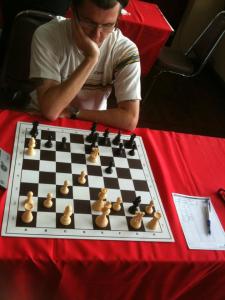
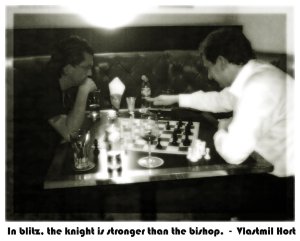
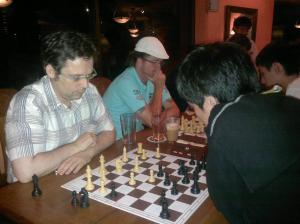
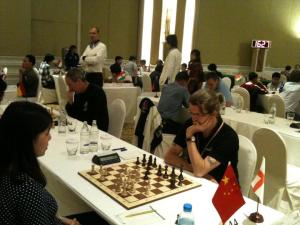
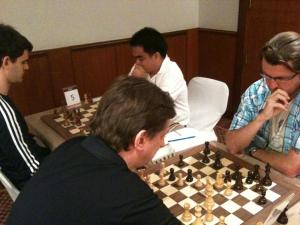
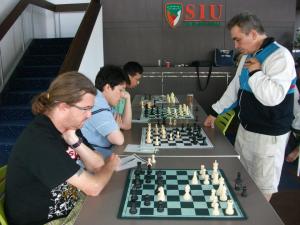
Our Catholic friends are at it again. A hot-tempered Italian and an Irishman (probably drunk during play) played a late night game of chess, which resulted in a throat being cut open, many other knife wounds as well as other details that the police could not reveal. Even old King Canute never got that carried away… .

Ghastly stuff… .

http://www.theguardian.com/world/2014/jan/13/chess-murder-dublin

Across the Board

In general I consider that in chess everything rests on tactics. If one thinks of strategy as a block of marble, then tactics are the chisel with which a master operates, in creating works of chess art.  –  Tigran Petrosian

If like myself you are a bit of a cynic when it comes to journalism in chess, you may have developed an eye for that worthy of attention. If so, perhaps you noticed the BBC Radio 4 production Across the Board by Dominic Lawson?

The caliber of the journalism is high as you would expect. In each episode a game is played between Dominic and his interlocutor, during which discussion is held about chess and how it has changed the lives of his opponents. There are five episodes in total, with opponents ranging from Politicians to Boxers, Political Prisoners, and even a certain Women’s World Champion.

I found Across the Board to be engaging, carefully researched and deft in touch. Dominic’s style is to converse by expanding on a series on well-chosen questions. The first episode in particular was handled very sensitively and with great dexterity. It was interesting to hear Mr.Healy’s side of his treatment by Faber and Faber, and for me, completely believable. Perhaps a minor criticism may concern the suitability of Hou Yifan. As lovely as she is, I thought she was, perhaps, too young and inexperienced for such a thing -was her inclusion a tip of the hat to chess fans?

The link to all episodes is below in case you missed it. If you are reading this from Jan 2015 onwards, I’m afraid you’ll have to root them out elsewhere. I hope we see Dominic at next year’s Thai Open. Apologies if my daughter’s screaming put him off his pasta during lunch that time last year…hopefully Ms. Trouble won’t cause so much commotion if I can make it this time.

http://www.bbc.co.uk/programmes/b03pc5q9/episodes/guide

The tactician must know what to do whenever something needs doing;the strategist must know what to do when nothing needs doing.  –  Savielly Tartakower

Queen Sacrifice

Queen Sacrifice is a short film that won many awards in its day. I remember it being shown on BBC 2 in the winter of 1989 but have not seen it since. Though, superficially, the work may appear utterly pointless it is quite a clever, light-hearted piece of work, the only real difficulty is working out if the writer is a chess player or not. The chess action is so quirky it’s hard to tell, though I suspect not.

MJM

Magnus on VGTV

As 2013 comes to a close and my inability to book a train ticket to Tbilisi in time has scuppered my plans for the new year, I will use some of the break ahead to catch up on the many films and documentaries which have appeared on Chessbase recently, linking the best of them on this site. In this post, however, I’ve linked an interview with Magnus instead, as it is impressive on many levels and certainly worth a watch even if you are not an admirer.

Interviewing is an art in itself, and like top-flight chess requires much preparation and understanding of your subject/opponent, some creativity and an ability to seize the moment don’t go amiss also. What I particularly liked about this interview is that it is exemplifies both how to conduct an interview professionally and just how difficult it is to show chess players in a more revealing light. To do this, the interviewer probes the mind of Magnus for 30 minutes, and quite skillfully at times too. Even though some of the questions asked are a little uncomfortable for him, they are handled by his interlocutor with a level of sensitivity that allows the conversation to flow sufficiently. That may sound insignificant but its not. As you will see, Magnus cannot help but ponder or think deeply about even the most trivial of questions, thus getting the subject talking is a tough ask for our non-chess playing friends. Perhaps that was why I did notice the occasional lack of finesse too. Some of the earlier attempts to flatter Magnus weren’t effective and the question ‘What makes you cry?’ asked so directly, isn’t likely to get much of a reply from a shy 23 year old male on tv. You would never have seen Frost blunder like that in his heyday. Anyway, enjoy.

http://www.vgtv.no/#!/video/76074/intervjuet-magnus-carlsen-english-subtitles/offsetVideoTime=1777531

MJM

Malpractice

The slow motion replay doesn’t show how fast the ball was actually travelling – Richie Benaud

In England, there’s much pub-talk about where people were when important historical events occured, such as Armstrong landing on the moon or when England won the world cup or when the great fire of London broke out, and so on, and so on. My question is where were you when McShane played 2 Nf3 against Anand’s Caro-Kann at the opening of the 5th London Chess Classic? For me…well I’d rather not say…I was helping a friend fix his washing machine but became trapped inside the bloody thing, anyway… .

At the beginning of December 2013, the London Chess Classic coincided with The Ashes down under (that’s cricket to all you saddo no-lifes out there), fans of both spent an exceptionally long weekend trying to keep up with the action. An almost improbable task given that we only had eight days for the chess and a mere five for the cricket. Like most, I had to take a week off work to recover from the excitement then several more from the tragedy of it all -well almost. Surprisingly, my request for such time off was not given the seriousness I had hoped for.

The crowd roars it’s deep and so unhealthy… .

Their gloomy beginnings left behind long ago, both chess and cricket now offer a resplendent, high-tech horizon where viewers across the globe can follow the action like never before. But looming on this horizon lies a dark foreboding menace beyond anything vocalist Mike Patton ever ingratiated his audiences with.

Purgatory and the gnashing of teeth…is our top GM going to play 1. b3 or 1. b4 today?

In search of greater revenue both chess and cricket have been forced to modernize themselves in favour of faster, sexier formats. In cricket, the patience batsmen need to build an innings has been steadily eroded by the dominance of one-day internationals and twenty-twenty, where the object of the game is to blast every ball into orbit and beyond, meaning that even world class batsmen (most of the English and some of the Aussie top order) now constantly get out to risky shots that people didn’t play with such regularity ten-twenty years ago, as we saw all too often in the third test. In chess, we now get quick-play tournaments where top Grand masters allow themselves to be checkmated having barely got out of the opening, and where ex-world champions lose in a manner which even beginners would be embarrassed by, as we saw in the London Chess Classic.

Do you feel sometimes that age is against you?

I didn’t follow-up on Kramnik’s defense of his knock-out loss, I assumed there isn’t one. Instead we can only reflect upon the pressure inflicted by such insidious time-controls, and ask ourselves if something is wrong when watching great players blunder game after game becomes synonymous with entertainment for the masses? Mistakes are part of the game at all levels but when the format of the game invites them with such certainty, something much more precious is lost.

The null of losing, can you afford that luxury?

Viewing on line for free I don’t want to sound harsh, especially when those involved did their best, but I for one would be more than willing to pay for a VPN and a choice of game with full commentary instead of what we were given…it was a shame to see the commentary team struggle with the revamped format of the fifth London Chess Classic but was it inevitable? Commentating on one quick-play game between two players, both of whom are several hundred rating points above you is hard enough, but four simultaneously is sheer folly.

The world expects a pose…perfectly natural?

Personally, I don’t like to see GMs making a mess of things. We ought to watch top-flight chess to see how things are done properly and not how they aren’t done properly. If I wanted to watch that, I could just go along to the nearest club and watch some games there.

It’s the thing you hate the most…the thing you hate almost.

Why did the London classic change its format? There are reasons, the main one being the proximity of the Vishy-Magnus match and the participants unwillingness to play classical chess so close to it. From what I understand, a change in format was the only way the tournament could be the first to parade the winner of the match. Sadly, this was not enough to persuade Magnus to join, so there was no world champion present.

“A very small crowd here today. I can count the people on one hand. Can’t be more than 30” – Michael Abrahamson

Was the revamped 5th London Chess classic a success? I have no idea. Given the caliber of the competitors, the play was poor I thought, the commentary even worse and when Vlad played that ridiculous move against Boris in the semis it was the final straw, at which point I turned all my attention to the cricket instead…unfortunately England were in pretty bad shape by then too.

Does life seem worthwhile to you? 

The weekend was over. It was not yet winter but bitterly cold and barely light as I walked across Baku to work, my hands numbed by the morning sleet that fell upon its backstreets leading into the city. With many kilometres ahead I walked slowly, not yet awake but pensive. By then England were close to losing The Ashes and Nakamura had won in London, I was dressed in black accordingly. Just before I reached the government buildings ungainly edged onto the city centre, shivering, I thought to myself ‘sometimes life is just shit‘… .

It was not yet 8.30 when I arrived at work. The office empty, I reclined in my chair. The heating was on high, I drank some hot chocolate undisturbed. Asleep again as my colleagues arrived, I awoke covered in snot, dreamt I’d swallowed my teeth and tried to cough them up…such lyrics and more came from my MP3 player, which I had forgotten to switch off.

Except for boiled potatoes and broccoli, only death is real.

It was a forgettable morning with little to do in the office. The final session in the cricket I dursn’t follow, the chess I just forgot about. The sleet had stopped but a low cloud stayed til lunch, when I ate the portion of boiled potatoes and broccoli given to me. I drifted into thoughts about England as I cut my food with my fork; the cricket, the chess, the inclement weather all reminding me of London strangely. But then my supervisor interrupted, standing at silly point he asked me to complete a report after I had finished. I took an afternoon nap first.

Someone taps me on the shoulder every five minutes, nobody speaks English anymore.

Nap over, bell stopped ringing, corridors all empty now. No one stood at urinals pissing nor in front of mirrors examining their tongues. Where were the students?

I spoke to no one that afternoon and left the office early to the winter park where the subway system beneath was warm and provided shelter. Nearer home, the backstreets were empty of the city traffic and muddy from the morning sleet still. An elder colleague once swore that in Soviet days Baku was a clean and orderly city but after the war, when the Soviets left, people from the country came into the city in their thousands and turned the place into a complete mess. I didn’t doubt it. I was barely 200 meters from the city centre yet the street I took home, named after the satirist Jalil Mammadguluzade, had an entire row of makeshift housing built on the road itself where it widened – most unwise considering that driving licenses are usually bought rather than gained via the proper channels but not unexpected. On the corner nearest, people stood selling bread every morning, hours before it was light even. A little further up I once saw chickens run freely across the road where washing hung between the trees, blocking off what little pavement there was. Nearby, groups of bored teens sitting by open fires on broken furniture left in the street offered to wash cars for a pittance except today, today of course, it was too cold. I saw only one other on the street, an elderly woman carrying a large jar of pickled watermelon in both hands. She had a row of gold teeth behind the grimace on her face…had she watched the cricket too I asked myself? I walked on as fast as I could, it would not be long before I was home and warm again.

Drought makes the workers dream.

The water was off yet again when I arrived. What was I to do tonight I asked myself? Sit staring at the computer screen again? I wanted to get drunk to forget about Baku, to forget about everything. Chess was a motivating factor in coming to Azerbaijan…curse that bloody board game I told myself. On the few times I found people playing, everyone looked so depressed and miserable I dursn’t say anything to anyone, fearing that their misery may be contagious. The fridge was always stocked with beer because I didn’t want a daily encounter with the peasant in the kiosk closest and his tiresome attempts to shortchange me. I drank Czech beer only, certainly none of that local rubbish. The fridge was the only modern item in my apartment. I trusted it, it was switched on to my needs. The first beer sank as I sat in my bed listening to the radio in the dark. I had no bed in the conventional sense of the word, only a mattress on the floor, an over-sized pillow and an old cardboard box as a head rest. I didn’t mind sleeping like that, somehow it seemed appropriate given the state of the building. It was a Stalinka -that being a generic term for anything built whilst Stalin was in power- and had seen better days. I wondered if I would ever return to Azerbaijan and its grotty little capital Baku -a city stricken by decades of Communism still. It would mean yet more time away from my daughter…her funny little laugh and her little smiles I had missed for too long now. I thought about the day I would see her again and wondered if she would still recognize her father. Every time a beer was empty I looked out of the window by the fridge when I got another. There was nothing to see other than the same parked cars and the same row of street lamps becoming fainter in the gloom. I don’t know why I always did that…but then I was unable to stop myself…perhaps it was disbelief. With each day passing as part of one long count, another empty evening lay ahead, soon it would be tomorrow, tomorrow, tomorrow… .

All behold the spectacle of fleshy, limbless rectangles… .
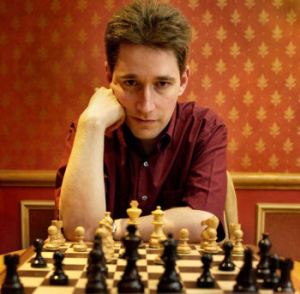
England's greatest ever chess player

Michael Adams – England’s greatest ever chess player

faithnomore-1340109125

Faith No More – America’s greatest ever export
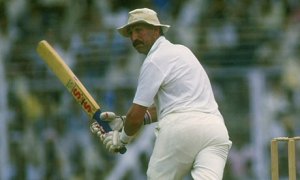
Graham Gooch – England’s greatest ever batsman

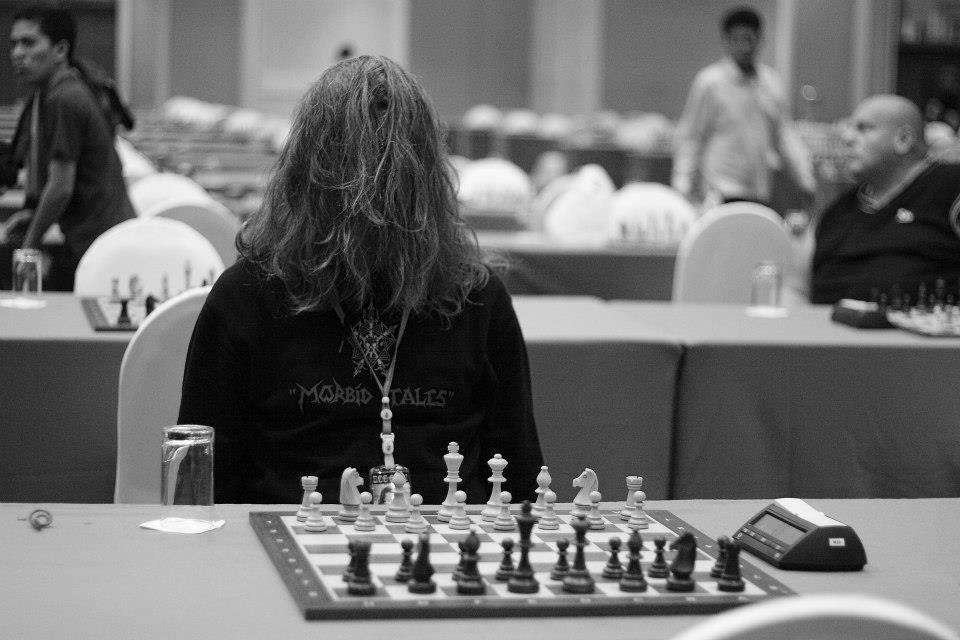
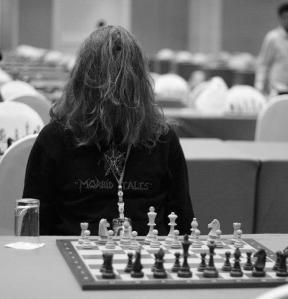
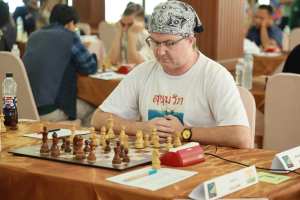
...and yes that is a Celtic Frost hoodie.

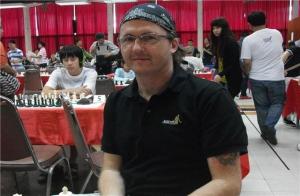
The author in contemplation, wearing that which he walks to work in. On the left cuff of his Celtic Frost hoodie lies the inscription:
‘Only Death Is Real…’.
 

Off-line mistakes

A short but interesting article has appeared on the NY Times. A chess coach has been accused of cheating and has been barred from chess.com. A lawsuit is pending.

http://nypost.com/2013/11/16/chess-coach-im-not-a-cheater/ .

Frost and Kasparov

Over the last half century the television interview has given us some of TV’s most heart-stopping and memorable moments. On the surface it is a simple format – two people sitting across from one another having a conversation. But underneath it is often a power struggle – a battle for the psychological advantage.

Sir David Frost

Click on the following link to find Sir David Frost’s interview with Kasparov, which he gave shortly before his sad demise.

Given that Mr. Frost is past his prime and that Kasparov is wily enough to evade clever questions, I think its fair to say that the interview isn’t a classic. It is, however, professional and probing enough to keep you watching -they even managed to get the history right too! But in chess terms a theoretical draw perhaps, with neither player spending much time outside their preparation. Anyway, its always a pleasure to see chess being handled well by those in the media who are unfamiliar with it, I’ll leave the final words to Sir David Frost.

Don’t aim for success if you want it; just do what you love and believe in, and it will come naturally.

Kubrik and chess

The communication of the dead is tongued with fire beyond the language of the living.

T.S.Elliot

After watching the documentary Room 237 recently, I felt compelled to delve further into Kubrik’s The Shining. Admittedly, its a film that I’ve never liked, having always found its intensity discomforting. However, in search of greater understanding, I also found an in-depth interview. It’s a wonderful piece of journalism, with Kubrik offering us great insight into who he is and how he works. To my surprise, chess gets more than a mention towards the end of the interview. Kubrik not only makes an interesting analogy between chess and film-making but also tells us how chess can help curb poorly made decisions away from the board. I’ve cut and paste the relevant sections and linked to the interview as well:

You [referring to Mr.Kubrik] are a chess-player and I wonder if chess-playing and its logic have parallels with what you are saying?

First of all, even the greatest International Grandmasters, however deeply they analyse a position, can seldom see to the end of the game. So their decision about each move is partly based on intuition. I was a pretty good chess-player but, of course, not in that class. Before I had anything better to do (making movies) I played in chess tournaments at the Marshall and Manhattan Chess Clubs in New York, and for money in parks and elsewhere. Among a great many other things that chess teaches you is to control the initial excitement you feel when you see something that looks good. It trains you to think before grabbing, and to think just as objectively when you’re in trouble. When you’re making a film you have to make most of your decisions on the run, and there is a tendency to always shoot from the hip. It takes more discipline than you might imagine to think, even for thirty seconds, in the noisy, confusing, high-pressure atmosphere of a film set. But a few seconds’ thought can often prevent a serious mistake being made about something that looks good at first glance. With respect to films, chess is more useful [in] preventing you from making mistakes than giving you ideas. Ideas come spontaneously and the discipline required to evaluate and put them to use tends to be the real work.

Did you play chess on the set of The Shining as you did on Dr. Strangelove (with George C. Scott) and on 2001?

I played a few games with Tony Burton, one of the actors in the film. He’s a very good chess-player. It was very near the end of the picture and things had gotten to a fairly simple stage. I played quite a lot with George C. Scott during the making of Dr. Strangelove. George is a good player, too, but if I recall correctly he didn’t win many games from me. This gave me a certain edge with him on everything else. If you fancy yourself as a good chess-player, you have an inordinate respect for people who can beat you.

http://www.visual-memory.co.uk/amk/doc/interview.ts.html

Poetry may make us from time to time a little more aware of the deeper, unnamed feelings which form the substratum of our being, to which we rarely penetrate; for our lives are mostly a constant evasion of ourselves.

T.S.Elliot

MJM

I found a new documentary on chess, the link to it on imdb is here:

http://www.imdb.com/title/tt1800266/?ref_=sr_1&licb=0.19220617203973234

You can find the trailer here:

I only watched it once and don’t intend to watch it again so its best that I keep this as brief as possible. Wiseman’s ‘High School’ ( http://www.imdb.com/title/tt0064429/?ref_=fn_al_tt_2 ) is the most accomplished documentary I know of that tackles school life. It exemplifies a level of control and finesse which is noticeably absent in Brooklyn Castle. At the risk of sounding old-fashioned, I found it’s modernity to be annoying throughout let alone the shoddy camera work. More importantly, I felt there were unresolved tensions from the pre-production phase, as the film-making is standoffish in places. Moreover, I couldn’t understand why there is little chess to watch, and why in places it is completely absent, forcing the viewer to become reliant upon descriptions of games rather being able to watch them unfold. This becomes particularly annoying when we have characters in the documentary breaking down into tears over what they did wrong. Couldn’t the reasons have been shown rather than told? I wondered if this was due to a lack of interest in the subject or perhaps an attempt to draw attention away from the quality of the chess played instead. As a viewer, I found myself guessing far too often as to what was really occurring over the board, and thought frequently that the over-reliance upon statistics to show how the tournaments unfolded was a cheap way out. Many parts of the doc feel rushed, poise plays truant in this production.

We do have balance though: this a documentary that gives equal consideration to the various aspects of the lives of its subjects, and in this respect it is to be commended. The biggest mistake documentary makers make when turning to chess is that they fail to remember that the subjects have lives outside of chess and show them as nothing more than chess players. Such a criticism cannot be applied to this doc.

Overall, my feeling was however, that it was a case of nothing ventured, nothing gained. Certainly nothing much learned… .

MJM

A well-written account of the state of chess today. Journalism how it should be:

http://www.economist.com/news/international/21587245-professional-chess-has-chequered-history-fans-hope-revive-it-sporting-chance

Enjoy.

MJM