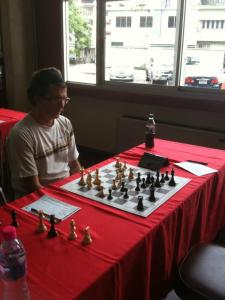
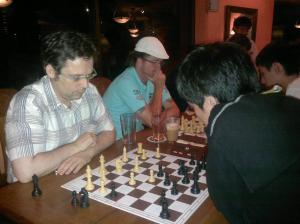
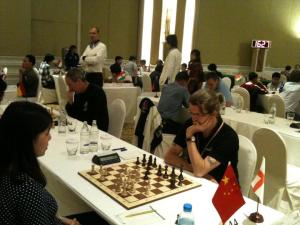
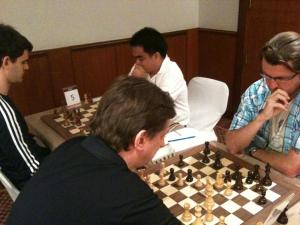
The Bedfordshire League was where I began playing competitive chess, my first rated game being February 11th 1988 whilst in my last year at school. For those who don’t know, Bedfordshire is the smallest of the home counties in south-east England; it is mostly flat farmland with a few main roads connecting its villages and towns. Conversely, our chess league was also small, rarely going beyond two divisions but bolstered in strength by the addition of Milton Keynes/Open University, Northampton and briefly Rushden, all of whom sought a stronger league to play in than their own. Their addition added greater rivalry within the league without causing any real harm, helping the county teams achieve unprecedented levels of success during the 90’s.

League chess in Beds was always an evening affair, with games starting around 7.30-8pm. Journeys for away games offered short drives, often with little of interest to see and an uninspiring venue at the end. Some clubs were notoriously difficult to find enabling them to pick up points by default occasionally; Cranfield, for example, could only be accessed by narrow country lanes with few signposts, finding it in the dark was very tough indeed; Milton Keynes won the league many times, not because they had the strongest team, but because navigating your way through that city is actually much tougher than chess itself, meaning that most visiting players were usually both late and mentally exhausted upon arrival.

Bedfordshire had a small but strong league, and in many respects, it was no different to many others around the country. I played in nine consecutive seasons, and what little incident there was, is well remembered to this day. I thought I would reflect upon some fonder memories and the distinct lack of impact they had.

1. Sheepdog mauls chess computer

In late November 89 on a dark and rainy day, I drove with playing partner Damon D’ Cruz to March, Norfolk, in search of a Novag chess computer which he wanted to purchase. Not long after, the expensive machine became an object of affection for the family sheepdog Sam, who mauled it one evening. The pieces had all been heavily chewed, some beyond recognition. It was funny to see a chewed chess set with teeth marks and chunks taken out of them. It was as if they had suffered defeat even before the game had begun. The ill-fated machine was then ‘borrowed’ but never returned by another club member some years later.

2. Rogue milk bottle angers A-Team players

A milk bottle escaped from a bag of shopping in the Luton A-team captain’s car once and, unbeknownst to him (Damon D’ Cruz), hid itself under the driver’s seat. Some weeks later a stench arose. In a match to Milton Keynes, team members (especially Andy Perkins) complained incessantly and asked for windows to be left open. It was finally discovered after the smell became unbearable.

3. Player gets beaten up in the snow

Ah, the legacy of the seventies, you can’t knock it. We had a player at our club, I won’t say his name because that’s not fair, we’ll use his initials MD instead. I liked him even though many did not. Whilst playing for Vauxhall, when Luton was ‘able to operate its own league’, he brought his electric guitar to the chess club to play some heavy metal one winter evening. Unfortunately this didn’t go down too well and a fight soon broke out featuring Dave Considine. My friend Michael Joseph informs me that it carried on out into the snow. MD slipped and got punched in the jaw, after some rolling around they both returned to play some chess, without an encore!

4. Scotsman chases football hooligans down the road!

Jim Jeffries, a Scotsman who used to play at Luton Chess Club when it was based in Bury Park near the football ground, was a no nonsense player. According to Nick McBride on one occasion some football supporters saw chess being played in the club whilst walking to the ground to watch a match, and banged on the windows with some amusement. Jim got out of his seat, ran out the club and chased them down the road!

5. Suicidal newbie almost causes punch up at AGM 

There was a player who joined the Open University named Gerrard Ashby. He was rated around 200 and a thoroughly unpleasant man. The league AGM was usually held at our club, which was where the then president Ken Liddle played. Ashby came along once and called the president a wanker during the AGM. Ken quickly stood up and asked him to step outside. The offer was declined but it set the tone for the meeting which was full of arguments. I only saw Mr.Ashby once after that, he was sporting a horrendous black eye for yet more foul language. Not long after that he killed himself.

6. Engine blows up after stunning county victory

Bedfordshire first made a name for itself nationally when the second team beat Warwickshire in the Minor Counties Final at Aston University in July 91. I was sub that day and didn’t play, as we strengthened the team with a host of 180s. The journey back was memorable for all the wrong reasons. I traveled up in Olly’s light blue Skoda, back in the day when Skoda’s were cheap and nasty. After the match, we had real difficulty getting out of the car park and then got completely lost in Birmingham. Once on the motorway things went more smoothly until the engine blew up and filled the car with black smoke. The windows were quickly opened as we rolled to stop on the junction just before Milton Keynes. No real damage done except to the engine, which had a big hole in it. We were picked up by the side of the motorway and taken home by the driver’s father.

7. Open-top bus blasts out music during play

Towards the end of the season 93-94 we played Norfolk in the King Edward VIII hall, Newmarket. It was a sunny afternoon and all the venue windows were open where we played, overlooking the main road on the first floor.  Well into our match with Norfolk a carnival suddenly rolled into town. An open-topped bus stopped outside the hall, giving a live radio dj a direct view of our match, which he began reporting on the radio with great amusement. A brass band then began playing, accompanied by a group of female dancers, also looking into our venue with amusement as the window frames vibrated from the deafening base. This went on for far too long, causing many of the older players to get out of their chair and walk off into the tea room in disgust.

8. Raj loses in four moves!

One of the Luton players once started drinking cans of Guinness on the way to a match. He wasn’t bad, about 160, but lost in four moves due to drunkenness at the board. If memory serves me correctly he left a bishop en prise and resigned.

9. Offensive t-shirt results in life-time ban

A totally ridiculous incident occurred one summer afternoon in Luton when a new member got himself banned for life over his T-shirt. The manager of the social club we played in objected to the message on the back of the shirt, which was obscene. It was suggested, politely, that he should turn the shirt inside out, as it was a family club and would cause offence. Some people, however, are incapable of accepting criticism. Rather than do as asked, a crazy half hour arose with the new member repeatedly storming in and out of the building, asking why it was a problem and confronting club officials. At one point he stormed up to the club president looking like he was about to hit him and called him a c**t, resulting in a ban from the social club for life. Fortunately, he had arrived early and most members did not witness the incident. The person in question was aptly named Steven King. I will never forget him for the aforementioned incident and the fact that all his post-game analysis involved the word hassle, ‘He was hassling my rook, so I hassled his king’, and so on…he was about as bad as it got over the board.

10. Player thrown through windscreen during chess club car crash

I’ve talked about it before and I didn’t witness it. It happened in the 80s. Ivan Mitchell’s name for the victim was piss-head Pat, a man I did meet a few times, and whom the author can confirm, lived up to his name. Once, after leaving the chess club, the taxi he took crashed, throwing him through the windscreen into a bush. Pat had no recollection of the event, it was the police who informed him the next day. It sounds apocryphal but was confirmed by several other members.

11. Game lost due to call of nature

One of our more recent players (again he shall remain unnamed) had the ability to cause mild controversy every time he came to the club. He is, unfortunately, one of those people who can’t control themselves and speaks too loudly all the time. Much of what he says confuses those who know him, let alone visiting team members. I always remember him repeatedly asking average club players if they could show him how to beat Karpov!! One evening during a blitz tournament he lost a game (not too uncommon) and tried to stop the clock because he needed to go to the toilet. He then tried to cancel the game because he was unable to concentrate due to the call of nature. He was deadly serious about it. An hour must have passed before we heard the end of it. The following week, he was still unable to stop talking about it. When his opponent from the previous week turned up, he demanded justice: a best of three, which then went to a best of five, and then a best of seven. Sadly he wouldn’t listen to the advice of others, that trying to win on time in blitz by playing entirely random moves isn’t an effective strategy.

12. Loudmouth American gets thrashed by junior

There is an American military base in Bedfordshire. Once in a while we would get personnel from it coming to the club. One evening an over-sized soldier came with a smart case containing numerous neatly packed sets and clocks. He talked a great game and initially refused point blank to play our best junior, who would indicate to us just how good he was. I remember watching events unfold with interest. Within the hour the American packed up all his equipment and promptly left. He lost 6 games in quick succession and never returned. Typical yank, I thought.

13. Dubious tea urn causes speedy exit from makeshift cafe during county match

In truth this happened a number of times as county matches tend to seek the same venue. When Bedfordshire first started using the Turner Hall in Newmarket, it had a tea urn that had a problem with its thermostat and teetered on the edge of explosion at times. And what in chess could be worse than traveling across flat countryside, playing out a dull draw in quiet country town, wandering off for a quick cuppa in the endgame, being badly scalded by an exploding tea urn, and then unable to secure the draw! Nothing right? The one occasion I remember this happening was during a casual chat amongst team members, suddenly interrupted by a violent rattling of the tea urn with boiling water spilling over the top, custard creams were laid aside in favour of a hasty exit.

14. Drunken playing session and heavy cigars lead to urinating up walls and puke going everywhere

Another late night session, this time in the Summer of 93 took place at my friends detached house on the town’s most expensive road, involving Ivan Mitchell. Much alcohol was consumed and a box of heavy cigars came out. At the end of the evening, a drunk Ivan decided not to water the flowers but to water the walls twice, finishing the evening off by puking everywhere in the host’s car whilst being driven home. Nice!

15. Relative newcomers encounter air bombs 

Once in November 92, several matches were being held at Luton chess club, one of which involved Milton Keynes C team. From memory, Milton Keynes had many new players in their team that season. The week before I had agreed with the team captain to let air bombs off in the car park close to the playing hall to see if I could unsettle the opposition, as he knew I had a love of fireworks and had previously suggested it for a laugh. This then happened and a number of heads went up and started looking around to see what was going on a friend told me. During a quick couple of pints in the bar afterwards, no one mentioned the air bombs before setting off in the dark. Alas, a couple of loud bangs weren’t enough to unsettle our opponents, making it the only occasion where such measures were employed.

16. Embarrassing incident over the board

There was a gentleman who played for Leighton Buzzard whose name I forget, he was always rated around 150 (1900) in strength, in his late 50’s, grey-haired, always wore a suit and was very polite, I believe he mentioned once that he worked in the city. The first time I played him was in the very early nineties when Leighton Buzzard had those hideous boards with yellow and black squares, and pieces that were slightly too large to fit on them, and as if that wasn’t bad enough, we had to play in some school on the other side of town, or Linslade as its also known. I’ll never forget the incident during the early middle-game where my impeccably mannered opponent accidentally belched and farted simultaneously with such force that everyone in the room must have heard it. He was quite embarrassed and sincerely apologetic even though, out of courtesy, no one acknowledged what happened….I found it funny.

17. Stand off between karate club and chess club emerges over doors not being closed properly

This happened in 85/86, so I didn’t witness it but was told about it several times. The first venue I played in was a horrible church hall which we shared with a karate club, and had to cross through their hall to get to our equipment. I noticed that there were still signs on all the doors asking you to close them some two years on. Sometimes there were even instructions how to do this. The reason being that many doors slammed loudly and upset the more sensitive karate club members. Once, during a league match, a member from the karate club entered our room, slammed the door as loudly as he could three times and shouted ‘THERE, SEE HOW YOU LIKE IT’. Unsurprisingly, no one got out of their seat and confronted him.

18. From Gambit Publication gets author’s head smashed open

On March 6th 1993. I got a lift into London to buy a book on the From Gambit in Foyle’s. Unfortunately I hadn’t slept much the night before, and whilst ascending an escalator, stretched my back over the rail out of tiredness. I didn’t see the metal and glass display cabinet further up, wrecking it beyond repair with my head by accident. There was quite a lot of blood, out of disorientation and fatigue I then left the book behind on the tube.

19. Acts of violence deny school champion a regular playing partner

I cannot write about my experience of chess at school without mentioning my old friend Jalil who provided stern opposition, enabling me to gain valuable practice as I began playing for my home town. I befriended him instantly when he joined our school as he spoke no English, and when he saw me go up on stage to collect my trophies for winning the school championship and league, he wanted to play at every opportunity. Fortunately we had both been kicked out of almost every class in school already, thus had plenty of opportunity. Sadly, Jalil got himself expelled. He came from a family of martial artists and was a black belt in Karate at 15, he was also very hot tempered. A series of events occurred which finally gained him expulsion. First, he threw a typewriter at another pupil’s head, then in English (we called this class Cards, as everyone played blackjack at the back of class instead of study) the day after Luton won the league cup, a riot occurred in our class, during which he ripped the legs off a table and started whacking another boy round the back and the head with them, then finally he got expelled for beating the games teacher up. Some years later I met up with Jalil again, and true to form we played some chess (this time in his Kebab shop). I was already a county player by then, and he was a 2nd dan in a number of martial arts. He wasn’t a bad chess player and helped me use my time in school more effectively.

20. Under real pressure, the author performed at his very best.

I am not and never will be a great chess player due to a distinct lack of talent, and an inability to retain concentration sufficiently. However, this doesn’t mean that there are moments of which I am not proud. When I assumed the role of B Team Captain, my first task was to stave off relegation. It came down to the last game of the season, at home to Leighton Buzzard B, and more importantly my game. Though my opponent was some 200 FIDE points above me, I was so fired up that he was blown out of the water within 25 moves. I kept my team up, something I remained very proud of for a long time. Whilst playing for our A-team a few years later, I also saved it from relegation by winning the final game of the season’s final match, against Bedford A. It’s true that beating someone with a FIDE rating of around 2000 is nothing exceptional but it was the manner in which it occurred. I played with immense passion.

21. County player takes corners faster than Mansell!

It’s MD again, this time with myself in the back of a car that is running late for a county match against Norfolk, held in the equidistant Newmarket. Mr. Mirza, our driver, decided that we wouldn’t be late and started driving like Mansell, we swerved through some bends on the outskirts of the town so fast that we crossed into an oncoming lane and could have caused a serious accident. MD, who had suffered a nervous breakdown in his youth was a fragile character. He became panicked by the excessive speed, and held onto a handgrip tightly. I remember this because I had to inure hours of monotone analysis, suddenly cut short after he was thrown across the backseat whilst entering a sharp dipping bend, prompting a nervy fixation of the road ahead. It was one of those rare occasions where apparent danger came as a godsend.

22. Player pranked by late night playing session

Poor old Roman, sadly no longer with us. I will be forever indebted to his kindness when, as a junior, he showed me how to play the c3 Sicilian. So it is with a little sadness that I remember a late night session between him, my friend Damon and myself in late 89. He went to bed just before midnight but we kept playing until beyond 4 am. It was a slow Sunday morning in late Autumn, Roman awoke at 8am, and being a guest he could have taken offence at having to wait until 4pm before my friend and I finally awoke and went downstairs. Being a gentleman however, he did not and was even able to greet us with a smile.

23. Crafty pensioner retracts move during game.

In the Summer of 93 I was playing in our club quickplay championship and got up to go to the bar. Looking at my position from afar, I saw my opponent play his move. Upon a second glance some minutes later I also saw him retract the move and play something else. I didn’t mind at all because I was clearly ahead and he was one of the weaker club players. I went on to win and said nothing about it. If anything, I found it quite amusing.

24. Super GM downs one of Bedfordshire’s finest.

IM Andy Ledger. I first saw him in action at the Hitchin Open in 89, where he came up against a certain Michael Adams. Andy was way ahead in material, a knight if memory serves me correctly but was under pressure both on the board and on the clock. I remember how it had welled up in his face, knowing that with calm play he would surely beat GM Adams. Sadly for us, a clever tactic ending in a back rank mate put paid to Andy’s efforts.

25. Duff joke fails to amuse team members.

In late September 89, a friendly match between Luton and Hitchin was arranged. Most A-team members went in the same car, finding the venue with ease. Upon entering, Mr D’Cruz mentioned that he could no longer wear one of his T-shirts as it had turned pink courtesy of being washed with an unknown red garment. I quipped that he should wash it with something white in order to restore its colour, which er, didn’t go down so well.

26. Atonal renditions of arcane Nirvana tracks irritates opponent during blitz game. 

Like just about everyone else on the planet, I fell in love with Nirvana when they made it into the big time. Many of Bleach’s later tracks became nice little numbers to sing and hum along to during blitz. Upon reproducing the line ‘Don’t have nothing for you’ in the track Sifting, my polite opponent promptly retorted with annoyance that he didn’t want anything thanks, perhaps referring to the position rather than the track… it made me chuckle anyway.

27. Nutter causes incident in library

There was a nutter in town for a few years who was a bit of a chess fan I believe. He was of African appearance, wore dark glasses and was walked around town in a step-by-step manner, like a slow motion military march or something. He was once spotted trying to rub the top of his head on a leaf of a tree, with a bishop placed horizontally between his nose and mouth. On another occasion I saw him with a bishop inside his mouth, the base protruding outwards. He entered the library in the town center once, spent about two minutes walking up the stairs and then stood directly behind someone reading a book. When the reader turned round to see what was going on, our local nutter kicked him in the shin hard, though not too hard. Given that he wore dark glasses and was twice the size of the man he kicked, this was obviously very intimidating, and I don’t believe I have ever seen someone’s face go red so fast. Nothing happened for a few seconds, the nutter just stood there without moving before continuing to walk around the library in his own distinctive way. The assaulted, now looking very confused, made a hasty exit.

28. Author becomes saddened after learning that a playing partner is to move to Wales.

My first two playing partners when I joined Luton were Peter Whone, and his friend Richard. It took me 6 weeks to beat Peter. Even though it happened 27 years ago, I still remember the game. A few months after that, his friend Richard, who I had also managed to beat by then, mentioned that he was moving to Wales, and said he had only come to say goodbye. I was not yet 16 and felt a raw sadness from his farewell. I cannot be sure that I managed to stop myself from crying though I think that’s how it went. In the early nineties, Richard returned to pay us a visit, it was lovely to see him again. I spotted him the second he came through the door.

29. Changes in league structures causes objections by Bedford players

Chess had a bit of a boom after the Short-Kasparov match in 1993. Our club suddenly had 62 members, and other clubs had swelled in size. The league went to 4 divisions and Luton had 9 teams, the last being Luton I. This caused an imbalance in division 4 which consisted of nothing but teams from Luton and one team from Bedford. At the end of the season an objection was raised by Bedford that they spent half the season playing in Luton. Not everyone saw this as an objection.

30. The author is nearly knocked off his bicycle en route to the chess club and killed!

When I was 17 I couldn’t stop listening to thrash metal. Even when I cycled, I had it on the walkman and often warmed up for a chess match by listening to it. This had disastrous consequences once as I was cycling en route to my chess club and didn’t hear a car behind me. It hit me quite hard and knocked me off my bike. I managed to wheel it the rest of the way there and explained what had happened. This was a critical mistake as many members were too absorbed in their games to listen.

31. Unpopular player throws birthday party…it goes as expected

Bob Harnett was an odd fellow. A deeply unhappy soul who on his day could and did beat the odd GM here and there. He once had a birthday party and invited a number of players from the various chess clubs he played at. He could have held it in a telephone box as only 4 people turned up, and two of those only went out of sympathy. I think a few cheap cans of lager were drunk whilst the tv was on and there were a few blitz games, that was about it.

32. Late night blitz with adult entertainment thrown in! 

I shan’t be pointing the finger here or naming names but if you know which club I played for you can probably take a guess, especially if you look at the point placed directly above this. Anyway in 1991, after the chess club evening had ended, a few of us who hung out carried on affairs into the wee hours at the home of whoever was most accomodating that evening. Usually this involved blitz as part of some ad hoc tournament, accompanied by blue movies put on the big screen behind the games in progress. I was still a teenager back then and hadn’t even had my first girlfriend, and so only took amusement in it more than anything else. Even with the sound up just enough to hear, I seem to recall enjoying reading the subtitles more than watching them. I also recall, him mentioned directly above once saying ‘Oh look, she’s trying to act!’ once. In defence of my former playing partners, and myself, I never quite got it. No one seemed that interested and made little or no effort to watch them -it was just a bit of background entertainment or something. Still in my teens, I was too young for such stuff and rarely if ever paid attention -it seemed like a distraction I once thought. However, I should point out I cannot recall the amount of times this happened…dozens at least I’d say.

33. Coffee requires diplomacy

In the early 00’s a visit to the Luton Chess Club was followed by a drive into the town centre by a few and some late night food. We went into a kebab style place on Chapel Street and had food & drinks and some late night chit-chat. I don’t quite know why but I ordered an Irish Coffee and barely touched it. Damon D’ Cruz was unaware of this, and after finishing his food asked if he could finish my coffee, seeing I was not drinking it. ‘Of course’ I said, but kept shtum over what kind of coffee it was. The look on his face was priceless. The gulp he took knocked him back, he then returned the cup to the table posthaste. Instead of firing expletives at me, he said unimpressed, ‘I think someone’s put something in that’. It was hard not to laugh at him caught off guard like that. No harm done though.

34. Paganism appears

Shoud you wish to trawl through the S.C.C.U Bulletins throughout the 70s and 80s, you will find a certain J. Killminster playing for Bedfordshire, many, many times. He also played for my home town Luton, so I have been informed. Members who played alongside him, and me for that matter, namely Damon D’ Cruz and Peter Montgomery, both confirmed independently of each other that John, used to go dancing naked in the woods in Clophill. Of course I had to ask what that was all about and asked Damon whether that pertained to paganism or something. He said yes, in fact it was a group thing, there were often women and alcohol involved! ‘Each to his own’ Damon then said. How does this function as a fond memory? Because I was first told about it during friendlies at Kents Athletic Club before we were turfed out of it…‘Each to their own’.

35. Disbelief over first name nearly gets me beaten up

We once had two new members join and one of them was called Garfield. I found this highly amusing and assumed it was a nickname and not his real name. At one point I said ‘Just imagine if that was your real name,’ and kept laughing. This did not go down well. I kept getting glared at and at one point Ivan Mitchell came over and told me to pipe down. As it so happened I did and even walked home with the two new members who were both okay about it after I kept my mouth shut.

That is about eventful is it got. Chess is generally a serene affair with little of note, there is nothing else I can think of that is noteworthy. In future blogs I will attempt to write about the mundane, which believe it or not, is usually of greater interest. Until then… . 

M  M

New Year Quiz

What better way to start the new year with some mind-bending questions about chess could there be? That’s right, none whatsoever. I’ve drawn material from Mr.Winter’s Chess Facts and Fables (2006) and added some broader general knowledge questions to balance things out a little. Solutions can be found below. Enjoy:

1) The New York Leger paid which player a sum of $3000 (approx.$60,000 in today’s world) to write a weekly chess column for a period of one year starting in May 1859?

2) Which country did Capablanca once claim to be ‘most suitable’ for producing chess players, courtesy of its ‘raw climate’?

3) Prior to F.I.D.E’s decision to hold a tournament to decide the vacant world championship in 1948, a match between which two players was suggested by Eugene Znosko-Borovsky as an alternative solution following the death of Alekhine?

4) What is the shortest decisive game in a world championship match?

5) Against which former embattled F.I.D.E president did Mikail Tal play his first game as world champion at the Leipzig Olympiad 1960?

6) What infamous event concerning the chess player F.Womersley occurred in Hastings on September 13th 1911?

7) Which ex-world champion was accused of being a collaborator with the nazis by much of the chess world?

8) Which player has beaten 7 world champions, (including two with the opening move f4?)

9) As of 2013, Russia has more registered Grandmasters than any other country, but which country is second according to F.I.D.E?

10 Who is the only Englishman to compete in a F.I.D.E world championship final?

Answers, (page numbers refer to Chess Facts and Fables)

1 Paul Morphy, (pg 69)

2 England, (pg 90)

3 Euwe and Botvinnik, (pg 93)

4 Anand-Gelfand (http://www.chessgames.com/perl/chessgame?gid=1666558)

5 Campomanes

6 He was shot dead. (pg 163)

7 Alekhine

8 Bent Larsen

9 Germany

10 Michael Adams

Your score:

7-10. You clearly have a fantastic knowledge of chess. If knowledge and ability were one and the same, you’d be a 2600 player for sure.

3-6. You can talk a good game no doubt and can contribute to any pub conversation. Everyone will think you are a tidy little FM.

0-3. Time for you to buy Chess Facts and Fables.

MJM
If you scour the sites on the net for the latest chess news,  as I sadly do, you might have noticed that the quality of the journalism often leaves a lot to be desired. This isn’t just an on-line phenomena, many chess magazines aren’t much better…certainly the ones I subscribe to aren’t anyway. Although you are more likely to find better writing within them, much of the content isn’t inspirational in my opinion. But whenever a quality broadsheet turns its attention towards chess, we are often presented with the opportunity to see how it should be done. With this in mind, I was very happy to find the following article http://www.independent.co.uk/news/people/profiles/i-never-wanted-mens-pity-chess-child-prodigy-judit-polgar-on-the-games-inherent-sexism-8340951.html  If you haven’t already, I suggest you read the article before you continue.

If you have read carefully -which of course is the only way to read- rather than glance over the article, you will have noticed the ease with which the writer handles the subject, in part this is due to the fact that the author used to/still plays chess himself. Having been a fan of ‘The Late Review’ myself for so many years, I was happy to see a distinguished journalist turn his attention to our beautiful game. So apart from the ease with which he handles the subject, what else is there to say about this intriguing article? Firstly, though we are undoubtedly aware of the paucity of women’s chess during the 80’s & 90’s, we -or certainly I- weren’t aware that it was personal tragedy which previously brought out the best in Judit. This gives us a new angle on the issue of gender in chess in an informative manner: what I am referring to specifically is the level of stress in top-flight chess was ‘perhaps’ affecting Judit’s ability to have a child.

I have spoken in a previous post about the issue of gender in chess (https://mccreadyandchess.wordpress.com/wp-admin/post.php?post=360&action=edit) and will not go into that here. There is no need to add to what has been said, as the topic is well handled here. Judit tells how she was taught there should be no limit to what a woman can achieve, questioning the prevailing culture of the game, where women still tend to compete against women. The odd thing about this I thought though, is that given she herself has clearly benefited from stepping outside of the women’s circuit so to speak, why haven’t others followed?

The topic of gender is handled well in this article. He even knew of Zsuszu’s amusing reflection that she had never lost to a healthy male! Gender aside, the difficulty of achieving success within a communist state is touched upon as well as the importance of ethnic background. A light touch is used by Lawson to identify defining, personal moments in Judit’s past. The article concludes by pointing out that it will be the first time since 88 that we have seen Judit in the UK (another point I was unaware of).

So there we have it: craft and expertise from Lawson, whose effortless, unpretentious style brings us closer to the world’s best ever female chess player.

MJM

Among top grandmasters the Dutch is a rare defense, which is good reason to play it! It has not been studied very deeply by many opponents, and theory, based on a small number of ‘reliable’ games, must be rather unreliable.  –  Bent Larsen

The producers of the F.E.B (The Full English Breakfast http://thefeb.podbean.com/) recently put me onto a stunning victory by Simon Williams with the Dutch Defence against Boris Gelfand.

It can be found here: http://www.chessgames.com/perl/chessgame?gid=1694581

One of the things I like about this game is that it exemplifies what the Dutch is all about. The position quickly becomes complex and unbalanced, and though black goes the exchange up quite early on, it isn’t clear if he’s winning at any point. The game, then, teaches you how important it can be NOT to simply rely on a material count to see who’s ahead. White’s strong knight and pawn majority in the center make it, in my humble opinion, difficult to be sure whether black has a winning advantage.

Another thing I like about it is that there is consistency in strategy from black’s point of view. If you happen to read or even watch William’s material on the Dutch (I do and I have to say I am not a fan) he does chide an early b4 but more importantly, we see the more typical f-pawn push to f4 (A move Williams likes to play with white, perhaps he is an f4 addict!), and an attack on the kingside, all atypical features of the Dutch, as understood by Mr.Williams.

A game well worth studying, one which can teach a great deal.


MJM


The beauty of a move lies not in its appearance but in the thought behind it.  –  Aaron Nimzowitsch

And so too with literature. Occasionally in chess literature we stumble upon a book based upon a concept that appears so self-evidently sound, it demands that we take a deeper look. When I then saw a plethora of rave reviews for the aforementioned text, I was powerless to resist locating it on amazon, and then as if like a robot, began punching in the numbers on the credit card, salivating in stupor, awaiting its delivery with…something or other.

More seriously, I intend to marginally break rank here. I don’t write for anyone or anything other than the joy of writing, which gives me a greater level of freedom than those within literary circles within chess. Some thoughts on that: book reviews tend to suffer from time pressure and lack of interest, and more importantly a lack of freedom. It is in the interests of a titled player not to be too critical of a text published by the company which employs him. Some criticism is both necessary and acceptable as long as the bar is raised accordingly. By this I mean an average book becomes a good book, a good book becomes a great book, and a terrible book becomes a bad book. A lack of time is more pernicious than may first appear. Personally I like to take my time to think more deeply about certain issues, as the answer isn’t always apparent. Sometimes we don’t know for sure how we feel about something until we’ve had a good night’s sleep. Of course, being rubbish at chess means that my understanding of the game is much less than titled opposition, but having invested my entire life into education, having always been an avid reader and lover of writing per se entitles me to an opinion, one which I believe is informed enough to express. In previous posts I durstn’t refer to a text without quoting from it, as I didn’t want to drag the culture of chess literature into the gutter -as its never been there before honest!-but this time it has to be that way. More importantly, I will keep this brief as the text allows me to do this.

The text in question has clearly had a lot of thought put into the construction of it, although some explanation upon how the ‘modern’ era is defined would have been nice. Is there any reason why the author chooses 1993 as a starting date I wonder? The games are chronologically ordered and fascinating without being exceptional due to  the primary purpose of the text being instruction. The quality of the annotation and commentary is consistently high, which makes reading the book an absolute pleasure. Furthermore, Stohl does a good job of choosing lesser known games, and making them, as the title says, instructive. Some of them cannot be found on-line, even though the players are well-known.

A solid effort by Stohl and well-worth buying. He should be very proud of himself. My suggestion for an active reading process with this book is to play through each game carefully, then spend time thinking about how the game is instructive in the context of the modern game. It’s not as easy to do as you might think.

MJM
John Lennon once said that French rock is like English wine. Would he be rocking if he read ‘The Modern French’ if he were still alive…well read on and decide for yourself.

They say you should never judge a book by its cover but surely the best way to know what a book is about, who wrote it or what the price is, is to look at the cover which tells us the text ‘The Modern French’ arrives courtesy of Antic (no not Raddy) and Maksimovic, who have teamed up with New In Chess. On the back cover, the text claims to ‘change your view of one of the most popular openings of all time’ – and no that’s not a daft attempt to sell a book, it is in fact a very daft attempt to sell a book. Literature in chess tends to lack the transformative capacity its impoverished authors & publishers tend to play up, so along with the bright red cover it was I who was initially ‘rocked’ upon receipt of this rather strangely bundled reading material. Also on the cover we see the words ‘A Complete Guide for Black’. Given that Carlsen has recently been lashing out with the Winawer, I thought I’d look up the lines he’s been playing. Imagine my surprise when I found it had been omitted from the text altogether, along with the also popular Burn and Rubinstein variations. What kind of ‘Complete Guide’ could this be, I asked myself? The title -also to be found on the cover oddly enough- claims that the book details ‘The Modern French’ yet upon perusal many of the lines covered are far from modern…I was indeed perplexed and felt compelled to read on, safe in the knowledge that any book on the French Defence simply must be a good read (yes you’ve guessed it, the author plays the French Defence too).

Start Right!

The Foreword (more about that to come) reads as follows ‘Over the intensive two-year effort of writing this book, the aim of the authors has been to present you with more than the traditional bone-dry analysis of all possible variations [?]. To this aim, apart from explaining the essential strategies and plans pertinent to this opening, we also cover a multitude of complex plans and theoretical novelties as part of our new strategic approach’. That’s a strange start. Those who write in a professional capacity don’t usually draw attention to a period of time as short as that, bearing in mind to get where you are usually involves research over periods far greater. Fifteen years or a lifetime of effort, okay now we are getting there but two years? That’s on a par with the your first post-grad qualification, what’s so exceptional about that? More crucially, for a number of reasons I will point to later, I don’t believe the text even constitutes two years of ‘intensive’ effort. I also don’t believe that the approach offered by the authors is particularly new either; ‘new’ for them maybe but only them. One text that does attempt to give a ‘bone-dry analysis’ and, in my opinion is what the authors are alluding to, is Lev Psakhis’ book ‘The Complete French’, but if this is the sort of thing they are trying to move away from it needs to be asked why they have copied/used the same format? Though successful attempts are made to summarize and highlight key positions throughout, originality or lack thereof pervades the text from start to finish on a number of levels. The text smells of a copied, but improved, version meaning that aspects of the text are misdescribed by the authors.

Once again from the Foreword: The French has been an integral part of many top players’ repertoires  [but isn’t this true of most mainstream openings?], and it was the key weapon in the hands of old masters such as Botvinnik and contemporary stars such as Carlsen and Morozevich. When you look at their tournament results, it becomes clear that they chose the French Defence in important games, when they need to secure a win with the black pieces.’  What a load of old tosh, the sentence simply isn’t true -shame upon the editor. Carlsen does play the French but only occasionally and rarely in crucial games. Trying to over-emphasize the importance of the French Defence by construing language to suggest that its selection is habitual amongst certain top players is just another cheap sell. I don’t understand why the Foreword is used to try and sell you the book. It’s an unpersuasive start I must say. To conclude this section, I also don’t understand why the Winawer has been left out, if demonstrating how essential winning with the French is, then I suspect it’s omission tells us more about the book than anything else -the authors simply don’t play it.

What I definitely liked about this book.

1) It’s about the French Defence!

2) The analysis is, undoubtedly, the strong point of the book. It is sound throughout, as well as being easy to assimilate. A good balance has been found between range and depth of response with much quality annotation to boot.

3)  I was personally happy to see that the authors dropped the tradition of starting with rare and unusual moves. I’ve always found retaining motivation to be an issue when you are forced to wade almost half-way into a book before anything familiar emerges. I was also happy to see that chapters are finishing with concluding remarks. Though perhaps more could be said, the remarks do tie in well with the content, helping those of us who are less gifted.

What I definitely didn’t like about this book

1) Attention to detail is lacking in places. A foreword is only a foreword when its written by someone else and not when its written by the authors of the book. That’s what we’ve called a preface for the last several hundred years. The game on pages 58 & 59 isn’t referenced properly. It reads Schebler-Art.     Minasian, Kalithea 2008. Since I know GM Schebler, I asked him about this. He informed me that his opponent was named Artashes Minasian, and not Art. The punctuation denotes abbreviation but given the spacing, I wasn’t sure whether Minasian was part of his name or a place, it is unclear in the text.
2) Some attempts to infuse modernity or provide context are crude and inexact. For example, pg 59: ‘3. e5 is regarded as the third strongest move, [justification?] after 3.Nc3 and Nd2. The recent tournament practice confirms this assessment.’ Poor English and vague, unsupported statements here. ‘When it comes to old masters, the biggest fans of the advance variation, Nimzowitch and Paulsen, provided the biggest theoretical advances. Later on, a number of top players, adopted this variation as part of their regular repertoire [the correct connotation is main repertoire]. You couldn’t make this stuff up, and I am supposed to believe this book constitutes a two-year intensive effort? This is just another example of crap writing in chess.

3) The concept of the book lacks refinement. The format of the book is so similar to Psakhis’ ‘The Complete French’ I did expect it to be in the wafer-thin bibliography but its not there. I find that to be rather suspicious. Also missing is Nigel Short’s book, and Shaun Taulbut’s, both of which are essential reading for the French. More importantly, the handling of the Tarrasch is somewhat idiosyncratic. We are only offered Morozevich’s 3…Be7. All it needs is for someone else to come over the top with more concrete analysis showing exactly what is wrong with the response 3. Be7 (though the authors seem to know already), and the entire chapter will be rendered obsolete. Sounder 3rd moves clearly exist, Nf6 and c5 spring to mind and should have been offered. Though 3. Be7 is a modern move, and thus fits in with the overall aim of the book soundness cannot be sacrificed for the sake of modernity. In offering more third move alternatives, at least the authors would have a get out of jail free card to play if 3 Be7 does not stand the test of time. Some of the positions shown, particularly where white plays 4. e5 & 5. Qg4 require a horrendous level of precision if black is to avoid being wiped out early on…I for one certainly won’t be playing them. The poor exposition of the Tarrasch reveals the limitations of the book more clearly than anywhere else. The reader has little choice other than to follow the authors down a precipitous path, the option of an alternative route would have been a more pragmatic decision in the pre-writing phase.

When I studied at post-grad level, I was taught by one of my professors that in order to write about something, you need to define what it is first. So what is the modern French? We simply don’t know because the question doesn’t arise. What does modern mean? Post-Kasparov? I don’t know. Confusingly, I noticed John Watson in the reading list, who is one of the few authors in chess that can document development in chess successfully, but why can’t the authors reference his work and inform the reader since he is in the bibliography? We are presented with an array of carefully indexed modern games, but that is just exposition. No effort is made to state whether the line being played is modern -often not the case in the text- and in what sense it is modern. Why are certain moves defined by modernity? Too little is said.

What I think the title alludes to is a modernized text on the French. Questions can be asked over why we have both the Steinitz and the McCutcheon in the book when the Winawer can replace both. If the McCutcheon is so great, then perhaps the authors would like to explain why it is virtually non-existent at the highest level? Again, this ‘Complete Guide’ is complete in the sense that it fulfils the authors impartation of their own preferences, whether they have homed in on relatively unexplored, modern lines solely to create strong marketing points or to substantiate their own analysis is a question only they can answer, the answer lies somewhere between the two I suspect.

4) Given that the book aims to provide key positions and structures, as part of its successful attempt to offer an in-depth look at the french, why are we denied, middle and endgames? Surely its crucial to see how the strategic motives are played out, seeing that such value is placed upon them? Annotation would be useful but not necessary. The authors could have given you the option of playing through the game yourself without having to go on line.

A Conclusion

I’m not sure what John Lennon would have made of this book, I think he would have said it hummed rather than rocked. But seriously, I think ‘The Modern French’ has greater strengths than weaknesses but will never be considered to be a classic, as there is too much room for improvement in it. The content is at times superficial and at others in-depth and highly informative. We are never freed from its erratic twists and turns, which probably comes down to a lack of writing credentials more than anything else. How else can we interpret the total lack of originality in the format and style of the book as constituting anything other than a lack writing craft? It is true that improvements have been made if you compare the work to Psarkis’ but they are not sufficient in themselves. The analysis is sound and impressive but just about everything else is sloppy and imprecise. There is a strong tendency in chess to copy or base your work previous publications, ‘The Modern French’ disappointingly fits into that tradition in my opinion.

Anyway, that’s just my take on things. I stand to be corrected as always.

Did you know that a rain forest the size of Covent Garden is cut down everyday to make way for chess publications? Hundreds of species are reported to have lost their home, become untraceable (as no forwarding address was left) and even extinct occasionally. One species, it is said, secreted an oil which has soothing capacities for those in time-trouble, an indigenous GM from Brazil claimed. He added further that pre-match preparation rarely extended beyond incorporating the oil into a balm which would be rubbed into the shins during play. I wonder if chess will ever become partially responsible for environmental catastrophe -that is should such a thing be possible-hmm…perhaps I should stop buying hard copies and seek out the soft copy in a less guiltier fashion just in case?!

Not intentionally -and without guilt I might add- I recently picked up the publication that cost the most out of the 30-something books I’ve acquired this year. It’s not often that I pay over 40 quid for a book, in fact its only ever happened twice in my whole life. Being the most expensive chess book I’ve ever bought, perhaps it was inevitable that the publication would pop its way up the reading order somehow.

The book I am referring to is Edward Winter’s Chess Facts and Fables. which is a McFarland publication from deepest, darkest two thousand and six…or 2006 as its also known. Winter is known for his famous Chess Notes website. Like many, I have respect for its author, which is the primary reason why I bought the book. Specifically, I wanted to see how the published and on-line content differed, hoping the published material would be superior in content. Though there’s truth in that, the published material does not differ greatly in quality, though enough to justify purchase.

Some Comments

The purpose of the text is explained clearly in the preface:

‘Fact and fable are commonly intermingled, and chess historians have a hard time disentangling them, for the game’s literature is particularly blighted by untrustworthy assertions, rickety anecdotes and dubious quotes. The intention of the Chess Notes series, which began in 1982, is to sort out fact from fable and to present fresh, accurate material.’

Winter is not a distinguished player as such but a historian (not an historian given that it is currently 2012), meaning that the text is academic in approach and format. He is critical of chess literature on the whole, with the rigours of academia perhaps putting him at variance with literary conventions, or lack thereof, in chess literature. Before looking more closely at the text, I would like to reflect upon this potential variance with a pre-amble.

A Preamble

How do we make headway through the jungle of chess literature effectively? Is it a fundamental mistake to attribute blame towards a collective of individuals within chess, or are there issues within the literary culture of chess which are broader? Here’s some thoughts from William Hartston, taken from the August edition of the British magazine Chess:

“You have to separate the professional players who are actually making a living out of the game, and the professional players who are just layabouts who don’t do anything other than play chess of whom there are always lots” (pg.24) 

I would like to argue that Bill’s comments apply to literature in chess for a number of reasons. Without over-simplifying matters, there are many authors in chess who have a noticeable weakness in terms of distinguishing ability from knowledge, and in turn knowledge from the communication of knowledge. There’s often an underlying assumption amongst the guilty that being endowed with chess ability enables you to write & research competently, which are it seems, not skills in their own right. Instead, they are natural bi-products from chess ability and thus do not need to be practiced and mastered to the extent that chess does. Unfortunately, there is some justification here: if a literary genre is poor on the whole, why should anyone have to worry about the quality of their publications? Aren’t my mates the publishers? And won’t that uncritical reader Joe Public just buy anyway? However, should you want to achieve originality rather than mediocrity, then a more reflective approach is required. On page 132, Winter describes the writing of Reinfield and Golombek as being glib and portentous in its attempt to reveal the motivations of Botvinnik. I can’t reproduce the source as the quotation is lengthy, however, it is hard to disagree that what is reproduced appears fabricated rather than researched. On page 248, former world champion Lasker comes under scrutiny, appearing in an article named ‘Literary Controversies’

“An English edition of Dr.Lasker’s ‘Chess Manual had just come out to a most reverential reception by the critics. The Doctor, however, had by no means done his homework, and furthermore had indulged in some obscure philosophy and phoney eloquence which, had it come from anyone else, might have raised an awful whisper of waffle!”…

Personally, I’ve always found motivation to be a perpetual problem in chess literature, and that its vital -not necessary- to ask yourself what the primary purpose behind writing is: to educate or to supplement an income in a poor man’s game by making a name for yourself? Did the author actually enjoy the writing process, do they have the credentials to write effectively, and if so, exactly how much thought went into the construction of the text, given that incoherent analysis, incomplete sections, rushed, wrong format, contradictory, poorly researched, no substantiation of important points, can seem par for the course with certain publishers & authors? Winter, often appearing as a sniper, has an easy time taking such individuals to task, as we all have. However, it is important to remember that the relative structure of academia (where some of us do perform proper research) and publishing in chess differ greatly.

In broader terms, the problem of practitioners misapplying themselves to the craft of writing can be found in all sports & pastimes. It is not just chess that suffers from this problem as many distinguished sportsmen/women often turn their hand to writing, usually with negative results. Though, in my opinion chess literature is generally poor, there has been discernible improvement in the last ten-twenty years. Poker, the game of the day according to Kasparov, is another good example of game in which top players will write about how to improve your game, whilst lacking the skills to do so effectively. The author of this blog has delved into such publications, and can confirm that poker literature is in far worse shape than chess literature, generally speaking (but makes for a better xmas present).

The question of exactly who should and shouldn’t write is a complex one as many factors -most importantly profit-can dictate; having a name or a title, however, can create a false sense of security by offering opportunity where those more suitably qualified are overlooked. After all, why wouldn’t you want to hear directly from someone who has helped fashion history rather than some unknown academic or journalist, isn’t that how the story goes? Well you should at least question such an approach because the person who literally writes history with their achievement is rarely able to document it effectively. Sometimes, sound literary practice doesn’t even come in the window let alone go out it, what is produced is often questionable on a number of levels, as Winter mentions above. What I think is particularly frustrating about chess is that it is an intellectual pursuit, you -or at least I- don’t expect the craft of writing to be treated with such scant regard. Top chess players are noted for being bookish and intellectual yet they frequently contribute poor literature, completely lacking in inspiration and originality. Writing, like chess, is an art/science/skill, whatever you want to call it, that takes years to master. If you believe you can write effectively about something you do just like that with no real talent, training or application, then in my opinion, you have allowed either a need for money or a love of chess to blind you. There’s a saying which goes ‘Those who can, do, those who can’t teach’ In the context of the modern game I would modify that to ‘Those who can, do and write about it too, whilst those who can’t teach’. It shouldn’t be like that, pools of talent should be based on merit only and should remain separate from one another so that neither drags the other down. It’s only us who are rubbish at everything -my particular field of expertise-that should cross boundaries so willy-nilly, as no one cares what we say -right readers?

Once again my points are generic, I will refer more directly to examples as I encounter them. I should close by stating it is not my intention to review texts that are suspect, nor to criticize and offer solutions. This pre-amble was written to highlight issues that are apparent to me within chess literature and to reflect upon them, that’s all.

Content

Some points of personal interest within, starting with the Anglophile, Capablanca.

Chess by climate

It’s probably illegal for Cubans to dislike Capablanca and being a Brit I am compelled to say that I also enjoyed the Capablanca interview on page 89. I say this because of the close relationship Britain and Cuba have, ever since a bus route was constructed between the two, following this linked tv clip http://www.youtube.com/watch?v=Uc_NS_4QCWI. The tricky thing about interviews, however, is that the uncreative journalist can only publish what was said, they cannot publish what the interviewee thought of the interview or the interviewer. There are often good reasons for this, such as wanting to keep your job. But all this means that its difficult to ascertain the seriousness of what has been said. If the person being interviewed disregards the publication or doesn’t like the interviewer, the interview is often best ignored. Let’s look at a rather tongue in cheek Capablanca in transit from Havana to Moscow:

‘Climate, Capablanca said, has more to do with creating chessplayers than any other factor. He regards himself as an ‘accident’ in the chess world, as, he asserts, tropical or semi-tropical countries seldom produce a chessplayer…England, he thinks, produces excellent chessplayers because of its peculiarly raw climate, which drives men into indoor pursuits’.

Though he may have been able to support his views with statistical data, I would like to think his comments are somewhat light-hearted, perhaps inspired by a cuise-liner martini? Of course Capablanca wasn’t to know of the contribution chess has made towards environmental catastrophe and its impending doom, in which most countries will be either ‘tropical or semi-tropical’ as he put it.

More seriously, a serious attempt is made to document the often overlooked period of transition between Alekhine and Botvinnik. I found this to be section fascinating if somewhat incredible in places. Above all, I helped frame the difficulties F.I.D.E has had throughout its history, revealing that internal dissensions are precisely what gives F.I.D.E its name. It is a sad fact that 70 years on, little has changed. I don’t think we’ll ever be seeing GM Danny King applying his catch-phrase ‘Start-right’ to F.I.D.E.

An example of how easy Winter’s job is can be found on page 110. He addresses a misquotation by Chernev, concerning what is generally considered to be the worst advice in chess, that being the oft quoted ‘Great players never castle’. Winter is quick to point out that the original statement runs as follows ‘Good players seldom castle until the end of the game, and often never at all’. The alleged ‘worst advice in chess’ is in fact nothing more than a statement based upon the play of a few individuals.

On page 257, Mr Winter turns his attention to Kasparov’s work entitled ‘My Great Predecessors’ ??! –  a highly dubious publication. Though, admittedly, much of the content of Mr.Winter’s writing can appear a little obscure and perhaps even irrelevant, here is a topic which is of great importance for the modern chess player. The account provided is invaluable to any inquiring reader as so much can be learnt -and not learnt-from the collective effort which Mr.Kasparov has put his name to. The listed errors alone is off-putting, however, but for those of us who do enjoy writing for what it is can tell you, it is the construction of the text that is most revealing. What Mr.Winter has to say is important not only because it draws into question the text itself but also, to some degree, the literary circles within which the text appeared. Those of us who have dared to delve into them know how abhorrent they can be…sadly we are in a small minority.

To conclude, reading Winter’s work is an education in itself. It questions the efforts of generations of chess players without being haughty or condescending. Given that it is the only text I have read which he has written, I do not wish to extend my comments to his more general aims for writing. It is true that there is a sense in which exemplifying the mistakes of others is an all-too-easy task, and at times I did wonder where it all leads, as defining what history is or what it involves for Mr.Winter is difficult to establish. I hope that I will one day find a definition of what history is according to Mr.Winter, because his efforts to establish truths in chess more often involve correcting others than constructing the past with his own voice.

Unfortunately, many regard the critic as an enemy, instead of seeing him as a guide to the truth …  –  Wilhelm Steinitz

The Genius and the misery of chess, I came across this text after reading several reviews on-line. It arrived in my hands just before I was about to order an Arrabbiata, at a local restaurant and being relatively small text, I began reading what at first appeared to be an entertaining, if somewhat superficial, account of genius and misery in chess, the purpose of the text being to account for both in chess, and perhaps reveal connections between them. The title and concept behind the book struck me as being not just intriguing but entirely sound, with the lives and characters of players ranging from As-Suli the exile (880-946) to Magnus Carlsen being covered. However, the final paragraph of the introduction reads as such “You won’t find full biographies here. What you will find is the essence of players, the triumphs and tragedies that shaped their lives. You will get a fascinating look at chess and chess players from a perspective you may never have considered before” (pg6) It is undeniably true that literature in chess is primarily theory orientated and that we often don’t know much about the lives of past and present practitioners. Whether or not the ‘essence’ of an entire career can be told in one or two pages is another issue. Personally, I think that’s stretching the concept a little, particularly when there is no methodological account of how the author arrived at his conclusions. Another compounding difficulty is that we are also denied the author’s sources. Though some scant referencing is in evidence, we do not have a bibliography and are thus unable to check whether the author has researched the subject sufficiently. Though this may sound pedantic, it is in fact essential; without such literary conventions in place, the reader is practically forced to go along with what the author says. Irrespective of how knowledgeable the author may feel, it is unscholarly to assume that what they say will be correct per se. Unfortunately, there are moments in the text where it becomes abundantly clear that the author isn’t correct (more on them to come). Though we are offered a list of Suggested Further Reading, it is far too thin for a work which covers so much ground. More worryingly, some texts directly contradict the author, and others are contentious to say the least, drawing much criticism from many within the game. Though I did gain some enjoyment from this lite-read, I found myself gradually losing more and more confidence in it, to the point where I stopped taking it seriously on any level. The author is an International Arbiter and has written over 30 publications yet what I found was someone with poor writing skills relying on his experience -and presumably contacts- within the game to sell the book. Though it could serve well for cross-referencing purposes, I concluded that the only real use of the text was to serve as a starting point of interest, in the same way that web-sites such as Wikipedia function. If trustworthiness isn’t top priority, and you need background info, then The Genius and the Misery of Chess, has a use. It could also serve well as a present for someone with a passing interest in the game. It took me 2 long days to get from cover to cover, which I felt obliged to do, seeing as I had bought the thing.

Some points:

Prior to this read, I’d never heard of Mongoose Press, and hopefully never will again. It’s claimed that there was a team of editorial consultants but I find that difficult to believe. The book was originally written in Russian and translated into English, though it’s not clear whether the translation is in-house or not. I noticed very early on that there are a number of issues concerning unnatural usage of English. Other issues concern paragraphing, which is completely random throughout, and tone which is frequently informal and at times conversational. In general terms, the writing displays a lack of craft and control. Serious issues arise concerning content, some of which, raises doubts that need answering. For example, (pg 25) :

“…he [Morphy] began his historic, triumphant journey around Europe, during which he defeated all the champions of England and France, and finished with the German Anderssen, the untitled chess king of the Old World.” 

What is the basis for this assertion? Why does he say this when it is common knowledge that Staunton avoided Morphy, and when the texts contained within the suggested reading support this view explicitly?

Most of the official world champions (presumably the most talented of their era) are missing from the text, there is no explanation why or those who have suffered a far more tragic end than many in the text are omitted too, the sad figure of Lembet Oll springs to mind. The section on Capablanca is incomplete, it cuts off half-way through his playing career. Though noted for his genius, the account of him reiterates that which has been documented countless times before, leaving us wondering why the section is there at all. A similar problem arises with Przepiorka. Again, much of what is said is superficial and not well-researched. There are uncommissioned documentaries on youtube which do a much better job of telling his tragic story. When literature has to succumb to amateur film-making for content, something is clearly not right. The section on Nigel Short is also incomplete and makes no effort to explain what became of his genius. We are left with the feeling that the author is over-reliant upon his own concept for the book and own understanding of chess history, without having the skills necessary to offer a more professional and thus credible account of what is presented. Though a chronology of players is offered, understanding the nature of the chronology presented is almost impossible, owing to the arbitrary selection of material chosen.

What did Bobby do wrong in the eyes of the author?

Some content suggests a lack of self-reflection in the work itself. The writing descends to a tone of hostility at times, and shows an uncritical bias towards the author’s origin. Rather than analyze Fischer’s claims that ‘The Russians’ (of which the author is one) conspired against him, he fires a cheap ad hominem against him and claims that ‘he [Fischer] even claimed the Russians of conspiring against him’. Those more professionally minded might see such material as an opportunity to explore, and potentially re-write history with evidence supporting their claims. Another issue concerning control arises, again concerning Fischer:

“…Bobby won by 17.5:12.5 and received $3.5 million.

And so ended the new chess fiesta in Robert James Fischer’s biography. It ensured him a proverbial place in the history of chess”

The style and content is simply too conversational. Apart from the lack of clarity regarding the terminology employed, a two-line paragraph beginning with a conjunction shows a lack of understanding behind the purpose of a paragraph. Further contempt towards Fischer is evident:

“But the 29-year old American Grandmaster was dissatisfied, so he began with his notorious tricks. The opening ceremony was postponed twice; there were rumours that the match was threatened by failure. However, Bobby had foreseen everything; at the critical moment, the news arrived that Slater had doubled the prize money.”

Context is essential 

Many great players died in poverty, some from incurable diseases. Given the era they played in there is, however, nothing exceptional about that. Without sounding cold, its not moving to learn that Rubinstein lost his mind in an age where diagnosis of mental illness was in its infancy or that a chess player died of an incurable disease. It stuck me that the fate of many great chess players was no different to many of their era. Of course it is sad that their lives and chess career were cut short but the circumstances surrounding such demise was not untypical. Cases where death came cruelly, such as Przepiorka, occupy only a fraction of the material covered.

Some points of interest

I did notice that the content showed greater insight towards the modern era, and that the author did have a much better understanding of the Russian players. The sections on Alekhine and Spassky appear sound, but again since we are denied the sources we cannot be sure, however, a degree of control appears which we don’t see elsewhere.

There isn’t too much chess in the publication but its there. Ignoring a few exceptions, I found the games included to be of much interest. The author sought out career-defining victories, though not necessarily those commonly found elsewhere. Pilsbury’s talents are exemplified well, and lesser known players such as Stolberg all have games to play through. This is a definite strength of the book, and in terms of aspect, comes closest to realizing the author’s aims. Games can shape careers more perspicuously than events can shape lives (anyone who has studied consequentialism in its modern form can attest to that).

To conclude, to me this text is an example of what is questionable about chess literature rather than what is great about it. It is an over-ambitious work that makes no real effort to account for historical events with any credibility, leaving the reader with the awkward dilemma of having to accept what is said unequivocally or treat the text with a general mistrust. I chose the latter and hope that the author confines himself to auto-biography in the future, where I am sure he has much to say. The content is really nothing more than oration, with a few literary practices dressing it up to appear as something else. Should it leave you feeling somewhat down, there’s always the following link to read, which addresses similar topics but more professionally, and hence with greater credibility http://chessbase.com/newsdetail.asp?newsid=8534 .

MJM

The hallmark of the artist is simplicity.  –  Larry Evans

Somewhat irrelevant introduction 

After an inordinate amount of time in the desert and an inability to find anything better to do than re-create a chess library -I say re-create because I stopped playing for well over a decade and threw out most of the books I had ages ago- I thought I’d work through what I bought on-line, starting with one of my favourites as a young player -Chess for Tigers.

Sadly, the author is no longer with us, after dying in tragic circumstances, (http://www.chessbase.com/newsdetail.asp?newsid=2277), so it was with some poignancy that I began reading a book which I had not come across since my teens.

I should point out that I could not get hold of the original Pergamon Edition and had to settle for the updated Batsford Edition. However, such details are trivial as the modifications to the second edition are minor, and do not really alter the book on the whole.

Basic Observations

First question, what is it that makes CFT (Chess for Tigers) a good read? The answer is twofold; firstly Mr.Webb is a good writer (rare in chess) his style is clear and concise, meaning that he is able to communicate effectively; secondly, also immediately apparent, is who the target audience is, and therein lies the real strength of the book. Unlike many writers and titled players, Webb has the ability to understand and explore the mind of the average player. Again, this is usually not the case in chess and in fact most areas of expertise. In order to achieve expertise it is necessary to overcome error and focus on perfection, therefore, when presented with error, an expert can easily become flummoxed by its presence, particularly when their area of expertise is more of a pastime than a profession per se, as is the case with chess. Even the greatest player of his day, irrespective of his era, would probably never be able to answer the question ‘Why did that amateur play that move?’ effectively. Understanding -the lack of ability- in others is a recherché artefact in chess literature and amongst titled players in general, an easy way to see this is to notice how GM’s sometimes take interest in the lower sections at tournaments. You may occasionally find one of them looking at a position with interest, however, you sense that they are not so interested in the play itself but are thinking more in terms of ‘How did that bishop get there?’ or ‘How did he end up with such bad pawns?’ or ‘Why doesn’t he just checkmate him?’ Sadly, I’ve had more than one top GM look at my score sheet and even return to my game, since the position was so irregular. For this reason, I would like to point out that I think this review of CFT may be more valid than others because I am precisely the type of player that the book was written for: I am not a tiger…well not yet anyway, I am an average club player whose love of chess blinds him towards certain practicalities, of which Mr Webb is unduly aware.

Second question, what is the purpose of the book? It is, according to the back cover, to move the club player away from the abstraction of aesthetics and towards the beastly brutality of winning at all costs. This overall objective is retained throughout, giving the book an even consistency. Mr.Webb had clearly thought about the ramifications of playing for a win at all costs before he put pen to paper, which cannot be said of all publications in chess.

I shall not go into great depth, instead I shall restrict myself to basic observations. First and foremost, even simple points made by Mr.Webb have a degree of practicality that is often overlooked by more modern, technical works. For example, in the chapter ‘How to Build an Opening Repertoire’ he suggests restricting yourself to an opening (line) as a main response and then choosing an alternative. Though simple enough, such advice is not always followed by club players. I know individuals that like to and do play just about everything they can, slavishly following the more modern GM professional approach, but the difference is that they are rated between 1800-2100 and are far from the level of those they imitate. Given the time and understanding that learning 1 d4, 1 e4, 1 c4 and all responses with black requires, I am more inclined to lean towards Mr.Webb’s advice. Obviously this does not apply to master level but for the average club player, it is simple and sound advice. As Mr. Webb put it ‘The main advantage in specializing in an opening line is that you obtain positions which suit you and which you are familiar with. If you play several different openings, you will find yourself having too many problems to solve at the board. and this will make you a less effective player than you ought to be.’ (pg36)

Another point I would like to draw attention to comes from the chapter ‘How to win won positions’, something which I am personally poor at. Mr.Webb offers four main points of advice, again, being simple but effective (1) Keep the Initiative (2) Give your opponent as little chance as possible (3) Check complications carefully but don’t be afraid of them (4) Don’t assume the position will win itself. Each piece of advice forms a sub-heading in which Mr.Webb goes into more detail and explains what he means. One of the things I like about CFT is how well backed-up his points are with examples, the games he offers to support his points do their job well too throughout, suggesting that great care and thought was put into the book, sadly I cannot find some of his games on-line, and cannot thus link them ( I will try to add them to chessgames.com and return at a later date).

Other points of interest include why playing the best move might not always be the best thing to do, how to swindle your opponent, and what to do in drawn positions. Should you wish to gain further insight into the mechanics of team-play or perhaps quick-play, you will find quality material inside that will help you in your play. Regarding team-play, issues such as the role of the captain are covered. Having been one myself for many years, I know how important the role can be, so it’s pleasantly surprising to see that it hasn’t been overlooked.

A potential criticism

Much of what Mr.Webb is anchored around the dichotomy play the man/board, with Mr.Webb suggesting that club players stick to playing the man. In truth I am not sure what to make of this. When I first read this book, back in 88, this was the chapter I spent the most time on, however, there are question marks regarding the antithesis itself. Computers have modernized the game in such a way that sometimes no man is present! So at the very least we should reflect upon a trichotomy ‘Play the man/board/computer’. But even without interference from AI, the concept of playing the man/board itself is in much need of clarification. How do we apply this to tactical play, for example, when our thought processes are direct and propositional in content, (If p then q [If the knight moves to d4 then I will capture it with the knight on f3]). Am I to believe that when calculating tactics I should be able to somehow introduce terms of reference with a qualitative change in meaning, one that can encapsulate a different approach altogether? For example If his knight moves to d4 then I will capture it with my knight on f3 ? There is no change in meaning here, what my opponent may or may not be thinking of is of no relevance. I may look to my opponent and his probable style for clues concerning strategic or positional play but that’s all -surely?

During tactical phases of the game play can go down forcing lines for a number of moves, isn’t this a critique of such advice? Under what circumstances are we playing the man when this occurs? Perhaps, then, we should think of Webb’s advice as being generic and nothing more than a practical approach towards the game. He cites world champions as being knowledgeable enough to prepare for their opponents, and mentions that club players may also know their opponent well but in my opinion these cases are peripheral in chess. More often we don’t know much or anything about our opponent, let alone the position we find ourselves in over the board. At lower levels players have a tendency to over-compensate and will ruin the balance within a position for the sake of general principles. If we become reliant upon what are essentially stereotypes in chess, such as ‘He’s Russian, he must be strong, or, he’s old so tactics won’t be his forte’ we are more likely to get it wrong than right. Ok, so your opponent is in his 60’s, so you want to play aggressively towards him but when do you play like that in the game? From the outset or do you wait? If you wait, how long for and why? What if the position becomes too unfamiliar? Do you -as Mr.Webb will also go on to suggest- strive towards a position you are more comfortable with or do you stick to playing your man regardless?

I think more needs to be said over what playing the board/man entails. Chess has become more professional since the 70’s, playing styles at the top level have become more concrete. In the recent Anand-Gelfand match neither was playing the other, both were following computer analysis for the most part. Most modern players would frown upon Mr.Webb’s advice in Chapter 2 of his great book, context however, allows us to refrain from criticism, given that it was written in 77, and that the primary objective of the book is to increase the practical winning chances an average player might get.

A Definite Criticism

If there’s one point in the book which personal experience won’t allow me to accept, it is the relatively minor point concerning ‘The Barrage Technique’, which for those who don’t know is a direct attempt to win on time when your opponent is in time trouble. Essentially it means storing up thinking time so that you can blast out at least 3 moves at once, thus causing your opponent to panic and use more time. Mr.Webb states quite clearly that this technique should not be used if you are in a winning position, however, its so risky really I don’t know if it should be used at all. Not only is it partly dependent upon a rule which is now illegal in chess, writing down your move first, it invites error all too easily as you yourself are just as likely to fall victim to your own strategy. To pull ‘The Barrage Technique’ off well, I think you need to be of a certain strength and constitution which most non-tigers cannot reach.

A Modern Discovery

Somewhat sadly, Mr.Webb’s attempts to modernize his classic text came a little too early. A shame because being such a great correspondence player, he has much to say on it, and much of that has found new meaning in the modern forms of the game. With e-mail chess becoming increasingly popular, and GM’s becoming more insistent upon viewers spending time over-the-board whilst analysing, CFT’s chapter 14 Correspondence Chess contains advice which has found new relevance. There are a number of certain errors which Mr.Webb tells us to look out for in correspondence chess which apply equally to e-mail chess, such as learning how to ensure you are analysing from the game position still and not from within your own analysis. Having done it countless times myself, I have returned to the board set-up, only to find I was analysing from the anticipated move rather than the actual move played, sometimes sending a reply from the wrong position. He is also quick to point out how your games are likely to contain a greater number of strong moves, and how this should impact upon your chess in that form of the game. All interesting stuff, I found.

To conclude, I did enjoy re-reading Chess For Tigers again. Mr.Webb writes well and encourages his readers to self-reflect, offering advice on what they should be looking for and why throughout. It is unashamedly autobiographical, which is how chess literature should be, rather than a mishmash of games and positions which the author will inadvertently or otherwise hijack with his own material and experiences, or pass off as his own when such is not the case. The book loses its way towards the end a little but remains entitled to being ‘A Chess Classic’, it is a great shame that Mr.Webb is no longer with us, I would have liked to have told him how much I like his style.

For those interested, below is his profile on chessgames.com. I will add games of his in due course.

http://www.chessgames.com/perl/chessplayer?pid=23327

In addition, here’s a link to his respected series, ‘How do chess players think?’

http://exeterchessclub.org.uk/content/how-do-chess-players-think

The pupil wants not so much to learn, as to learn how to learn.  – Samuel Boden

MJM

How does a world champion, who is by all accounts a quiet, courteous man, become embroiled in two of the bitterest rivalries in chess history? Even the KKK couldn’t conjure up anything nearly as nasty as the K-K-K (Korchnoi-Karpov-Kasparov) battles which dominated the chess world for well over a decade. In the following clip the trials and tribulations of being world champion are touched upon by Karpov, and then re-enforced by an ungentlemanly Korchnoi http://www.youtube.com/watch?v=WjLU03_KqbA&feature=plcp.

Are Karpov’s remarks equally valid in the context of the modern game? Probably not, since the title of World Chess Champion does not carry quite the same weight it once did. Not only have some of the top players dropped out of the world championship cycle of late, the rating system is now seen as a more reliable indicator of true playing strength. Anand recently defeated Gelfand yet the chess-playing public largely rejected the notion that the match would establish who the greatest player in the world was, since both competitors were both past their prime and ranked outside the top three. Concomitantly, the gradual dissolution of nationalism coincidently coupled with an ascent to global internationalism in chess, over more recent decades, has dampened or destroyed much of the dogmatism which underpinned many forms of rivalry at the top; the world champion, whoever he may be from now on, cannot be backed or used by a government in quite the same way as was the case in the 70’s, by this I specifically mean there is no back drop of the cold war intensifying measures over the board.

Moving on, the book ‘The Greatest Ever Chess Endgames’ by S. Giddins, contains a game between Kurajica & Karpov (pg.56) which is interesting on a number of levels, it can be found here.  (http://www.chessgames.com/perl/chessgame?gid=1067946)

Not only does the endgame have a beautiful and instructive winning procedure but Kurajica missed a drawing manoeuvre, thus exemplifying just how incredibly tough the endgame can be even for top players. In the following position, white must not allow black to break up his kingside pawns, which he will later do with a kingside pawn sacrifice. He must create a ‘fortress’ of some kind to stop the black king from invading and should play either h3 or g4. But as several annotators pointed out, placing the pawns on light squares was, psychologically, very difficult to do.

White played 34 g3 ?! here.

White played 34 g3 ?! here.

It is endgames like the one above that show how strong Karpov was around the time of his ascension to the throne of world champion. Would he have beaten Fischer had they played? Probably not but the match would have been close, with the determining factors being Fischer’s mental health and rustiness.

I must confess that when I studied the above game, I had absolutely no idea of how to win or hold the draw but then I have come to appreciate just how difficult it is to understand the play of a world champion. The disparity in levels between a club player and a world champion is so great that bridging it is a task that requires copious amounts of highly exact analysis as well as a number of well-timed, insightful remarks concerning more general considerations from a guiding author, on top of the obligatory ‘enormous’ commitment by yourself…but even then the most sufficient analysis can still leave a sense of magic untouched. For club players it is probably best not to study world champions, it is more pragmatic to study players around 2400. To contradict myself slightly, here is my favourite Karpov game. http://www.chessgames.com/perl/chessgame?gid=1022951&kpage=1#reply4

Here’s a clip of Karpov excelling in an area where ex-world champions are not famed for: http://www.youtube.com/watch?v=yQbhtNnlRIY . As one commentator says ‘The world would be a nice place if everyone were like Karpov’ -well said.

MJM