We had a certain Donald Curtis appear in our league once. Who was he?


More info can be found here.


MJM
We had a certain Donald Curtis appear in our league once. Who was he?
More info can be found here.
MJM
Posted in History of Bedfordshire Chess | Leave a Comment »
If we broaden the criteria to those who played in the Bedfordshire league and also played at an Olympiad, then we have two players.
First was Sergio Mariotti (70-71 Beds. league). He was an IM then but soon became a GM and played for his home nation Italy.

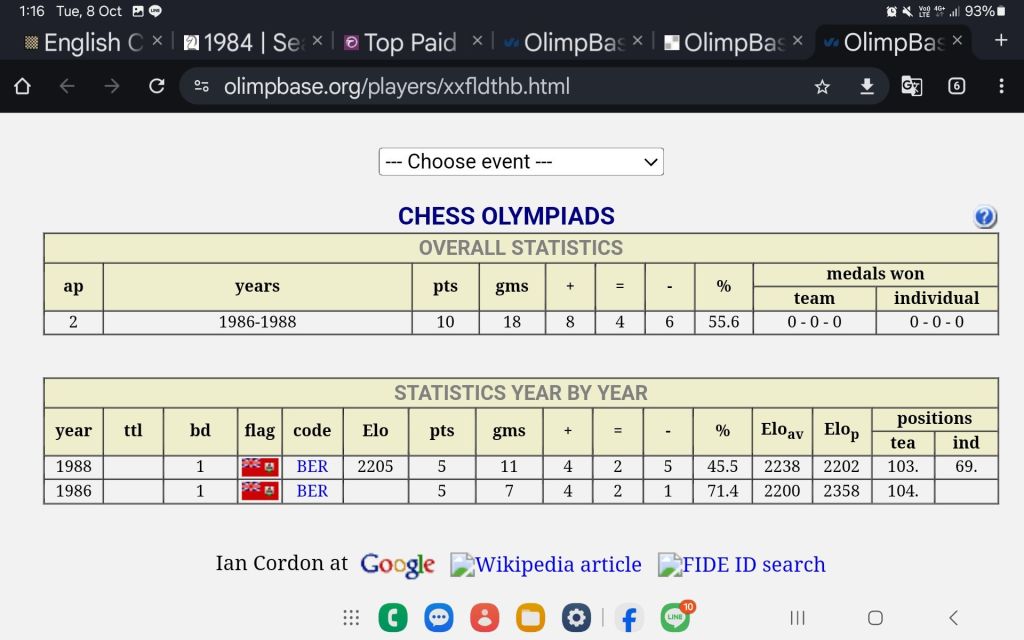
Second was Ian Cordon from Kempston (Sandy’s son). He played for Bermuda twice.
The third case that never was. In 2004 Nick McBride of Dunstable was selected to play for Jersey but declined.
Former Beds. league players who can be discounted, having not participated in an olympiad.
Is there anyone I have missed? I really don’t think I need to research J. M. Craddock. Anyone else I should look into?
MJM
Posted in History of Bedfordshire Chess | Leave a Comment »
Has anyone from Bedfordshire ever participated at an Olympiad? Yes but perhaps only one, a certain Ian Cordon (son of Sandy Cordon). Details have been found from looking through previously posted content, which can also be found below.
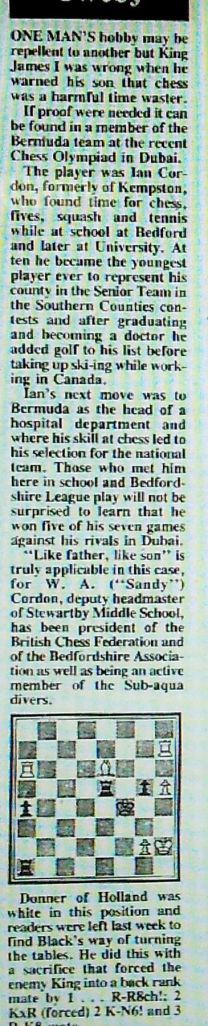
And can be verified here via team results: https://www.olimpbase.org/1986/1986ber.html
MJM
Posted in History of Bedfordshire Chess | Leave a Comment »
“The experience of art is exemplary in its provision of truths that are inaccessible by scientific methods, and this experience is projected to the whole domain of human sciences.” Gadamer
As an undergraduate in Philosophy, I once took part in the Erasmus programme, where students spent a semester at a designated university of their choosing somewhere in Western Europe -and got paid to do it also! I chose Turku University, Finland in the rainy Autumn of 96.

There, I took book exams (one of which was on Plato’s Republic), lectures and seminars too, mostly on the Philosophy of Science, principally focusing on the text below.
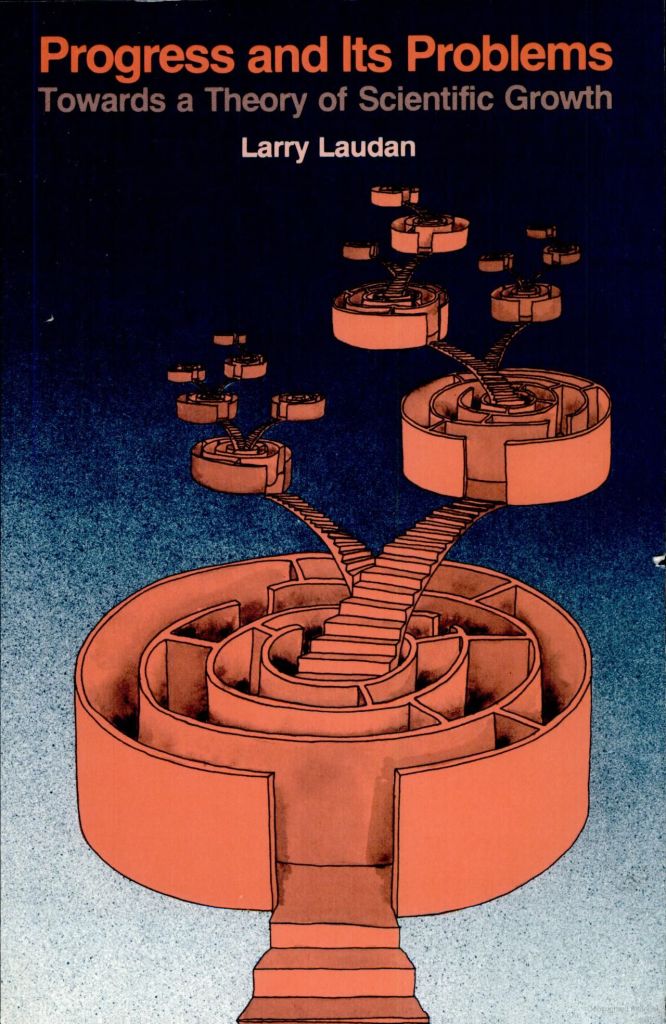
It was a very good read with an interesting title that helped no end that dull grey morning I had to give a presentation on logical posivitism to my class, as my friend Markko watched on with interest. Progress and its problems. Hmm…
It could be argued the modern chess world has much progress and it, too, is not without its problems. For computerization, and the reliance on it, has created a culture of suspicion which reaches beyond you not being allowed to use electronic devices during your game. In fact anything that allows you to store information is expressly forbidden nowadays. This includes objects that were never seen as a problem for decades.
You aren’t allowed to write your move down before you play it now as this can be interpreted as taking notes. Also, you are not allowed to use a scorebook anymore as they may contain notes from previous games which may assist you.


So no more scorebooks then. I had many from the early 1990s as I always used them and never dreamed of using them to look at pre-existing games during play. No one ever did but in the current climate, this is not acceptable. Scorebooks just aren’t allowed anymore. End of story. Don’t ever mention that hardly anyone cheats ever, or anything like that. It won’t do you any good. Supposedly borne in mind here is the greater good and it is that what counts…or so I’ve been told.
I used to enjoy studying the hermeneutics of suspicion immensely as I was something of a Nietzschean back in the day. But I must say it is somewhat saddening that so much suspicion exists in chess today. Quite unnecessary if you ask me. But given that chess doesn’t exactly pass as an academic discipline and languishes in and amongst the netherworlds of intellectual pursuits instead.
MJM
Posted in Life beyond the chess board | Leave a Comment »
Not me at my best but how often do you get to deliver checkmate with underpromotion? Which I might add was due to my opponent generously allowing me counterplay and failing to identify a threat in the position.
MJM
Posted in My Own Games | Leave a Comment »
Determining whether a sacrifice is sound or not is never easy but it is generally accepted that greek gift sacrifices usually are not. So I accepted rather than decline and came under the kosh but hung on in there as my opponent allowed me to simplify all too easily.
MJM
Posted in My Own Games | Leave a Comment »
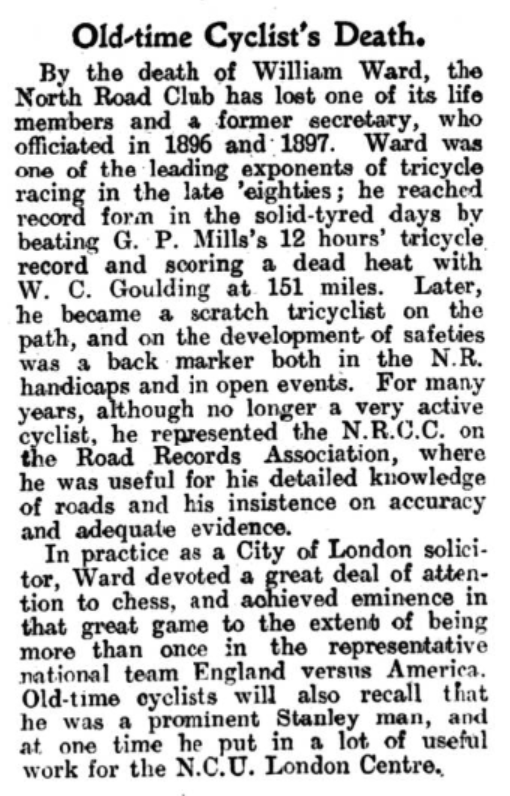
I have written about the once famed amateur William Ward many times on this site because he was the first player to represent Luton who went on to make a name for himself. Having done further research it has become clear that Ward was established as a player in London before his documented appearances for Luton in 1896 & 1897. They were at best cameos, most likely he still had family in the area and retained his attachments. The reportage below show he had commitments in London during those years.
We have been been able to establish that by profession he was a solicitor. But information about his life outside chess and the circumstances concerning his death have remained unestablished until very recently. I am indebted to the individuals on the English Chess Forum who have taken up a thread I started almost ten years ago and have long since forgotten about! Please see below.

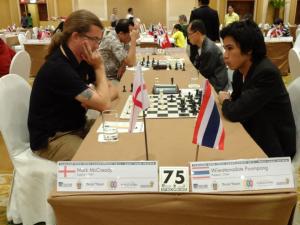
Mark. J. McCready, Bangkok
Posted in History of Bedfordshire Chess | Leave a Comment »
I am re-reading Eales’s: Chess the History of a game, as chess history is supposedly my thing, and I did accidentally throw the thing away four years ago 😦 . New copy came through the post before the woeful summer commenced!
The first paragraph of the preface is as follows:
A history of chess is firstly a history of chess players, and as such I hope it will interest modern players who realize that in taking up the game, they are entering on a rich inheritance built by their predecessors. But it is also an account of the changing background against which chess has evolved, the forces which have caused it to be sometimes respected and encouraged, sometimes disapproved of, or even made illegal. The long development of chess has led through many different cultures and societies. It has been variously described as a game, a sport, a science or an art. At different times its social appeal has been seen as primary noble, intellectual, or even proletarian. In literature it has served as a metaphor, for order through its ranking of distinctive pieces. For these reasons I hope the book will also interest those who do not play chess well (or at all), because it deals with many important historical issues, though from an unfamiliar point of view.
pg. 9
I have to say, as something of an admirer, what does the final clause in the final sentence mean? ‘…an unfamiliar point of view’? probably that it is based on discourse. I may be wrong but some explanation would have helped.
Posted in Quaint Chess History | Leave a Comment »
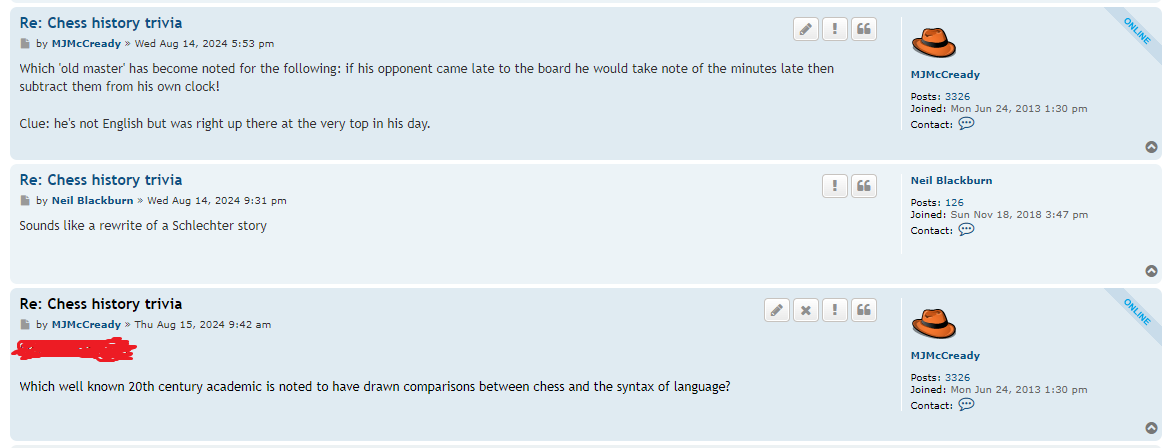
Here’s two more questions from myself, which you may or may not get.
Posted in On-line journal | Leave a Comment »
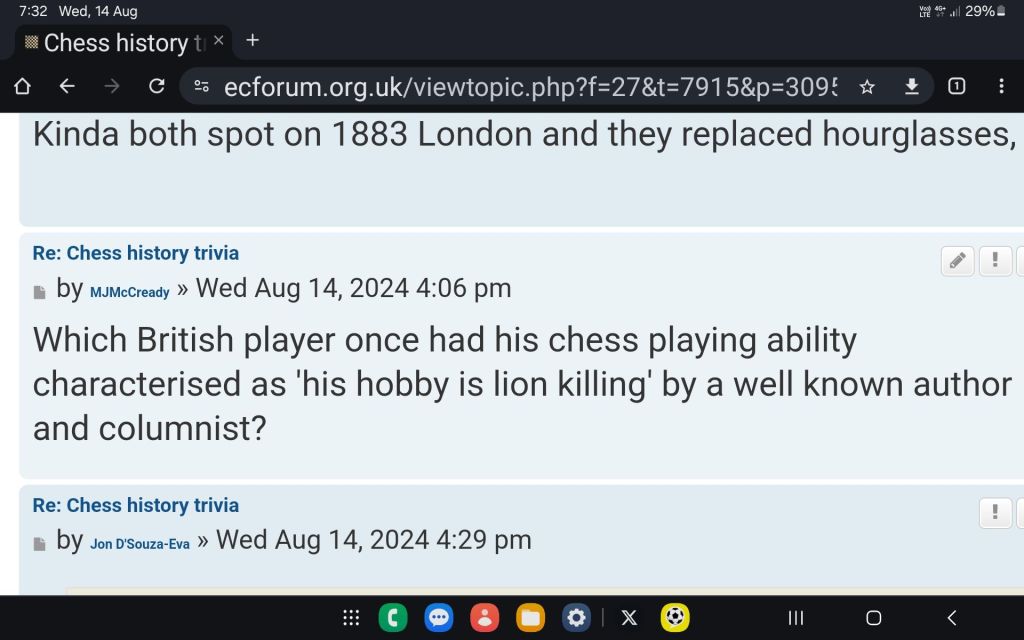
Here’s the latest, can you answer it?
Posted in On-line journal | Leave a Comment »
| M | T | W | T | F | S | S |
|---|---|---|---|---|---|---|
| 1 | 2 | 3 | 4 | 5 | ||
| 6 | 7 | 8 | 9 | 10 | 11 | 12 |
| 13 | 14 | 15 | 16 | 17 | 18 | 19 |
| 20 | 21 | 22 | 23 | 24 | 25 | 26 |
| 27 | 28 | 29 | 30 | |||
A side note on how to read old Tom Sweby's columns
Not perhaps, but quintessentially, Old Tom Sweby is best thought of as a passionate devotee to the newspapers he wrote for. He was well read and knowledgeable of the Bedfordshire chess scene and well beyond, given that he was the president of the S.C.C.U. once upon a time. He was generally well-respected and rubbed shoulders with many, if not all, of those eminent within British chess circles. It would, however, be a critical mistake to see his column is primary source material entirely. That it is not. You will also find secondary source material quoted too, and the reliability of that is not quite as Tom hoped. Given that he wrote for decades, this is to some degree inevitable, and after all we are all prone to error whether we realize it or not. Thankfully, with regards to old Tom Sweby, they are infrequent and for the most part old Tom continued to document events and developments in the Bedfordshire league from the get go as best he could but, of course, everything lies open to interpretation. Despite this, and generally speaking. this does indeed make him informative and thus worth reading. Dare I say his columns constitute a narrative describing the latest developments, match reports and changing nature of the Beds league...he knew his audience and wrote according. This manifested itself over decades but brevity was always in play courtesy of the restictions imposed by writing a column. Should you wish to read a in instrumental figure of the Beds' league post WW2, you are quite welcome to peruse what has been posted here... . :-) I should, however, point out that as the decades wore on he gradually moved on away from narratives concerning the Bedfordshire league towards affairs both historical and international. The reasons for this are multifarous, old age was a predominante factor presumably, however, the bottom line is with regards to how the Bedfordshire chess scene developed post WW2: old Tom Sweby is your go to guy. He wrote more about chess in Bedforshire than anyone else did but given he was a Lutonian and writing for a Luton newspaper there is both bias and greater coverage of his hometown than the rest of the county.
















To add comments, please see the bell at the top of the page.
 McCreadyandChess