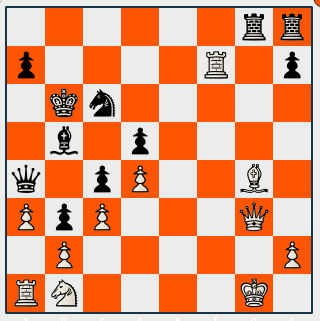
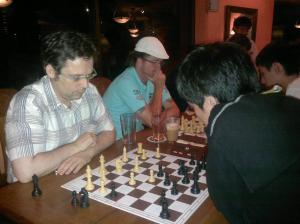
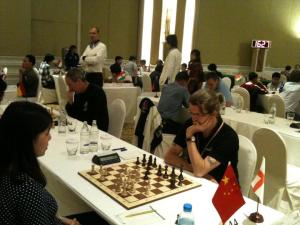
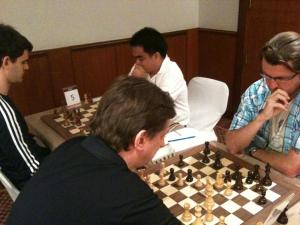
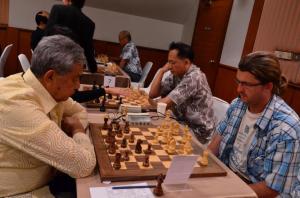
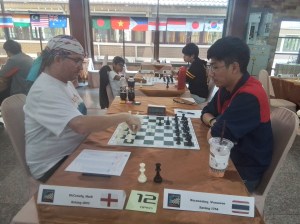
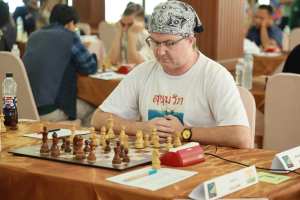
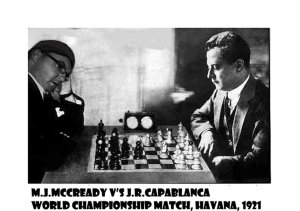
Not me at my best but how often do you get to deliver checkmate with underpromotion? Which I might add was due to my opponent generously allowing me counterplay and failing to identify a threat in the position.

MJM

Determining whether a sacrifice is sound or not is never easy but it is generally accepted that greek gift sacrifices usually are not. So I accepted rather than decline and came under the kosh but hung on in there as my opponent allowed me to simplify all too easily.

MJM

The missing links

I have written about the once famed amateur William Ward many times on this site because he was the first player to represent Luton who went on to make a name for himself. Having done further research it has become clear that Ward was established as a player in London before his documented appearances for Luton in 1896 & 1897. They were at best cameos, most likely he still had family in the area and retained his attachments. The reportage below show he had commitments in London during those years.

We have been been able to establish that by profession he was a solicitor. But information about his life outside chess and the circumstances concerning his death have remained unestablished until very recently. I am indebted to the individuals on the English Chess Forum who have taken up a thread I started almost ten years ago and have long since forgotten about! Please see below.

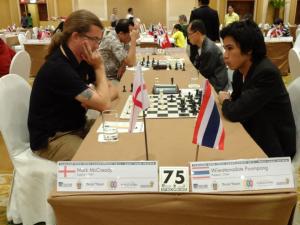
Mark. J. McCready, Bangkok

I am re-reading Eales’s: Chess the History of a game, as chess history is supposedly my thing, and I did accidentally throw the thing away four years ago 😦 . New copy came through the post before the woeful summer commenced!

The first paragraph of the preface is as follows:

A history of chess is firstly a history of chess players, and as such I hope it will interest modern players who realize that in taking up the game, they are entering on a rich inheritance built by their predecessors. But it is also an account of the changing background against which chess has evolved, the forces which have caused it to be sometimes respected and encouraged, sometimes disapproved of, or even made illegal. The long development of chess has led through many different cultures and societies. It has been variously described as a game, a sport, a science or an art. At different times its social appeal has been seen as primary noble, intellectual, or even proletarian. In literature it has served as a metaphor, for order through its ranking of distinctive pieces. For these reasons I hope the book will also interest those who do not play chess well (or at all), because it deals with many important historical issues, though from an unfamiliar point of view.

pg. 9

I have to say, as something of an admirer, what does the final clause in the final sentence mean? ‘…an unfamiliar point of view’? probably that it is based on discourse. I may be wrong but some explanation would have helped.

Here’s two more questions from myself, which you may or may not get.

Here’s the latest, can you answer it?

Although I have oftentimes told myself not to write if I have nothing to say, there are exceptions because the principle reason for writing is not to be read but enjoy the process per se.

I’m writing because I have, to some degree, lost touch with chess this summer. The amount of chess we have in our lives never is constant due to circumstance or other matters foreseen and unforeseen. In writing this I have decided, that I should address this matter and have more chess in my life, and start taking note of current affairs, and so on -keep more in touch with things if you will. It’s sometimes helpful to ask do I have too much or too little chess in your life as it may change without you noticing -just my opinion.

The good news is over the summer I talked myself into larger projects, firstly that I should write a history of Bedfordshire chess, then after that was dismissed, that I should write an essay on the history of chess in Luton. Prompted because the person doing a cracking job of running Luton chess club currently asked me if I could write a short history for something or other. I did that but its not really my thing, so an extensive -that may not be the right word- a fuller account will be written. So at least some, correction -one good thing has emerged. This helps counterbalance the missed opportunities to play OTB that have passed, as I did not visit the chess club so much. I stayed true with my intentions to remove classical chess from the agenda, and as it so happens the tournament I refused to participate in was cancelled anyway… .

It would have been nicer to have made more effort to read the two books I recently ordered, especially since they are both well-written. Never mind, plenty of time for that still. It would also have been great if I had checked if any one day tournaments were held over the summer. Again I didn’t that, as mentioned, chess took a backseat over the summer if you like. I did play on line but not so much, and most likely matters will continue in a similar vain. To some degree this was tied to a failed attempt to establish the etymology of the term stalemate, which I did not get far with even I have sufficient material currently at my disposal…ah well some things are harder than they seem sometimes.

So as it stands for the rest of the year I will have to conduct further research. There is always work to be done, and helping improve upon the periods that I am less certain of is, perhaps, a necessity. Other than that all I can add is that the history presented will be in the form of post-modernism -of that I am certain.

Little else to say except it would have been nicer not to have drunk alcohol when I did play at the club, since its the sense of occasion rather than improvement that matters most, and since when did alcohol help with such matters bloody drunkard .

So there you have it. Later in the month I shall begin research again with the eventuality being an essay on the history of chess in Luton, probably something around the 10,000 word mark. And if that’s not boring enough, you can follow the updates on what was Twitter and is now X.

I can’t really add more than that, it has been a quiet few months and I have something to do of which I am passionate about to be getting on with. How drawn into correcting the co-authors of Chess in Bedfordshire I will get is hard to be certain of but hopefully the reaction to the final product won’t be in line with theirs; namely, that the author (s) should be tied up and shot against a post. Or put differently the subject will be covered more extensively, half the bloody county was left out thus more wholesome in the narrative offered -which is all you are getting! And just perhaps the most recent attempt at research had its minor frustrations here and there due to traces of the past not being entirely compatible with the intentions of old Tom Sweby, whom I have come to know more so than before, as he remained the primary source. I am a little sad to say I don’t have a great deal of material to work with, as you might expect, but this is not necessarily a problem, depending on how you define history, there isn’t a great amount of reportage I can use as traces of the past but I will do my best nonetheless.

To conclude, I decided to abandon all attempts to improve on Chess in Bedfordshire as I don’t have enough material and don’t feel capable of it, The smaller project of a history of chess in Luton is what it will be. Perhaps, just perhaps, I do enjoy writing about chess than actually playing it, in which case, the next few months should be productive…well hopefully so. I ought to remember to thank Humuyan (the organizer of Luton chess club( for putting good ideas in my head and wonder less why I couldn’t have thought about it myself.

Editor’s note: answer to that coming within the next 50 years -that’s a promise!

Webmaster’s note: going to live to 100 am I? You sure?

I shall sign off here, sometimes I just like to write.

Mark. J. McCready
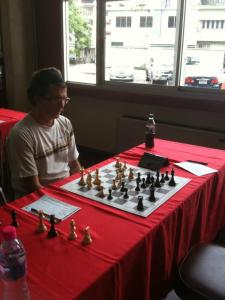
BKK

If you are ever taught by a GM, you will learn quickly that you should not make mistakes in the opening, well I was at least… .

this game makes me smile because you don’t normally deliver checkmate barely out of the opening without even moving your queen

especially in the Italian game of all things but it does sometimes happen

enjoy

MJM🙂

On Sunday April 24th, 1988 Luton town centre was quiet indeed because half the town went off to see Luton beat Arsenal in the Littlewoods cup final. I didn’t go. Instead, I entered a Barcley’s bank office next to the Polytechnic college and played a Grandmaster in a simul. Since I’d only being playing competitive chess for three months and he has a 100% record against GM Gary Kasparov, considered by Carlsen to be the greatest player of all time, and also published what was considered to be the best book on the Ruy Lopez for many, many years, which was the opening of our game…erm my chances were rather slim. Nonetheless back then chess was more important than football.

Speed forwards two years and the 1990 world cup was wonderful to watch but I entered a tournament in Hitchin and missed two games on the Sunday (sorry can’t remember which two) but do recall when asked how I got on, I was able to answer I won both my games.

So there you have it, as a teen playing chess took precedence over watching football (and also playing).

Exciting stuff huh?

Brief book recommendation here (allegedly). Only on chapter II but I am well-read enough to spot a read worth its price.

Yes it’s rather outdated. Yes descriptive notation is used. Yes the author ran a column in The New Statesmen for decades. And yes when I created a thread about him, noted authors were generally complimentary towards him.

But as you may know. Not all books on chess are written well and as is true in all fields some are better than others and some are much better than others. The authors style is indeed impressive. Here he makes a rather basic point but expresses it rather eloquently:

‘It is nice enough to enjoy other people’s brilliances, but nicer still to produce one’s own. To derive some aesthetic pleasure from the flights of fancy conjured up on the sixty-four squares is delightful enough when the conjurer is someone else, but the pleasure can be much enhanced by the thrill of creation and the pride of achievement.’

In the following passage the author Heinrich Fraenkel gives you an idea of his playing ability and character :

‘Regarding the topic of blunders the topic is handled quite delicately and written for a broad audience:

‘What about our own? Most of us, surely, have no shortage of them and some (some?) of us may have more than they care to remember. They are wrong for there is nothing like of the past to serve as a useful lesson for the future (ed: most, if not all SGMs will cite that as an integral part of the leasing process. A lesson to never blunder again. That could hardly be expected (please take note this was written before faster time controls were introduced). More likely, it will be a lesson to accept our every future blunder with ever more equanimity.

The only sad point I feel worth drawing attention to is on page 53 where he commits the cardinal sin in the chess literature genre, that being defining chess players as only that. He portrays Botvinnik as the world champion only, rather than a human being and a Soviet citizen. ‘Botvinnik has the rare distinction of having gained and lost and regained such paradise ‘the glory of supreme achievement’ as he put it. Although undeniably true, the tragedy is when you bypass the normative aspects of what something is, you invariably say very little about it. Botvinnik took time out to do a Ph.D, he became an engineer and was well promoted. He was a father too! It was a little saddening to find another characterisation where only their chess was of importance, but then it is replete within chess literature as a genre and has always been. It’s a little saddening when the author clearly has strong writing skills that they don’t write as broadly as they could…but the good news is a more wholesome account of Symslov appears in the following chapter, which we are entitled to dub a reprieve.
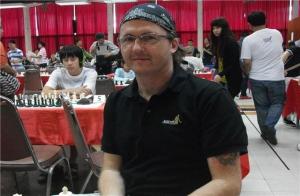
August 15th update

So I read the book. The latter sections contain content I found astonishing. I don’t ever recall seeing someone who is not a native speaker of English write so well with it, I really don’t. Great writer, of that there is no doubt. His stature in his day I am less sure of. His account of Soviet Chess I shall reproduce on this site at a later date.

Well worth a read if you can lay your hands on it.

Mark. J. McCready