When the county first team won the minor section of the national county championships on June 20th 1992, IM Andy Ledger was on board 1 for our county. Courtesy of former team mate and county captain Kevin Williamson, I have procured his game as well as information concerning his opponent. The source can be found here 1, the scoresheet is below, it’s quite an interesting game.

Let’s have a brief overview of a few positions:

We have the Breyer variation with e5 (not the main response).
After 7. …Re8, not your average Caro-Kann position.
Here Andy plays 12. ….Bxf5. There’s no immediate threat since the position is closed but definitely understandable as who would want that Knight to sit there on f5?
18. … Nc3. This lone attacker isn’t likely to win the game but is, perhaps, eyeing up d4 after being shunted from b6.
25. Qf4 played. Quite a complex, imbalanced position. White’s spatial advantage looks promising.
Andy plays 28. … Qh4. I’ve run it through the engines, which assess the position as -2.2, and yes his opponent’s next two moves are computer approved.
After 32. Ng5, the LiChess engine I am using assesses the position as -3.0 and recommends 33, Nc1 (which Andy’s opponent plays)…thankfully white is about to go awry.
Lichess thinks white slipped up with 34. Qf4 and that 34. …Rxh3 secures the draw. Hey presto, a draw by perpetual check is indeed soon to follow.
Draw agreed by perpetual check.
  1. https://www.ecforum.org.uk/viewtopic.php?f=2&t=13950 ↩︎

MJM

“The beast lives unhistorically; for it ‘goes into’ the present, like a number, without leaving any curious remainder.”

― Friedrich Nietzsche, On the advantage and disadvantage of history for life

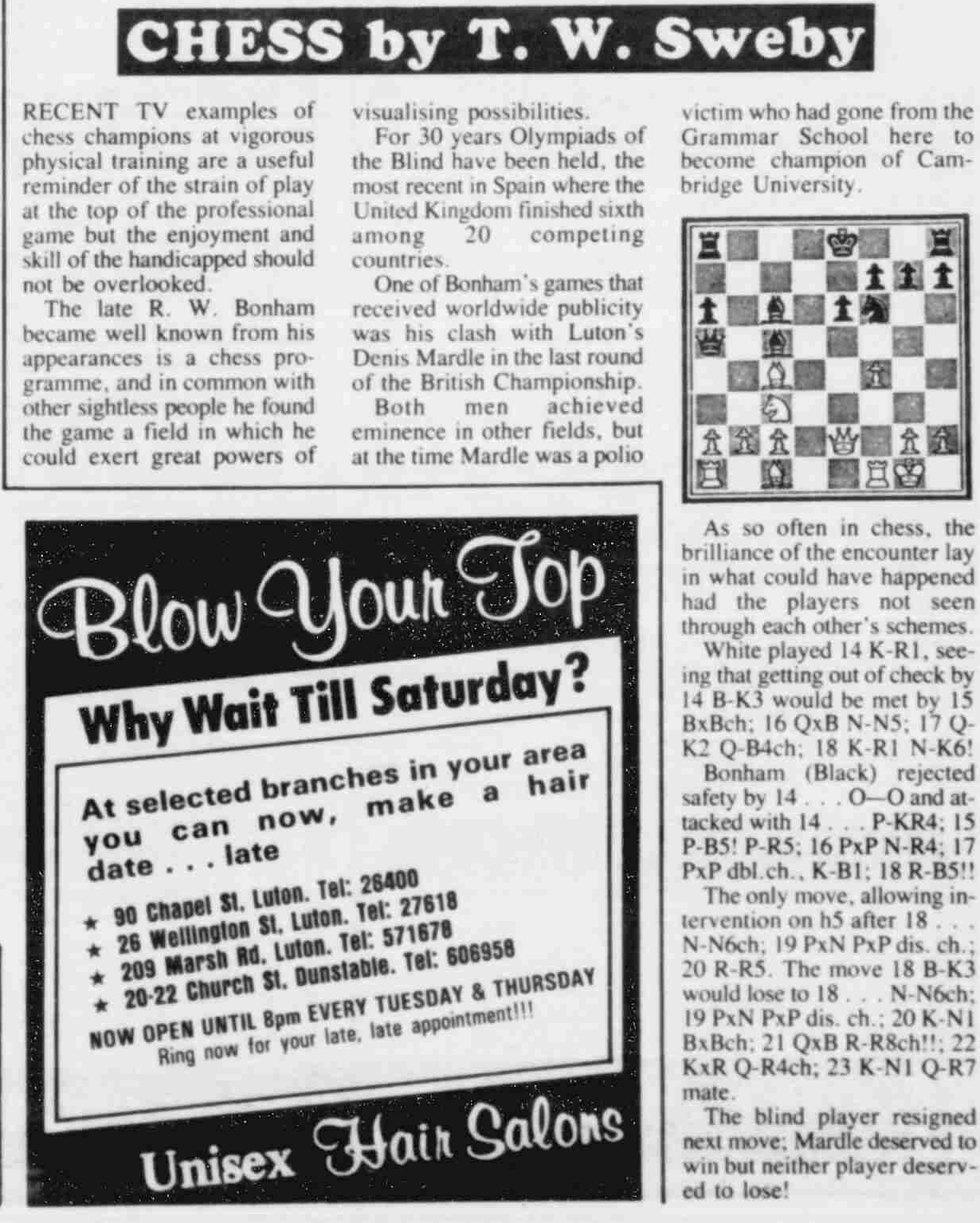
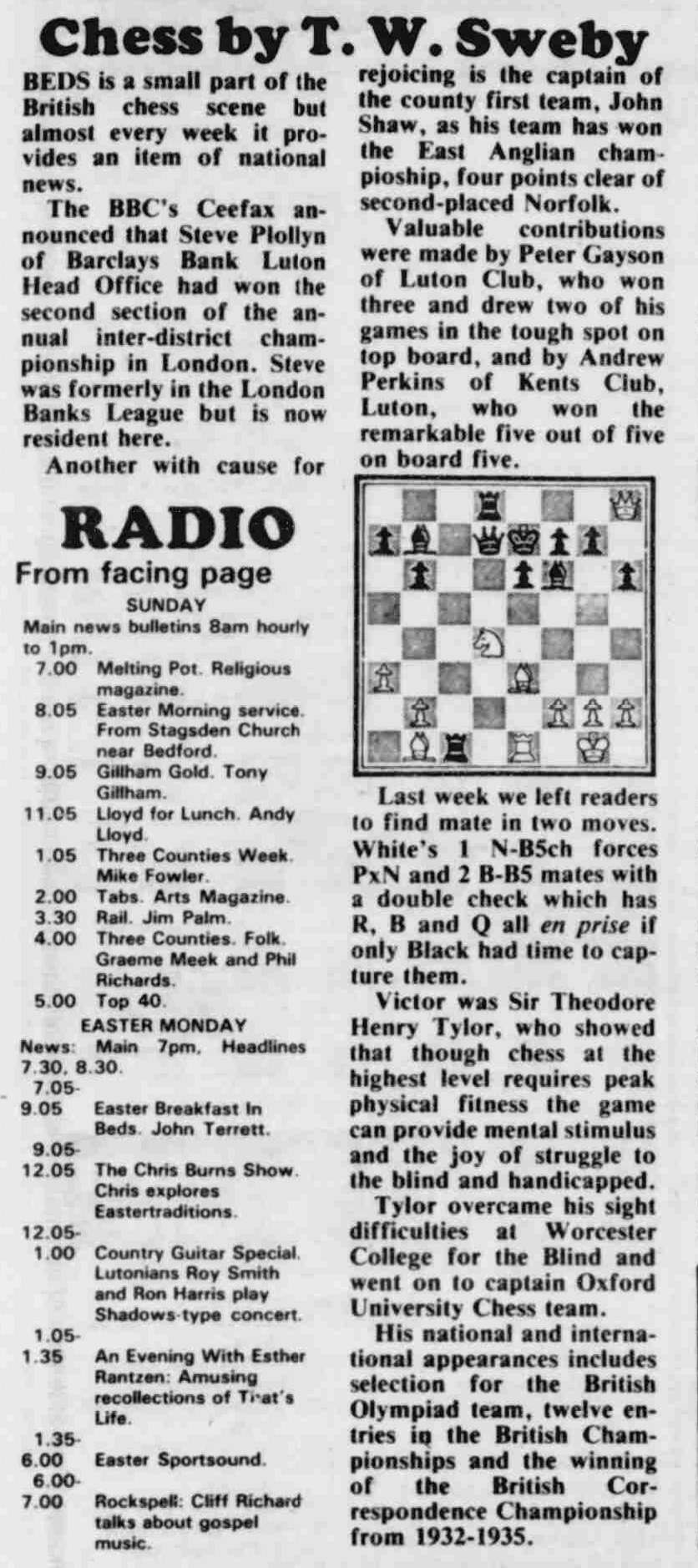
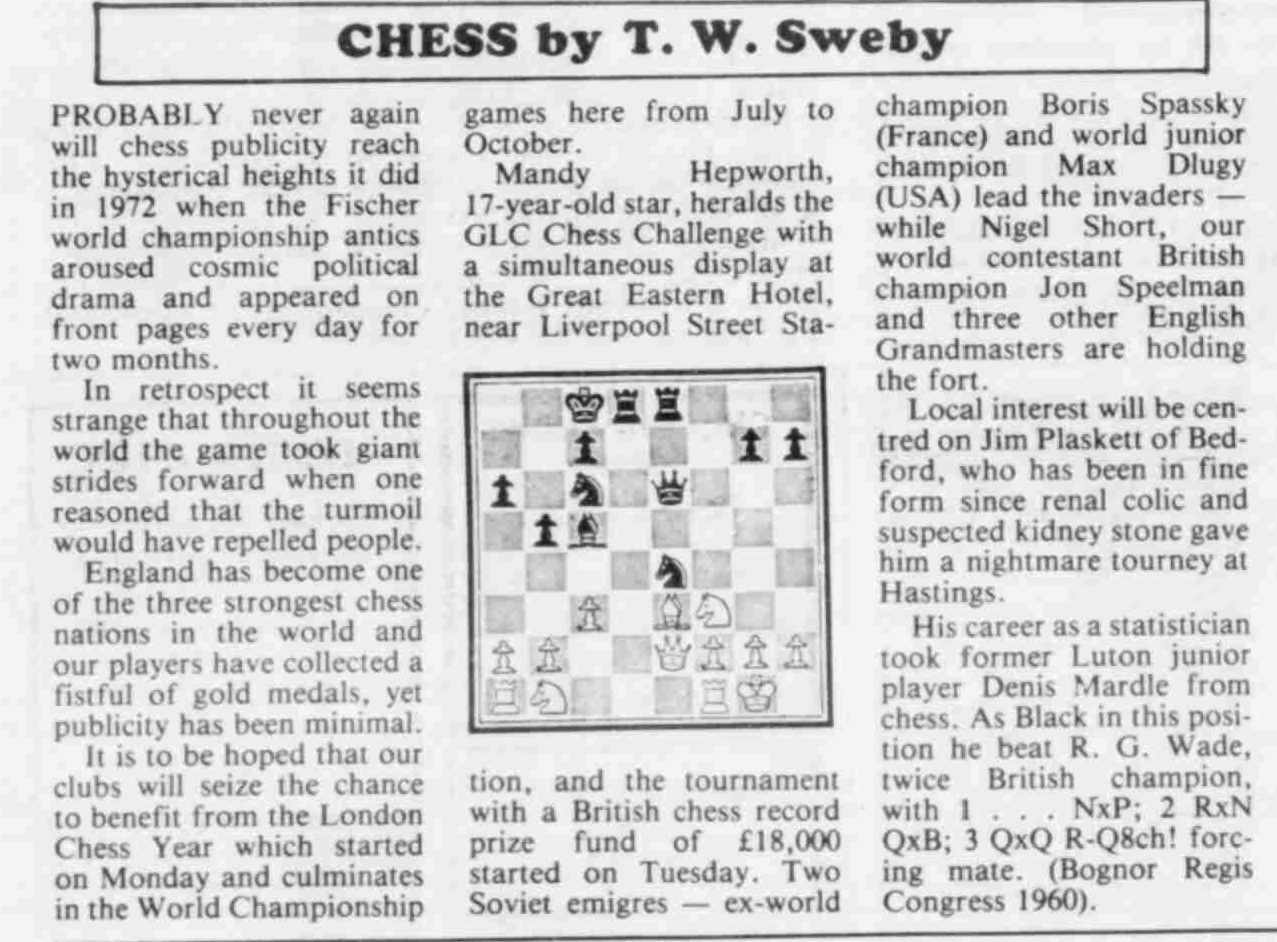
Old Tom Sweby’s former playing partner, friend, and team mate Dennis Victor Mardle, was the first from Bedfordshire to represent England, and the only from Luton. Even though William Ward, who participated in the (1896-1911) Anglo-American cable matches numerous times did indeed play for Luton before moving to London, he is in fact from Abotts Langley, Hertfordshire.

Once again I am indebted to John Saunders and his excellent site Britbase for the latest discovery, and indeed it does appear that on the back of Mardle’s success on the circuit in 59, come late October, he was asked to step up to the mark and play for England in a match against the Dutch, please see below:

You may find the link here 1. Please note that Dennis Mardle is well documented on this site and for further information, please follow the instructions below.

Go to Categories on the right-hand side of the site, select the option highlighted below:

  1. https://www.saund.co.uk/pdf.js/web/viewer.html?file=../../britbase/pdfs/ned-eng-matchrecord.pdf ↩︎

MJM

Past his prime, but not by much in terms of his results, Mr. William Ward (previously of Luton) has had his 1911 City of London Championship success, his sixth at that club, documented on the glorious website Britbase, you can find the exact page here1. For those of you who do not know who he was, please look to the right of my site, click on Category History of Bedfordshire Chess on my site (see below: highlighted option).

  1. https://www.saund.co.uk/britbase/pgn/191011cityoflondon-viewer.html ↩︎

MJM

If, like thyself, you’ve put your back into reading up on all that past, across days, weeks’, bank holiday week ends and months woven together, pat yourself on the back, sit yourself back down, and have a cup of tea, just ad milk and 1-2 sugars.

As a first year undergraduate writing away in leafy Hertfodshire, the two modules I took for history 15/16th century English history and the Industrial Revolution -both well worthy of study for this unbiased Brit with nothing better to do anyway.

My lecturer used to makes jokes about our industrial revolution, one was him going back in time asking people who it’s like to through the industrial revolution, with one answer being ‘oh are we, I thought we just sold more stuff’!

Back in the hallowed antiquities in the 1990s, where governance in the UK went into slow decline, everyone watched The Spice Girls and Mr.Blobby: unspeakable acts of crime were committed at my chess club in a manner that was as perfunctory as it was unforgiveable.

The 90s was not a digital era as such, clubs that had records kept them on paper. It was all paper back then. All our league tables, match cards, team lists, and rating lists were sent to the lockers in the football club’s changing room, then some months later lobbed out. Makes your spine chill doesn’t it?

In our modern age everything is digital and exists in the form of data. It doesn’t get lost.

It’s very saddening to think back to those evenings where match results were thrown out. No historian would do that. Instead they would classify them as primary source material, most likely they would remain covered. It was a great shame that our president Ken Liddle saw them as taking up space and to be slung out.

We value data and information much more now, which in turn means we are compelled to think of the 90s as depressing, from a historical perspective. Sadly the question of who a game scoresheet belong to in the modern game is a complex one, and to some degree, debatable.

Note to self: If you are interested in playing through the 496 competitive matches you wrote scoresheets for, erm, maybe not go up into loft and chuck the lot out -bloody hypocrite!

Drive

As the shy teenager I was, I so loved how after dusk fell I was driven to league matches along dark country roads. What a wonderful way to explore Bedfordshire, Buckinghamshire, and Northamptonshire in your youth. A supressed excitement in seeing small towns and cities such as Bedford, Leighton Buzzard, Cranfield, Milton Keynes, and Northampton kept me wide-eyed always. Those dark A-roads and narrow country lanes, that amber street lighting, the knowledgeable teammates who drove me to the venue, their respectful inquisitiveness and oh-so careful driving, the sensation of parking up. Entering the building and readying yourself for your game, the shake of the hand…game on… .

A brave new world where a long game of competitive chess was the light at the end of the tunnel. Then, a drive home where we could converse about our games and indulge in more general chess conversation. Once Ken Grogan picked myself and Marcus Dunne up for a match. On the way home I asked Ken ‘Is it difficult to concentrate on driving after your match?‘ Marcus interjected, ‘that’s a good question’, I was only 16. What should I know about driving, I wasn’t even old enough to get behind the wheel!

Through chess I learnt the importance of travel and how it broadened your horizons. It was -if you like- a perpetual night out. A ride away from the drudgery and monotony of daily life into the endless evening ahead. No one in my family took me anywhere ever, except to clinics, surgeries and hospitals. But where they stepped back, team mates stepped forwards.

It is the sense of occasion that chess offers which appeals the most. Chess is a game of calculation. We cannot follow our game thoughts so easily afterwards but mood we may remember still, especially mood both before and after the game. Those sentiments are not so easily lost and may stay with us five decades on, as mine have. The drive to the game. Those dark roads. The game play. The journey home. The companionship en route. The occasion and all it has to offer.

Mark John McCready, 0700, February 19th 2024, Al-Fursan, Dammam, KSA

We played on the same team on 87 (Luton A), and were members of the same club in its final year, so let’s see if Board 1 can beat Board 4! (most probably!)

Game on

1. e4 c5. We start with a Sicilian because it offers more counterplay than the French, which I grew rather tired of as the years rolled on by.

2. Nf3 e6 3. d4 cxd4 4. Nxd4 Nc6 5. Nc3 Nf6 (note to self: try to remember the correct bloody move order next time please!). Uppsala! Having not played one single game in 8 months, I simply forgot 5. …a6 or 5. …Qc7 are the most playable responses that avoid transposing towards the deluge of open Sicilian theory -clumsy.

6. Ndb5 d6 (almost a necessity and frighteningly transpositional!)

7. Bf4 e5 8. Bg5 a6 9. Na3 b5 10. Nd5 Be7

We have transposed into the Sveshnikov but that’s quite alright as I played it for a few years and read up on it too! But as GM Rowson once said ‘the Sveshnikov is full of holes’. They can appear on both flanks, some caution is needed.

11. Bxf6 Bxf6 12. c4

Yoicks, not the main move, so now I am out of book. Although 12. …Qa5 may look tempting, its not at all, its premature. Black has threats to attend to before any counterattacking ideas can be put into play. I could lose the exchange or a pawn easily if I am not careful. So the plan is to shut things down and shore things up, that way the position should stay in tact – hopefully should! I can’t really tell because I am out of book already, so will stick to the few opening principals I learnt some ten years ago.

12. …b4 (let’s shut things down) 13. Nc2 a5 (and shore things up) 14. Qf3! I chose exclamation mark because I’ve never seen that move before and don’t know why it’s played. Here I play 14. …Be6 because usually the light-squared bishop goes to either e6 or b7 and I never worked out why the latter was the preferable option so, once again, I stuck it on e6, and also because I couldn’t work out what else to do, so blindly follow opening theory and principles I shall but this is really just about as far as I can go, I’m pretty much on my own from now on. I know I may get double f-pawns but that’s okay, all it means is the king should stay in the centre, and that’s okay, its quite safe there with the bishop on e6.

15. Nxf6 (from what I understand this is thematic as black usually ends up with doubled f-pawns)

15. … Qxf6. I spent around 5 minutes thinking about this. In principle, white’s remaining knight is heading to d5, so why would I want to put my queen on f6? I played it because the white queen is on f3, and unless white exchanges, I gain a tempo, which I can lose with, say Qg6, should the knight land on d5. I’m not expecting an exchange of queens.

16. Qxf6 gxf6 17. 0-0-0. Now what do I do?

Much thought required here. Where does the king go? I don’t really want to place it on e7 if a knight can pop into d5. I have to keep my bishop on e6 and exchange off if that happens but if it does, I think my knight is slightly better than white’s bishop as it can stay unchallenged on d4. Do I castle queenside? My rook can gain counterplay on the a-file, do I want to take it off that file?

18. … 0-0-0

Updates to follow

Birthday wishes

A happy 62nd birthday to Damon Gene D’ Cruz, formerly of Challney Boys School and pupil of Tom Sweby as well as Luton Chess club and Bedfordshire County Team.

Damon’s opponent was most likely Donald Curtis, former Welsh champion.

In 2002, Damon took me to St. Albans, to a lecture by Sir Patrick Moore on his birthday.

Happy birthday Damon (now based in Leicestershire)

MJM

Around the hero everything becomes a tragedy; around the demigod everything becomes a satyr-play; and around God everything becomes–what? perhaps a “world”? Nietzsche Beyond Good and Evil 150

Dual purpose intentions in play here; firstly, to challenge the demi-gods of Bedfordshire chess past because they challenge me (only so historically), secondly, to give myself real purpose to play on, to play meaningful chess if you like…

First up, a certain Peter Gayson. Dunstable’s first resident to play board 1 for Bedfordshire since J. M. Craddock 1 lived there one, two and three decades before him. He went on to play for Luton up until the 87/88 season and was board one whilst I played board four or five. ELO rating usually between 2150-2250, with a peak rating of 2281 and if I am not wrong, currently 2117 well so says FIDE. In English money that’s 188 (ECF-188 [2117-700÷7.5=188]). Peter is an FM and currently plays in the 4NCL for White Rose.

Pre-game thoughts? Despite being rubbish at chess, I gunned down an FM in Turku, Finland at the 3 beers pub in the student village -and that’s the only time I have beaten an FM. He was rated 2340 and I beat him with 1. f4 (which he accused of being very drawish after the game, which was his way of saying he like facing it hence his laconic play and overall lack of interest!). Prior to that, I drew with FM Dave Ledger in 93 in Luton. Dave played the King’s Indian Attack against me but didn’t open the position up, ran out of ideas and lost interest in it. Eventually it fizzled out to a draw. No other results against FMs were had. I’m bloody rubbish at chess anyway, so I’ll probably lose.

You may, if you so wish, find the game here, I am black.

https://www.chess.com/game/daily/623139629

And yes the title comes from one of Metallica‘s better songs and yes I wanted to include the line ‘sent here by the chosen one’ but decided against it for what are, perhaps, obvious reasons… .

  1. https://mccreadyandchess.co.uk/2023/12/17/a-stand-out-figure-from-the-50s/ ↩︎

Mark. J. McCready 06.45 February 16th 2024, Al-Fursan, Dammam, KSA.
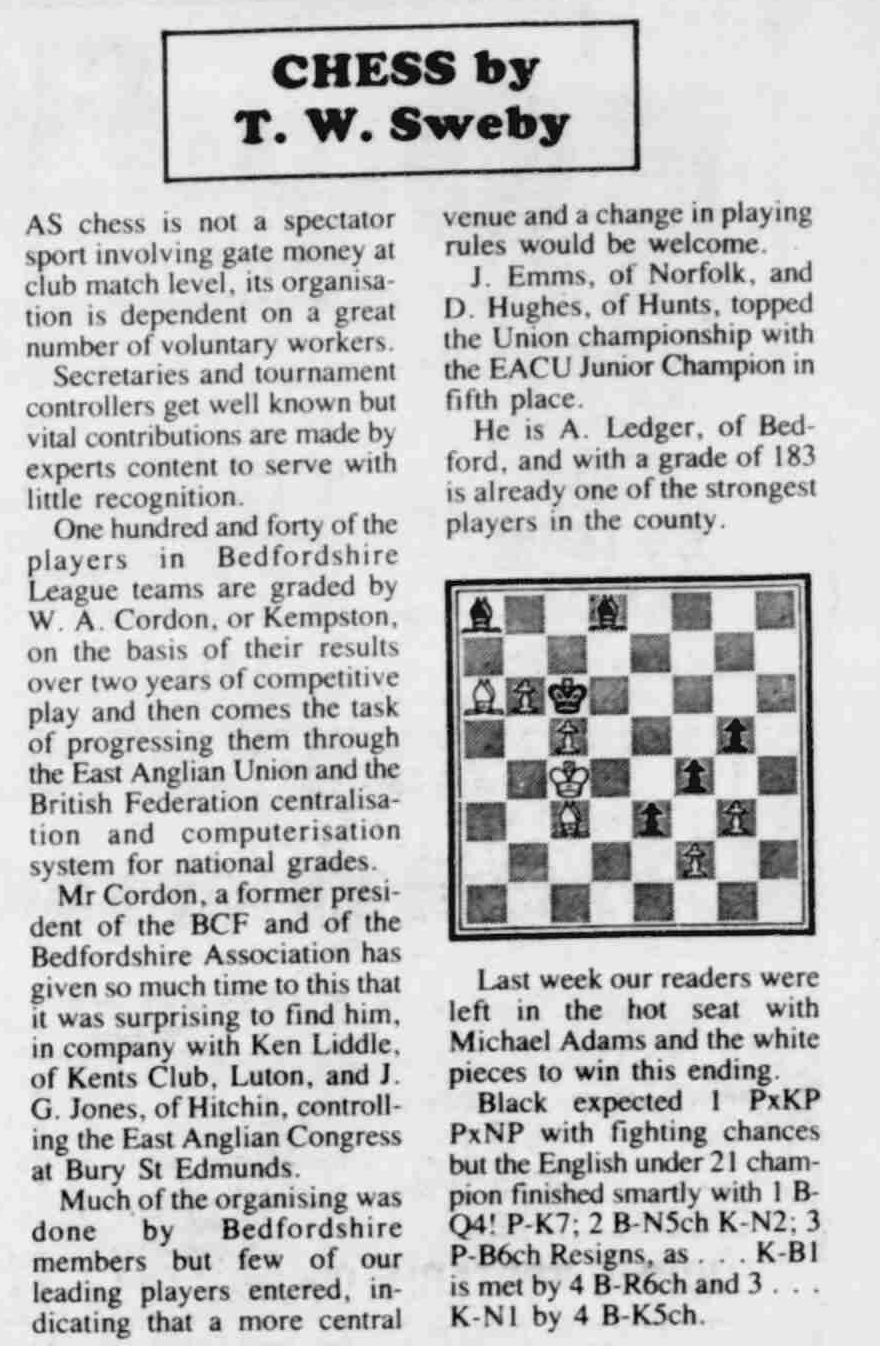
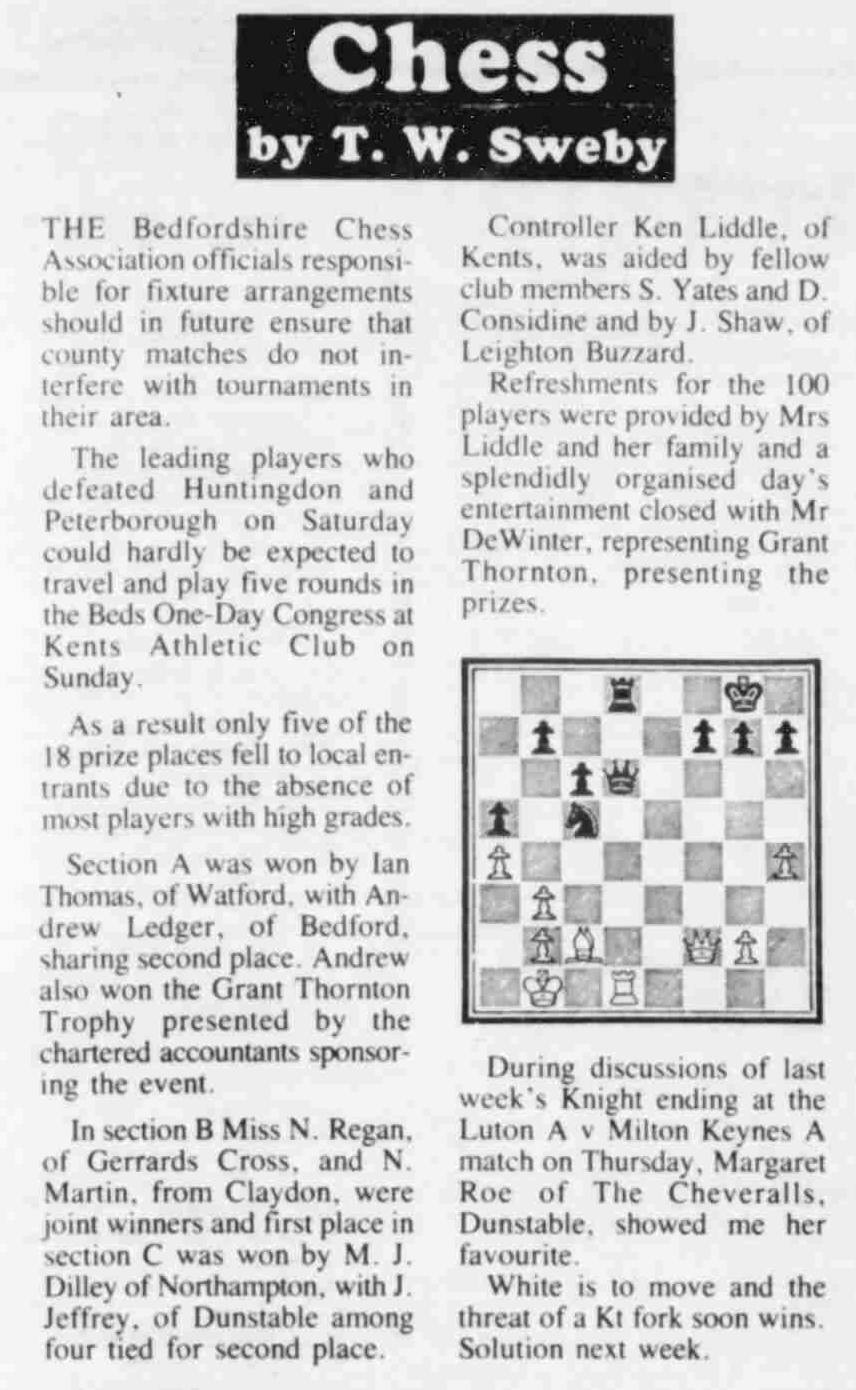
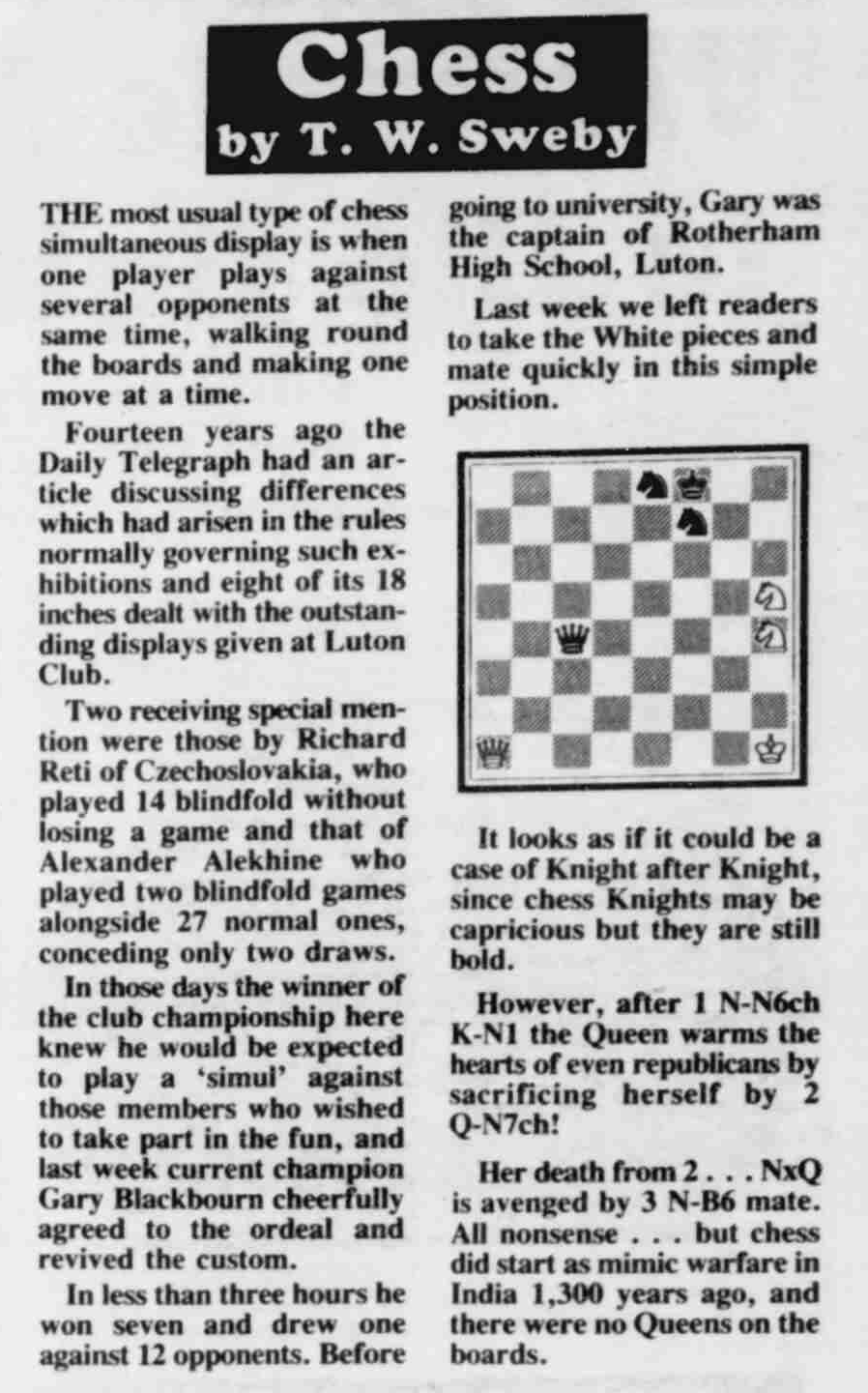
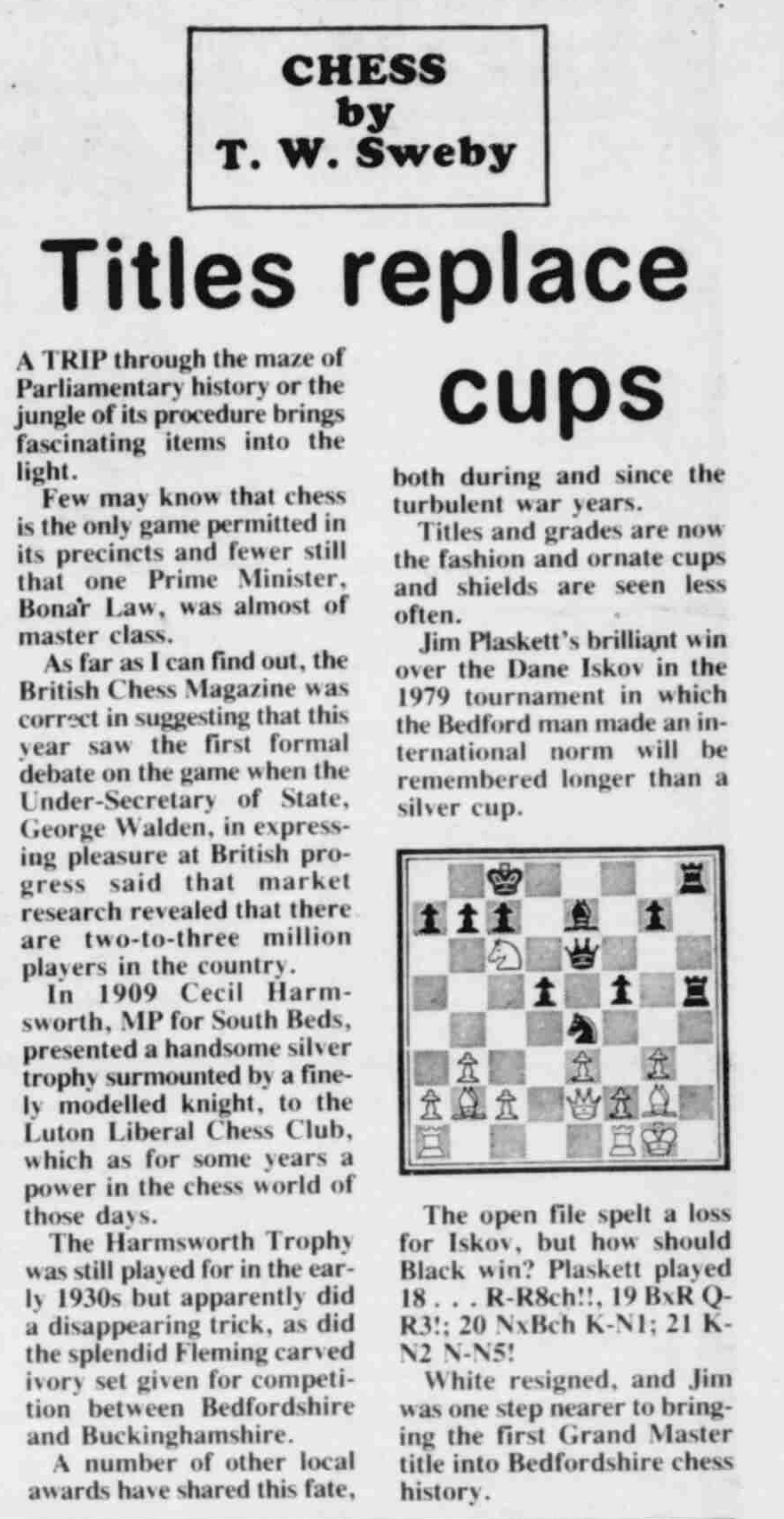
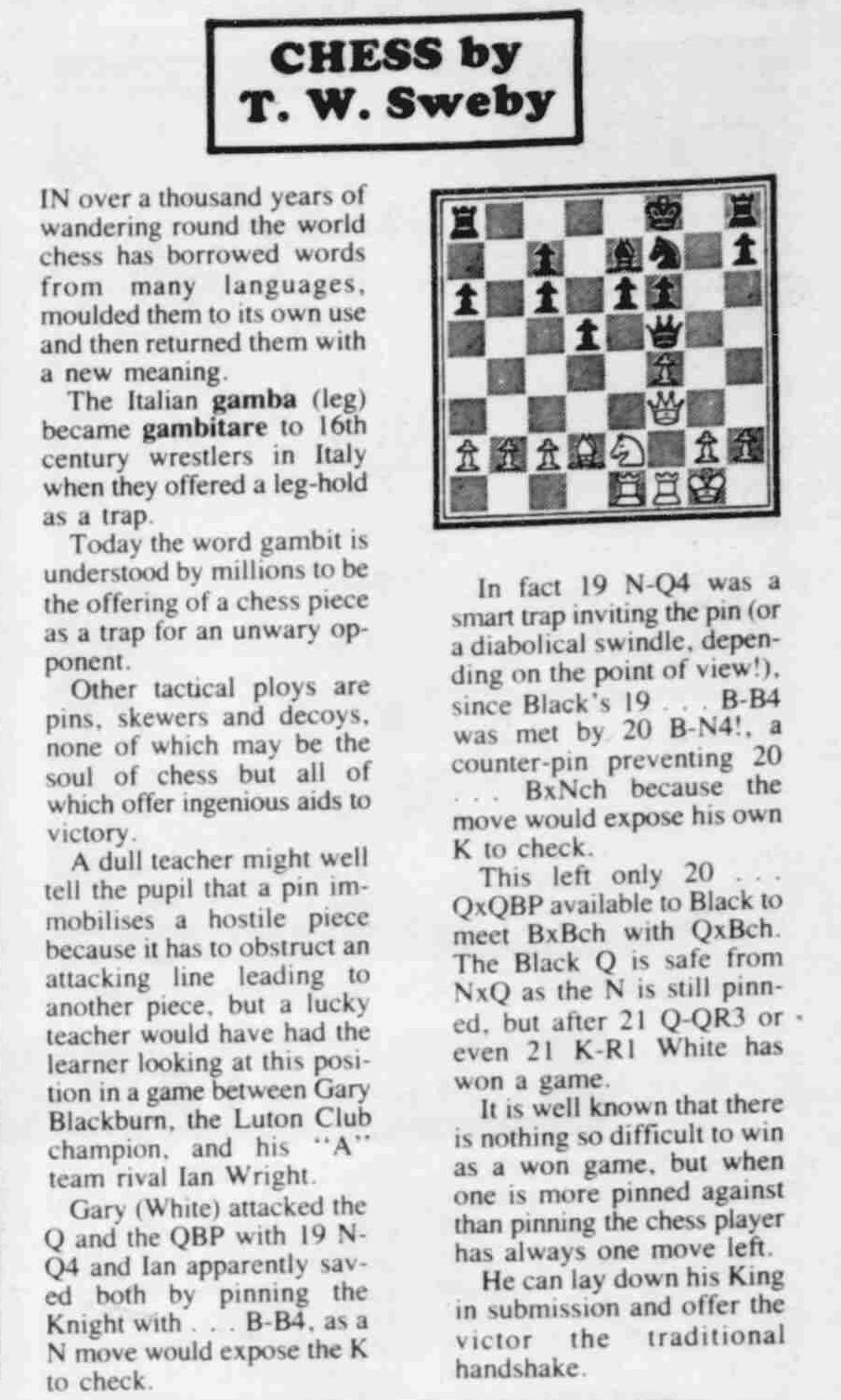
Hard to spot if you ask me.

Alas! Once again stumped I be by a puzzle exemplifying my very own lack of tactical ability -and now I’m apoplectic! What am I to do I ask myself? Just what am I to do? Are ye able to find thy answer? Me nearly, but when several good moves are there, I just cannae find that killer blow.
MJM – – Al Fursan الفرسان