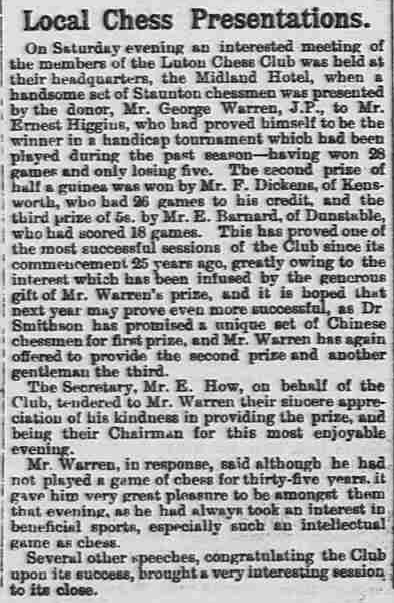
Significant for the records if, and only if, the reportage is correct.

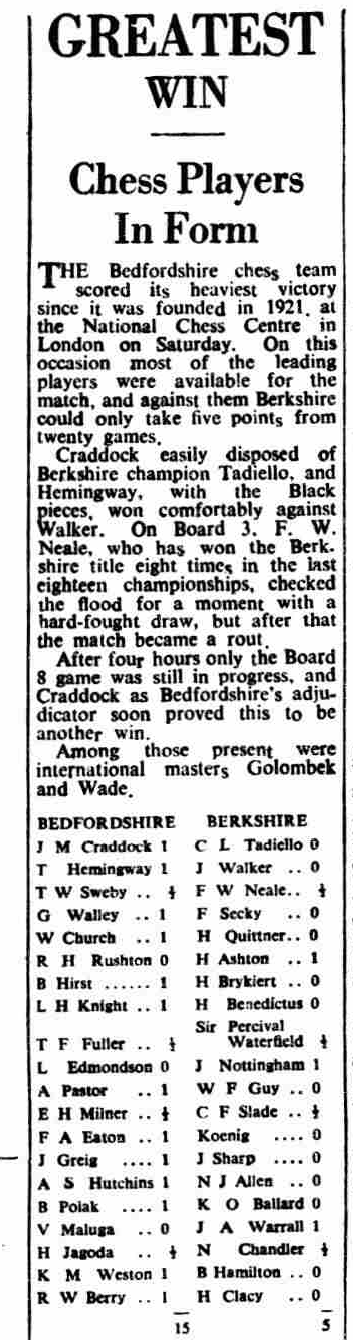
Posted in History of Bedfordshire Chess from 1940-1960 | Leave a Comment »
Courtesy of Tom Sweby, some background information can be found here. Some advice -do not attempt to solve that puzzle!


Also from the oftentimes resourceful English Chess Forum.

MJM
Posted in History of Bedfordshire Chess from 1980-2000 | Leave a Comment »


Please refer to the publication Chess in Bedfordshire (found on this site) for further info concerning Mr. E. How.
MJM
Posted in History of Bedfordshire Chess from 1920-1940 | Leave a Comment »
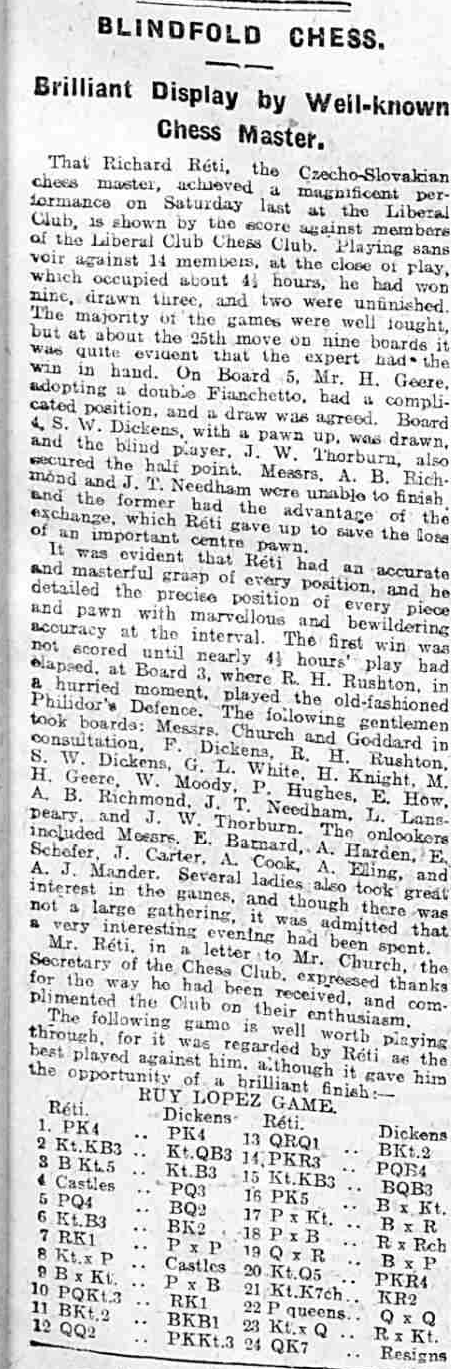
The reasons why one player is chosen over another to perform a simul are multifarious. On Tuesday December 14th 1926, Luton Chess Club invited former Russian Eugene Znosko-Borovosky to the town to perform a simul but why him in particular? Was it related to his publication mentioned in the reportage? Was he much cheaper? Did it concern availability? Was it about reputation? Who else was available? Was it seen as something of a coup? Most likely we will never know, perhaps it was all of the aforementioned combined.


With the information to hand, we cannot discount this as Znosko-Borovosky’s only visit to Luton.


Should it be the case that E. Znosko-Borovosky did return he would not be alone there. In more recent times (88 & 89) GM Chandler did that in Luton too. When further evidence concerning the aforementioned master is found, I shall post it.
MJM
Posted in History of Bedfordshire Chess from 1920-1940 | Leave a Comment »
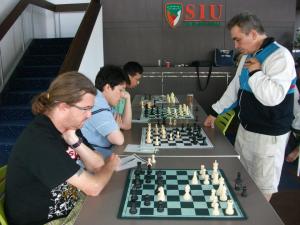
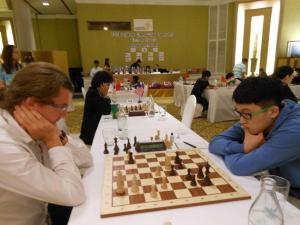
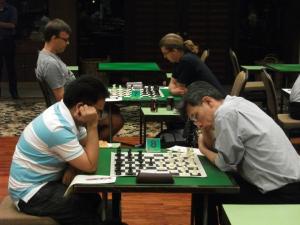
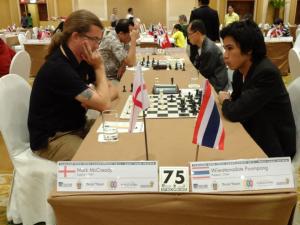
Last month I participated in a classical tournament for the first time in eight years – I didn’t enjoy my chess. It wasn’t a mistake to play because my family enjoyed the experience as a whole -and I was chuffed to see my daughter helping out! Nonetheless, what can we learn from such experiences? What is that one thing, above all else, we should take from chess and apply to life itself? In my humble opinion, it is learning from your mistakes. Okay, so why exactly was it I enjoyed the occasion but not the chess? I shall leave you in the capable hands of GM Speelman.
“…one doesn’t always mind losing, it depends on how you lost. If you played extremely badly you can mind or if its very important but if you are beaten by a very good player in a very good game you mind quite a lot but its not so terrible…”
Grandmaster Clash 16.26 (see previous post)
I agree it is how you lose that matters and not that you lost. I didn’t like being out of practice and being conscious I was playing below par. I didn’t like the sense in which I felt I was letting myself down. I didn’t like seeing carelessness in my play. I didn’t enjoy being out of shape, too rusty, and not really up for it: it wasn’t that I lost, it was how I lost that stopped me from enjoying my chess. Furthermore, I didn’t care for the victories either because once again I felt I was not up to it. Yes I won a prize. A medal and some money but I finished the final game is quickly as I could and left hours before they were awarded. I was done with playing chess like that by then.
Today I saw this:

I have the time. I have the money. I like the city it is hosted in. I will not participate.
The month before there is a tournament in Phuket. I like Phuket. I will not participate.
To reiterate: chess teaches us to learn from our mistakes, and I believe this skill is transferable. I will not endure a repeat of last month this summer. Case closed.
Classical chess is to stay out of reach. A bit of blitz or rapid here and there yes -nothing too serious. That’s it. That’s as far as it goes.
MJM
Posted in My own endeavours | Leave a Comment »
For the longest time, I have believed the greatest documentary ever made on chess was the BBC production Grandmaster Clash. Impartiality aside, that it shoots the English Olympiad conquest of 1988, coupled with it being one of the very first documentaries I ever saw, just may have something to do with it.
Written by Steven Fry, it is very well-produced and makes for great viewing. After searching for well over a decade, and even writing to the BBC to see if they had it in their archives, finally I can link it for you. It’s a well-written, well-directed must watch – no doubt about it.

MJM
Posted in Documentaries | Leave a Comment »

Chess lovers: what is the missing link between The Damned —– and —– Nirvana and how could there be a chess connection? Any ideas? Tough questions huh? Okay let’s make it easier then.
Nirvana. Truly fantastic trio from Seattle (and surrounding areas). Have a listen to this:
———–missing link ———-missing link————missing link ————— missing link ———-missing link————missing link —————missing link ———-missing link————missing link missing link ———-missing link————missing link ————- missing link ———-missing link————missing link —————- missing link ———-missing link————missing link ————– missing link ———-missing link————missing link———missing link ———-missing link————
The Damned. Top notch UK punk outfit. Attention please.
The Damned ‘life goes on‘ —– Killing Joke ‘eighties’ —— Nirvana ‘come as you are’. ‘Come as you are’ was borrowed (for want of a better term, perhaps ripped off lifted is better) from the song ‘eighties’, everyone knows this. But what most people don’t know is that the song ‘eighties’ was borrowed (ripped off lifted) from ‘life goes on’ by The Damned.
So where lies the chess connection? The missing link Killing Joke wrote a song which alludes to chess in the chorus and uses chess metaphors. It’s called ‘Chessboards’ and can be found on their album ‘Brighter than a Thousand Suns’. In my opinion, it is a strong contender for being the best song written about chess ever -truly great chorus! Here it is. Please do have a listen.
Best Nirvana song: Lounge Act
Best Killing Joke song: Euphoria
Best The Damned song: New Rose
Are you converted? In case you don’t know, music is much better than chess.

Mark. J. McCready
Posted in Chess | Leave a Comment »
Before the motorization of vehicles, there is evidence that matches were played at mutually agreed venues, halving journey times. We find William Ward, future champion of London, playing for Luton in such an arranged match. Please see the reportage below.


This is quite an important find as it helps us understand William Ward’s movements between Luton and London better. Not before Feb. 18th 1897 then, but before November 1898? Why was St. Albans chosen? It is important to note that at the tail end of the industrial revolution when rail was made available, most matches were between cities and towns who were connected by it. At the time of the match it was possible to travel to St. Albans by train from both Luton and Watford. As the links below show you trains were up and running from 1868 and 1858 respectively.
https://en.wikipedia.org/wiki/Abbey_Line
https://en.wikipedia.org/wiki/Bedford_railway_station
William Ward has been written about numerous times in this blog. The best post is, I think this. https://mccreadyandchess.wordpress.com/2016/02/12/our-clash-of-future-champions/
Posted in History of Bedfordshire Chess in the 19th century | 1 Comment »
A side note on how to read old Tom Sweby's columns
Not perhaps, but quintessentially, Old Tom Sweby is best thought of as a passionate devotee to the newspapers he wrote for. He was well read and knowledgeable of the Bedfordshire chess scene and well beyond, given that he was the president of the S.C.C.U. once upon a time. He was generally well-respected and rubbed shoulders with many, if not all, of those eminent within British chess circles. It would, however, be a critical mistake to see his column is primary source material entirely. That it is not. You will also find secondary source material quoted too, and the reliability of that is not quite as Tom hoped. Given that he wrote for decades, this is to some degree inevitable, and after all we are all prone to error whether we realize it or not. Thankfully, with regards to old Tom Sweby, they are infrequent and for the most part old Tom continued to document events and developments in the Bedfordshire league from the get go as best he could but, of course, everything lies open to interpretation. Despite this, and generally speaking. this does indeed make him informative and thus worth reading. Dare I say his columns constitute a narrative describing the latest developments, match reports and changing nature of the Beds league...he knew his audience and wrote according. This manifested itself over decades but brevity was always in play courtesy of the restictions imposed by writing a column. Should you wish to read a in instrumental figure of the Beds' league post WW2, you are quite welcome to peruse what has been posted here... . :-) I should, however, point out that as the decades wore on he gradually moved on away from narratives concerning the Bedfordshire league towards affairs both historical and international. The reasons for this are multifarous, old age was a predominante factor presumably, however, the bottom line is with regards to how the Bedfordshire chess scene developed post WW2: old Tom Sweby is your go to guy. He wrote more about chess in Bedforshire than anyone else did but given he was a Lutonian and writing for a Luton newspaper there is both bias and greater coverage of his hometown than the rest of the county.
















To add comments, please see the bell at the top of the page.