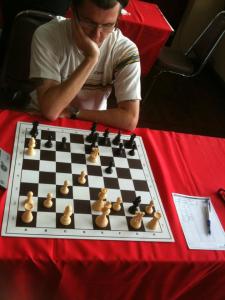
Like all young players growing up with chess, there were many past masters I liked and played through the games of. At 16, Morphy was most certainly the first, the other two I was an awe of most of all being Capablanca and Fischer. But the first player whose edifice of work I laboured over was Nimzowitsch. In retrospect this has become something I lament because in trying to mimic or copy him, which I did to considerable degree, I found myself embroiled in positions too complex for my level, and often too obscure to benefit from also. I liked the obscurity of some of his moves and often found it mystifyingly enthralling. Sadly I confess, in the following position, Nimzowitsch played precisely the sort of move only he played, which in my youth I found most impressive -the writing was on the wall methinks.

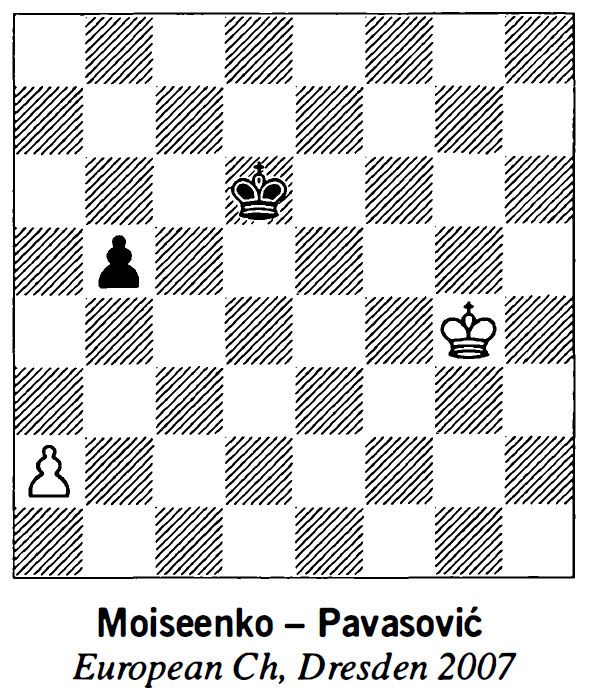
Mannheimer – Nimzowitch, Frakfurt 1930

Here Nimzowitsch plays Qh8!! If you can explain why, I am all ears.

A busy August

“We must learn to reawaken and keep ourselves awake, not by mechanical aids, but by an infinite expectation of the dawn, which does not forsake us even in our soundest sleep. I know of no more encouraging fact than the unquestionable ability of man to elevate his life by a conscious endeavour. It is something to be able to paint a particular picture, or to carve a statue, and so to make a few objects beautiful; but it is far more glorious to carve and paint the very atmosphere and medium through which we look, which morally we can do. To affect the quality of the day, that is the highest of arts.” ― Henry David Thoreau, Walden

Through submission to and admission of how the entrails of normality have been garroted in the months gone by, owing to a pandemic that Chomsky describes as ‘a colossal market failure’, a slow subterranean maneuver has been made.

I’ve followed suit and forgot about chess over the board because it just isn’t happening. Well it is. I mean should I saunter off to Bangkok Chess Club, I can play in a blitz tournament each Friday evening. But at the end of a working week, a tournament with a time control of 3m 2s, just isn’t worth it. I don’t consider that time control as conducive to ability and love of the game but rather a game of he who moves fastest wins. That’s just silly to me, invariably I lose on time and if I win it is at best a pyrrhic victory…it’s not worth the effort frankly. Blitz, to me, is a rather childish way to play chess, I don’t see what there is to be gained from it…

So I transgressed from OTB to on-line via whichever server is up and running. In having abandoned chess theory altogether and relying solely in what I learn from my own games, I would appear to be on the up. And then all of a sudden I realized I love playing on-line, despite it being a depersonalized alternative to what I am used to. I’ve begun to take it seriously and play some very good chess at times.

I went and joined my home town club, which is now established on-line. I went and played for my county and rejoined The English Chess Federation. They’ve invited me to represent ‘the south’ of England in a match against ‘the north. I admit I played for my town, my county and my region as a promising junior but never the part of the country I am from. That’s a first for sure.

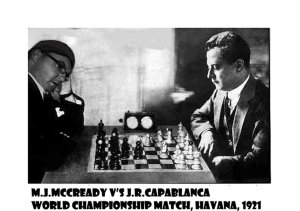
I’m told it’s a resumption of a match that was last played 126 years ago (details to follow). In those days you only played OTB, by cable or by correspondence, an example of the latter can be seen below.

Things have moved on from 1908 but on this sceptred isle an undying love of chess beats with the hearts and minds of men who play on, and on. One of whom is myself. And the consequence of which is? I had better continue getting my act together because pride and honour are at stake. Details of the invite can be found here: https://www.chess.com/news/view/north-v-south-match-5-september-2020

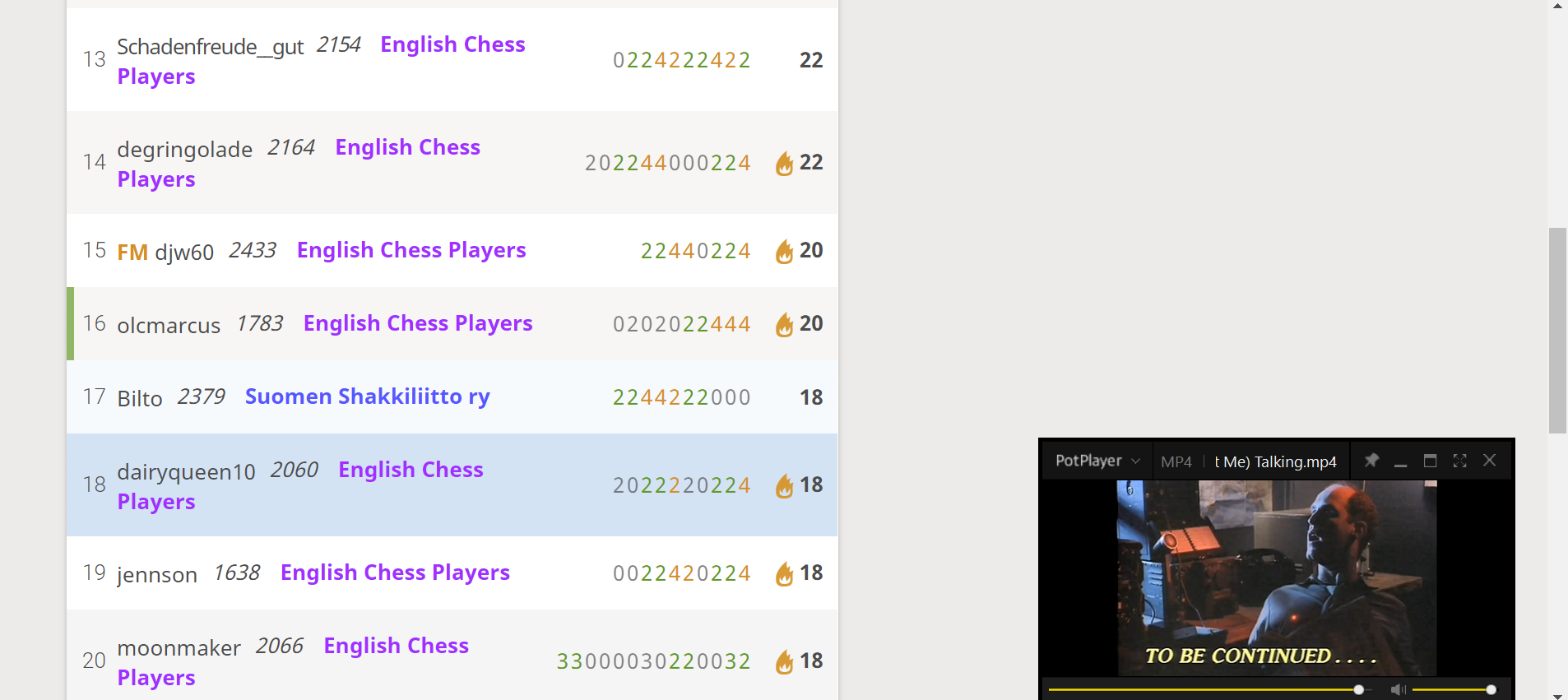
To give a sense of where I am at, here’s two games. I make mistakes in both but are not beaten in either.

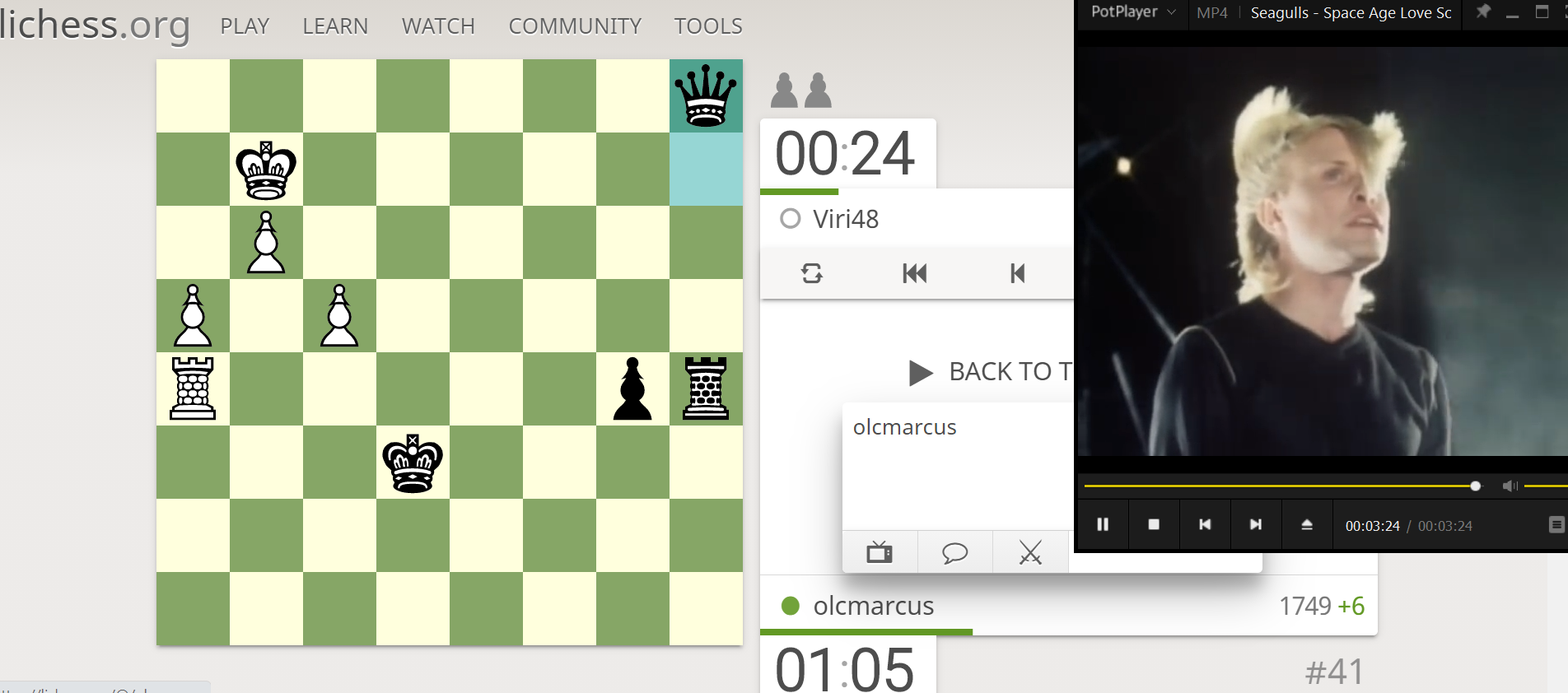
A draw by repetition through fear of a back rank weakness in an endgame with a position I thought was unclear.


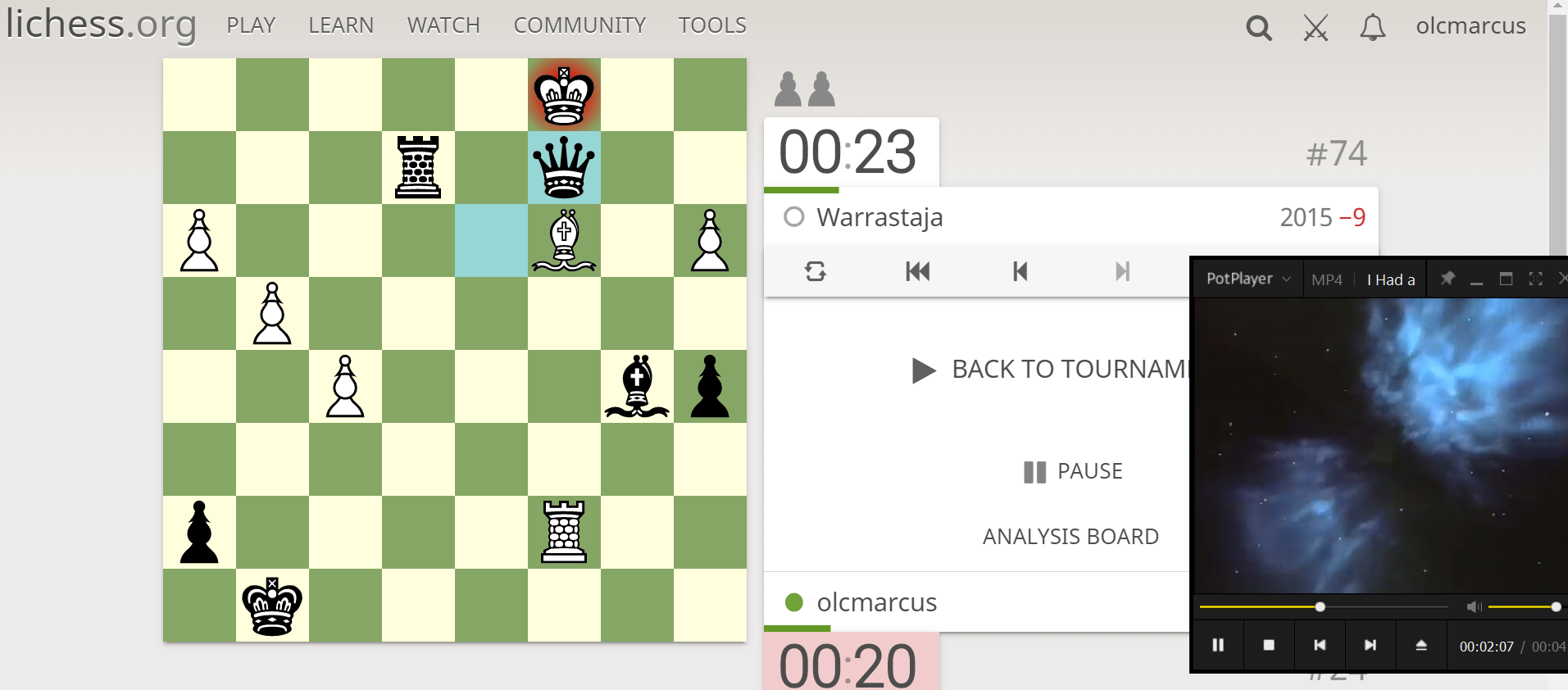
After being outplayed in the middlegame, shoring up my defences allowed me to exploit my opponent’s uncertainty and win quickly.

Olcmarcus
Just watch.

Olcmarcus
Under starters orders as white it’s 1. e4 hoping for 2. Nc3 and a pawn structure as such:

With black:

Against 1. e4 it’s 1. …a6

Against 1. d4 it’s 1. …b5 (intending to transpose to the above)

Against 1. c4 it’s 1. …e6 (possibly going for a Queen’s gambit declined Tartakower or aiming for a Dutch defence with a similar pawn structure as above.)

It’s more than enough to be getting on with. Theory is of no interest. I learn from myself only.

@a6crush

For a 1. …a6 start, that’s some swift victory.

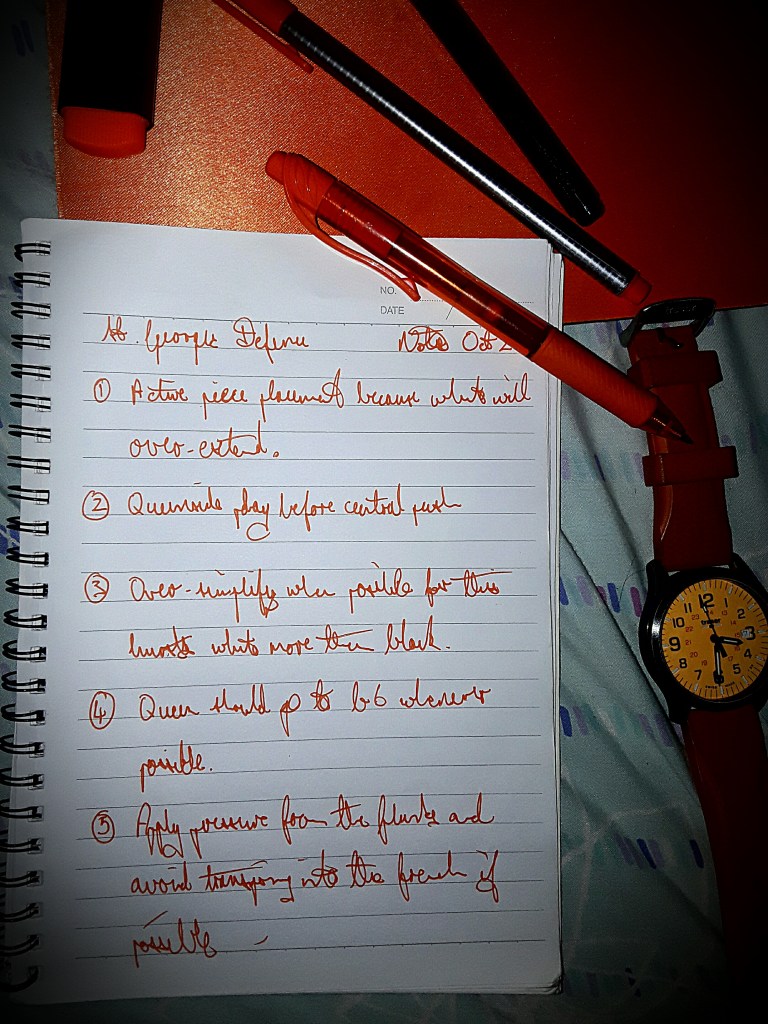
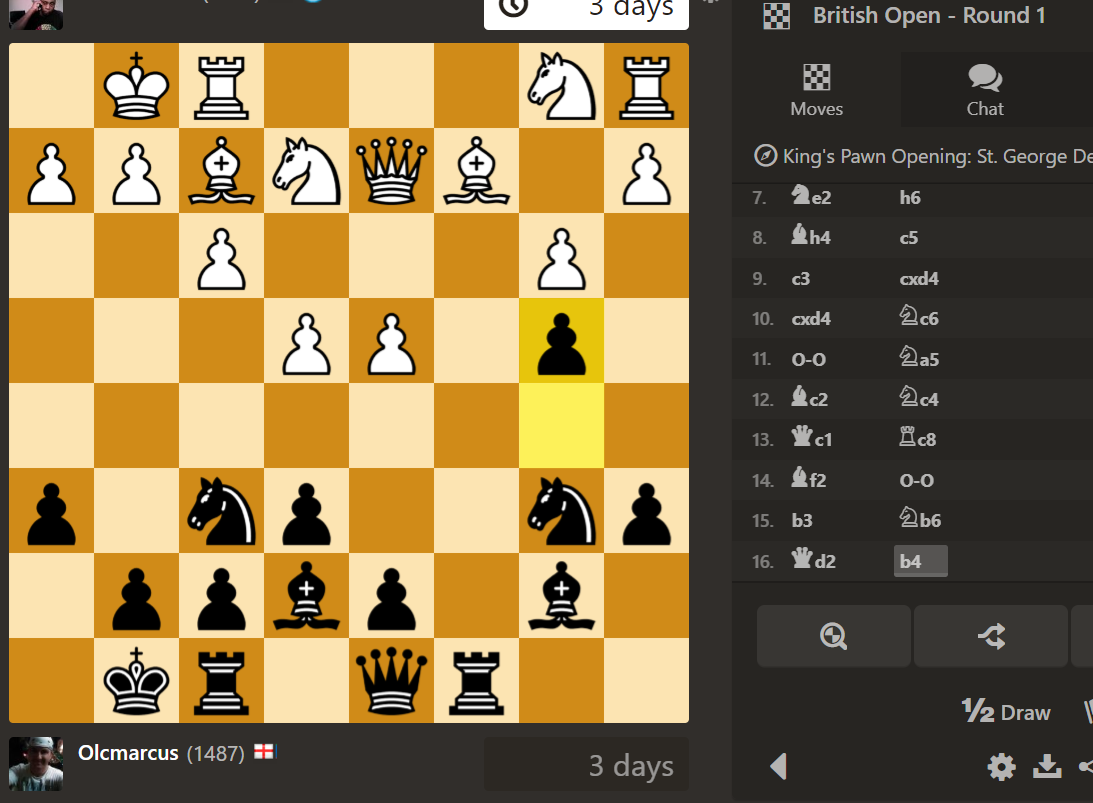
The St. George’s Defence.

I played this on a speedy skytrain but how fast does it get with The St. George’s Defence? Watch and find out but understand I am not posting out of pride, I am posting out of amusement.

A decent opponent outplayed me and then I blundered but I did not lose for it was I who checkmated him, commentary is provided. I confess I am quite proud of this, especially since I saw his mating threat late on and won the game by averting it.

Olcmarcus

All you need to do is the watch the video on how I win this game, it won’t take long. Commentary is provided. I solemnly swear I played purely on instinct and never gave my moves any real thought.

Olcmarcus

Some little on-line pipsqueak beheld my St.George’s Defence and tried to mate me in the opening! Okay it’s suspicious from the outset, The St.George’s Defence that is. But it’s highly transpositional, and so making use of the spatial advantage granted is not as simple as it may seem. You are welcome to see how I got my game together in the middlegame and took him to pieces, played on a skytrain too I might add. Some sound middlegame play here by myself, none of it required any real thought.
https://lichess.org/JrrvYmu9MGbt

Enjoy.

Mark.J.McCready

Should we both warp and strictly adhere to Collingwood’s concept of what history is, we could argue that Bedfordshire was the stopover point of a Grandmaster smuggling ring during the cold war. With strict adherence to Collingwood, the claim is unchallengeable and irrefutable if and only if intentionality lies at the very heart of discourse thus of history too.

Ok so I have no evidence of the above claim concerning a smuggling ring in operation and neither has anyone else but that’s not the point. It’s unfactual but history, for Collingwood, is about establishing why people wanted the things they did, in particular what they had in mind. Since the governments played with their cards close to their chests always to resort to ‘the facts’ as Ranke would is rather pointless as you can never unearth them all anyway. A pertinent point is if we warp into the equation a dose of drunken deductive reasoning we could argue pre-conceived notions of my country’s strength in yesteryear doubled up as pretext for positional play left without discourse until now. Again its factuality or lack thereof remains inconsequential but also partially explaining why no Soviet or American Grandmaster showed their face in the Bedfordshire league despite its ‘locality’. Whether what found counts as identity-conferring is, perhaps, rather fanciful if not overtly playful academia. (Note to self@ Mark, if you recall you wrote an essay about Collingwood’s devotee Dray during your MA, and there was nothing fanciful or playful about that if you remember those long April days.)

Is it 2.30am already? Hmmm, abandon academic musing and conjecture for a game of blitz on-line then bed methinks… .

R.G.Collingwood. An academic whose works you really do need to read in order to understand him.

Olcmarcus