The answer is less obvious than you think. It’s not necessarily 2 since in binary it would be 10. So what did more practice + a change in approach = ? It equalled this:
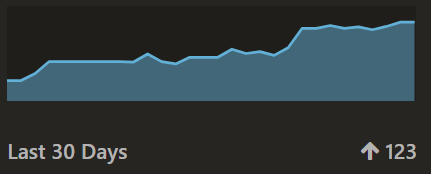
The answer is less obvious than you think. It’s not necessarily 2 since in binary it would be 10. So what did more practice + a change in approach = ? It equalled this:
Posted in On-line journal | Leave a Comment »
Rust removal no longer required. Directness creates pressure, pressure causes collapse…
Posted in My Own Games | Leave a Comment »
Something I bought in the mid 80s
I visited Vienna in 97. It is still today one of the most beautiful cities I have been to…

Posted in Selected on-line games | Leave a Comment »
I’m in a state of sworn silent swinehood, being well and truly disgruntled! Why? Because I am learning the hard way that starting competitive chess at 0030, six hours ahead of your opponent is massively disadvantageous. Maintaining your highest level of concentration at 2-3 am -the wee hours as they are known colloquially -is a very big ask even for those saddle sore with hyper mania. Don’t get me wrong, the normative aspects of daily life are…are fatigue-free but to raise the bar at that time -no way! And for the second time consecutively, I could neither raise my game nor play as directly as I normally do. Common sense dictates to play at your peak, play during the afternoon or early evening. Don’t leave it until past midnight, that’s time for hours of sleep not hours of competitive chess. From last night I learnt that tiredness over-simplifies your decision making process. If your thought process becomes less robust, errors creep in because you become less diligent and aren’t checking as much as you should be. In sum, that’s the principle reason why I lost: whilst sleepy I became sloppy. Ah well, I tried at the end of a long day but it just wasn’t quite enough. At least after I realized I had made a mistake, I went on the front foot. Credit to my opponent for making my kingside attack look rather flimsy. I lost but learnt from it -a pyrrhic victory of sorts you could say… .
https://englishchessonline.org.uk/wp-content/uploads/2020/09/N-v-S-Final-Scores.pdf
Olcmarcus
Posted in Chess, My own endeavours | Leave a Comment »
With seven hours to go only, I am quite excited about representing the South of England as we compete against the North of England, a match which last occured 126 years ago. Given the current climate, the match has to be held on-line, and once again I am six hours ahead, meaning I will most likely be playing at gone 3am again.
Details of the match can be found in both below:
https://www.englishchess.org.uk/online-north-v-south-challenge-2020/
With 107 boards that means 214 English men will compete against each other. The North of England is the slightly stronger team, with an overall average rating of 139, given that the South of England has an overall average rating of 132. There’s a noticeable difference between the two teams on the top ten boards but it evens out the further down you go. My opponent’s rating being exactly the same as mine on board 51. Seven points is not a big difference but perhaps the strength at the top is what will bring home victory for the North of England.
There are four players from Bedfordshire competing, I have the black pieces and am sincerely hoping for 1. e4, in which case my opponent is in for quite a shock! It’s a very passive opening I play but being played by a southern softy it’s not. I know it very well and know what to target, how to transpose and when, if necessary. There is, in fact, very little left to learn regarding that opening, so in all probability I will come out of the opening with a slightly better position or one relatively equal but leading to a type of middlegame I have much more experience with than him.

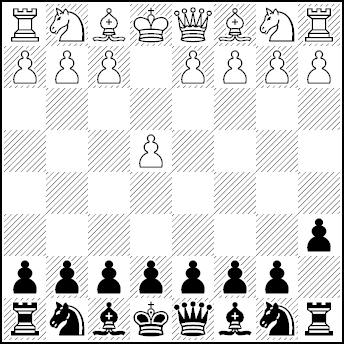
Olcmarcus
Posted in Chess, My own endeavours, Tournament Chess | Leave a Comment »
After years without one, I changed tack and put a signature at the end of my posts on the forum I’m always on. I thought it was funny at first but then perhaps a bit silly, so came up with one more to the point, and closer to the mark.
Old.
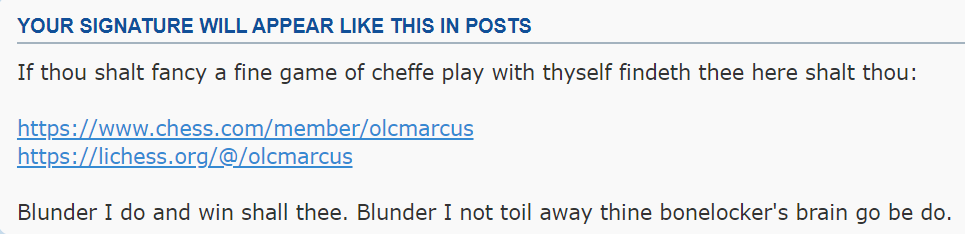
New.

Marcus
Posted in On-line journal | Leave a Comment »
In the following link, you can find Bedfordshire’s champions since 1980.
http://www.adrianelwin.co.uk/Bedfordshire/Bedfordshire.html
Of all that I played, I’ve beaten 2, drawn with 2 but lost to 3 although one of them conceded I had completely outplayed him, which I did. I don’t recall how I lost the game, it may have been on time. Of the two I beat, one was titled and rated around 217 and the other was over 200 also but only just, 203 I think but may well be wrong there. He played an obscure line against my French defence with an early b3, possibly 2. b3, which as anyone will tell you, doesn’t do very much at all. It was an easy win. I mated him within 30 moves. Perhaps its so had I not given up chess and put a solid 10 year shift in I may have became on me of them but would it be worth it? The moments of love and joy chess brings are ephemeral, is there really a pay off for being a bit better or a lot better for all those minutes, hours, days, weeks, months, and years invested -I don’t think so.
I’m prepared to admit, in the many qualifying rounds played in a Winter’s eve, I got more than one sound beating from the very strongest in the county, and infrequently, walked away from the board with a hard fought victory and a wry smile on my face.
Posted in History of Bedfordshire Chess from 1980-2000 | Leave a Comment »
Like all young players growing up with chess, there were many past masters I liked and played through the games of. At 16, Morphy was most certainly the first, the other two I was an awe of most of all being Capablanca and Fischer. But the first player whose edifice of work I laboured over was Nimzowitsch. In retrospect this has become something I lament because in trying to mimic or copy him, which I did to considerable degree, I found myself embroiled in positions too complex for my level, and often too obscure to benefit from also. I liked the obscurity of some of his moves and often found it mystifyingly enthralling. Sadly I confess, in the following position, Nimzowitsch played precisely the sort of move only he played, which in my youth I found most impressive -the writing was on the wall methinks.

Here Nimzowitsch plays Qh8!! If you can explain why, I am all ears.
Posted in Chess | Leave a Comment »
“We must learn to reawaken and keep ourselves awake, not by mechanical aids, but by an infinite expectation of the dawn, which does not forsake us even in our soundest sleep. I know of no more encouraging fact than the unquestionable ability of man to elevate his life by a conscious endeavour. It is something to be able to paint a particular picture, or to carve a statue, and so to make a few objects beautiful; but it is far more glorious to carve and paint the very atmosphere and medium through which we look, which morally we can do. To affect the quality of the day, that is the highest of arts.” ― Henry David Thoreau, Walden
Through submission to and admission of how the entrails of normality have been garroted in the months gone by, owing to a pandemic that Chomsky describes as ‘a colossal market failure’, a slow subterranean maneuver has been made.
I’ve followed suit and forgot about chess over the board because it just isn’t happening. Well it is. I mean should I saunter off to Bangkok Chess Club, I can play in a blitz tournament each Friday evening. But at the end of a working week, a tournament with a time control of 3m 2s, just isn’t worth it. I don’t consider that time control as conducive to ability and love of the game but rather a game of he who moves fastest wins. That’s just silly to me, invariably I lose on time and if I win it is at best a pyrrhic victory…it’s not worth the effort frankly. Blitz, to me, is a rather childish way to play chess, I don’t see what there is to be gained from it…
So I transgressed from OTB to on-line via whichever server is up and running. In having abandoned chess theory altogether and relying solely in what I learn from my own games, I would appear to be on the up. And then all of a sudden I realized I love playing on-line, despite it being a depersonalized alternative to what I am used to. I’ve begun to take it seriously and play some very good chess at times.
I went and joined my home town club, which is now established on-line. I went and played for my county and rejoined The English Chess Federation. They’ve invited me to represent ‘the south’ of England in a match against ‘the north. I admit I played for my town, my county and my region as a promising junior but never the part of the country I am from. That’s a first for sure.
I’m told it’s a resumption of a match that was last played 126 years ago (details to follow). In those days you only played OTB, by cable or by correspondence, an example of the latter can be seen below.
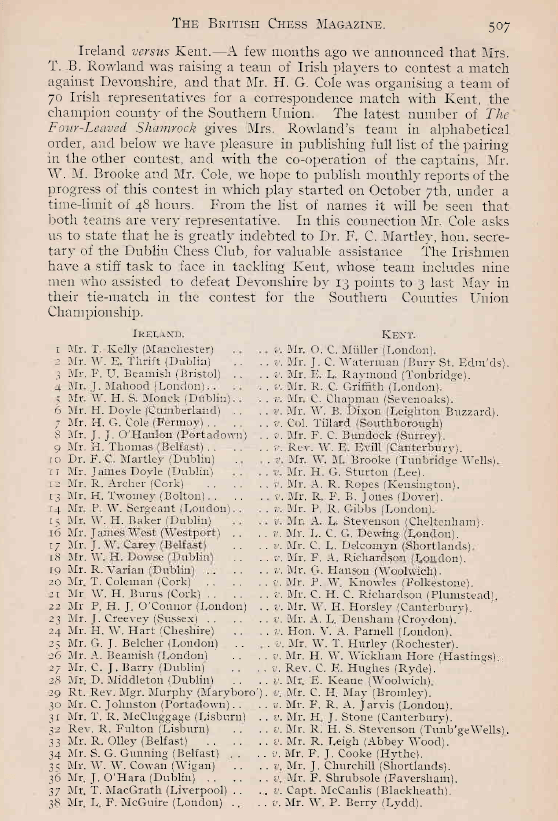
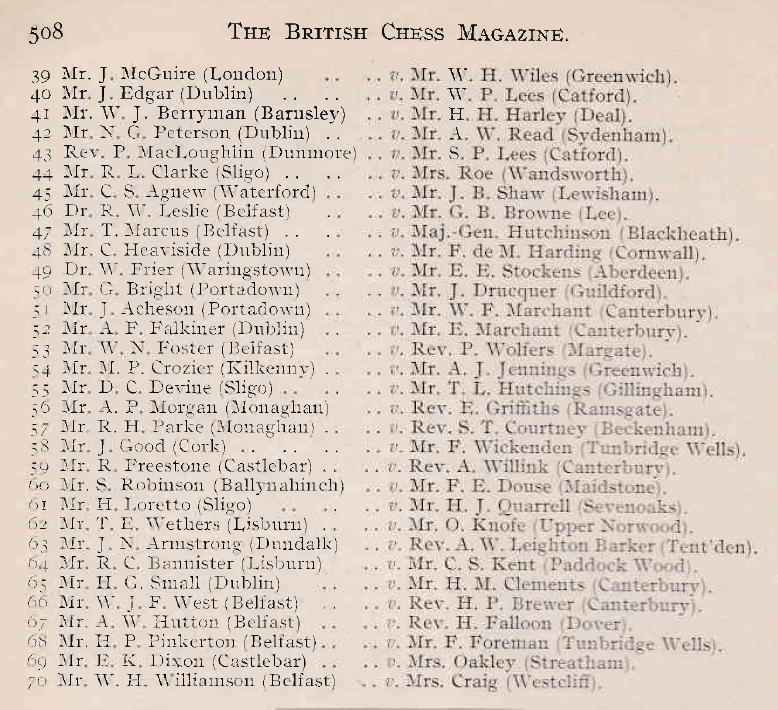
Things have moved on from 1908 but on this sceptred isle an undying love of chess beats with the hearts and minds of men who play on, and on. One of whom is myself. And the consequence of which is? I had better continue getting my act together because pride and honour are at stake. Details of the invite can be found here: https://www.chess.com/news/view/north-v-south-match-5-september-2020
To give a sense of where I am at, here’s two games. I make mistakes in both but are not beaten in either.
A draw by repetition through fear of a back rank weakness in an endgame with a position I thought was unclear.
After being outplayed in the middlegame, shoring up my defences allowed me to exploit my opponent’s uncertainty and win quickly.
Olcmarcus
Posted in On-line journal, Selected on-line games | Leave a Comment »
Just watch.
Olcmarcus
Posted in Selected on-line games | Leave a Comment »
A side note on how to read old Tom Sweby's columns
Not perhaps, but quintessentially, Old Tom Sweby is best thought of as a passionate devotee to the newspapers he wrote for. He was well read and knowledgeable of the Bedfordshire chess scene and well beyond, given that he was the president of the S.C.C.U. once upon a time. He was generally well-respected and rubbed shoulders with many, if not all, of those eminent within British chess circles. It would, however, be a critical mistake to see his column is primary source material entirely. That it is not. You will also find secondary source material quoted too, and the reliability of that is not quite as Tom hoped. Given that he wrote for decades, this is to some degree inevitable, and after all we are all prone to error whether we realize it or not. Thankfully, with regards to old Tom Sweby, they are infrequent and for the most part old Tom continued to document events and developments in the Bedfordshire league from the get go as best he could but, of course, everything lies open to interpretation. Despite this, and generally speaking. this does indeed make him informative and thus worth reading. Dare I say his columns constitute a narrative describing the latest developments, match reports and changing nature of the Beds league...he knew his audience and wrote according. This manifested itself over decades but brevity was always in play courtesy of the restictions imposed by writing a column. Should you wish to read a in instrumental figure of the Beds' league post WW2, you are quite welcome to peruse what has been posted here... . :-) I should, however, point out that as the decades wore on he gradually moved on away from narratives concerning the Bedfordshire league towards affairs both historical and international. The reasons for this are multifarous, old age was a predominante factor presumably, however, the bottom line is with regards to how the Bedfordshire chess scene developed post WW2: old Tom Sweby is your go to guy. He wrote more about chess in Bedforshire than anyone else did but given he was a Lutonian and writing for a Luton newspaper there is both bias and greater coverage of his hometown than the rest of the county.
















To add comments, please see the bell at the top of the page.

