It does appear that in the early days of our participation in the S.C.C.U we were somewhat out of our depth even though matches between neighbouring county towns and cities were often close.

Posted in History of Bedfordshire Chess from 1920-1940 on April 27, 2026| Leave a Comment »
It does appear that in the early days of our participation in the S.C.C.U we were somewhat out of our depth even though matches between neighbouring county towns and cities were often close.
Posted in History of Bedfordshire Chess from 1920-1940 on April 27, 2026| Leave a Comment »
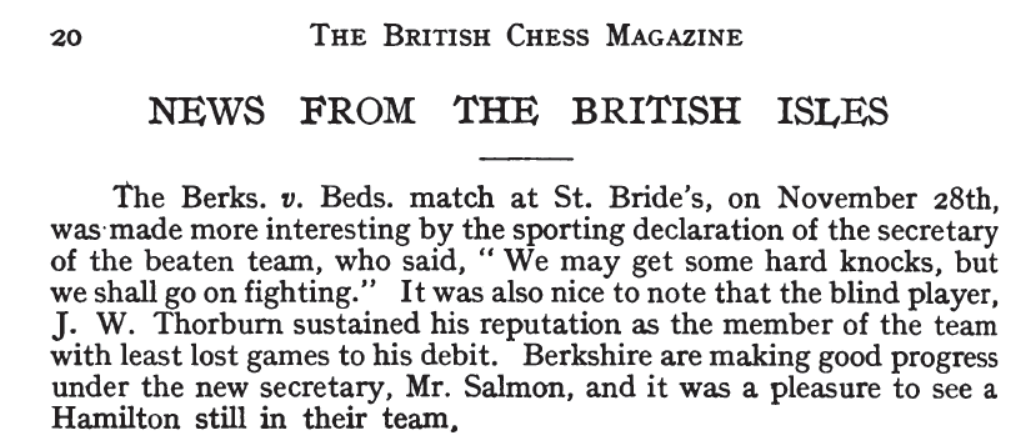
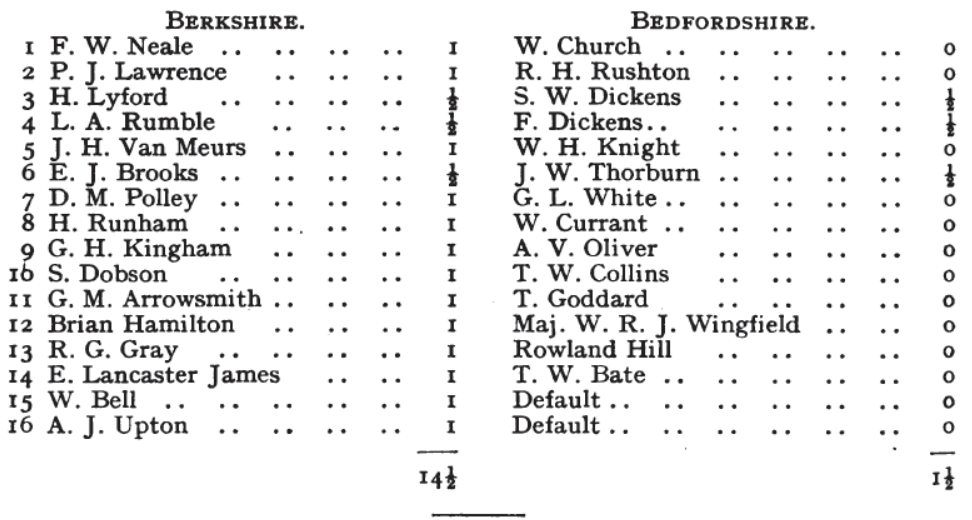
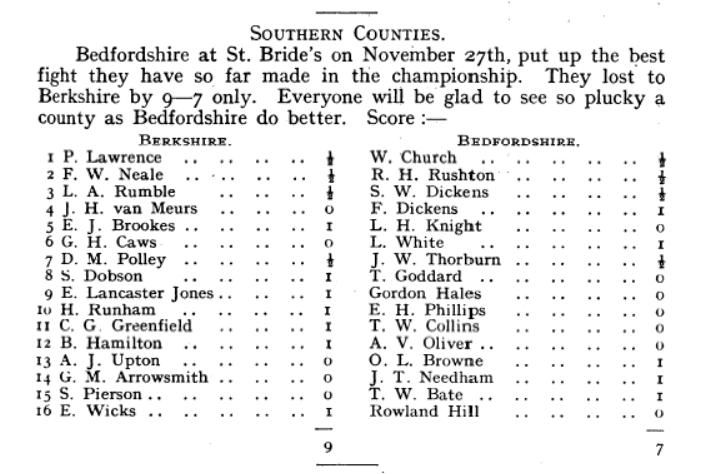
It does need to be pointed out that the county then was not what it is today. There was a very clear north/south divide which would have reflected on team selection. I can confirm that the entirety of the top half of the team (including co-authors of Chess in Bedfordshire) is from the south of the county, the bottom half I cannot comment on. Additionally, take for example the quotation from the same 1926 BCM but earlier in the year.

Posted in History of Bedfordshire Chess from 1920-1940 on April 26, 2026| Leave a Comment »
As difficult as it may be, please note that Bedfordshire is referred to as ‘plucky’. The choice of word is based on results, this being our best so far apparently. Bedfordshire was in the process of putting itself on the map still, having only joined the S.C.C.U 4 years previously, and still continuing to attract some of the best players in the world to the county for simuls and talks. You would have thought if strength and depth had beeen there, it would have been reflected in county results, which is not the case as yet, mainly because a league north/south divide remained in operation until 1952. This means that the team chosen at county level was predominantly a south Bedfordshire team, as that is where the power lay.
Posted in History of Bedfordshire Chess from 1920-1940 on April 26, 2026| Leave a Comment »
Posted in History of Bedfordshire Chess from 1920-1940 on April 26, 2026| Leave a Comment »
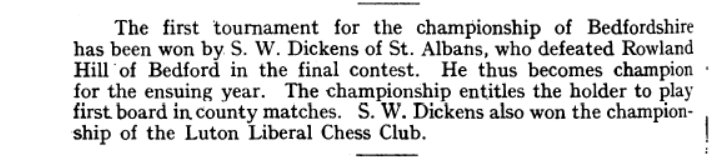
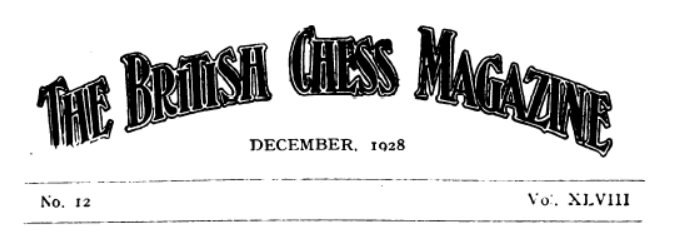
On Adrian Elwin’s site about Beds. chess, you may find a list of previous county champions here, Previous County Champions. Evidence that S. Dickens did indeed become county champion in 1927 and 1928 is corroborated below.

Posted in History of Bedfordshire Chess from 1920-1940 on April 26, 2026| Leave a Comment »
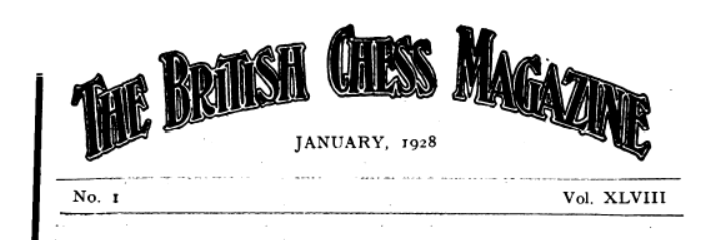
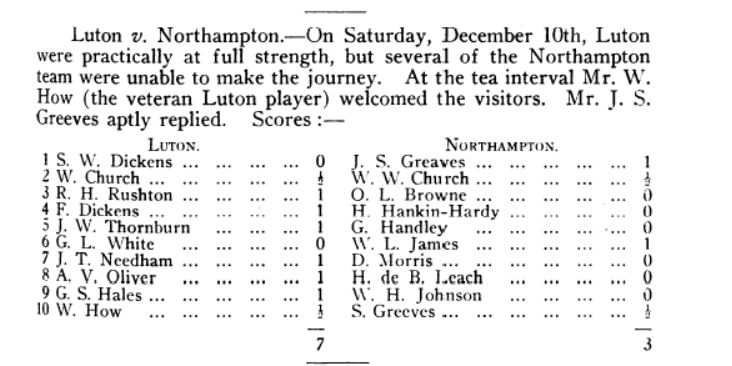
Nothing is said in the BCM about the nature of this match. Northampton joined the Beds. league in the 80s it is often thought. There is no evidence of this happening before then. Furthermore, the Beds. league retained its north/south divide until the mid 50s, which practically rules out the possibility of this being a league match, and is instead a friendly.
Posted in History of Bedfordshire Chess from 1920-1940 on April 26, 2026| Leave a Comment »
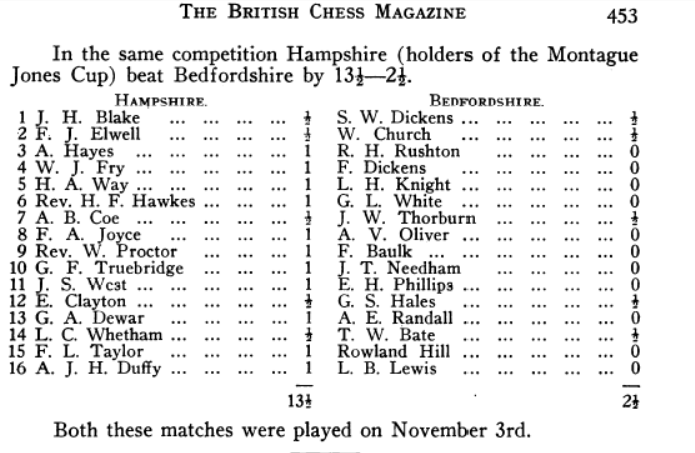
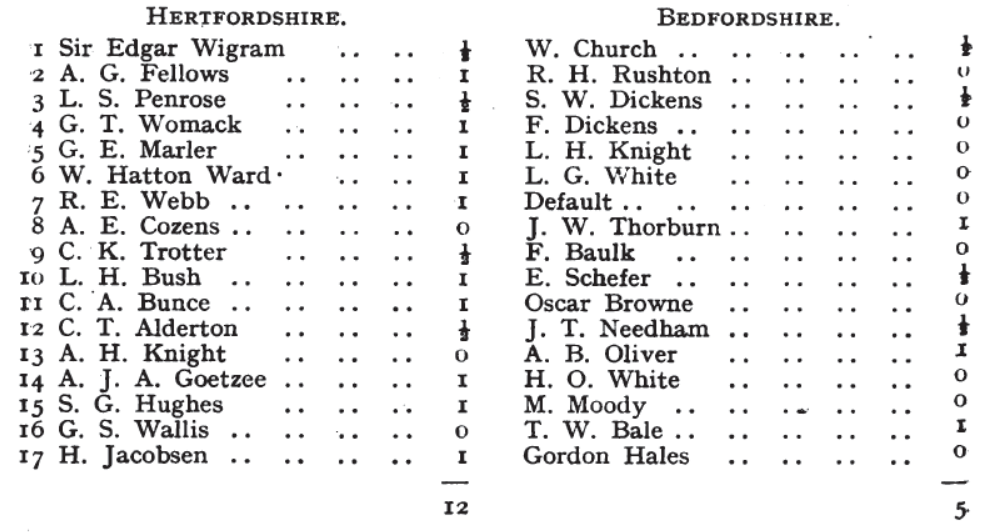
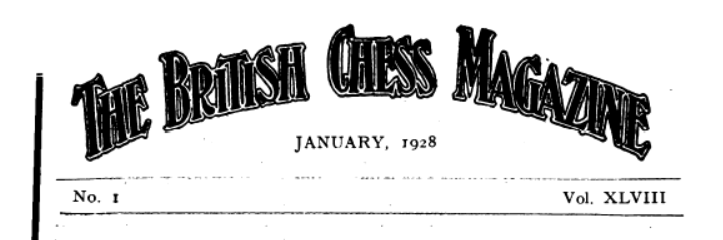
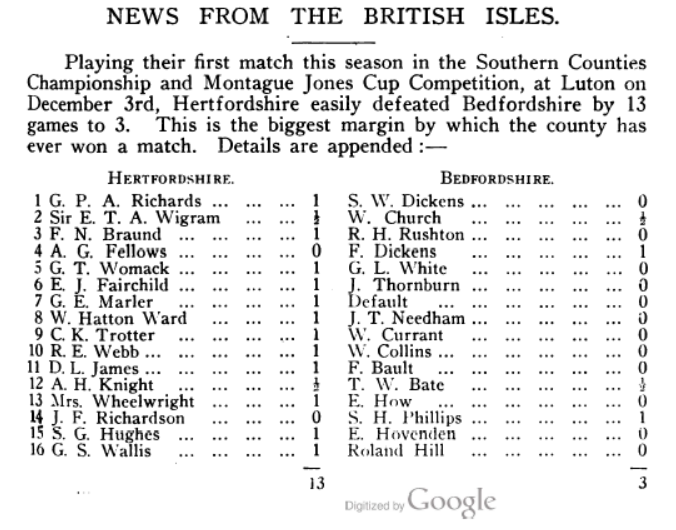
Details below can be found concerning a SCCU match between Bedfordshire and neighbouring Hertfordshire. The match is dated December 3rd 1928.
Posted in History of Bedfordshire Chess from 1920-1940 on May 27, 2025| Leave a Comment »
“Truth is what your contemporaries let you get away with.” -Richard Rorty
Fellow chess players of Bedfordshire, in returning to Chess in Bedfordshire (F. Dickens & G. L. White: Leeds Whitehead & Miller 1933) once again, courtesy of ineluctable ongoing research, please allow me to draw attention less so to the quote above and more so to the once documented county debut defeat of ours in the S. C. C. U. with special attention paid to a certain individual in particular, since none was given in the aforementioned publication. First, a recap of the result:
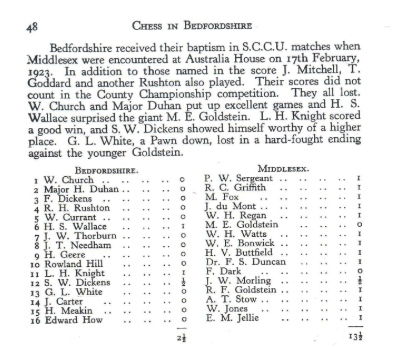
Somewhat aside: chess history is not always as laudable as some readers may assume, with not all authors not seen as paragons of virtue by their readers, particularly postmodernists or historiographers who may continuously connect interpreting meaning to establishing significance of events and occurances within discourse, rather than rely on facts or just raw data; and so to understand the nature of this defeat a little better, let us ponder over some rather helpful commentary on the match found in The British Chess Magazine, then move on to a comparison of Middlesex‘s top three boards to ours. This should show a gulf in class at the top end of the teams was in play, one which trickled down to the lower boards too most probably, thus a deciding factor in this defeat on our debut in the S.C.C.U.
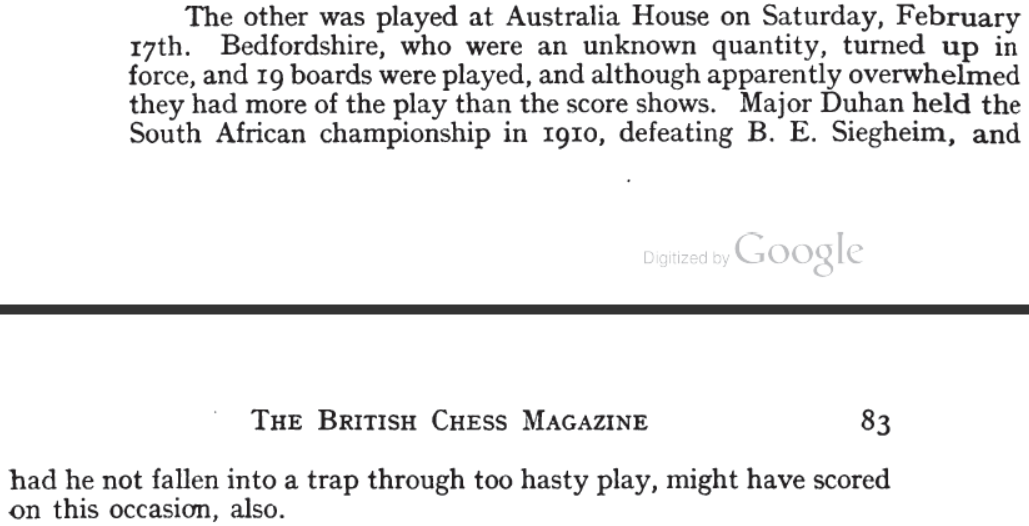
Their Board 1
Fellow county chess players, you may already be acquainted with their top board: the esteemed P. W. Sargeant, him being the author of the then future publication A century of British chess (1934). The estimated rating attributed to him by the EDO Historical Chess Ratings website (not entirely reliable but good enough) at the time of the match was 2115 http://www.edochess.ca/players/p4038.html but it should be pointed out, however, that he was the Middlesex county champion of 1921, two years previously.

Their Board 2
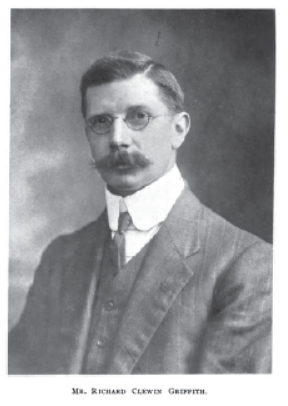
On board two was R. C. Griffith. British champion in 1912 in his only such appearance, and as can be seen above, champion of Middlesex some two years after that. Impressive indeed for a board number two. The EDO website has him estimated at 2261 that year http://www.edochess.ca/players/p4615.html.
Their Board 3
And so. onto thee board three, he who this post is about -the Canadian Maurice Fox. The EDO website has him rated at 2341 the year Bedfordshire was beaten. http://www.edochess.ca/players/p7358.html.
More significantly: four years before he beat our F. Dickens, he outfoxed future world champion Capablanca in a simul with the black pieces, Capablanca v Fox, suggesting that he was too strong to play on board three at county level despite Capablanca not being at his optimal best.

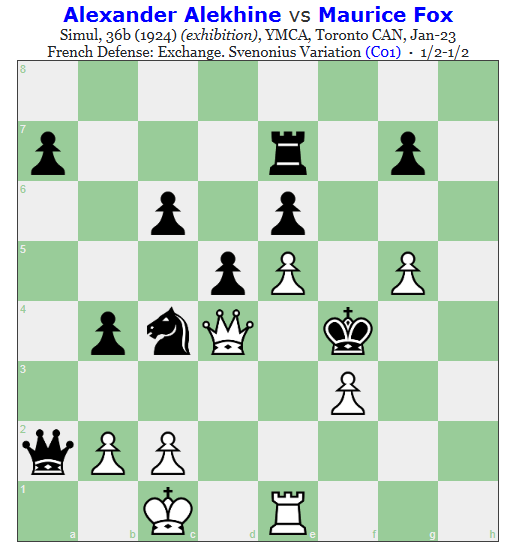
According to various sources, later in 1923 he emigrated to Canada. The following year he faced another future world champion with the black pieces, this time Alekhine in a simul in Toronto. During the middlegame, increduously, he decided to march his king down to e3 even though Alekhine still had a queen, rook and knight on the board; sacrificing a rook and a knight along the way and leaving Alekhine the option of allowing himself to be mated instantly or force perpetual check instead! See below. Alekhine v Fox
He then went on to win the national championships in Canada a joint record eight times (joint with GM Yanofsky), with his estimated rating peaking in 1929 to 2364. Much more impressively, in the 1950s he not only outfoxed yet another future world champion with the black pieces but beat him too, a certain Robert. J. Fischer. Fischer v Fox
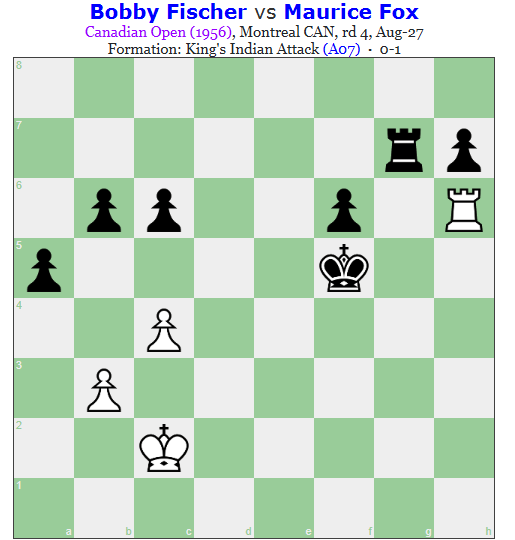
According to the following link, this game occured at the very first Canadian Open, in Montreal 1956 https://www.bcchesshistory.com/canop5662.html and even though Fischer was only 13 at the time with a rating as low as 2156, he could be hardly be classified as a push over given that at the very same age he played what was called the game of the century against Donald Byrne, thus described by Hans Kmoch ‘The following game, a stunning masterpiece of combination play performed by a boy of 13 against a formidable opponent, matches the finest on record in the history of chess prodigies.”
Shifting the focus homeward bound, how did our top three stand in relation? In terms of estimated ratings, there is little to go on.
Our board 1
W. Church of Luton (no results attainable, no rating estimated)
Our board 2
H. T. Duhan (of Bedford: estimated rated 2141, 12 years previously) http://www.edochess.ca/players/p12485.html
Our board 3
F. Dickens of Dunstable & Luton: no results attainable, no rating estimated (aside please note for our purposes, he played alongside Nigel Staddon’s father for many years).
Do also note that the co-authors of Chess in Bedfordshire (F.Dickens & G.L White: Leeds Whitehead & Miller 1933) are playing on boards 3 and 13, and H. T Duhan (our board 2) had already become champion of South Africa eight years after The Boer War had ended in 1910, as has been documented on this site, and also S.Dickens, who drew on board 12 once turned over Tartakower in a simul in Luton in 1928 (also documented on this site).
‘Bedfordshire received its baptism in S.C.C.U matches when Middlesex were (that’s a collective noun and so should be followed by was not were: subject and verb disagreement) encountered at Australia House on February 17th 1823′. Oh really? Baptism of fire was a more aptly chosen term I would say. Their board trois beat deux of, and drew with un of, those always in the top dix greatest players of all time! (Please excuse my French!)
A consolation of sorts
Last, but by no means least, another perspective: regarding county players who have beaten future world champions with the black pieces, the all-time score between Middlesex and Bedfordshire is most probably 1-1. If, and only if, it is true that Fox is their only player to do so, and GM Plaskett is ours (he beat Anand before he became world champion) that is. And on that note -draw agreed! Anand v Plaskett.

“The world does not speak. Only we do. The world can, once we have programmed ourselves with a language, cause us to hold beliefs. But it cannot propose a language for us to speak. Only other human beings can do that. ”
― Richard Rorty
Mark. J. McCready
Chapinero, Bogota, Colombia
Posted in History of Bedfordshire Chess from 1920-1940, History of Bedfordshire Chess from 1980-2000 on May 24, 2024| Leave a Comment »
Old Tom Sweby, so he got beaten up by Oswald Mosley’s henchmen did he? One of the reds in Beds. went down against the black shirts then? Having spent what must be hundreds of hours documenting his column and correcting his frequent mistakes already-I can’t say I will be losing any sleep over that! 🙂
Side note I have spoken to one of his former pupils, a subject of his reportage countless times over, a noted author who knew him, and also reflected upon the comments & messages from a county player who was both his and my team mate many, many, many times over, as well as reflected upon how he presented himself to me in my youth: the consensus being without doubt Tom went after them, or if you like, threw the first punch!


What the reportage says the thing is with old Tom, you can never be sure if he’s correct or not as it is sometimes not the case. The reportage below does indeed show that there was trouble but it suggests he may have been a victim rather than a perpetrator. We may also concede that since Tom reported it himself, that suggests he probably didn’t cause the trouble in the first place because if he had, he’d be much less likely to tell anyone especially when he got beaten up for doing it!



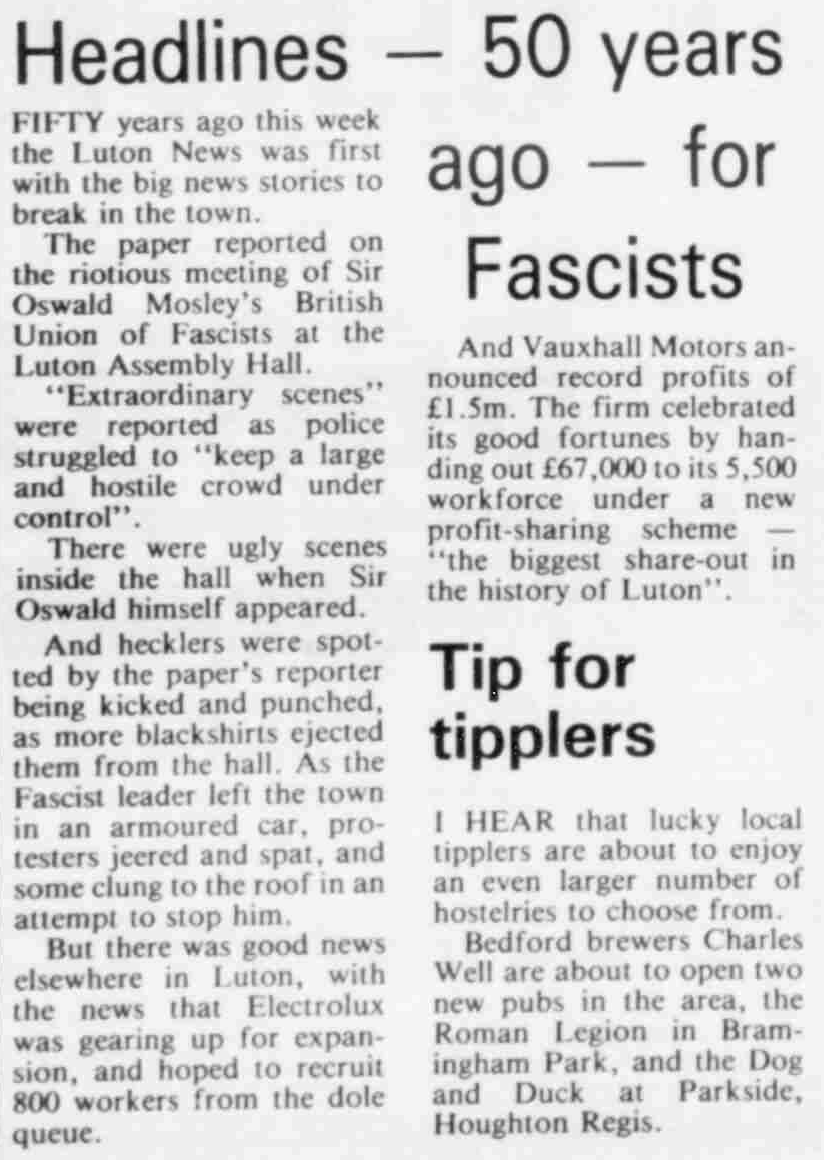
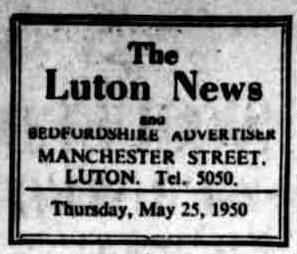
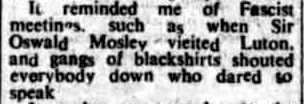
McCready’s last words despite his honorable intentions and ever-lasting attempts to generate interest in chess locally, Tom was not exactly a well-rounded person and had a tendency to be forthright and shoot his mouth off when he saw fit -as I myself witnessed. There is clearly a hidden agenda in play here also as he was a known communist thus opposed to facism as a result of his own views. Many have seen him become vociferous when he didn’t like something (myself included), he even brought Luton chess club to a grinding halt one evening with some overblown tirade just because its members weren’t giving him enough stories to report on -I should know, I was a member of the club then! Given that history does have a tendency to repeat itself, in all probability, given the nature of his reported position when Mosley rolled into town, he went and shot his mouth off to the wrong people and got done over!
Poor old Tom, did he not know learning to control your emotions is advantageous?
Mark. J. McCready
Posted in History of Bedfordshire Chess from 1920-1940 on May 11, 2024| Leave a Comment »
When you are up against stiff opposition, it’s not usually a good idea to field a weakened side! Especially when they have future Dunstable based J. M. Craddock on their team!


A side note on how to read old Tom Sweby's columns
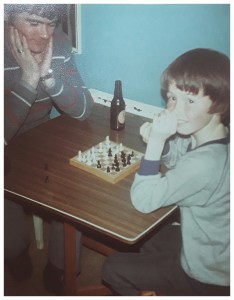
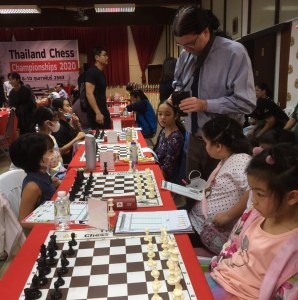
Not perhaps, but quintessentially, Old Tom Sweby is best thought of as a passionate devotee to the newspapers he wrote for. He was well read and knowledgeable of the Bedfordshire chess scene and well beyond, given that he was the president of the S.C.C.U. once upon a time. He was generally well-respected and rubbed shoulders with many, if not all, of those eminent within British chess circles. It would, however, be a critical mistake to see his column is primary source material entirely. That it is not. You will also find secondary source material quoted too, and the reliability of that is not quite as Tom hoped. Given that he wrote for decades, this is to some degree inevitable, and after all we are all prone to error whether we realize it or not. Thankfully, with regards to old Tom Sweby, they are infrequent and for the most part old Tom continued to document events and developments in the Bedfordshire league from the get go as best he could but, of course, everything lies open to interpretation. Despite this, and generally speaking. this does indeed make him informative and thus worth reading. Dare I say his columns constitute a narrative describing the latest developments, match reports and changing nature of the Beds league...he knew his audience and wrote according. This manifested itself over decades but brevity was always in play courtesy of the restictions imposed by writing a column. Should you wish to read a in instrumental figure of the Beds' league post WW2, you are quite welcome to peruse what has been posted here... . :-) I should, however, point out that as the decades wore on he gradually moved on away from narratives concerning the Bedfordshire league towards affairs both historical and international. The reasons for this are multifarous, old age was a predominante factor presumably, however, the bottom line is with regards to how the Bedfordshire chess scene developed post WW2: old Tom Sweby is your go to guy. He wrote more about chess in Bedforshire than anyone else did but given he was a Lutonian and writing for a Luton newspaper there is both bias and greater coverage of his hometown than the rest of the county.
















To add comments, please see the bell at the top of the page.