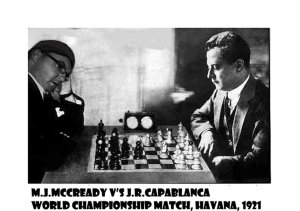
Diggle, who in a -news- flash has become my favourite chess writer, spent at least four years living in my home town just before the war, I was pleased to recently learn. There he befriended the ever-smiling Tom Sweby – Bedfordshire’s principle post-war chess representative, and a man I had the pleasure of meeting as a once promising junior, long, long ago. It would appear that he also knew the esteemed Secretary of Luton Chess Club Brian Cox too. (see Part 5 of https://mccreadyandchess.com/2015/06/05/bedfordshire-chess-in-the-70s-its-past-and-its-future/). Here is Diggle’s take on the unlikely duo and my home town. (Reminiscences of a Badmaster [Vol.1])
34. Grandmaster Mecca
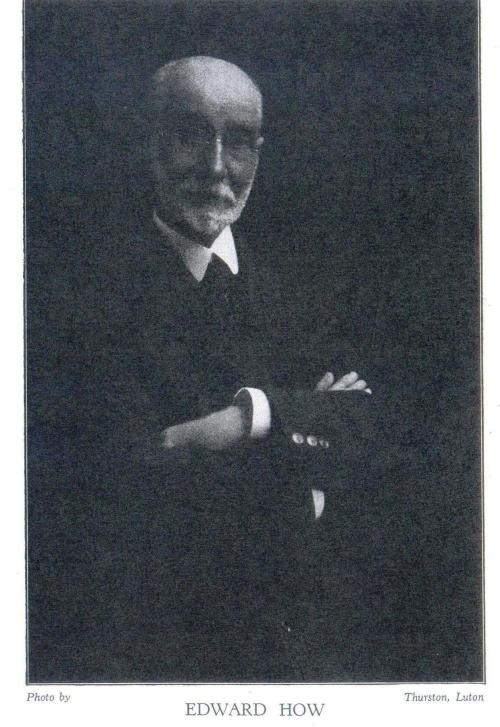
The Luton Chess Club (of which the BM has pleasant memories from 1935-1939) celebrates its Centenary this year. Among generations of its stalwarts, two great figures in particular bestride the Century. In a match played in 1931 between Luton and Northampton, we find on adjacent boards the names of Edward How and T.W.Sweby. The former, then 83 years of age, playing in his last match, had been a founder member in 1878, Hon. Sec. for over 30 years, and President thereafter. The latter, playing in his first match, was destined after a long stretch as ‘general factotum’ to ‘stagger along’ (his own expression) as President (which he still is) for the ensuing quarter of a century. In How’s time Luton was visited by Blackburne, Zukertort, Lasker, Capablanca, Reti, and Alekhine; in Sweby’s (during the past decade alone) by Larsen, Keene, Hartston, Wade, Tal, Glogoric, Suttles, Korchnoi, Petrosian and Hort. The popularity of Luton as a ‘Grandmaster’ Mecca can be ascribed partly to the organising genius and dynamism of a remarkable Secretary (Brian Cox) and partly to the hospitality of its President and his charming wife. One cam almost believe that Grandmasters (after the manner of tramps) inscribe mysterious signs on the front gate of the ‘White House’ when departing, to notify those that follow that they will find the place ‘a bit of alright’.
The younger generation of Luton chessplayers , however, may be surprised to hear that in his earlier days, ‘T. W. S.’ [Diggle is referring to how Sweby signs his Luton News Column] (who now ‘leaves all the organization to Michael’) himself embarked on chess ventures, some of a peculiar kind [of course, those of us who knew Tom Sweby would not be surprised at all, being the great raconteur that he was]. On one occasion eight local players received ‘top secret’ letters instructing them to be at the front entrance of the Midland Hotel at a certain hour – they would then be ushered in to take part in an eight round ‘Mystery Lightening Tourney’ against eight ‘Invisible Masters’! Another eight Luton chessists each received a similar letter, except that their venue was another entrance round the corner. The two parties (in the custody of T. W. S. and the BM respectively) were smuggled up different staircases and via separate doors into opposite halves of a large room divided by a high folding partition; each half contained a row of eight boards. Play then commenced T. W. S. calling out ‘over the wall’ the first move made by his No.1 Board and the BM making it at once on the corresponding No.1 and so on to No.8, then the process was reversed, the BM calling the replies and the T. W. S. making them. At the end of each round, one contingent ‘moved one up’ as in the Mad Hatter’s tea-party – the other lot sat still. Though all combatants had been enjoined to observe the strictest silence each set of ‘Invisible Masters’ rumbled the other (collectively) in no time, the rot being started by a well-known character with a notorious high-pitched cough which he suddenly emitted during the second round. Thereafter, the announcements of the moves were punctuated by derisive comments from the performers: P-KR3 ‘I bet that’s Joe, the cautious old bastard’ or ‘Resigns’ (loud laughter) ‘that’s Len’s cackle but he sounds three boards off me’. By a masterstroke of timing the last round terminated at 9.30 pm and was followed by a general stampede to the bar – where the ‘first round’ started!
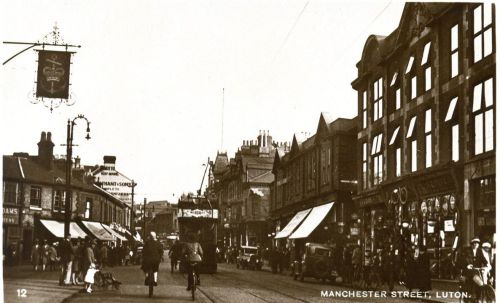
Luton in Diggle’s days. Note that the ‘Midland Hotel’ (painted white) can be seen to the left.
Read Full Post »

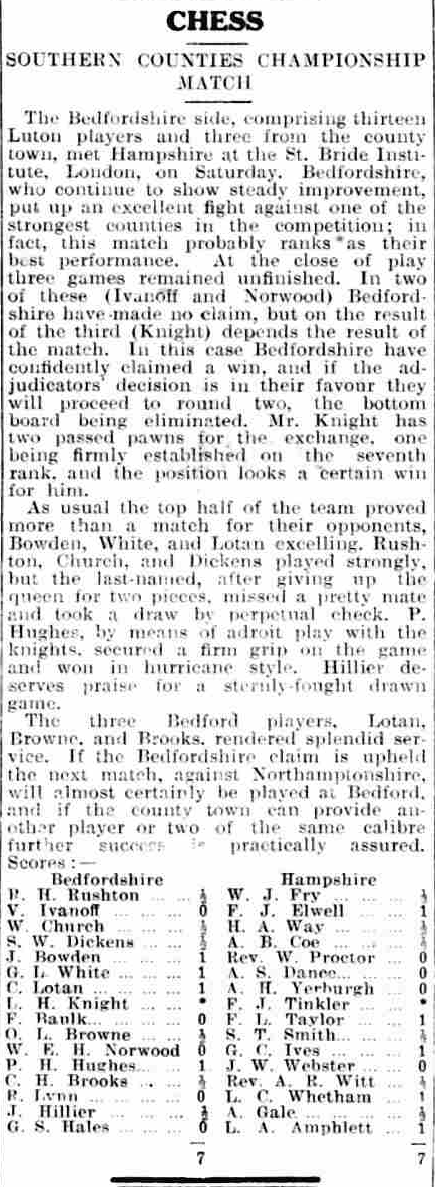



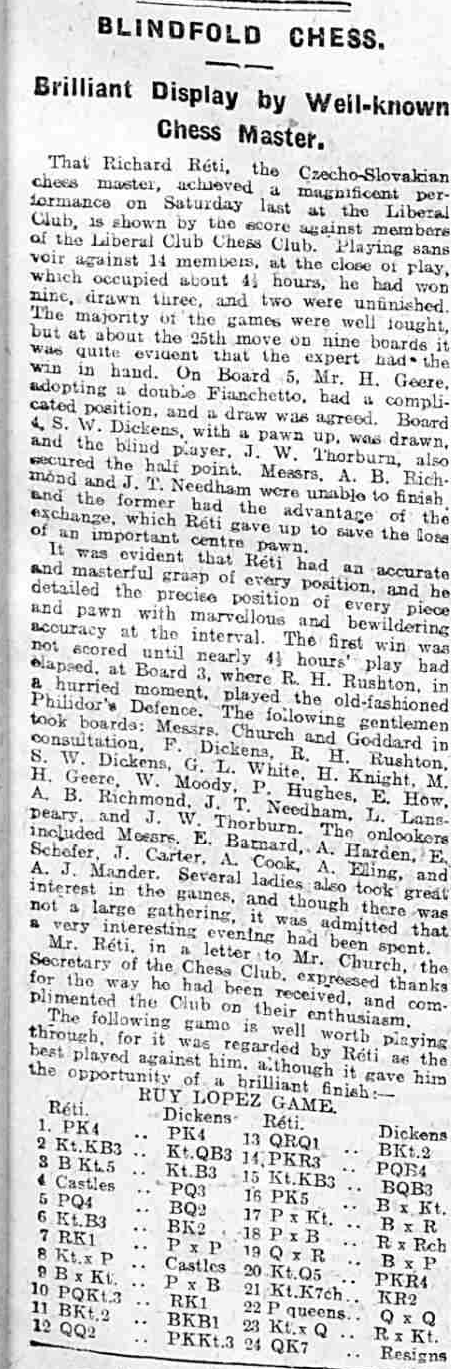






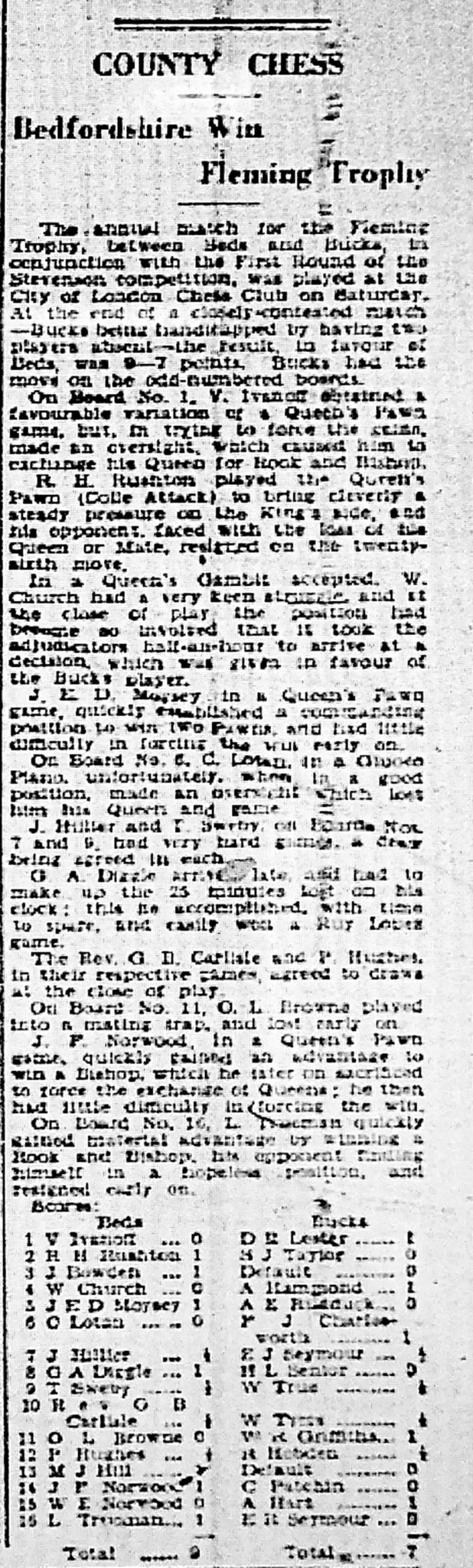
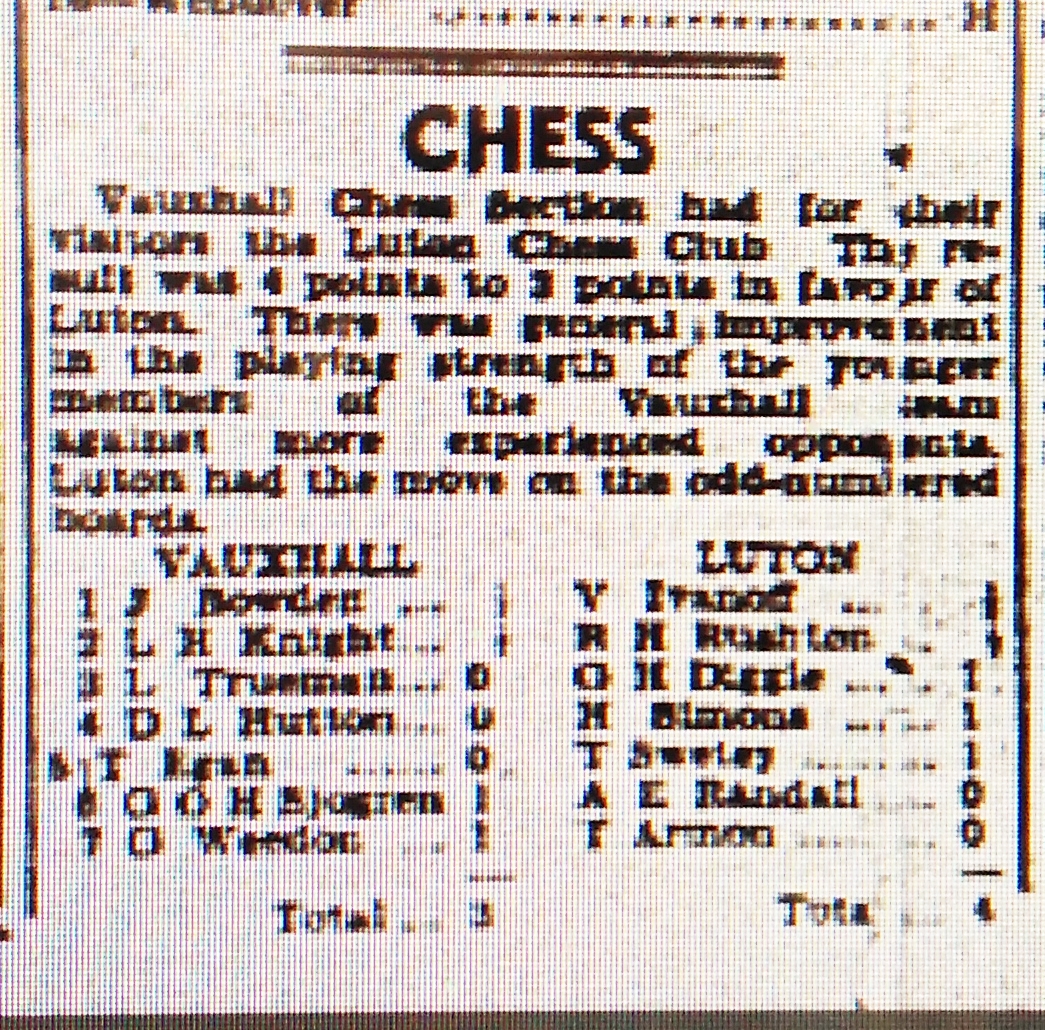 I am not yet sure who wrote this yet sure it was either Sweby or Diggle. It ends with the adverbial clause ‘Luton had the move on the odd-numbered boards’. That is more like Diggle than Sweby but could be either, I suppose… .