Well done Tom Sweby, the one armed bandit, for posting an objection to evenings of chess in Luton. But was anything ever done about it? I thinketh not!


Posted in History of Bedfordshire Chess from 1940-1960 on May 12, 2024| Leave a Comment »
Well done Tom Sweby, the one armed bandit, for posting an objection to evenings of chess in Luton. But was anything ever done about it? I thinketh not!
Posted in History of Bedfordshire Chess from 1940-1960 on May 12, 2024| Leave a Comment »

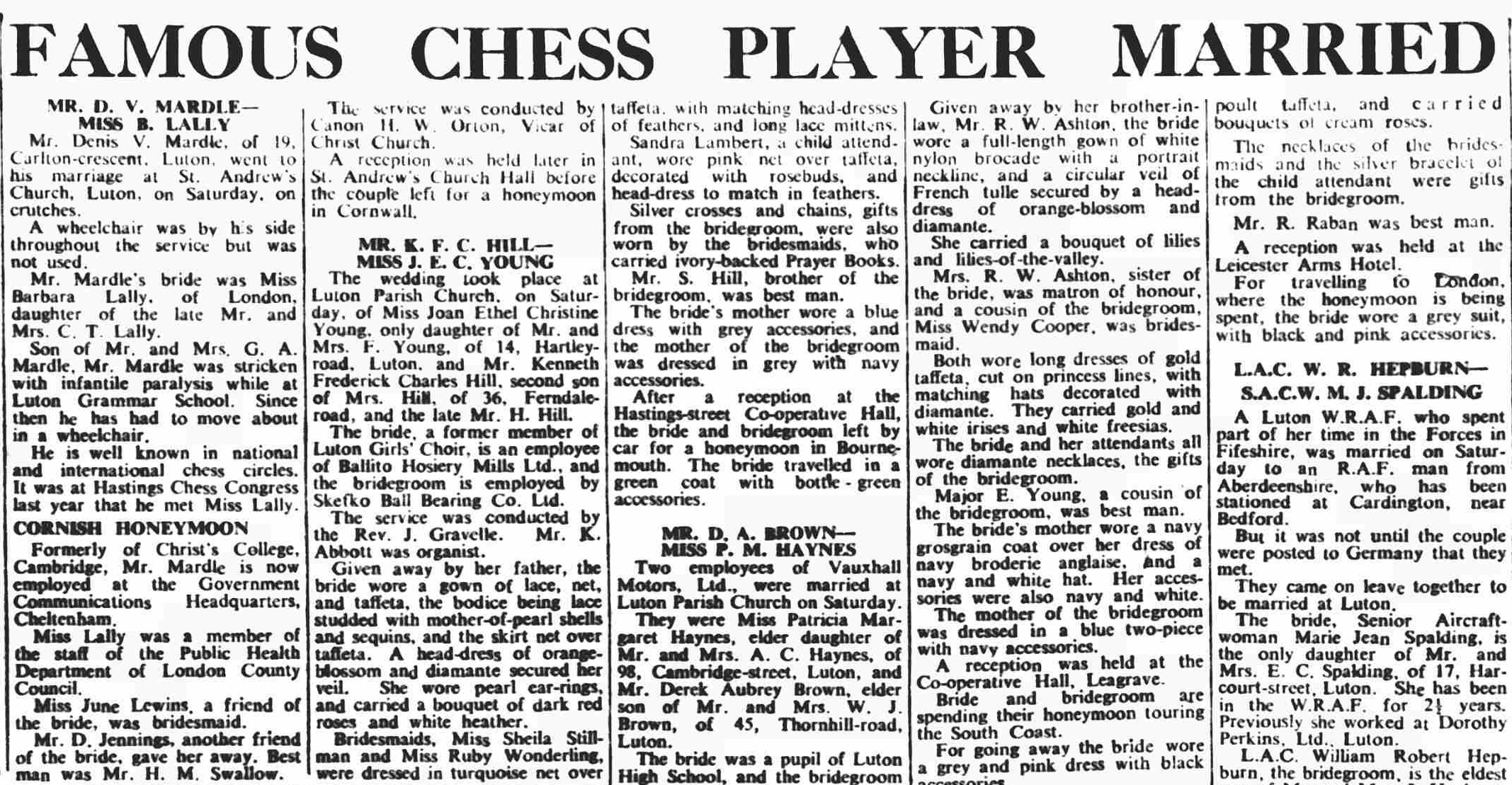
It would appear I am not the only Lutonian to have a marriage brought about by chess.
I should also add that Dennis and I share teammates and I am assured under circumstances containing no doubt whatsoever that Dennis suffered from Polio, which he contracted after drinking from a cracked cup at the ground of Luton Town football club. It was his work on polio that would lead to him receiving a C. B. E in 1988. I should also add that there is a further question pertaining to the reportage, that being that he did not in fact meet his wife at Hastings but rather at the British Championships, where they are both documented as participating in.
Posted in History of Bedfordshire Chess from 1940-1960 on May 12, 2024| Leave a Comment »
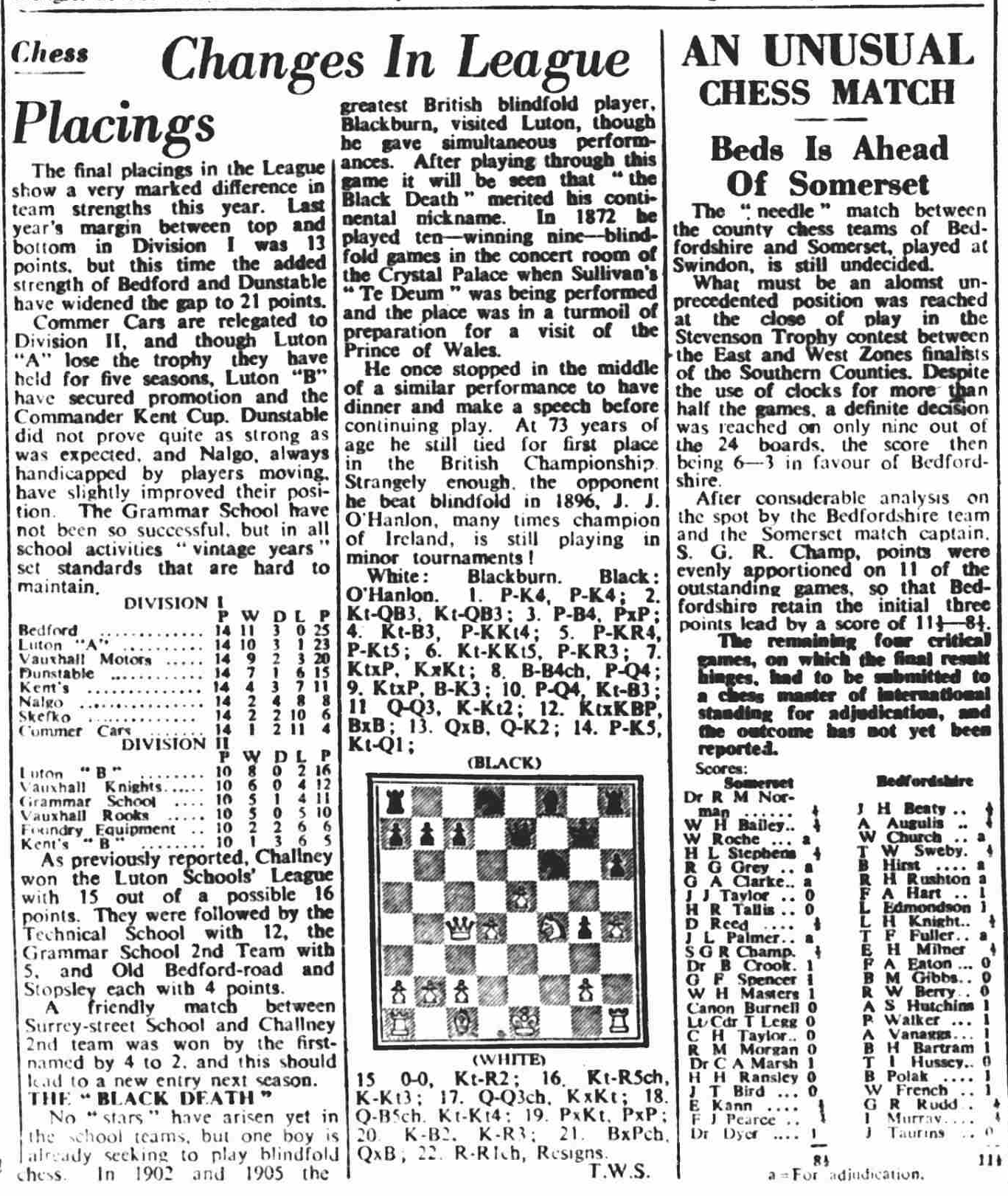
My home town Luton not only had its own league but also its own schools league simultaneously. Whereas reportage of the Luton league appears in several other posts, evidence of the schools league can be found below. If only it were true today!

It should be noted that at the bottom of the column the initials T.W.S are Tom Sweby’s, who was a science teacher at Challney Boys School, appearing in the league table above.
Posted in History of Bedfordshire Chess from 1940-1960 on May 5, 2024| Leave a Comment »
One question I cannot answer is when did Bedfordshire stop dividing itself up and play county matches as one only. I do not know when north Bedfordshire and south Bedfordshire matches came to an end but clearly later than what most would assume. Well perhaps not but I assumed they stopped in the 1920s -how wrong I was. I don’t have enough information to comment on their regularity and significance, however, the reportage below sheds some light on the matter.

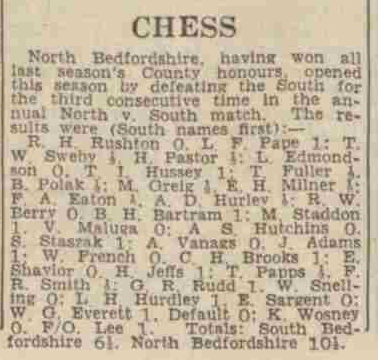
Update: the question of a north/south divide was in fact rooted in our league, which extended to county matches. I have uncovered reportage to prove this. The north/south Bedfordshire county matches were the only means for players within Bedfordshire to compete against each other. In the 1951/2 season, Bedford applied to play in the Luton League, as is stated below, with Leighton Buzzard having already entered a team into division 2. This is a significant discovery. In previous posts it was documented that Bedford also had 6 clubs of its own just after the war. I will continue to search until I find evidence which shows when Bedfordshire was united as a county in terms of league and county matches.


The following year Bedford won the league in their first season, with the team from Leighton Buzzard still in division 2.
Some three years later we find the term ‘Bedfordshire league’ being used and not ‘Luton league’.

Posted in History of Bedfordshire Chess from 1940-1960 on May 5, 2024| Leave a Comment »
Look at this. Following wartime regulations or perhaps prudence, the folk of Bedford kept their chess club closed during WW2 but did that stop them from playing chess? Not on your nelly!

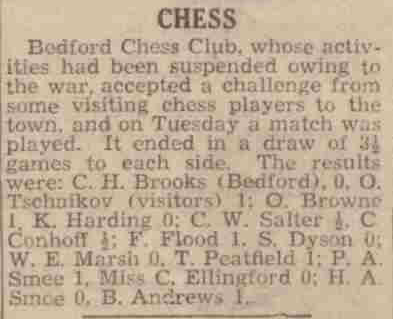
3 years on there were developments…
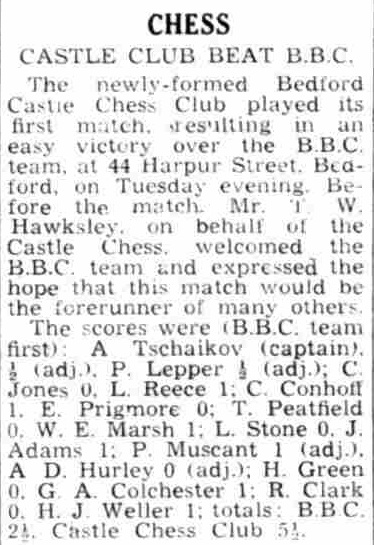
‘The forerunner of many others’, so says the reportage below but what is that supposed to mean? No matter what, we have unearthed reportage providing details of what is claimed to be Bedford Castle’s first ever match. For the purposes of this post, please take note that WW2 had not ended when the match was played. What conclusions can we draw from this? Mine is that those up in Bedford were a brave, rebellious bunch that played on, undeterred by the danger of bombs dropping on them during play. They must have been tough nuts, just imagine having fashioned a won endgame only to then fail to covert your advantage due to the club being raised from the ground by the Luftwaffe!

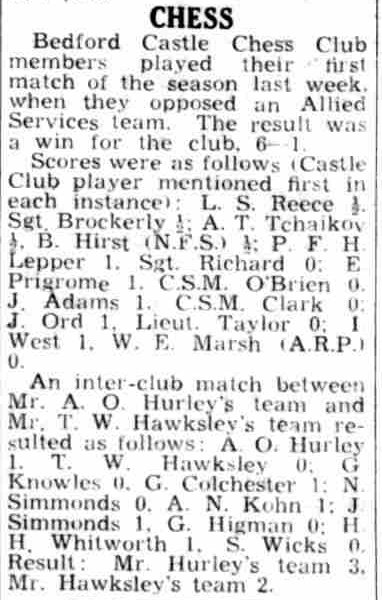
Later that year in their bombproof chess club, those indestructible Bedfordians took on allied servicemen and took them out 6-1, finishing a host military men, chiefly Sergeants and Lieutenants. And this was described as ‘the first match of the season’ by those hardmen of Bedfordshire chess.

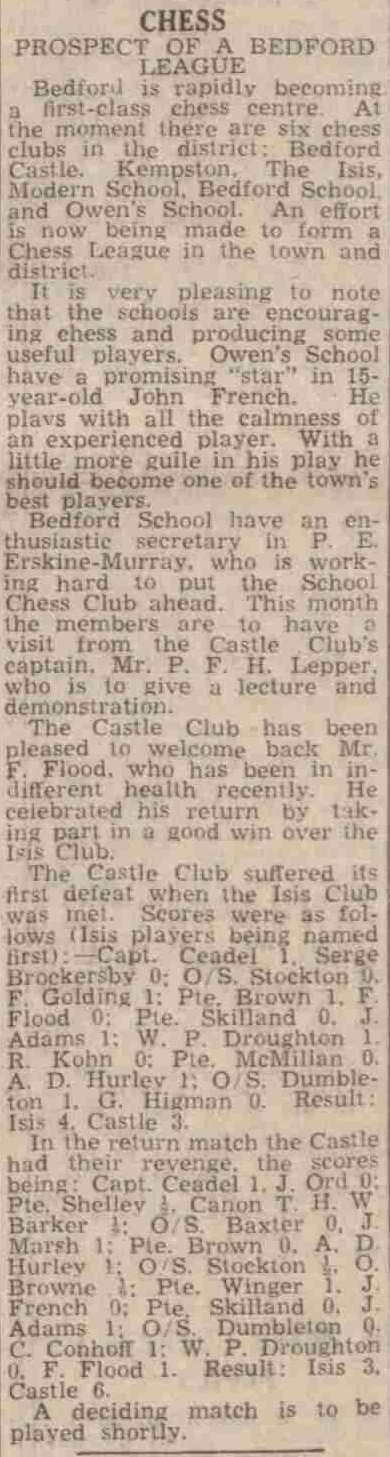
It gets worse, as the war came to a close there 6 -yes 6- clubs running in Bedford with plans to draw up its own league!

Posted in History of Bedfordshire Chess from 1940-1960 on May 3, 2024| Leave a Comment »
Posted in History of Bedfordshire Chess from 1940-1960, History of Bedfordshire Chess from 1960-1980, History of Bedfordshire Chess from 1980-2000, History of Bedfordshire Chess in the 19th century on March 25, 2024| Leave a Comment »
…history as a constantly moving process, with the historian moving within it…
E. G. Carr – What is history? p. 153
Within the chess world, to compare players of different generations and eras is treated with suspicion, thus deemed inadvisable and ill-judged. This is not the time nor the place to delve into the very great many reasons why. It is not my intention to do so here, however, I do wish to draw attention to the point that the tendency to evaluate players purely in terms of their rating and title can be broadened oh-so-slightly.
I have recently posted regarding the strongest players to have played chess within Bedfordshire, on a number of occasions, and thought that it may be of interest to readers who are more interested in their world rankings, with questions such as ‘Who across time achieved the highest world ranking ever?’. Generally, I am reluctant go down this path for a number of reasons, primarily because I believe narrative should remain synchronic, however, I have done it anyway. I have added sufficient information so that mistakes regarding interpretation cannot be made so easily.
Number 1 – William Ward
Recorded playing in Bedfordshire 1896.
Highest ever world ranking 56 *Classified as unofficial as FIDE did not exist then (historically estimated).
Year 19041
Rating 2418
Number 2 – GM Sergio Mariotti
Recorded playing in Bedfordshire 1970/71 (IM at the time not GM)
Highest ever world ranking 90
Year 19752
Rating 2495
Number 3 – GM James Plaskett
Recorded playing in Bedfordshire 73-80 (approx.) (untitled until 1981)
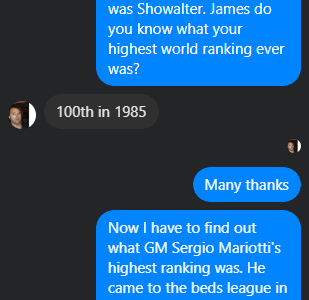
Highest ever world ranking 100
Year 1985
Rating 2495
So there you have it, if you want to know who played in Bedfordshire and gained the highest ever world ranking, now you know.
The craving for an interpretation of history is so deep-rooted that, unless we have a constructive outlook over the past, we are drawn either to mysticism or to cynicism.
F. Powicke, Modern Historians and the Study of History (1955) p. 174
Mark. J. McCready
Posted in History of Bedfordshire Chess from 1940-1960, History of Bedfordshire Chess from 1960-1980, History of Bedfordshire Chess from 1980-2000 on March 15, 2024| Leave a Comment »
“The advantage of a bad memory is that one enjoys several times the same good things for the first time.”
F. Nietzsche
One day in the distant future, the times we live in will most likely be described historically as part of the 4th revolution, or the digital revolution, which shapes how we gain and store information, amongst many other things.
Even me the academic that once was, concedes we do things differently now to when I was young. Through social media and ‘chat’ I have acquired knowledge which in itself can be placed into a narrative for further discourse on the history of Bedfordshire chess -something very close to my heart.
My very own research has revealed that Dennis Victor Mardle was the first from Bedfordshire to represent England but was he the only one to do so? I contacted GM James Plaskett on facebook, this is what I sent via Messenger.

The reply James gave me was as follows:
CIR Benedict, 1979
Telex match Vs Iceland, 1981
Lucerne World Team Championship, 1985
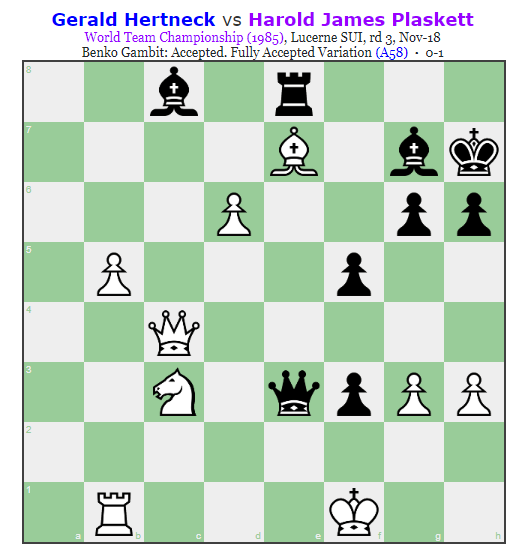
GM Plaskett was, then, the second from Bedfordshire to represent his country, however, there is a difference. Dennis, the first, played for England in England in a national match once only whereas James, the second, represented England abroad in an international tournament, helping England to achieve the Bronze medal 1 upon his third appearance. With certainty we can say that GM Plaskett’s representation of his country is, therefore, of greater significance for our purposes. His games are documented, notably his victories for England can be found here 2 and here 3, and the tournament as a whole here 4.
Interestingly, James won both games with the Benko Gambit, the games are quite interesting.

Should this not be enough to persuade you of my claims, I shall add also that as a senior, GM Plaskett went on to represent England 6 more times!
Dresden 3 times
Rhodes 1 time
Vilnius 1 time
Crete 1 time
Unfortunately, locating game information is proving tricky. I shall add when I find it… .
Mark. J. McCready, 00.05 Saturday March 16th, Al-Fursan, Dammam, KSA
Posted in History of Bedfordshire Chess from 1940-1960 on March 8, 2024| Leave a Comment »
“The beast lives unhistorically; for it ‘goes into’ the present, like a number, without leaving any curious remainder.”
― Friedrich Nietzsche, On the advantage and disadvantage of history for life
Old Tom Sweby’s former playing partner, friend, and team mate Dennis Victor Mardle, was the first from Bedfordshire to represent England, and the only from Luton. Even though William Ward, who participated in the (1896-1911) Anglo-American cable matches numerous times did indeed play for Luton before moving to London, he is in fact from Abotts Langley, Hertfordshire.
Once again I am indebted to John Saunders and his excellent site Britbase for the latest discovery, and indeed it does appear that on the back of Mardle’s success on the circuit in 59, come late October, he was asked to step up to the mark and play for England in a match against the Dutch, please see below:
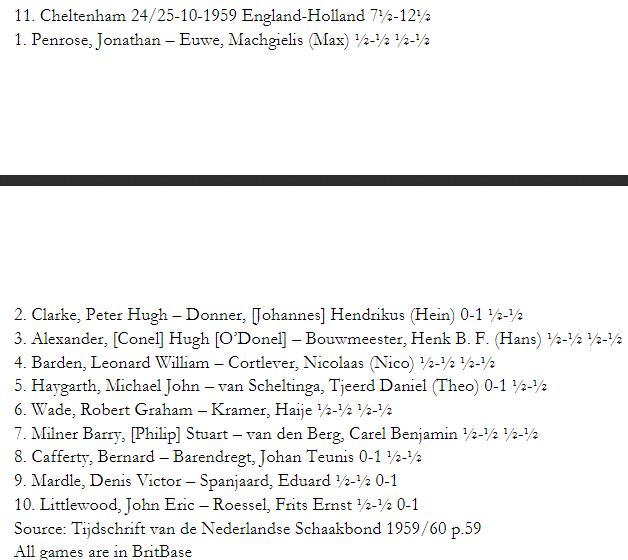
You may find the link here 1. Please note that Dennis Mardle is well documented on this site and for further information, please follow the instructions below.
Go to Categories on the right-hand side of the site, select the option highlighted below:

MJM
Posted in History of Bedfordshire Chess from 1940-1960 on December 17, 2023| Leave a Comment »
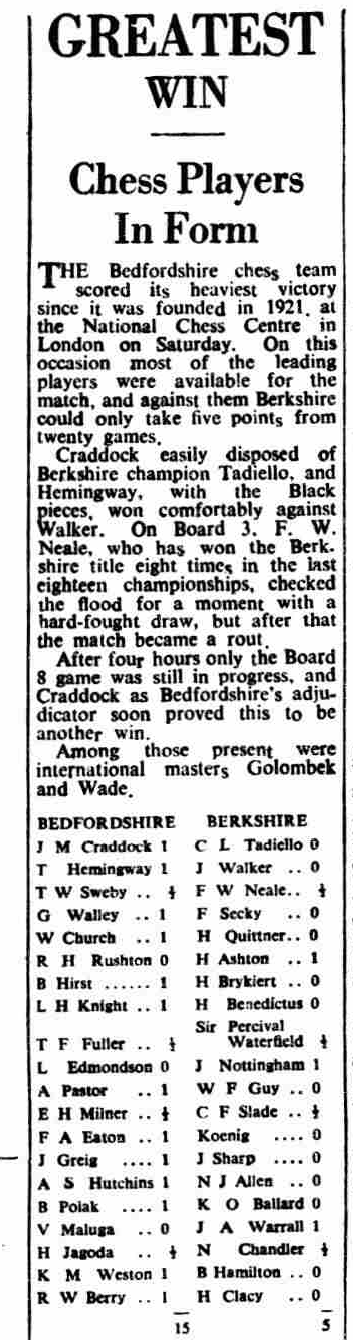
J. M. Craddock the schoolboy champion who took down those bigger than he
“History is on every occasion the record of that which one age finds worthy of note in another.” J. Burckhardt
There is no record uncovered where a Bedfordshire based player achieved recognition or success on a national or international level between 1910 and 1950. The only attention our county drew was courtesy of the chess scene in Luton and the high-profile simuls they arranged, attracting the likes of Blackburne (1905), Lasker (1908), Meises (1913) Tartakower (1918), Capablanca (1918), and Reti (c.1922). Yes its true a few of our homegrown talent achieved victories but this is hardly noteworthy (should you be interested you can find some of those victories on my site). But in the 50’s, according to our local columnist Tom Sweby, a certain J. M. Craddock was based in Dunstable and played board 1 for Bedfordshire (see fig 18. ‘Bedfordshire chess in the 70’s; its past and its future’). Who was J. M. Craddock? Once again there is a paucity of information, however, both Britbase and the ECForum enable us to fill in the blanks somewhat. The following is from Britbase:
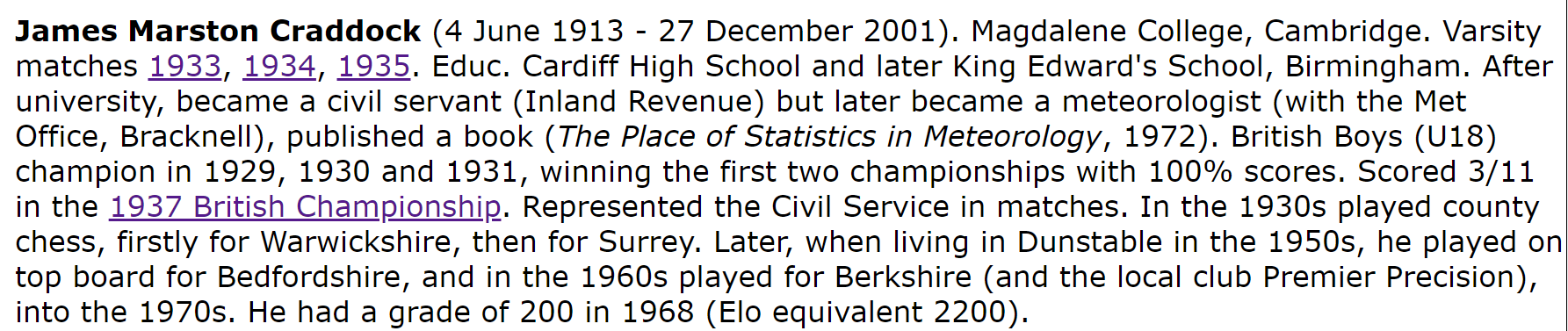

We only have one game surviving from his time in Bedfordshire, comments are from Tom Sweby.
‘When Bedfordshire played Oxfordshire in the Counties Chess Championship in January a much-admired victory was that of Beds leader, J. M. Craddock, over R. J. A. Persitz, the Israeli international and Oxford first board. Craddock, who was Cambridge University champion in 1934, and who now lives at Dunstable, has again shown his strength by beating Raaphi Persitz in the Counties’ Correspondence Championship. As Mr. Craddock rarely plays nowadays, few outside his Bedfordshire colleagues would have anticipated this fine “double” and the accuracy of his play brought from Persitz the comment “Very well played!” (I am indebted to W. G. Everitt for the score of the game which went 1. c4 c5 2. Nc3 Nf6 3. g3 d5 4. cd5 Nd5 5. Bg2 Nc7 Craddock played his own 6. f4 (see diagram) and in view of Black’s subsequent difficulties it seems that in this line he should fianchetto his KB on moves 3 and 4 and avoid the central thrust, at least until White plays Nf3 [Up to this point the game had followed one between Kirilov and world champion Botvinnik. In that White continued 6. Nf3 Nc6 7. 0-0 e5]

6… g6 7. b3 Bg7 8. Bb2 0-0 9. Na4 Nba6 10. Bxg7 Kxg7 11. Qc2 Ne6 12. Nf3 Bd7 13 f5 gxf5 14 Qf5 f6 15. Qe4 b5 16. Nc3 b417. Nd5 Kh8 18. Nh4 Nac7 19. Qe3 Nd4 20. O-O Nce6 21. Qh6 Rg8 22. Ne7 Ne2 23. Kh1 Qe7 24. Ba8 Qf8 25. Qf8 Rf8 26. Bd5 N6d4 27. Kg2 f5 28. Rf2 f4 29. Nf3 Bb5 30. Nd4 cd4 31. Bc4 Bc4 32. bc4 d3 33. Rf3 Rc8 34. Rd3 Rc4 35. Re1 Source: Beds and Herts Pictorial – Tuesday 17 July 1956
With regards to retrospective ratings, we can find J. M. Craddock here,1. Craddock is remembered most for his achievements in the 30’s, some 20 years or so before he represented Bedfordshire. His victory over Mir. Sultan Khan in 1933 was rather daring in play it must be said!
Mir. Sultan Khan v J. M. Craddock
Imperial CC v Cambridge University, London
November 25th, 1933
1. e4 e6 2. d4 d5 3. Nc3 Nf6 4. Bg5 Be7 5. e5 Nfd7 6. h4

a6 7. Qg4 h5 8. Qf4 c5 9. dxc5 f6

10. exf6 gxf6 11. Bh6 e5 12. Qd2 Nxc5 13. Be2 Bg4 14. f3 Be6 15. O-O-O Nc6 16. g4 d4
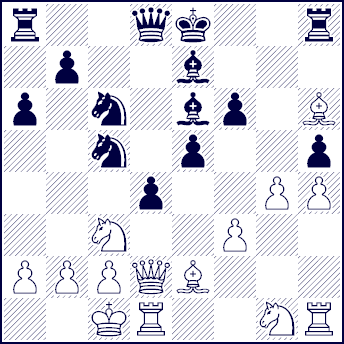
17. Ne4 Nxe4 18. fxe4 hxg4 19. Rf1 Rc8 20. a3 Qb6 21. Bg7 Na5
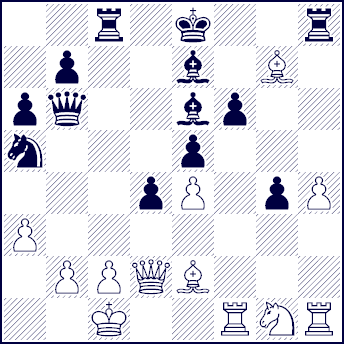
22. Qd3 Rg8 23. Bh6 Nb3+ 24. Kd1 Nc5 25. Qd2 Nxe4 26. Qd3 f5 27. Bc1 Bc4
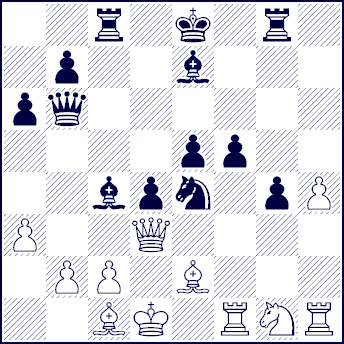
28. Qxc4 Rxc4 29. Bxc4 Rh8 30. Rh2 f4 31. Re1 g3 32. Rhe2 Nf2+ 33. Kd2 e4

34. Rxe4 Nxe4+ 35. Rxe4 d3 36. Nh3 Rxh4 37. Ng5 Rh2+ 38. Kxd3 Qd6+ 39. Kc3 Qf6+ 40. Kb3 Qxg5 41. Bxf4 Qg4 42. Bd6 Qd1 0-1
https://www.chessgames.com/perl/chessgame?gid=1956229
Update with reportage on Craddock’s time in Bedfordshire.

A side note on how to read old Tom Sweby's columns
Not perhaps, but quintessentially, Old Tom Sweby is best thought of as a passionate devotee to the newspapers he wrote for. He was well read and knowledgeable of the Bedfordshire chess scene and well beyond, given that he was the president of the S.C.C.U. once upon a time. He was generally well-respected and rubbed shoulders with many, if not all, of those eminent within British chess circles. It would, however, be a critical mistake to see his column is primary source material entirely. That it is not. You will also find secondary source material quoted too, and the reliability of that is not quite as Tom hoped. Given that he wrote for decades, this is to some degree inevitable, and after all we are all prone to error whether we realize it or not. Thankfully, with regards to old Tom Sweby, they are infrequent and for the most part old Tom continued to document events and developments in the Bedfordshire league from the get go as best he could but, of course, everything lies open to interpretation. Despite this, and generally speaking. this does indeed make him informative and thus worth reading. Dare I say his columns constitute a narrative describing the latest developments, match reports and changing nature of the Beds league...he knew his audience and wrote according. This manifested itself over decades but brevity was always in play courtesy of the restictions imposed by writing a column. Should you wish to read a in instrumental figure of the Beds' league post WW2, you are quite welcome to peruse what has been posted here... . :-) I should, however, point out that as the decades wore on he gradually moved on away from narratives concerning the Bedfordshire league towards affairs both historical and international. The reasons for this are multifarous, old age was a predominante factor presumably, however, the bottom line is with regards to how the Bedfordshire chess scene developed post WW2: old Tom Sweby is your go to guy. He wrote more about chess in Bedforshire than anyone else did but given he was a Lutonian and writing for a Luton newspaper there is both bias and greater coverage of his hometown than the rest of the county.
















To add comments, please see the bell at the top of the page.