

Posted in History of Bedfordshire Chess in the 19th century on May 8, 2024| Leave a Comment »
How are we to make sense of reportage below? Unless we can say when inter alia chess became the most popular board game in England we are limited. Although I have a background in both chess in draughts, I cannot give an account of which was more popular at the time in the content below. I suspect draughts was by some distance but cannot be sure.

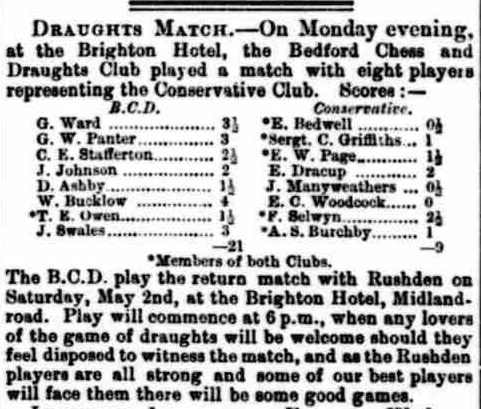
Not just in Bedford, Leighton Buzzard too.


Isn’t this how it should be done?


Posted in History of Bedfordshire Chess in the 19th century on May 8, 2024| Leave a Comment »
Documented on this site some nine years ago was Blackburne’s visit to Bedford in 1891. Please note, I have discovered reportage which gives a more detailed account of that evening and is well worth a read. It is a substantial improvement on what was previously posted -content-wise. Enjoy.


MJM
Posted in History of Bedfordshire Chess in the 19th century on May 7, 2024| Leave a Comment »
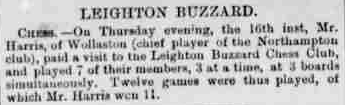
How old is Leighton Buzzard chess club? Don’t ask me, I’m not that old! But we can now say with certainty it was there in 1880, as the reportage below shows.

Posted in History of Bedfordshire Chess in the 19th century on May 6, 2024| Leave a Comment »

Chess in Bedfordshire, Dickens & White (1933), pg.41
The match below does not feature in the 1933 publication Chess in Bedfordshire but one later that year does. Note that it is described as a return match, so we can assume the two clubs played each other quite often. Here are the details.


Regarding the aforementioned match found in Chess in Bedfordshire of November that year, there were interim matches, also not included in the publication with reportage below which details the sentiments of the players somewhat.


Posted in History of Bedfordshire Chess in the 19th century on May 4, 2024| Leave a Comment »
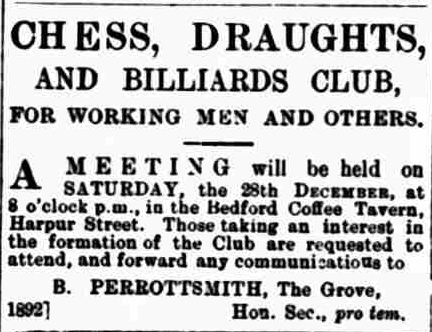
You don’t want to spend the night only playing chess do you? Why? How about you mix it up and play other games also, wouldn’t that be more enjoyable?
Just look at this cutting from The Bedford & County Record, December 28th 1889. There’s an ad with a proposal in it to generate interest in something special. To get people playing games. To get matches happening.

Posted in History of Bedfordshire Chess in the 19th century on May 4, 2024| Leave a Comment »
Once again special thanks to The Bedford & County Record for it’s sumptuous reportage of how things once were. A predilection of modernity across the globe is to think we are better off now than we were before -progress they call it. But is it cumulative with all things? I thinketh not. Look at those fine Bedford folk before the outbreak of WW1, and the evenings of games they had in each others’ company. They knew which side their bread was buttered on, that’s for sure. Want to read on?
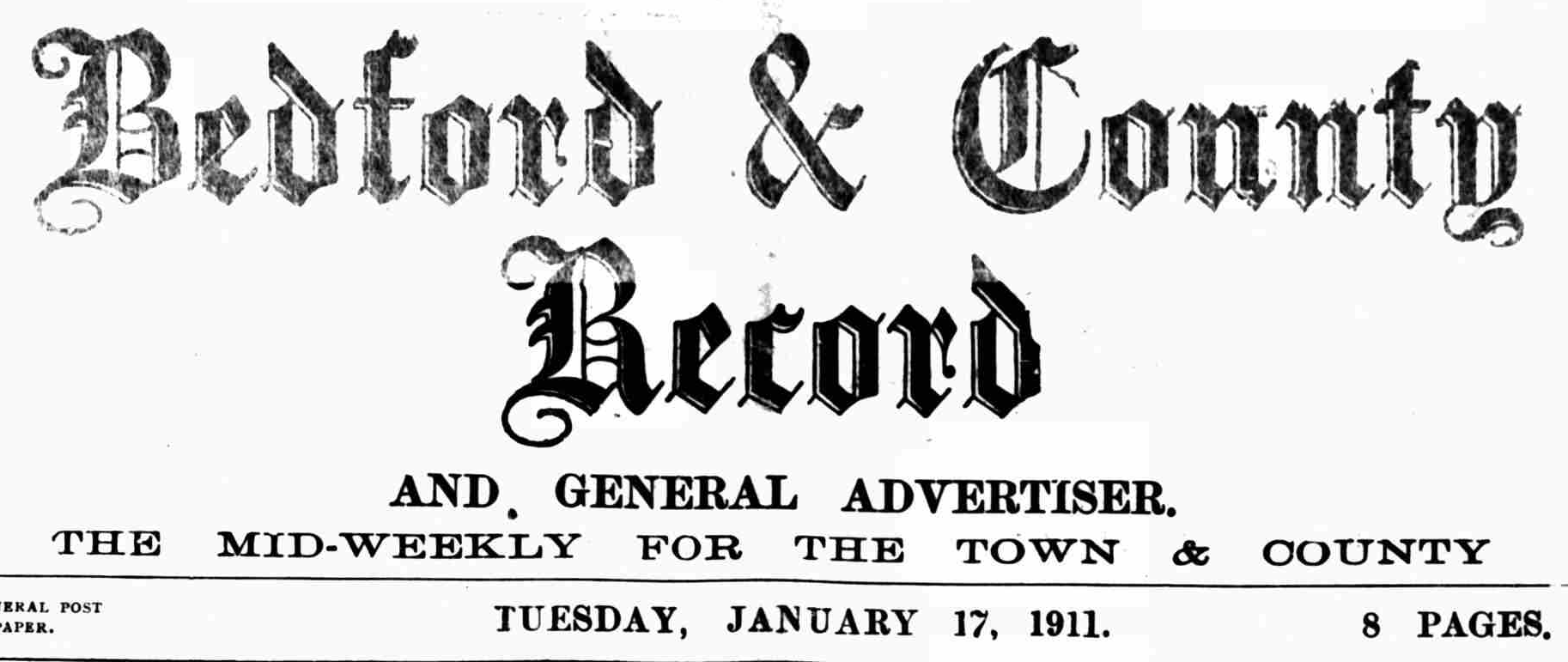
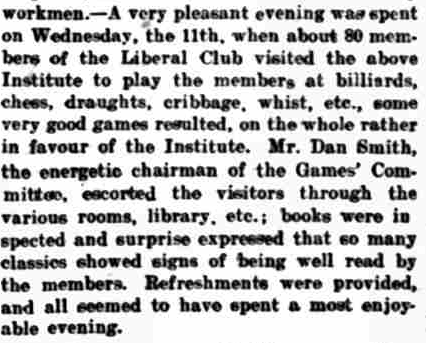
That’s the way to do it, is it not? But can we learn anything from how things once were before the advent of the Bedfordshire Chess Association formation and the Bedfordshire league? Although they were formed for the purposes of competitive chess locally, regionally, and then nationally, are the chess clubs that formed afterwards any better than the ones beforehand? Clubs created only for chess rather than games evenings, which functioned as chess clubs for chess only. Does it need to be asked why we no longer have games nights in clubs with more than one game on offer and couldn’t we ask whether chess sections could be housed within them if necessary? Is moving with the times always for the best? Must this involve selecting a venue cheap, empty and soulless rather than one accommodating and geared towards entertainment? Draughts and billiards have lost their popularity but chess has not, why is that? It seems to me that the clubs they used to play chess in were, generally speaking, more pleasant than what we have today, and that’s progress is it?
Mark. J. McCready
Posted in History of Bedfordshire Chess in the 19th century on May 4, 2024| Leave a Comment »
Once again we may offer thanks to The Bedford Record for its reportage and giving us an account of The New Conservative Club, Bedford and what it was like for chess players in our county. Did they have it better back then? Note there was a ‘chess room’.


Posted in History of Bedfordshire Chess in the 19th century on May 2, 2024| 1 Comment »
Before the motorization of vehicles, there is evidence that matches were played at mutually agreed venues, halving journey times. We find William Ward, future champion of London, playing for Luton in such an arranged match. Please see the reportage below.


This is quite an important find as it helps us understand William Ward’s movements between Luton and London better. Not before Feb. 18th 1897 then, but before November 1898? Why was St. Albans chosen? It is important to note that at the tail end of the industrial revolution when rail was made available, most matches were between cities and towns who were connected by it. At the time of the match it was possible to travel to St. Albans by train from both Luton and Watford. As the links below show you trains were up and running from 1868 and 1858 respectively.
https://en.wikipedia.org/wiki/Abbey_Line
https://en.wikipedia.org/wiki/Bedford_railway_station
William Ward has been written about numerous times in this blog. The best post is, I think this. https://mccreadyandchess.wordpress.com/2016/02/12/our-clash-of-future-champions/
Posted in History of Bedfordshire Chess in the 19th century, tagged Luton Chess Club on May 2, 2024| Leave a Comment »

Chess in Bedfordshire (1933), pg. 1

Chess in Bedfordshire (1933), pg. 2
We can assume, then, that arranging matches with local clubs was a priority. Regarding the renewed matches with St. Albans, at least one has been reported on.

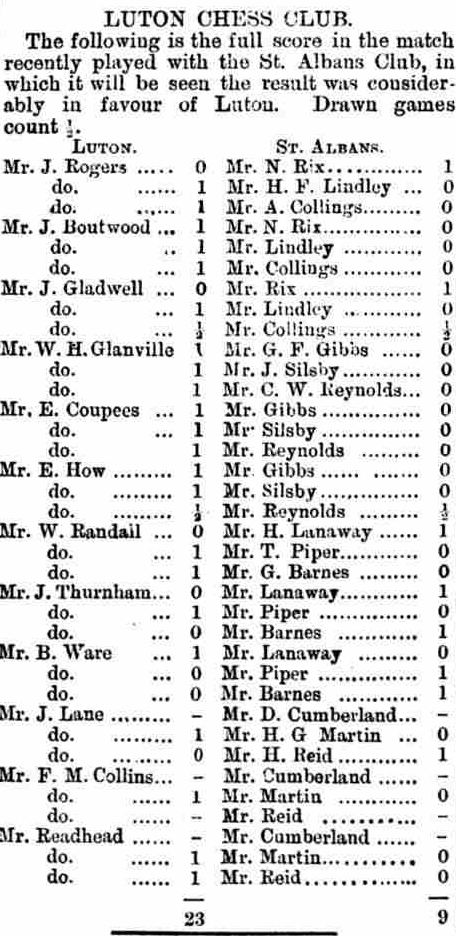
Reportage which refers to the matches against St. Albans and embellishes them can be found below.


A side note on how to read old Tom Sweby's columns
Not perhaps, but quintessentially, Old Tom Sweby is best thought of as a passionate devotee to the newspapers he wrote for. He was well read and knowledgeable of the Bedfordshire chess scene and well beyond, given that he was the president of the S.C.C.U. once upon a time. He was generally well-respected and rubbed shoulders with many, if not all, of those eminent within British chess circles. It would, however, be a critical mistake to see his column is primary source material entirely. That it is not. You will also find secondary source material quoted too, and the reliability of that is not quite as Tom hoped. Given that he wrote for decades, this is to some degree inevitable, and after all we are all prone to error whether we realize it or not. Thankfully, with regards to old Tom Sweby, they are infrequent and for the most part old Tom continued to document events and developments in the Bedfordshire league from the get go as best he could but, of course, everything lies open to interpretation. Despite this, and generally speaking. this does indeed make him informative and thus worth reading. Dare I say his columns constitute a narrative describing the latest developments, match reports and changing nature of the Beds league...he knew his audience and wrote according. This manifested itself over decades but brevity was always in play courtesy of the restictions imposed by writing a column. Should you wish to read a in instrumental figure of the Beds' league post WW2, you are quite welcome to peruse what has been posted here... . :-) I should, however, point out that as the decades wore on he gradually moved on away from narratives concerning the Bedfordshire league towards affairs both historical and international. The reasons for this are multifarous, old age was a predominante factor presumably, however, the bottom line is with regards to how the Bedfordshire chess scene developed post WW2: old Tom Sweby is your go to guy. He wrote more about chess in Bedforshire than anyone else did but given he was a Lutonian and writing for a Luton newspaper there is both bias and greater coverage of his hometown than the rest of the county.



















To add comments, please see the bell at the top of the page.

