Archive for the ‘History of Bedfordshire Chess’ Category

BRONSTEIN AND TAIMANOV IN LIVERPOOL

By DENIS V. MARDLE

CHESS, May 1952, Vol.17 no.200, p154

In 1951, it was decided to run an International Union of Students’ Chess Tournament in conjunction with the National Union of Students’ Arts Festival at Liverpool this Easter. The British Universities’ Chess Association co-operated, and some eight teams with three players in each were expected to meet from April 4th to April 10th, but by the opening date only one Belgian, one Dane and one Indian were at Liverpool to meet the British and Finnish teams. It was known that players were to come from the Soviet Union, and their non-appearance brought many enquiries from reporters. There was no “mystery” about the matter; the late choice of players had meant late applications for visas. In fact, only four days was required for the issue of these once Bronstein and Taimanov were known to be waiting in Prague.

The three individual players were grouped into an “International” team, and while awaiting the arrival of the Russians a short Tourney was held in which Finland beat Britain by 2-1, and the International team by the same margin, while the British trio beat the latter by 3-0.

The Soviet Grandmaster and Master arrived at 6 a. m. on April 10th, and a tournament was hastily arranged with the fast time limit of 40 moves in two hours. This was unfortunately necessary, as two games a day had to be played on two of the five days available. The other competitors were the Finnish master Pastuhoff and his fellow-countrymen Nyren and Rutanen with the Danish player Dinsen and the Indian Katragadda.

As was to be expected, the Russians won all their games against the other players, though they met stiff opposition. Nyren had a drawn position against Bronstein after 40 moves but was outplayed in the ending. The draw between the Russian players was a bitterly contested struggle. Taimanov, a concert pianist by profession, gave short recitals to the other competitors, and Bronstein’s work at the British section of the Institute of Languages in Moscow was of great service, even if he appeared to speak our language rather more quickly than most British people!

Unfortunately the impossibility of issuing advance publicity meant that few spectators witnessed the rare spectacle of two Soviet masters playing in a tourney in Britain.

In their individual game Bronstein avoided a draw by repetition on the fifteenth move, and after intense study of the transition to the middle game obtained a superior position, but as the time limit approached he had to make twelve moves in three minutes. At this point Taimanov sacrificed a piece for an attack which gained him a draw by perpetual check, Bronstein having missed a winning line.

The text above has been lifted from the following site:
https://www.saund.co.uk/britbase/pgn/195204liverpool-viewer.html

Read Full Post »

The 1956 grading list has been republished, unfortunately not a single player from Bedfordshire is on there. Why this is so is unclear since D. V. Mardle of Luton won most of his tournaments between 1955-1963 and was clearly one of the strongest players in the country at the time. The list is linked below.

https://www.saund.co.uk/britbase/pdfs/1956gradinglist.html
Read Full Post »

Read Full Post »

In the following link, you can find Bedfordshire’s champions since 1980.

http://www.adrianelwin.co.uk/Bedfordshire/Bedfordshire.html
Of all that I played, I’ve beaten 2, drawn with 2 but lost to 3 although one of them conceded I had completely outplayed him, which I did. I don’t recall how I lost the game, it may have been on time. Of the two I beat, one was titled and rated around 217 and the other was over 200 also but only just, 203 I think but may well be wrong there. He played an obscure line against my French defence with an early b3, possibly 2. b3, which as anyone will tell you, doesn’t do very much at all. It was an easy win. I mated him within 30 moves. Perhaps its so had I not given up chess and put a solid 10 year shift in I may have became on me of them but would it be worth it? The moments of love and joy chess brings are ephemeral, is there really a pay off for being a bit better or a lot better for all those minutes, hours, days, weeks, months, and years invested -I don’t think so.

I’m prepared to admit, in the many qualifying rounds played in a Winter’s eve, I got more than one sound beating from the very strongest in the county, and infrequently, walked away from the board with a hard fought victory and a wry smile on my face.

Read Full Post »

Most likely not, unless of course, the current world champion has had a litre of Vodka for breakfast and our Bedfordshire protégé is stone cold sober. Okay, so has a protégé from Bedfordshire ever outplayed our current world champion? The answer to that depends upon how you define what ‘a protégé from Bedfordshire‘ is. If you mean someone born in Bedfordshire, then no. If you mean someone who grew up playing chess in Bedfordshire, then yes. But -and yes it is okay to start a sentence with a conjunction, don’t go buying into Prescriptivism now -was the current world champion entitled so at the time? Sadly not. Was it a blitz game? Yes it was.

I shall now show you six diagrams and add some comments.

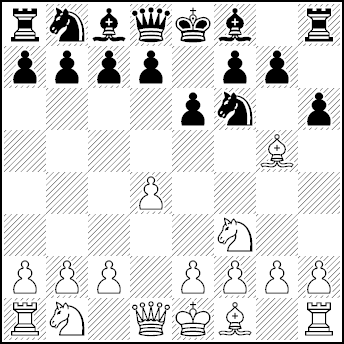
The Bedfordshire protégé plays with the white pieces, here. 3. …h6 has just been played.
Magnus Carlsen, a future world champion in 2006, has just played 10. …Nc6 and seems in sound shape as the middle game begins.
The Bedfordshire protégé has only just played 18. f3. As you know, every chess player’s favourite move is always moving your f-pawn one square only. Is the position equal, well I’m not an expert but notice that central pawn majority white has?
Ooh la la, sacre bleu, what is going on ‘ere? Zee future world champion has just played 26. ….Qxd6. Did he not see 27. c5 and the double-attack it unleashes?
This protégé from Bedfordshire is the exchange up and attacks the queen with 33. d6, surely the game is already won?
What trouble the future world champion is in here.? Or is he in any real trouble I should say? What is the result likely to be after black plays 37. … Qg5?

Some of us are proud of our county. I always have been. I am still. I will be always. Who was it that played our current world champion? The answer lies below.

https://www.chessgames.com/perl/chessgame?gid=1820780

Read Full Post »

In the only publication in existence on Bedfordshire chess, there are more games from foreign masters in it than local players.

https://mccreadyandchess.com/2015/09/09/chess-in-bedfordshire/

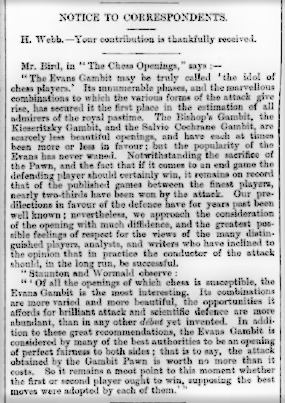
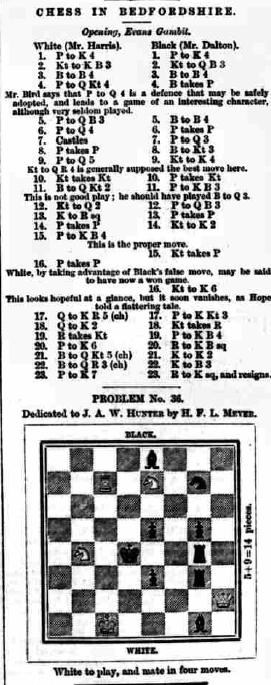
I’ve found in a Sussex Newspaper a game attributed to Bedfordshire Chess below some thoughts by H. E. Bird. None of this appeared in the text above.

Read Full Post »

Is there anything better to do than grabbing journalists and giving them a kick up the backside? Probably not…well probably there is. Seek out Primary Source material perhaps?

According to folklore and legend my hometown had it’s own league in the 70’s. Thankfully, we postmodernists do realize that history is per se discourse thus develops. Okay. Let’s look at things before the…before thee…thee so called Fischer-fiasco as our comrades once put it.

So a wintery 1952 it is. Here’s a snapshot of the Beds league. Even then Luton already has almost an entire league of its own, some 19 years before the famous Fischer – Spassky match and the ensuing ‘chess-explosion’ England underwent thereafter.

As some of you may know Dennis.V. Mardle went on to be given a C.B.E for his work on Polio, from which he suffered. He was an exceptionally strong player and many of his games can be found of this site.

Together the pgns above shows us that chess clubs flourished across Luton not long after the war had ended… .

More on Mardle can be found here:

https://mccreadyandchess.com/2016/12/07/mardles-battle-against-polio/?preview_id=6870&preview_nonce=9cae60ad6f&preview=true

MJM

Read Full Post »

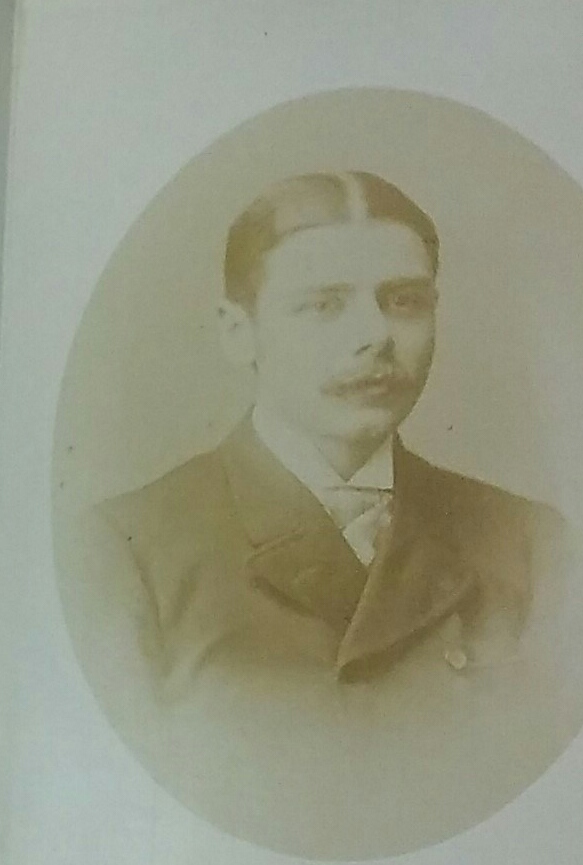
Courtesy of a source who shall remain anonymous, I have a portrait of William Ward, born in Abbots Langley in 1867 but lived in and around Luton for some of the first three decades of his life. He went on to champion the Atheneum club in London and the City of London club itself. He finished joint 2nd in the British Championships twice, and represented Great Britain in the Anglo-American cable matches long before we all had a plethora of expensive electronic devices at our disposal. Should you wish to know more about him, then by all means find the Bedfordshire Chess and Chess History categories, which is where he hangs out or alternatively click here.

https://www.chessgames.com/perl/chessplayer?pid=19561

aviary-image-1577081358301

Mr. William Ward

Read Full Post »

I thought it best to honour the life of Geoffrey Diggle in whatever way I could. 4 years ago I found a second hand book store that sold his extremely rare publications, so I bought them.

In case you don’t know who he is, he was a columnist for the British Chess Magazine for many years and made many people laugh courtesy of his way with words and immaculate sense of humour in his column ‘Newsflash’.

I took particular interest in him when I discovered passages of his on Edward Winter’s site http://www.chesshistory.com/winter/index.html
He spoke about my home town and I was soon to learn that he played for both Luton and Bedfordshire in the 1930’s -and was the manager of my bank as well. But more importantly I learnt that the venue for the Luton chess club at that time was The George Hotel on George street, which was the exact venue where my grandmother and grandfather met for the first time during ‘an evening of dance’. This I learnt through researching the post I hope to complete very soon: I wasn’t expecting it to go beyond 25,000 words but the care and effort put into I am deeply proud of, but more importantly, writing it has been more therapeutic than I can put into words.
Attached below are Diggle’s works. I apologize that some corners of some papers are slightly blurred. They were scanned 2 months back where use of my right arm was limited indeed, and there was no strength left to hold the cover down to my scanner. Anyway, enjoy Diggle, his sense of humour is second to none and the publications below are extremely rare. Now they are all yours…

An update to this post (13th December 2023)

After some thought and advice from friends, I have decided to remove the links to his works. I thought Diggle would like to be read by a newer generation and although that may well be true, it doesn’t excuse disregarding copyright laws, which I did. I strongly recommend you buy his works, and I regret to inform you it is improper for me to continue to link them here, so I have removed them)

Read Full Post »

F. Dickens who co-authored the only book ever written about chess in Bedfordshire is always described as a Schoolmaster from Kensworth. I cycled through there last weekend and took a picture of the only school it has, and what was his place of work during the 1930’s.

Read Full Post »

« Newer Posts - Older Posts »