As an experienced and usually enthusiastic photographer, I think I must have had around 30 people try to push me into professional photography over the years, some of whom were within the field itself. Most people are unaware that it is actually very difficult to make a living out of photography these days -being freelance is forced upon you unless you have influential friends. They also don’t realize that it is actually a mechanical and unsatisfying job, often with long hours and lots of unpaid travel time. Out of all the people I have met and worked with in photography, I still haven’t met one person that enjoys it. This includes those who ‘allegedly’ teach it. The only people who enjoy photography are those sensible enough to keep it as a hobby, people like myself.
Given that I have never taken photography too seriously, like many amateurs/hobbyists/enthusiasts, I have strengths and weaknesses. Photographing a human subject has always been my biggest weakness, mainly because being a shy person myself, overcoming shyness with the camera is harder for me than most, and also because I when I photograph a person, I haven’t really known what I should be looking for. Fortunately chess has changed all that, it has provided me with a solid platform to work from because most people are often too engrossed in their game to notice you, which means that you often get a more natural pose (as photographers will tell you, posing itself is an art-form), and also there is a often a large number of subjects to chose from at any given time. I have concluded that chess is a good medium to improve your skills of photographing people. In addition, I had to return to the fundamentals and approach the whole area by asking what does a picture of someone playing chess comprise?
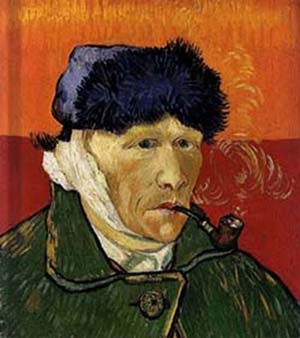
A self-portrait by Van Gogh. What does it express?
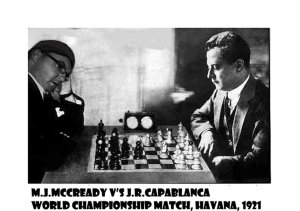
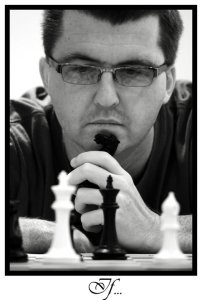
An instructive way to think of a picture of someone playing chess is to think of it as a portrait, this needs a little explanation. Firstly what is a portrait? A portrait is a concept which is not as easily explained as you might think. To begin we must transcend photography, since it cannot tell us much about what a portrait is. We must go back in time to before photography existed, to the world of art. Artists, especially those who specialized in portraiture, were much better at showing us what a portrait is about. Traditionally, portraits have had a living being as a subject, which in turn has mental states. In sum, then, portraits involve people -we couldn’t, for example, argue that an inanimate object qualifies for the subject of a portrait. The subject of the portrait should have a pose of some kind. An effective portrait should give us an insight into human nature by revealing the inner states of its subject in some way. With this in mind, we can see how chess is, potentially, a good medium for portraiture. Even though, strictly speaking, chess players are engaged in chess, the activity itself does not compromise the basic requirements for a portrait, using the definition posted. One last point before we move on, before photography came along, patience was a pre-requisite of both having and painting someone’s portrait. In our ephemeral embrace of digitalisation, patience plays no part. This is something that those of us wanting to photograph chess players must re-examine. Chess does not lend itself to self-expression. Often a chess player will be motionless and expressionless, to get the kind of shot you want, you must factor this into your photo shoot. Here’s a few other pointers that should improve your chess photography overall. These ideas should be understood as pointers towards a more aesthetic appreciation of photography rather than a mechanised one. They are geared towards appreciation of the process of photographing rather than the process of improvement, though as it already has and will again be suggested, enjoyment and improvement are correlated in photography.

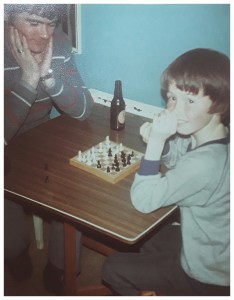
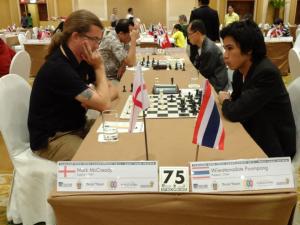
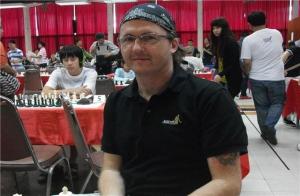
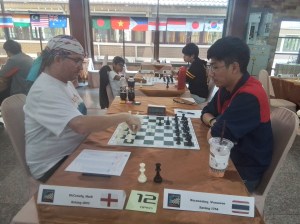
A worthy opponent who took me to the endgame.
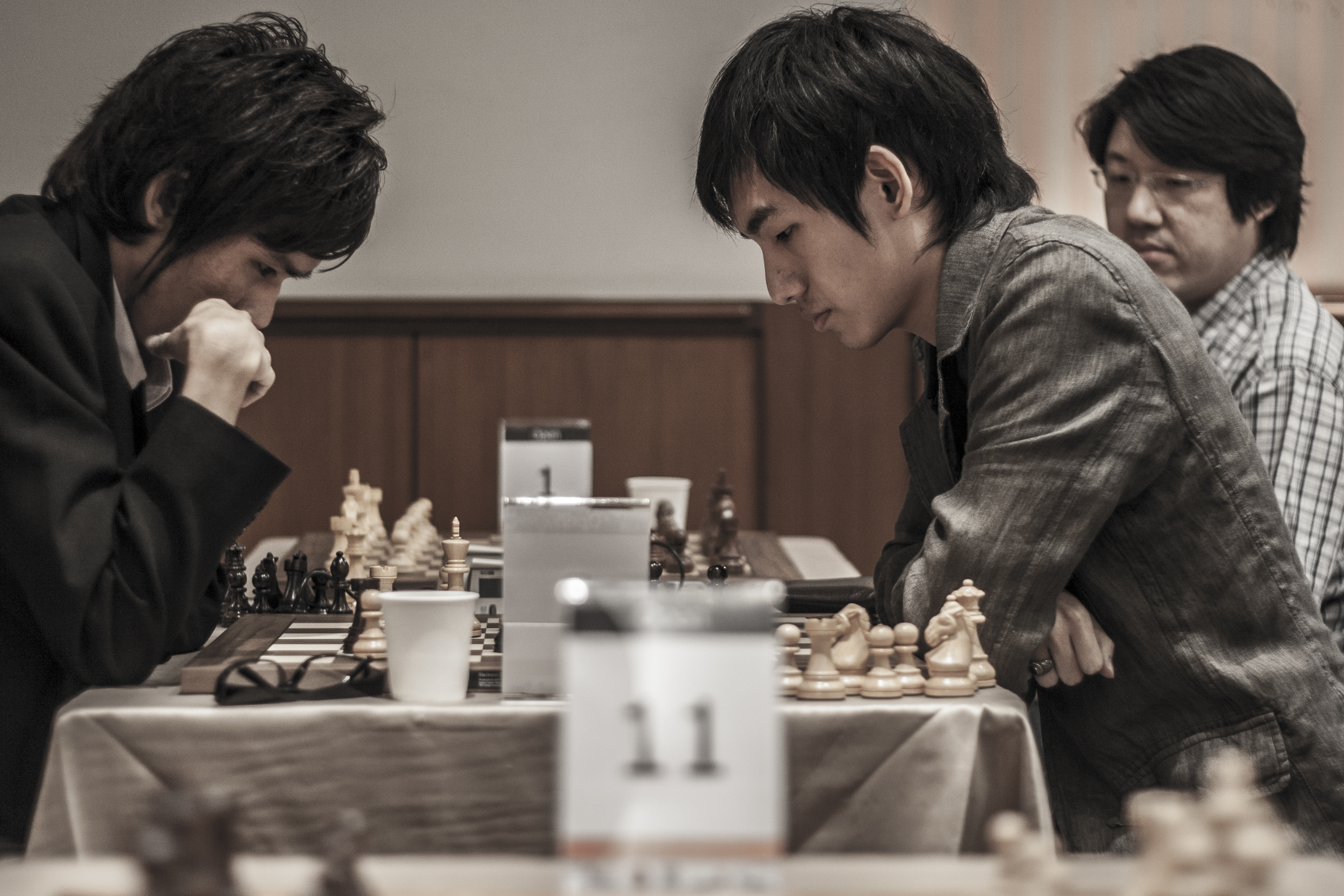
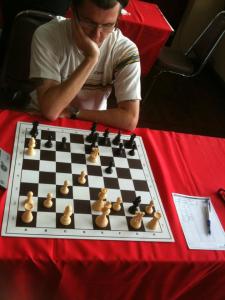
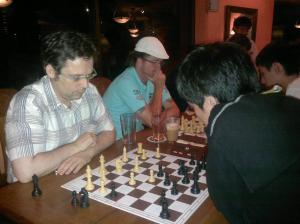
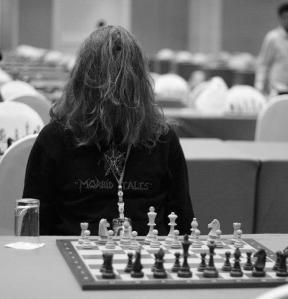
Your primary subject will usually be a person NOT chess itself. Since your subject is a person, you must concentrate on how they express themselves. Usually, this occurs through facial expressions, posture, or mannerisms -by this I mean the way someone might write the moves down or press the clock. You should know before you shoot what you want to capture. You should look for the way your subject expresses him/herself, as it will always be particular to them. One crucial point that less experienced photographers often overlook is, if you are taking a picture of someone’s face, you should photograph from eye level or below. Of course all rules have exceptions, but generally speaking, shooting from a standing viewpoint doesn’t allow you to see the subjects face wholly, especially if they are resting their head in their hands or leaning over. This means you will have to crouch down and get in someone’s eye line. Don’t worry about being a source of distraction too much. You will be one but chess players are used to such things and can easily ignore it. This brings me onto those who can’t/don’t.
Tip 2 Stealth captures what is natural.
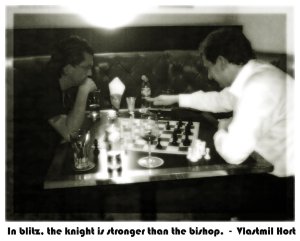
Generally speaking, most people like to have their photograph taken. The fact that they are playing a game of competitive chess does not always alter that fact, however, posing is an art-form that is lost on the vast majority. If instead you’re looking for a natural pose, the best way to move around a playing hall is, then, slowly and quietly. Try not to engage eye contact with players at any point as this can send signals that you intend to photograph them and can thus negatively affect the result of your picture. Why should you move around the playing hall slowly? Well, like in chess, patience is a great virtue in photography too. If you find a good spot, don’t be afraid to claim it as your own for a short while. Your subject may be deep in thought, there may be nothing interesting or no action to capture but this will only be temporal.
Tip 3 Some phases of play offer better photographic opportunities than others.
There are phases of the game which are incredibly valuable for photographers because they contain more action and response. The start of play and time trouble being the most significant. The end of a game, by this I mean after play has finished, should not be overlooked also.
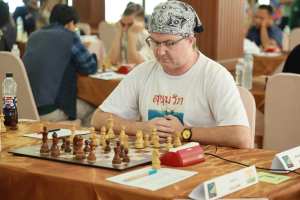
At the beginning of a game, players sometimes behave slightly differently than during the game itself. They may often express surprise or horror at their opponents choice of opening (having played 1 f4 for a few years in the past, I think I am qualified enough to speak about that). They may have certain habits which they only perform at the beginning of a game, such as aligning/fixing the pieces within their squares, or examining the clock.
Time trouble speaks for itself. We’ve all been there enough times. We know how we feel inside and act accordingly. Everything can be won or lost quickly at such times, so it is then when we are at our most emotive. The range of emotions on offer for the photographer is so great, that photographing players in time trouble should be a main inclusion of every photo shoot, perhaps THE main inclusion. You should remember that chess itself does not tolerate much self-expression, it is a game of composure and concentration, so you should target the phases of the game where play becomes looser. Also, time trouble can lead to dispute or intervention by an arbiter, once again broadening the range of emotions on show. However, it should be pointed out that it is advisable to keep your distance if you can. If you have a telephoto, this is the time to use it. The last thing someone desperately trying to save their position wants is someone trying to take clever pictures of them.
At the end of the game, players often carry the result of their game in their faces. There are also formalities which are interesting to observe and photograph, such as the the signing of score sheets and leasing with an arbiter. Some players chose not to hang around after a game has ended, offering few if any opportunities to catch the final moments of play. When a player has just left the table and turned away from his/her opponent, you should try to photograph them, as this is the moment where courtesy gives way to satisfaction/dissatisfaction.
Tip 4 Keep chess out of some pictures.
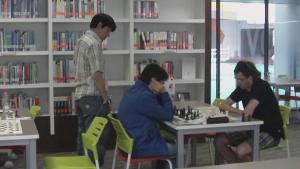
Away from the board there are so many things to photograph that it would be pointless to try and include them all. Instead, it is better to bear in mind some crucial ones. Firstly, some players like to go for a walk or socialize between moves, this often present good opportunities for a photographer. Secondly, tournament organizers and officials have jobs that are unseen by the majority of players and spectators. Thirdly, all locations contain features that are unique to them, such features are often used to identify a certain tournament and are thus important. Lastly, incorporate external factors into your photographs. That could be nothing more than including spectators around a particular board or perhaps the rain outside the hall. You might want to photograph other photographers going about their business or include items and/or rooms outside the main playing hall.
Tip 5 Study composition; always aim for variety.
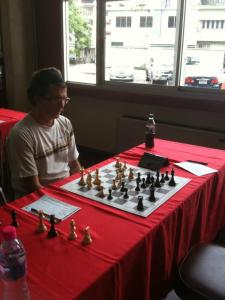
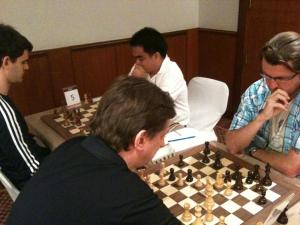
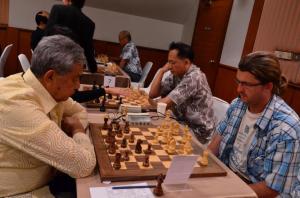
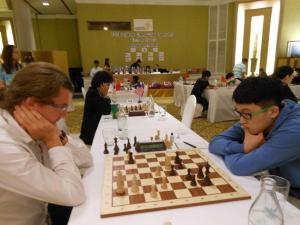
In spite of all the crumby adverts you see on tv nowadays, photography isn’t about point and click. You must bear composition in mind at all times. What does this mean? Well there are certain rules to composition which are worth looking at, such as the ‘rule of thirds’, which I don’t have time to go into now, though I do advise that you look at them at leisure on the net. Just google the aforementioned phrase and you’ll get lots of stuff come up. Traditionally in portraiture subjects are in the centre of the frame, however, in chess this need not be so. More often than not you will want to include the board too. This often means that the subject gets pushed to the side of the shot. Pictures that focus solely on a subject and do not include the board can and often do work very well, but it must be remembered that these should not predominate your shoot that day. Chess players need a frame of reference -chess! Instead, we should aim to include the focus of attention when we can, as this is what the subject is pointing towards, and so the subject as a whole should be seen as a person shown to be engaged in chess, and not just a person.
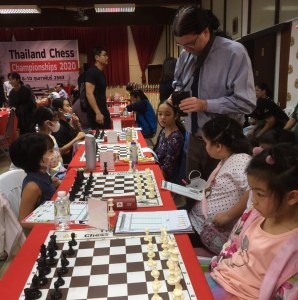
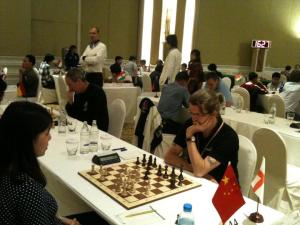
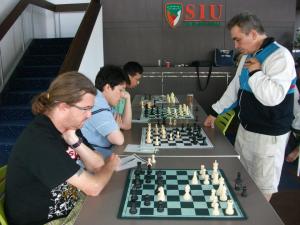
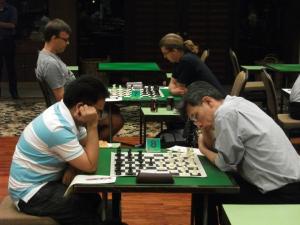
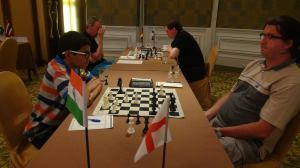
Within any playing hall there will be rows of players. Lines are very important for good composition. Strong, diagonal lines often work well. What do I mean by this? Well, rather than shoot from directly behind a row of players, move aside as much as you can so that more faces appear in the shot, rather than the back of heads. The line of players will move diagonally across your image when you do this, like in the image below.

Digital photography allows us to shoot hundreds of pictures at a time -and so we should. Vary your shots as much as you can. Take pictures of individual players, players with their opponents, rows of players, sections of players, players sitting, standing, eating, drinking, chatting. Photograph from different angles, try to be as free as you can in what you do. Not only are you more likely to get better results, you’ll probably enjoy the experience more.

Tip 6 Improve your editing skils.
Photography isn’t just about taking pictures nowadays. The industry has been revolutionized by the advent of digitalization. Bundled in with this change is the onus on editing and processing skills. It is now possible to transform an ordinary picture into an outstanding one by picking up a few skills. All camera manufacturers provide good software when you buy a camera, its worth spending a bit of time playing with it, and seeing what it does. The results can be surprising and effective. As great as digital cameras are, they still have issues regarding metering and exposure. You’ll often find that a few tweaks here and there can work wonders.
Anyway, that’s all from me. Hope it helps.
Oh, one last thing. If you enjoy photography and want to improve your pictures, consider purchasing one of Tom Ang’s books. Don’t buy the over-priced magazines you see for sale. Just buy Tom Ang.
http://www.tomang.com/
Mark.J.McCready
Read Full Post »



















 McCreadyandChess