Archive for the ‘Moves I could never play’ Category

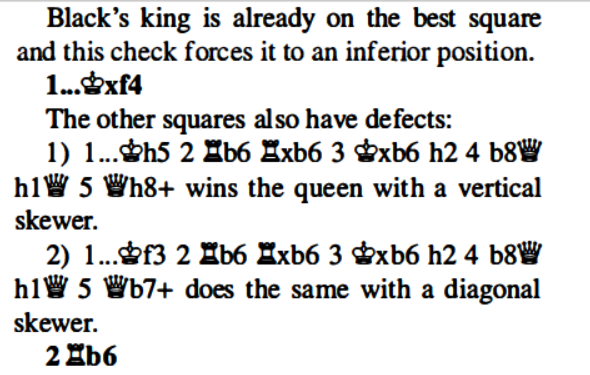
Straight from the source because I cannot link the game. GM Nunn’s book Understanding Chess Endgames again, I do suggest you purchase a copy if endgames are what you want to study, and you are a rather meek club player like myself. Have a look at the following position, it’s white to play.

White is able to win this but there is only one way to do it, via the intermediary check Rg6! As the analysis shows below, black is compelled to capture on f4 but a pawn race will soon ensue, which allows white to pick up a valuable tempo by queening his pawn with check. To me it doesn’t look like white can save himself. In endgames, where lines of calculation ealongate, I wouldn’t see the significance of the intermiediary check. Would you?

Analysis can be found here:

M J M

Read Full Post »

A mere mortal club player always in a muddle or worse over the board, am I meant to know how to weave a mating net in this position? Even if I did study endgames often, would I see it? Probably not. According to GM Nunn in his book detailed below, the move played is the only winning move. I am not good enough to consider how important the king position can be in such endgames and how it can be decisive also but then I am allergic to going more than 4 or 5 moves deep!

White plays 59. Kd3 here.

https://www.chessgames.com/perl/chessgame?gid=1125480

You can find analysis of this position in GM Nunn’s Understanding Chess Endgames, pg. 40.

M J M

Read Full Post »

Soviet chess and Bondarevsky plays a move against Panov I could not play. The queen and two minor pieces are on the queenside and white appears to have control over many squares on the kingside, so making a sac work on that side of the board feels counter-intuitive and inadvisable. But work it does with deep calculation and another sac to follow. Not easy to see how so.

Black plays 16. … Bxh3 here.

https://www.chessgames.com/perl/chessgame?gid=1411384

Analysis of this game can be found in this publication.

M J M

Read Full Post »

With regards to the publication below, which I bought decades ago, I’ve always had a strong admiration for Tolush. He was Spassky’s trainer, and his style of play is so reckless at times, as you will see below should you click on the link provided. I’m not a 1. d4 player but I know enough about The Trompowsky to say with some confidence that if you play it, and your queenside collaspes completely, and most of the kingside has been left undeveloped whilst your king gets chased half way up the board, perhaps you didn’t gain much of an advantage out of the opening! When you resign on move 26, that’s often the case. I couldn’t play the move below because my assessment is based more on evaluation than calculation and I am not brave enough to play such moves. How can he justify allowing 9. Nxc2+? Very brave indeed or failing that miscalculated-hard for me to tell. You may want to play through the game, many over the years have as it’s quite something.

White plays 9. Be5 here!

https://www.chessgames.com/perl/chessgame?gid=1270161

M J M
Read Full Post »

On pg. 101 in his excellent book The Soviet Championships B. Cafferty comments that the move below requires deep analysis. Far too deep for me and almost everyone else below 2600 ELO I would imagine. Sacrifices with long-term compensation are above my level I don’t mind admitting. I do not know how white is meant to proceed after the annotated move below.

White plays 12. Nc6 here.

https://www.chessgames.com/perl/chessgame?gid=1072785,

M J M
Read Full Post »

I’ve never sacced a queen in my life! So what are the chances of the likes of me playing the move below? Yes, there’s some immediate compensation but not enough and the win is from from easy. Another 13 moves are played before GM Miles resigns with mate imminent. A fine game by Bedfordshire’s GM Plaskett, considered his best.

Here GM Plaskett plays 19. Nxe4

Read Full Post »

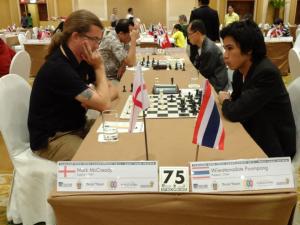
Even if shown it by Topalov prior to the tournament, as McShane claimed was the case back then, I still could not play this move. Unsurprisingly, long term exchange sacrifices are not my forte, only pawn sacrifices I can do if push comes to shove.

McShane plays here 10. …axb5

Great advert for English chess, and shows how immensely strong McShane was at his peak. A fogotten old favourite, still too above my level to grapple with.

https://www.chessgames.com/perl/chessgame?gid=1669470

M J M
Read Full Post »

In the position below I would be more inclined to lament over being under the kosh than what I should play next. A sort of ‘Blast it! Just play anything and expect to sac back at some point‘, said under one’s breathe to oneself whilst lurching over the board, psychologically defeated. Which moves are better than others, that I don’t know. Defeat for white looks inevitable to me despite him being a piece up -I stand to be corrected of course.

Topalov plays 20. Qb3+ here.

Somehow connected to saccing back presumably. The link to this long forgotten game is below.

https://www.chessgames.com/perl/chessgame?gid=1010744

Analysis (suggested) can be found in the forgotten publication ‘The Mammoth Book of The World’s Greatest Chess Games’ by Burgess, Nunn, and Emms.

M J M
Read Full Post »

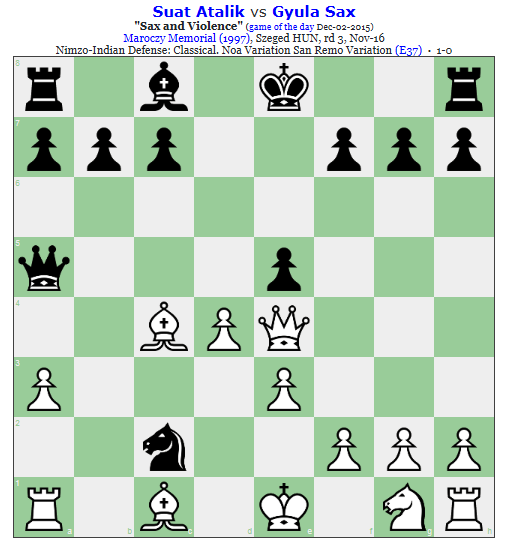
Since I used to admire Spassky’s old trainer Tolusch, who has a game in Cafferty’s book on the Soviet Championships, where he drops almost everything on the queenside and has to walk his king up the board in the opening before resigning, I try to avoid doing it myself. Without extensive opening preparation, something club and county players like myself are rather shy of, I could not play the move below, and would assume Kd1 is the safer bet. The alternative is so committal, you would have to be very sure it works to play it.

Here, Atilak plays 13. Ke2

As mentioned, without extensive opening preparation, how could you play that? Personally, I prefer the king to stay on the back rank if possible. The game is rather interesting though, showing capitalising on an out of play queen can be decisive. ‘Sax and violence’ they call that in the link below -good title.

For concrete analysis, it can be found in one of the many publications I have purchased over the years and also forgotten all about, that being ‘The Mammoth Book of The World’s Greatest Chess Games’ by Burgess, Nunn, and Emms.

M J M
Read Full Post »

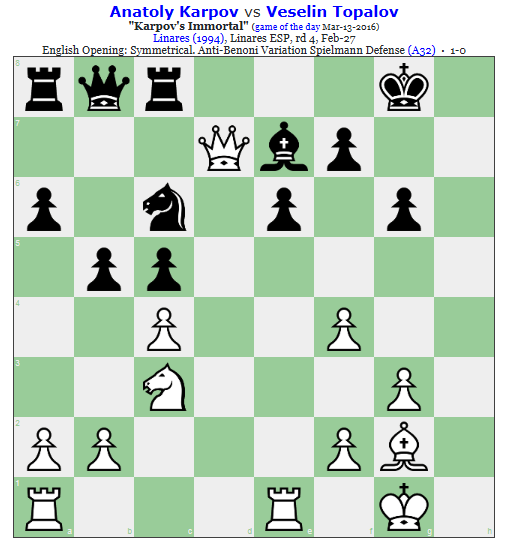
All games played by those above ELO 2700 with three rooks offered up in nine moves are easy enough to follow, right! But the first instance, a full on rook sac by Karpov, is far too above your average club player like me.

Karpov plays 20. Rxe6 here.

https://www.chessgames.com/perl/chessgame?gid=1069169

This game is described as Karpov’s immortal game in several places, and the tournament victory is considered one of his best, if not the best. Unsurprisingly, the move above and the game itself constitutes entertainment only for most of us.

MJM
Read Full Post »

« Newer Posts - Older Posts »