
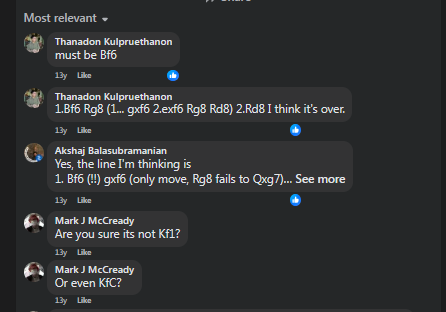
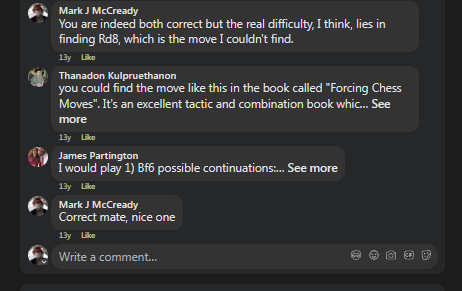
https://www.chessgames.com/perl/chessgame?gid=1281045
M J M
Posted in Moves I could never play on December 24, 2025| Leave a Comment »
Posted in Moves I could never play on December 9, 2025| Leave a Comment »
Posted in Moves I could never play on October 3, 2025| Leave a Comment »
Posted in Moves I could never play on September 28, 2025| Leave a Comment »
With Bob Hope and no hope the only two hopes I have at being good at chess, the rather radiant move below, that being 18. Nc6 is, above my level very much. The analysis required is so deep, and imagination is required as well. Yes I note that white wants to remove the dark-squared bishop which is a key defender but it looks like Black has enough still. Way, way, way above my level.

https://www.chessgames.com/perl/chessgame?gid=1034337
I found this game from surfing this: Tim Krabbe
M J M
Posted in Moves I could never play on September 27, 2025| Leave a Comment »
Who doesn’t like mad positions? What is black meant to play here? It’s another Soviet Championship game, this time between Balashov and Beliavsky, from 86. The move played looks rather suicidal to me but this position is too difficult to know what’s best imo.
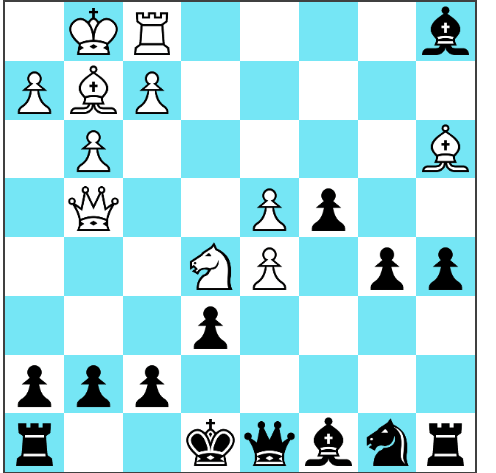
https://www.chessgames.com/perl/chessgame?gid=1024991
You can find analysis in the recommended publication below.

M J M
Posted in Moves I could never play on September 27, 2025| Leave a Comment »
One of Karpov’s best games and such a sublime and elegant move. This is Karpov v Dorfman, Soviet Championships 1976. Way above my level but so beautiful. Most would just want to grab material with dxe7, which is hardly going to win you the game. Karpov knows best.

https://www.chessgames.com/perl/chessgame?gid=1067966
You can find analysis here.
M J M
Posted in Moves I could never play on September 23, 2025| Leave a Comment »
The chess player I admire most is GM Magnus Carlsen.1 Second is his main rival Fabi.2 Here’s a position from one of their many clashes. It’s too difficult for moi to assess accurately in order to discern what is the best move to play, engines aside. Rook endgames are so highly nuanced that anyone can go wrong in them, so what chance has little ole’ me got of seeing GM Carlsen’s move?

Piece activity is essential in endgames, we all know that and black obviously wants to queen a pawn but can’t he shore up his position first by improving his king position? It doesn’t look right to drop the e-pawn and gift white greater mobility for his rooks like that. I would want to play Kf7-e6-d5 before doing anything else, try and march the king in if you can, assuming of course the position allows for this. Just looks safer and much less double-edged but with calculation skills as limited as mine, and me being prone to making a mess of things, how can I tell what to play for first, Rook or King activity? GM Carlsen only drew this game, so perhaps there are inaccuries in play, however, I would prefer to take black in the position above. I would play 38. … Kf7 here.
https://www.chessgames.com/perl/chessgame?gid=1916995
M J M
Posted in Moves I could never play on September 17, 2025| Leave a Comment »
I do love bravery over the board especially when it comes from those remembered more for defeat than victory. Pianist and GM Taimanov shows confidence in his calculation skills and plays something that myself, who is always a nervous wreck over the board is too feeble and rubbish to try!

Could you castle long here and leave your queen hanging? Perhaps you could if you can see whose king is in the most danger. At first blush it’s not for the faint-hearted me thinks but spend a few minutes and it’s actually quite playable. That said, instinctively I would discard such moves as being far too risky and look for something more solid instead. An interesting game with a devastating attack it is.
https://www.chessgames.com/perl/chessgame?gid=1111512&kpage=4&comp=1
Analysis of the game above can be found on pg. 105 of that below.
M J M
Posted in Moves I could never play on September 16, 2025| Leave a Comment »
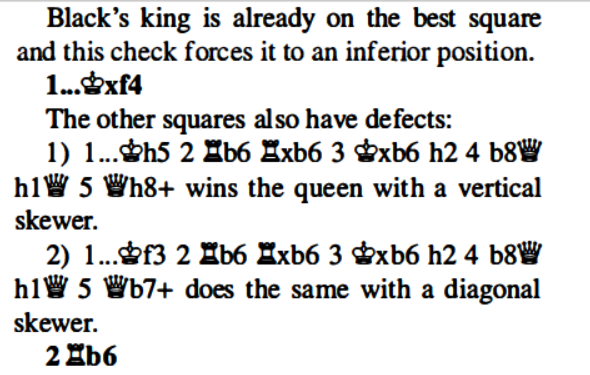
Straight from the source because I cannot link the game. GM Nunn’s book Understanding Chess Endgames again, I do suggest you purchase a copy if endgames are what you want to study, and you are a rather meek club player like myself. Have a look at the following position, it’s white to play.

White is able to win this but there is only one way to do it, via the intermediary check Rg6! As the analysis shows below, black is compelled to capture on f4 but a pawn race will soon ensue, which allows white to pick up a valuable tempo by queening his pawn with check. To me it doesn’t look like white can save himself. In endgames, where lines of calculation ealongate, I wouldn’t see the significance of the intermiediary check. Would you?
Analysis can be found here:



M J M
Posted in Moves I could never play on September 14, 2025| Leave a Comment »
A mere mortal club player always in a muddle or worse over the board, am I meant to know how to weave a mating net in this position? Even if I did study endgames often, would I see it? Probably not. According to GM Nunn in his book detailed below, the move played is the only winning move. I am not good enough to consider how important the king position can be in such endgames and how it can be decisive also but then I am allergic to going more than 4 or 5 moves deep!

https://www.chessgames.com/perl/chessgame?gid=1125480
You can find analysis of this position in GM Nunn’s Understanding Chess Endgames, pg. 40.

M J M
A side note on how to read old Tom Sweby's columns
Not perhaps, but quintessentially, Old Tom Sweby is best thought of as a passionate devotee to the newspapers he wrote for. He was well read and knowledgeable of the Bedfordshire chess scene and well beyond, given that he was the president of the S.C.C.U. once upon a time. He was generally well-respected and rubbed shoulders with many, if not all, of those eminent within British chess circles. It would, however, be a critical mistake to see his column is primary source material entirely. That it is not. You will also find secondary source material quoted too, and the reliability of that is not quite as Tom hoped. Given that he wrote for decades, this is to some degree inevitable, and after all we are all prone to error whether we realize it or not. Thankfully, with regards to old Tom Sweby, they are infrequent and for the most part old Tom continued to document events and developments in the Bedfordshire league from the get go as best he could but, of course, everything lies open to interpretation. Despite this, and generally speaking. this does indeed make him informative and thus worth reading. Dare I say his columns constitute a narrative describing the latest developments, match reports and changing nature of the Beds league...he knew his audience and wrote according. This manifested itself over decades but brevity was always in play courtesy of the restictions imposed by writing a column. Should you wish to read a in instrumental figure of the Beds' league post WW2, you are quite welcome to peruse what has been posted here... . :-) I should, however, point out that as the decades wore on he gradually moved on away from narratives concerning the Bedfordshire league towards affairs both historical and international. The reasons for this are multifarous, old age was a predominante factor presumably, however, the bottom line is with regards to how the Bedfordshire chess scene developed post WW2: old Tom Sweby is your go to guy. He wrote more about chess in Bedforshire than anyone else did but given he was a Lutonian and writing for a Luton newspaper there is both bias and greater coverage of his hometown than the rest of the county.


















To add comments, please see the bell at the top of the page.