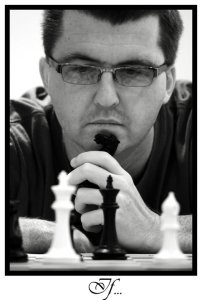
This comes from knowledgeable and respectable chess friend Mark Ruston who went to school in Charlton, London. There he was taught by former British chess champion IM Bob Wade OBE. Where did IM Wade live in London and which former British champion did he rent a room from in his palatial mansion?

Helpful but chronicled clue: whilst teaching south of Charlton in New Eltham one summer, I used to cycle to The British Library to look at the chess books available to the public in its reference section (especially Sargeant’s A Century of British Chess). En route, and after a tough climb, where IM Wade lived I fell for because it was the first part of the city I rode through that was very green and quiet, and not like London at all. Still to this day, I often think if I could choose a part of London to live in, that would be it.

Shorter helpful clue

It would be more accurate to hyphenate the term ‘champion’ in the question.

Trivia Q

Which online bank and global payment platform has a founder who shares his name with a popular Soviet world chess champion?

Reflections 11

Those 7 seconds of fame for the school chess champion

In 1988, and as school chess champion, I can be seen on Match of The Day for about 7 seconds, although you won’t really be able to tell it’s me. I am wearing my beloved blue and yellow Puma jacket and went to the FA Cup reply with school mate Stuart Tennyson (more on him below). If you go to 1.04, and look towards the bottom of the screen you will see someone standing with a blue and yellow jacket on, that is me, and the person to my left who you see me talk to but can barely make out at all is Stuart -I leant him my membership card to get in the ground, handing it to him through the turnstyles after I had got in.

Memories of Stuart at school that refer to chess but touch upon football can be found lifted from a previous post. I do need to clarify, that post is 35,000 words long and took 19 months to write. It is an accurate account of chess in my youth and nothing below has been exaggerated or invented on any level, instead the most accurate recollection of what occurred has been documented (not for the faint-hearted):

Chess in classrooms where riots broke out

A kid called Jalil joined our school in the first term of our final year. He was Turkish and spoke little English but became my little friend quickly. Classmate Martin and I were asked to show him around and help him find classrooms. His English was very poor, he was new but we smoothed it over for him until his personality began to protrude, then we had to duck for cover. Jalil came from a family of martial arts experts. He was short, stocky, and a blackbelt in karate well before he became fifteen. He worked out rigorously and destroyed everyone in arm-wrestling contests. He had plenty of hot Turkish blood flowing through him and like myself he loved chess. He called me ‘Scottish’ because ‘Scottish’ was my nickname at school. Afterall, most of my relatives were Scottish and I spoke some of the words my nan taught me in her Scottish accent. And whenever England played Scotland at football, I would always run across the road and watch it in their house with a kilt on and support Scotland.

Jalil and I played chess at the back of the class in most lessons, and when we didn’t play chess we played blackjack. Jalil was expelled from school because he threw a typewriter at another pupil’s head -missing by inches only. That boy was a certain Matthew Jefferson -himself a right handful to say the least. In French Matthew once came to class late, and as he walked behind the row those in front of us sat in, he stabbed three people in the back of the head with his pen in one swift movement, much to their dismay and my amusement. But as Matthew found out, Jalil was the wrong person to try it on with. When summoned to a senior teacher to explain why he threw a typewriter at Matthew’s head, Jalil said nothing and again took no nonsense. I stood outside and heard the kerfuffle. What was going on in there I didn’t know. But furniture was being damaged of that I was sure. I saw the look on the teacher’s face as he left visibly flustered, definitely unvictorious in his hurried departure.  

But just before Jalil was thrown out there was a riot in our class, and Jalil was on fine, fine form. Luton Town F.C won the league cup at Wembley Stadium the weekend before. All week we waved our tightly knotted scarves about and spent break times running about smacking smaller kids round the head with them. We were all so happy –but at Stockwood High School, that was frowned upon in classrooms. During English class, a pupil named Stuart Tennyson paraded his Luton scarf in class proudly but our substitute teacher was having none of that. She was more middle-class than the many others ushered in before her, and so confiscated Stuart’s scarf as he brandished it. Uppity and uncaring, on she carried, focusing on her next pay packet more than her insolent pupils –that was her mistake. Up Stuart stood and strutted up to her desk, snatching it back with a smile on his face to show us all.  She stopped writing on the board, walked up to his desk, and visibly angered, snatched it back. A fierce argument broke out, ending when Stuart snatched back his scarf for the last time and whacked her round the side of the head with it in front of everyone. Out she stormed, cheer ourselves on we did then we rioted. At first Jalil and I carried on our game of Blackjack at the back of the class, then it got messy, really messy. Everyone was going at it so we joined in. We both turned over tables and together ripped the legs off them, then an about to be expelled Jalil really went for it. Bruce Lee-like he started spinning round at speed and whacking people about with the table legs we tore off. He gave us a full-on demonstration with impassioned B-movie sound effects thrown in –highly entertaining to me but not anyone else. One or two took him on but were whacked about at great speed and fell back fast. I just stood to the side, booted in study cubicles then kicked chairs about whilst watching Jalil take on anyone in his path. There was no end to the destruction but what got us caught was throwing hundreds of books out the windows and cheering each other on as we did. Teachers in the classes below came to see what the commotion was and why hundreds of books went flying past their windows. They didn’t take too kindly to seeing us have such a laugh whilst destroying the place, myself and Stuart together throwing away the shite we were supposed to read, seeing who could chuck the most out in one go. What came of that I can’t remember. It mattered not. ‘Scottish’ as I was known as was done with school anyway.

M J M

Reflections 10

At first sight the ploughman’s task seems to be one which ought rightly to be set only to some well-balanced philosopher, who could calmly descend into himself during the many lonely hours and think of nature and man in orderly thoughts. To the ordinary man, with his drug-habit of taking to reverie during any long spell of solitude, such a task would seem fatal. In fact, it is pretty certain that many a plain fellow must be turned into a fool by the immense monotony of similar furrows and the same view repeated exactly every quarter of an hour. When he is still a boy, he goes about even in the four hours’ darkness of the winter mornings with always a song amidst the sleet or the silent frost. At lunch he can look for nests or nuts or hunt a stoat. Edward Thomas, The Heart of England, Part Two The Lowland, Chapter 2 Faunus, London J. M. Dent & Co. 1909

The road taken and the road not taken…

I couldn’t have known at the time, of course, because nothing loomed large in the future, only in the past it did, but Wednesday March 29th 1995 was indeed a day not to be forgotten.

For a Spring morning the weather was nothing untowards, no not at all. No rain, no wind, no hail. Below some light cloud that feint sunshine pierced, a local train, where a future friend sat, halted in Luton and I got on. He’d come from London and went past Hertfordshire into Bedfordshire unbeknownst to himself, so stayed on the train that had reached its end before heading back to London. Mario Nicolaou was his name, I was the one who explained he had already gone past his stop when he asked where we were. Rather approachable he was and some small talk was had. Then as the train left the station and left the town some five or so minutes after, the countryside stretched over the widening River Lea and the grasslands it bent beyond. Harpenden and St. Albans came and went, then at Radlett off we stepped in search of a bus that took us to a university campus hidden in the countryside, not much past 10 am still. It came soon and up a long hill where country folk were housed far back from the road before it left us behind and further still towards Aldenham, a quaint rustic village where the bus turned off and dropped us nearby, along with a collective of students and their book bags headed towards their halls and their lectures.

It was an Open Day for whoever had their application accepted, home to undergraduates who studied for an Arts Degree only at Hertfordshire University, and some post-graduates too I suppose, all lectured within a 19th century Grade 2 listed building named Wall Hall, it’s accompanying gardens as impressive as they were pastoral when the weather was kind to all grazing in the farmland yonder.

The day itself was timetabled for they offered a modular degree in which you could then specialize in beyond the first year. We were all invited to sit in the largest of the rooms on the ground floor. It had bay windows, wooden panelling and a large stone fireplace that resembled a portcullis. Various heads of departments came and went to promote their courses, and of course, some hours were spent listening to them whilst taking tea and biscuits. History I recall too little of to mention except that in the second semester I took a module on the Industrial Revolution in England taught by him presenting, linguistics I found thoroughly unappealing, literature and its Marxist interpretation of what that was I found unpersuasive, my mind already settled on studying Philosophy, which I warmed to with the little sun that fell through the windows at back of the room where the sagacious lecturer stood as he foretold what we would study with those under him that long afternoon.

After the presentation, freshmen provided a guided tour of the campus with us all being split up into groups. Mine was orchestrated by a chap from Peterborough named Paul. He showed us around and his room also. There, I asked if I could see one of his essays, which imprinted something on me I still use today; that being how to indent ‘,then,’ stylistically in writing as so,1 and that I really ought to start improving my writing.

A jolly good day ended late afternoon and there was I in a bit of a rush all of a sudden. I had a match in the Bedfordshire County Championships that evening against future county champion Paul Kendall, rated 168 that season but usually rated around 180-190 (abouts ELO 2090), which if I recall correctly, due to the type of board and set used, took place in Leighton Buzzard. My mind was elsewhere and had been all day, it really was, thus the game was rather peculiar. It may have been the case that Paul assumed victory was forthcoming before play began for he played an innocous sideline against my French Defence (1. e4 e6 2. b3) a double edged position arose as we castled on opposite sides of the board, me kingside and him queenside but that left him with no real attack and me much easy play. He allowed checkmate on move 25 with both of us playing as if it were a blitz game. All relatively meaningless, the result was of no importance but the manner of it was suggestive however. I was already doing well in the county championships and that result put me into second if I recall correctly, with only 1-2 rounds left. Paul was stronger than those I would normally beat but I was interested only on how the day went and where my life was going for I saw it all up front for the first time. I played chess that evening in a carefree indifferent mood and was elsewhere mentally but somehow I pulled it off and won easily. This put me in the reckoning for the title, much more prestigious than any before it but a combination of me believing it to be beyond my grasp and not coused on my most recent win in it at all, consigned it to nothing more than history post-haste.

A love of chess did indeed get me reading in my teens voraciously then continually, which lead to a love of literature in all its forms and guises thereafter, poetry especially. That began to foster in 1991 and by 1995 had already reached the point where I wanted to carry it on further as much as I could: exemplifying that reading habits had remained in place but its subject matter had broadened. Wednesday March 29th 1995 was a day where academia and chess began to diverge from one another; one representing the past, the other the future, which would be mapped out by it in my neighbouring county. 2 With a waning interest, I would carry on playing chess for another two years before it was put on hiatus so that I could focus fully on academia. For years chess became the road not taken and that has made all the difference.

The Road Not Taken – Robert Frost

Two roads diverged in a yellow wood,

And sorry I could not travel both

And be one traveler, long I stood

And looked down one as far as I could

To where it bent in the undergrowth;

Then took the other, as just as fair,

And having perhaps the better claim,

Because it was grassy and wanted wear;

Though as for that the passing there

Had worn them really about the same,

And both that morning equally lay

In leaves no step had trodden black.

Oh, I kept the first for another day!

Yet knowing how way leads on to way,

I doubted if I should ever come back.

I shall be telling this with a sigh

Somewhere ages and ages hence:

Two roads diverged in a wood, and I—

I took the one less traveled by,

And that has made all the difference.

End

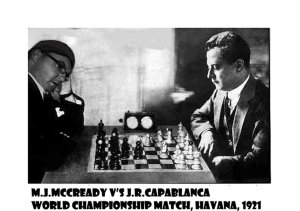
The rest, says old McCready, is history… .

There is little of wisdom in his words except moderation; but his garden is luckier, his kitchen sweeter than all the rest in the hamlet, and of all his tasks—ploughing, harrowing, rolling, drudging, reaping, mowing, carting faggots or corn or hay or green meat or dung—he likes none better than the others, because he likes them all well as they come. And ah! to see him and his team all dark and large and heroic against the sky, ploughing in the winter or the summer morning, or to see him grooming the radiant horses in their dim stable on a calm, delaying evening, is to see one who is in league with sun and wind and rain to make odours fume richly from the ancient altar, to keep the earth going in beauty and fruitfulness for still more years.‘ Edward Thomas, The Heart of England, Part Two The Lowland, Chapter 2 Faunus, London J. M. Dent & Co. 1909

  1. I have temendously fond memories of Paul as he was such a great laugh and the amount of parties and drinking sessions down the student union bar with our many mutual friends cannot be counted. During the winter of my year as freshman he got into a snowball fight in his kitchen once. Jason, his opponent, ran out of snowballs and scuttered out to make some more. Paul thought he had gone and sat down at the table by where I was. Jason then stormed back in and pelted one right at him, going straight into the mouth whilst he was talking to me, which made him go ‘Aaaarrrggghhhh!’ with a look of disdain before chasing him out and carrying things on in the snow. He lived in the building just across from mine on the campus and he had 4 exchange students on his floor, one from Germany, another from Greece, one from Spain and another from America, they only had one toilet on their floor, as we all did, and I browned them all off in one party once by putting an empty wine bottle in the tank which made it difficult to flush! The American guy was called Mike Howard and was studying at the University of Wisconsin, in Eau Claire (He is the one fully responsible for getting me into American Football by insisting I watch games with him and supporting The Green Bay Packers with Brett Favre at quarterback, especially when they played the Minnesota Vikings). Paul loved playing pranks and did so to everyone on his floor by adjusting the embezzled dial at the top of the door to the kitchen, which determined how slowly or quickly it would close. Paul worked out that if you turned it in a certain direction fully, the door would take about 10 minutes to close and you had to push it very hard to force it to in order to speed it up. Mike came into the kitchen and Paul went and showed him what he had done and how you had to bust your balls to close it properly now, which being a fire door was funny to him. He then came up with a brainwave and did it to the door to Mike’s room whilst he was in the kitchen. When Mike went back to his room with his plate of food, all we heard from down the corridor was ‘Oh that’s really clever, show someone how to do a trick then pull it on them thinking they won’t know it was you!’

    I do have a picture of Paul, Mario, Jason and I all with our arms around each other in Paul’s kitchen during some party/drinking session that winter but I simply cannot post it, I really can’t. Let’s just say, clearly much drinking had already gone on and leave it there. SEE BELOW FOR UPDATE
    ↩︎
  2. In Wall Hall Campus, I stayed at Room 6, Hall 6 Kennedy Court for one year 95 – 96 (it was called that because John. F. Kennedy used to stay in the large stately home before it became part of a university campus). I was so well read by then, I never made that much effort to study in my first year and found it all rather easy. So much so that I spent more time reading The Guardian newspaper and attending The Philosophy Society, of which I would become the President of the following year and attend dinners in St. Albans with many visiting lecturers, and of course, the student union bar both before and after lectures and at weekends also. I hung out and played football with the exchange students mostly, we drank together too, and went shopping around Hertfordshire, especially in St. Albans. For that reason, I joined them in my second year and also became an exchange student in Finland. I have lifelong friends from my first year at university and was more socially active than I had ever been. The most intelligent person I have ever met in my entire life was one of my lecturers also, a certain Prof. Daniel. D. Hutto. To this day I have never met one chess player with anything like the intellect he has. My family drove me and my possessions to the campus to help me move in, including a large book collection, with my mother and sister insisting on a guided tour that Autumn after I had settled in. Friends came to visit and have a look round also, Paul especially, I even took ex-girfriend Rachel there during her visit to England. I completed my degree by helping out at a conference for the Aristotelian Society and have nothing but pleasant memories of my time there. On my very last visit, I rolled up on my bicycle from Luton to collect my results: 2nd in the year in the Philosophy dept., and Upper 2.1 awarded, achieving 67.4%. I then put another 85kms on the bike by shooting off to Cambridge where I spent the summer, having already accepted an offer to commence with an MA at Warwick University that Autumn. ↩︎

WITH RELUCTANCE: HERE IS A PHOTO FROM THE XMAS PARTY 95

LEFT TO RIGHT ITS PAUL, MARIO, ME, JASON

Mark J McCready

Reflections 9

Didn’t the last game just say it all…

Never nothing more than your average club and county player, my chess playing days in my younger years weren’t much to be proud of. But that’s not the point, finding meaning in them is however. Before a long, long break, I played competitive chess from February 1988 to May 1997…and didn’t my last game of that particular epoch just say it all?

It was played in my home club Kent’s/Luton and was the last league game of the 96/97 season, played against Leighton Buzzard B team, we were positioned along the side of the dance floor between the bar and the entrance/exit for the match. I was part of the furniture back then and had been captain of B team and tournament organizer for 5 years already. Slowly but surely, I had lost almost all interest in everything chess related by 1997, and more importantly, was in my second year at university too. Giving up chess for once and for all to focus on my education felt logical and wise, and that’s what became my every intention. ‘Why’s that’ you ask? Off the record, it almost did at the beginning of that season because I sauntered off to Turku University, Finland (a.k.a Turun Yliopisto: Turun means Turku with the possessive form case ending, ylio means over, pisto means school), to study Logical Positivism and Plato in the unending rain and snow of that first semester, as part of the Erasmus exchange programme I had signed up for.

Helsinki, Finland as an exchange student.

Presumably, I must have asked for someone to step in whilst I was away for when I returned, just days before Chistmas, I resumed responsibilites once more, and didn’t the last game of that season just say it all?

My opponent, who I knew well but cannot remember his name anymore, was rated around 150 and I was black. He was a well to do fellow, grey hair, dressed like commuters often did and conducted himself with impeccable manners always. An e4 player, I responded with the only thing I had some idea of -that being the French Defence. Being unsporting and wanting to win by boring me to death, or perhaps being downright unimaginative, or whatever it was, we had an exchange variation on our hands and a symmetrical position soon arose -as you might expect for a game played between two average club players. 1 I just went through the motions mechanically and was of course partly to blame. A lifeless early middle-game position arose and true to form I switched off altogether. I don’t recall where we were in the league for the final match of the season but my team never got relegated once -I made sure of that! Wherever we were in the league, the game had the feel of there being nothing left to play for, so presumably we were safe.2

With so little interest in chess left and no intention to carry on anymore, a bore draw should have been the icing on the cake. But it didn’t go that way: a talentless me never did improve that much in the 90s 3 but I did become more solid as a player and was not easily beaten. I usually played board two in division two of the Beds. league, usually playing opponents around 170, usually grinding out draws. I never usually played to win much because of this. My team, chosen by me, had strength and depth, and if Steve Yates and I held our own on the top two boards, the bottom three (Michael Josephs, Peter Montogmery + one floater, often journalist Sean Ingle) would win us the match almost always. But instead of play out a draw rather unthinkingly, I impulsively threw caution to the wind and unleased a devasting attack in a completely symmetrical postion that won me the game unexpectedly as my opponent was caught off guard completely. Back in the day before computer analysis, most would not dream of launching their sheltering kingside pawns down the board at their opponent’s king (also castled kingside) just to open things up no matter how good or bad they were. Perhaps in favour of what is commonly classified as ‘Old Man’s Chess‘, my aged opponent didn’t know what to do and just sat back. Somehow I gained control of the e-file with my rooks and the move XX. …Re2 brought serious problems as mate was imminent. He couldn’t cope and resigned against an attack that came out of nowhere just to alleviate boredom.

Doesn’t that just say it all? How replete with detachment does it have to get? That summer didn’t I just go off gallivanting around central Europe with student friends made in Finland? The following year, studies concluded successfully and America after Cambridge it was.4 Either study or travel reigned supreme and I never ever looked back that decade -chess had been vanquished. Even when, I even returned from America all loved up by a partner in crime Philosophy graduate from that neck of the woods. We not only walked past a team mate’s house en route to The Moat House pub in Luton once and never stopped to knock on his door so that I could introduce her to him, but weeks later then walked past the school opposite St. Albans Cathedral, with I pointing out in passing only that I played chess there once -she was not interested and neither was I!5

That is the way the cookie crumbles as they like to say over that side of the pond: my last game of a 9-year chessfest where 496 competitive games amassed ended in a way which said it all – I simply was no longer interested. That game I won yes but it mattered not. How it was won did so, but importantly, it brought the final curtain down on the show! Life was to be lived and live it I did -no time for board games anymore I’m afraid… .

  1. It was only later in life, when I returned to chess refreshed, better educated and able to study more critically, that I learnt how to play against that line better through the games of former champ Alekhine; in particular on which side to castle, which squares to develop the knights to and where to redeploy them for a kingside attack…assuming of course your opponent castled kingside early (as they so often do at that level).
    ↩︎
  2. Through this year’s continuous study, a broadener understanding of how memory functions has emerged, which allows this raconteur to avoid proclaiming history being made here, instead, what little I recall and why I can recall it is mentioned only. No confabulation in play here.
    ↩︎
  3. Even though during that sojourn in Finland I did play an FM down ‘The 3 Beers’, the student pub, and beat him, he was rated 2340, way above my rating. further aside: that only came about because he was working behind the bar, and that evening he had great difficulty with a very drunk customer who would not leave and wanted to fight him when pushed to do so, and whilst sat supping pints with another Englishman, a Yorkshire man named Phil, who lived in St. Albans and studied the Finnish language, I was having none of that and threw him out myself. For this the barman was most grateful, wanted to join us for a chat and buy me a drink: a common interest was found and so we played. Thankfully, I did not make a habit of running goons out of his bar -just the once! That was one of many memories I have of Phil, the best by far being when we travelled up way beyond the Artic Circle to Pyhätunturi with another Englishman and a Dutchman named Robert, who we shall never forgot. Upon arrival we found a tourist hut to gather information and various questions were asked. One by Robert, however, blew Phil right back as well as the man behind the desk providing us with information. Both were left speechless for a few seconds because Robert asked where the bears were. His reply was that they were hibernating (it was winter and it was dark all day long). Robert then asked ‘Is it okay to go into the caves and take pictures of them?’ Stunned, Phil glanced straight at me, came up to me and whispered ‘If he wants to go into caves and wake bears up that’s up to him. I’m not doing it.’ Struggling not to laugh at it. Phil also made me laugh on the trip when he joked about Robert’s accounts of going to the Spar supermarket down the hill, he said ‘it’s like Scott of the Antartic everytime’. I made Phil laugh once because Robert placed his boots too near the open fire in our cabin and they caught on fire. Later that night we went off to the resort in the evening for some drinking and dancing, where Robert met a Russian woman with jet black hair and went off with her. When he returned, he talked about being surprised to have had the opportunity and said he didn’t know what she saw in him, to which I quipped ‘Maybe she liked the smell of burnt rubber‘, which Phil found highly amusing.
    ↩︎
  4. The year after, America coast to coast twice over and Euston Square, London all Summer long too, with Belgium and Thailand the following season to start the new decade off -boy did I have itchy feet by then!
    ↩︎
  5. Regarding the time spent in The Moat House, my assertions are also corroborated by the recollection that family friend and piss head Marc Courtney, spotted us and staggered up asking ‘Ya still playin’ the chess?’, with some slur, whilst performing an impromptu impersonation of me playing by moving invisible chess pieces about on an invisible chess board with his hands moving about in an ungainly manner. I believe I either lied with a quick ‘Yes’ or said nothing so as to get rid of him as soon as I could as I was accompanied and she had only just arrived in the country.

    Rather reluctantly, I should preface the previous paragraph with the following: prior to bumping into Marc Courtney, and before heading off to California in 98, I was working at Cambridge train station as a porter. One afternoon Matt Payne, who briefly played for Luton in the early 90s spotted me and came up to ask how I was. He asked whether I knew what had happened to former tutor, friend and team mate Roman Korzeniewski, who sadly died ealier that year, suffering a heart attack in a hotel in Norwich, aged 42 only. Caught off guard completely by such saddening news, I knew nothing of it and had no contact details of anyone anymore, so had to ask for some for further information. It can be concluded that chess really was not part of my life anymore by then. Further proof can be found some weeks later at Heathrow Airport, as I awaited my flight to LAX. I saw in the departure lounge who was 2nd county team captain when I played, a certain John Shaw. In the corresponding match against Leighton Buzzard B in that last season (mentioned above in the post), I played him just after I had arrived back from Finland. I had the white pieces for that game and beat him with the Stonewall Attack, he was rated 152 then. I often helped him carry sets from his car into venues for county matches and we got on quite well, however, at the departure lounge I didn’t speak to him and didn’t want to say hello even though he had spotted me. Chess had already been forgotten about, and I had far more important things to think about -that being by far the longest flight of my entire life, whether my bicycle was defintely on it, and which British heavy metal songs to keep listening to on my walkman. In total, chess only appeared in my thoughts 4 times in 1998. ↩︎

M J M

Bahrain

Apologies if this sounds rhetorical but with conservatism so rampant in chess “What are we supposed to do?” Buck the trend and become more playful with language perhaps?

Which former British Chess Champion wanted to reach out and touch children through his chess the most?

Naughty clue: ‘ee by gum, it ain’t just folklore this. And if ya think otherwise you’re as daft as a brush’

Less naughty clue: he became British champion the year I was born (early 70s).

Inpiration

M J M

Bahrain

Reflections 8

The night grew darker. The sound of pianos mingled with the wind. I could not see the trees—I was entrapped in a town where I had once known nothing but fields and one old house, stately and reticent among the limes.‘ Edward Thomas -The Heart of England, Chapter one, Leaving Town (1909 London J. M. Dent & Co.)

First chess in the big smoke

Why I was barely 17 when my love of chess took me to London. It was late spring, May 7th in fact, a quiet sunny Sunday in the home counties and London too. Damon D’ Cruz fellow club member of Luton chess club and friend, was late in picking me up. He used his brother’s Vauxhall Cavalier that day, the number plate I still recall -E391BGS. Whilst waiting, I listened to songs on a thrash metal compilation I had bought recently, the vinyl still unscratched then; Life in Forms by Acid Reign, and Open Casket by Death being the main two. As I recall he was due to pick me up at 8 am but did so at 8.45 with play commencing at 10 am. Once collected, off to London we went, Islington, as it were.

It was all Damon’s idea, I just went along, us both well into our chess. The name of the tournament I cannot be entirely sure of, believing it to be The Islington Quickplay or The Islington and Highbury Quickplay, one of the two. Held in a school I cannot remember the name of but do remember well the streets and roads that lead you there, the affluence that draped over them, and how the morning light cut clear and crisp angles on rows of blanched stone walls besides flower beds bright in the sun, and clearly painted signs on the fresh tarmac beyond garden walls where hedges were neatly cultivated -something a few streets in Luton had only a paltry smattering of.

Run by Adam Raoof, who seemed somewhat unkempt that day, I was paired in Round 1 against someone rated 187, who insisted upon playing the Evan’s Gambit against me and won with not too much difficulty. And although I would love to say how the day went, I just can’t. All I rememeber was sat in some school assembly hall we were and I found it difficult to cope with the experience on the whole. In what I recall was the final round of the day, that being Round 5, I cannot tell you what my score was prior to it but only that my opponent played the Vienna Game against me and I didn’t know what to do against it. After the game had finished, I do remember asking Damon for his advice but with some bemusement for I had not even been playing chess for two years at that point, and had shown relatively little interest in opening theory throughout that time or so I remember.
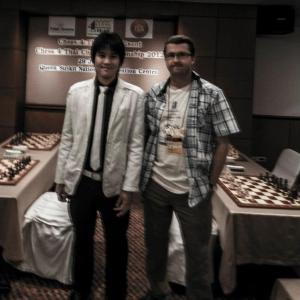
I had left school less than one year prior to that quickplay, soon stopped cutting my hair thereafter, was now at VIth Form College and wore only heavy metal T-shirts. I knew nothing of the world and went along for the ride it could be said. What stands out most from that experience was being part of the chess scene in England was more engrossing and engaging than the chess itself, of which I was still not very good at. It was the first of innumerous forays into London for chess to come across five consecutive decades and counting. A mere six months later, Damon and I returned to Islington to watch Karpov, Yusupov, Speelman, and Timman compete in the FIDE Candidates semi-finals at the Saddler’s Wells Theatre, and although Islington heralds where my love of chess first blossomed in London it was soon to be superceded by life, which per se was shaped by chess, that in turn shaped the lives of others from Italy of all places, some years later. Before that, though, those categorically distinct; namely history and the past, both require some context of sorts.

Further back still, Islington was the first part of London I ever visited and where my first ever memories come from, as I still fleetingly recall the road I walked down with my mother as a toddler, as she took me to where the first man who would replace my father lived -a certain Terry Whitbred.

Moving forwards to 1993, Islington was the first part of London I did work of any kind, and where I had my first ever interview by the music press. Team mate Damon opened a record company called Culture Vibes Records, at an office in Leroy House, on the corner of Essex Road and Balls Pond Road. Once, the press came round late that August and wanted to interview someone from the company, being little more than hired help I was lumbered with that because no one in the office wanted to do it. They took my photo, and music aside, asked many questions, one being ‘What is your favourite day of the week?’ I told them it was Saturday. When asked why, I said it was because I got to see my girlfriend that day (a teenager called Lorraine who was well into Grunge like me and listened to the same bands, wore the same clothes, was friends with the girl I had dated not long before (Emma), and more than happy to have prolonged snogging sessions in the long shadows of Luton Town Hall across late afternoons before her bus went up to Eaton GreAnother first I am beholden of Islington for is that it has always been the part of London I said I liked the most…well until I began working in Covent Garden in 2001 that is. Much before then, many times over I took the tube to Angel station and walked up to Damon’s office, a good 1 hour walk past Islington Green until St. Paul’s park arrived and stood opposite. I liked the feel and swagger of Essex Road very much; the affluence the little roadside cafes and coffeeshops brought, with their seating outside making them look rather chic, not to mention those regal Victorian pubs on street corners and the up-market restaurants that paved the jolly little streets running away from them also. Pedestrians and those seated on park benches were often well-dressed, even the cars parked and in passing symbolised wealth. That affection held throughout the 90’s and is easily remembered when I had my first position in the education sector back in the warmest months of 99, when I was both the Hall Manager and Activities Organiser for a school all Summer long, staying in Euston Square at the time, Endsleigh Gardens I might add. Asked to entertain a group of mature Italian students one evening mid-week (one of which I had great sympathy and compassion for as she suffered with depression and needed assistance sometimes, requiring me to hold her hand and steady the ship if she became tearful), I decided to take the 10-20 or so up away from the UCL to Islington for the night out as I knew it was cosmopolitan but also an authentic experience in real London, as opposed another meander through a touristic area, something which the students wanted to wander away from. After exiting Angel Tube station, it was not long before we found a swanky little bar full of well-to-do city-commuters enjoying their beer and conversations. One gentleman in particular was very pleased to meet one student, Marco from Milan, long, curly hair and very Italian looking, and was most welcoming, keen on practicing his limited Italian as well as shaking hands with whoever he could with that unsober smile of his. Wine and beer went down, cultural exchange went on, and moods went up amidst the decor between the bar and the open front end that led onto the street. That evening we sauntered through for the evening panned out as I hoped it would, all because I knew Islington well enough to know it was exactly what our students were looking for through connections to chess and friendships formed from it, which altered my experience of London irrevocably: through chess, Islington was were I first gained a grounding in the big smoke before off I went to university and before work placed me elsewhere around the city, and life, in general, took over in all its guises… .
‘How noble the long, well-lighted streets at this hour, fit with their smooth paved ways for some roaring game, and melancholy because there is no one playing. The rise and fall of the land is only now apparent. In the day we learn of hills in London only by their fatigue; in the night we can see them as if the streets did not exist, as they must have appeared to men who climbed them with a hope of seeing their homes from the summits or of surprising a stagbeneath. The river ran by, grim, dark and vast, and having been untouched by history, old as hills and stars, it seemed from a bridge, not like a wild beast in a pit, but like a strange, reminiscential amulet, worn by the city to remind her that she shall pass.’ Edward Thomas -The Heart of England, Chapter one, Leaving Town (1909 London J. M. Dent & Co.)

Islington High street
More of Islington

M J M

I hold it true, whate’er I befall;

I feel it when, I sorrow most;

‘Tis better to have loved and lost

Than never to have loved at all.

Tennyson, In Memorium 27

Old Heraclitus once said ‘You can never step into the same river twice for it’s not the same river and it’s not the same man’. When I bought and read IM Littlewood’s publication ‘Chess Tactics’, I did so voraciously at school; therefore, I was a mere teen and not a man. That book was one of many my small school bag was stuffed with, often read in T. D. (Technical Drawing), on the bus too, and wherever else whilst uniformed. How would it read upon rediscovery some 37 years on?

The cover was green, now it’s orange. The song does not remain the same. It’s a book for beginners and I don’t recall any of the puzzles, just that I found it challenging… .

Why does the song not remain the same? The reasons are multifarious, primarily however, reading it is of no benefit anymore thus of no interest: it retains a certain sentimental value, perhaps, but no more really… except that it may be helpful if teaching chess… .

Type O’ Negative have a song called ‘Everything Dies’. In death I will now become known as one who once read Littlewood’s ‘Chess Tactics’…what else have I got to hope for?

O heart, how fares it with thee now,

That thou should’st fail from thy desire,

Who scarcely darest to inquire,

‘What is it makes me beat so low?’

Something it is which thou hast lost,

Some pleasure from thine early years.

Break, thou deep vase of chilling tears,

That grief hath shaken into frost!

Tennyson, In Memorium 3

M J M

In these wee hours, I rediscovered a game I have not looked at in 15 years or more, and so remembered little of. It surivived in the memory banks as little more than ‘GM Miles playing a strange game with the Dutch Defence in it against someone but who?‘ In reading -possibly re-reading- his autobiography ‘It’s only me’, it has been rediscovered -and yes it is highly unusual!

https://www.chessgames.com/perl/chessgame?gid=1266657

M J M

Kasparov in 25

Ever wondered how GM Kasparov plays these days and how strong he still is? Watch this and decide for yourself.

Can we agree he’s still got it?

M J M